
J-Pull Handleless Kitchens.
The routed groove explained.
A J-pull handleless kitchen uses a routed finger grip instead of a separate handle. A specialist CNC machine cuts a curved channel along the top or side edge of each door and drawer front. You hook your fingertips into this recess to open the cabinet. No hardware. No rail. The grip is part of the door itself.
From the front, a J-pull kitchen reads as clean and minimal. A slight shadow line marks the grip point, but no separate fitting projects from the face. This suits UK buyers who want a contemporary handle-free look without the additional engineering cost of a true handleless rail system.
German manufacturers offered J-pull widely for many years as a way to deliver a modern handle-free kitchen at a more accessible price point. In recent ranges, many have moved towards rail-based systems, so J-pull now appears in fewer collections than it once did. It remains a valid choice for the right project and the right budget.
This guide covers how the profile works, where it performs well, where it has limitations, and how it compares to true handleless rail systems and push-to-open. Use it to decide which route suits your household before you request a design appointment.
What is a J-pull handleless kitchen?
The J-pull profile sits in the door or drawer front itself, not in the cabinet carcass. A CNC machine cuts a curved channel along the edge of the panel. The curve needs enough depth for fingertips while keeping the panel structurally sound. The grip is the door. There is no separate component to fit, align, or maintain.
On base units and drawer stacks, the groove runs horizontally along the top edge of each front. You slide your fingertips up and into the channel and pull toward you. On tall units and wall units, the groove sits on a vertical edge so the grip comes from the side of the door rather than the top. The motion is slightly different, but the principle is the same.
The shadow line of the groove is visible from across the room. On a long base run it creates a consistent horizontal detail at the same height across every front. This is a different visual effect to true handleless, where the shadow gap sits at rail level and the door face is completely unmarked. Neither is better. They are different aesthetics, and which one reads better depends on the kitchen design and the user's preference.
J-pull uses standard carcasses. The shaped door is the only difference from a standard slab door build. This keeps the supply chain and fitting process simpler than a rail-based system, which is one reason J-pull reached a wider market position at an earlier stage than true handleless did.
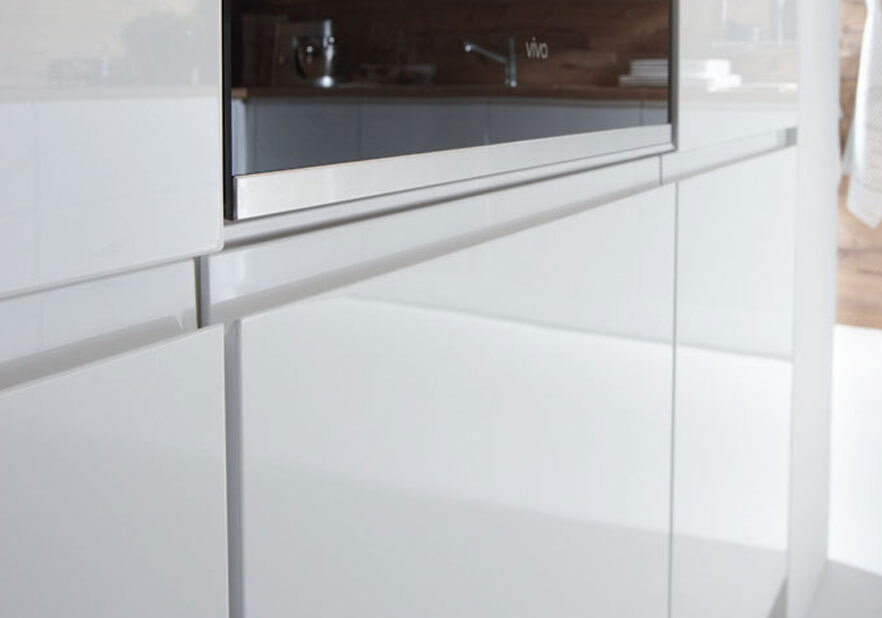
The J-pull groove runs along the top of each door and drawer front. No separate fitting. The grip is part of the door panel itself.
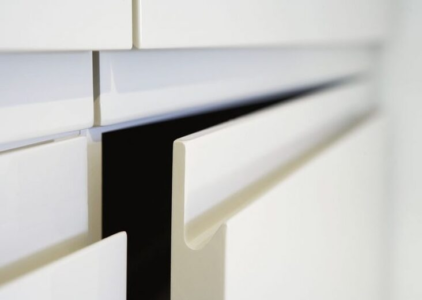
Profile close-up. The curve gives a smooth entry for fingertips. Panel thickness and core material affect how solid the grip feels.
How the J-pull profile works.
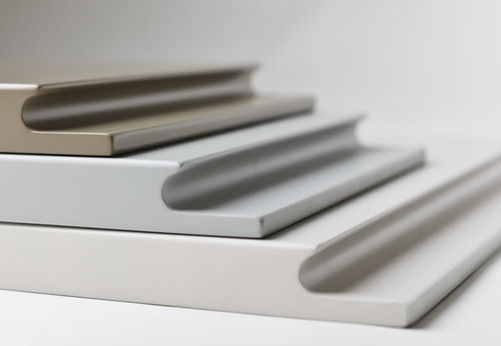
The profile is made at the door manufacturing stage, not on site. A specialist router or CNC machine cuts the curved channel to a consistent depth and radius along the full width of the panel. The quality of this cut determines how the grip feels and how long the profile holds up. A well-routed profile has smooth, consistent edges throughout the channel. Poor routing leaves sharp transitions that are immediately noticeable in daily use.
Panel thickness and core material are both relevant. A thicker panel, typically 19mm to 22mm on quality German doors, gives more material around the profile and results in a firmer, more confident grip. Thinner panels and softer core materials produce a lighter feel that some users find less reassuring on heavy doors.
The finish at the routed edge needs specific attention. Lacquered doors need the edge sealed to the same quality as the face. Laminates and high-pressure laminate fronts are routed through the facing layer, which exposes the substrate at the channel edges. Quality manufacturers seal these edges to prevent moisture ingress and keep the profile looking crisp. On cheaper doors, the cut edge is left unsealed, which shows wear and discolouration quickly.
Hinge and runner specification is the same as any standard door and drawer. The J-pull profile does not affect the motion of the front. Soft-close hinges and runners are specified at the cabinet level as normal.
Profile on a contemporary German kitchen layout. The groove creates a consistent horizontal shadow line across the full base run.
- Groove runs horizontally along the top of base doors and drawer fronts.
- On tall and wall units the groove sits on a vertical edge. You grip from the side.
- Panel thickness and core material affect the firmness of the grip.
- Cut edges need sealing to the same standard as the face finish.
- Fingertips slide up into the groove and the door pulls toward you.
- Grip depth and radius have a strong influence on comfort and ease.
- Heavy appliance doors place more demand on a shallow channel than light cupboard doors.
- Sharp edges or inconsistent routing become apparent quickly in family use.
User comfort
and cleaning.
Comfort varies from household to household. In a light-use apartment kitchen the J-pull grip often feels entirely adequate. In a busy family home with heavy drawers, tall fridge freezers, and frequent cooking, the shallow groove starts to feel less supportive over time. Understanding where the grip works well, and where it starts to feel marginal, helps you decide whether it is the right fit for your specific household.
- Compact or mid-sized kitchens with lighter storage loads.
- Homes where a handle-free aesthetic is the priority and the budget is controlled.
- Wall units and lighter base doors where door weight stays modest.
- Lighter daily use in a home office kitchen, utility room, or second kitchen.
- Wide pan drawers filled with heavy cookware or dry goods.
- Dishwashers, fridge freezers, and tall larders with heavy fronts.
- Households where several people of different heights use the kitchen throughout the day.
- Users with larger hands, long nails, or reduced grip strength.
Cleaning the J-pull profile. The routed groove collects dust, crumbs, and grease if left between cleans for long periods. This is a routine maintenance consideration rather than a serious problem. A quick wipe once or twice a week with a soft brush or microfibre cloth along the channel keeps the profile sharp and pleasant to touch.
Avoid sharp tools along the groove edge. Lacquered and laminated finishes are thinnest at the routed channel, and any scratching here is difficult to repair. Ask your retailer which cleaning products suit your chosen finish before installation. Not all cleaning agents suit all surface types, and using the wrong product at the thinnest point of the profile causes damage that shows quickly.
A practical check in the showroom. Open a pan drawer with a firm pull, then try a tall fridge door. Both should feel secure without requiring unusual grip strength. If the channel feels narrow or the edge feels sharp against your fingertips, that profile depth and radius is not right for your household.
Strengths and limitations.
- Delivers a clean, handle-free appearance at a lower cost than rail-based true handleless systems from German manufacturers.
- Uses standard carcasses with shaped doors. Ordering is simpler and fitting is straightforward for any experienced kitchen fitter.
- Reduces visual clutter on long runs and islands where protruding handles would interrupt the line.
- Works with a wide range of finish options, from budget-friendly laminates to premium lacquers and painted doors.
- The pull action is immediately intuitive. Most users understand how to open a J-pull door without instruction.
- A good option for landlords and developers who want a contemporary handle-free look while maintaining control over furniture spend.
- The groove depth sometimes feels tight for users with larger hands or long nails, particularly on drawers with a narrower channel radius.
- Heavy pull-outs and appliance doors place more demand on the grip than the shallow profile comfortably supports.
- The routed section thins the door edge, which feels less solid than a full-thickness slab when pulled firmly.
- The visible shadow line of the groove is a less minimal visual than the cleanest true handleless rail designs, where the door face is completely flat.
- Future door replacement in the same profile may be harder to source as the number of J-pull collections in German ranges reduces.
Market direction
and availability.
J-pull doors helped bring the handleless look to a wider market in the UK. As German rail-based handleless systems matured and became more accessible in price, many specialist retailers repositioned J-pull as a supporting option rather than the lead display choice for new showroom installations.
This shift is visible in current German kitchen catalogues. J-pull collections carry fewer colour and finish options than they once did. Matching tall unit and feature door choices in J-pull profiles have narrowed. Showrooms in the UK that previously featured J-pull as the primary handleless option are increasingly updating to rail-based systems for new installs.
None of this makes J-pull wrong for your project. It remains available across many German catalogues and is a legitimate choice for the right brief and budget. The practical consideration is longer-term support. If you expect to need replacement doors in ten or twelve years, confirm with your retailer that the specific J-pull profile you are ordering will still be in production and available to source at that point.
In current German ranges you typically see:
- Fewer colours and finishes in J-pull collections compared to newer handleless lines from the same manufacturer.
- Reduced choice of matching tall units and feature doors in J-pull profiles.
- Showrooms updating displays towards rail-based handleless systems for the current premium look.
- Designers tending to highlight newer handleless systems first when a client wants a handle-free kitchen.
If long-term support matters to your decision. Ask your retailer specifically which J-pull profiles are confirmed in the manufacturer's forward range plan. This is a straightforward question and a good retailer will answer it directly.
Cost positioning.
Price levels vary by brand, finish, and layout. J-pull typically sits as a mid-position handleless choice. Expect a higher figure than a simple handled slab door and a lower figure than advanced rail-based systems from German manufacturers. The difference is not dramatic at the furniture level. The gap widens where you compare full projects including labour, because rail systems require more fitting precision and time.
Design considerations
in a German-style layout.
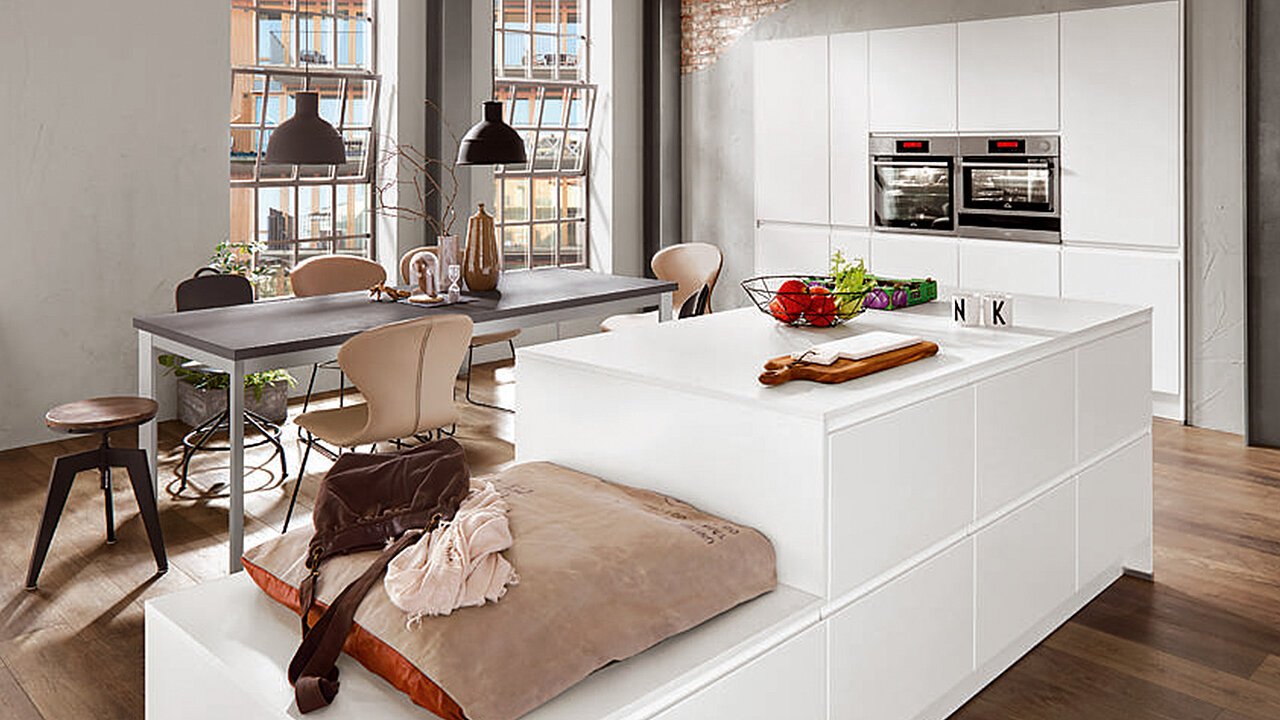
German kitchens rely on strong horizontal lines and consistent joints. With J-pull, the shadow line of the groove becomes an active design element, particularly on long runs and islands. It is not a neutral feature. It reads across the room and should be treated as part of the overall design intent rather than an invisible detail.
Lines and proportions. The groove creates clear horizontal emphasis on base units and drawer stacks. This works well with simple slab tall units and larder columns where no additional detail competes. On both light and dark fronts, particularly in matt finishes, the shadow line of the groove gives the run a defined, structured quality without the visual complexity of visible handles.
Corner layouts. Where two runs of J-pull base units meet at a corner, the grooves from each run arrive at the same point from different directions. This junction needs careful planning in the design to avoid the profile looking awkward or misaligned. Ask to see the corner detail specifically on the elevation drawing before the order is placed.
Mixed heights. Where the base unit run changes height, for example stepping up to a raised breakfast bar or down to a lower prep zone, the horizontal groove line is interrupted. This is less of a problem than it initially sounds on most layouts, but it is worth reviewing on the elevation drawing to confirm the result is what you expect.
Islands with seating. Where the island has seating on one side and a J-pull profile on the other, ask the showroom to demonstrate how the profile feels when seated at worktop height. The grip angle changes significantly when you are seated and reaching up, compared to standing and reaching down.
- Strong horizontal emphasis on base unit runs and drawer stacks.
- Pairs well with simple slab tall units and larder columns.
- Works on both light and dark fronts, particularly in matt finishes.
- Visually cleaner than a handled kitchen on long straight runs and islands.
- Corner junctions where grooves from two directions meet need careful planning to avoid visual clutter.
- Mixed height runs interrupt the horizontal line of the profile and need review on the elevation drawing.
- Islands with seating need checking in the showroom so you understand how the profile feels when seated.
Ask to see the full elevation drawing. Walk through it from floor to ceiling: plinth, base units, groove line, worktop, wall units, top line. Corner details and height changes are much easier to evaluate on a drawing than to correct after installation.
Is a J-pull handleless kitchen
right for you?
- You want a contemporary handle-free appearance without pushing to the very top of the furniture budget, and prefer to balance spend across the full project.
- Kitchen use is light to medium. Storage loads are reasonable and heavy daily loading is not a regular occurrence.
- The property is a rental or a development project where a modern handle-free aesthetic is needed within a controlled figure.
- You accept a short regular cleaning routine for the groove and understand how to keep the profile in good condition for the long term.
- You want the latest rail-based handleless look strongly associated with current German showroom displays, where the door face is completely flat.
- The kitchen will see heavy daily use with wide, fully loaded drawers and tall integrated appliances opened frequently.
- Long-term support and door replacement flexibility are a priority, given the narrowing of J-pull collections in current German ranges.
- A household member finds a visible handle more secure or more comfortable for reasons of grip strength or fine motor control.
Compare it directly in a showroom. Ask the retailer to show you a J-pull door, a true handleless rail door, and a standard handled door side by side. Open and close each one on a pan drawer and a tall unit door. The difference in feel, not just appearance, is the information you need to make the right choice for your household. Also see the true handleless guide on this site for a full comparison of both handle-free routes.