
Domino hobs.
Build your own cooking station.
A domino hob is a compact cooking module — typically 30cm wide — designed to be used alone or placed side by side with other domino modules to create a custom cooking surface. The name comes from the rectangular tile-like format. Unlike a standard hob where the manufacturer determines the zone configuration, a domino system lets you choose exactly which cooking technologies occupy your worktop and in what order.
Five module types cover the UK market: gas, induction, teppanyaki, grill, and fryer. You combine any of these in a run on the worktop. A common combination pairs a 60cm induction hob with a 30cm gas domino module — giving you efficient everyday induction cooking alongside a flame burner for wok work and charring. More specialist configurations combine teppanyaki with induction for open kitchen entertaining, or add a grill module for indoor barbecue results.
Domino hobs are not exclusively a small-kitchen solution. They are specified in large high-end island kitchens where the cooking station is designed around specific habits rather than a compromise standard hob layout. The flexibility to replace one module independently if it fails — without changing the rest of the surface — is also a practical long-term advantage.
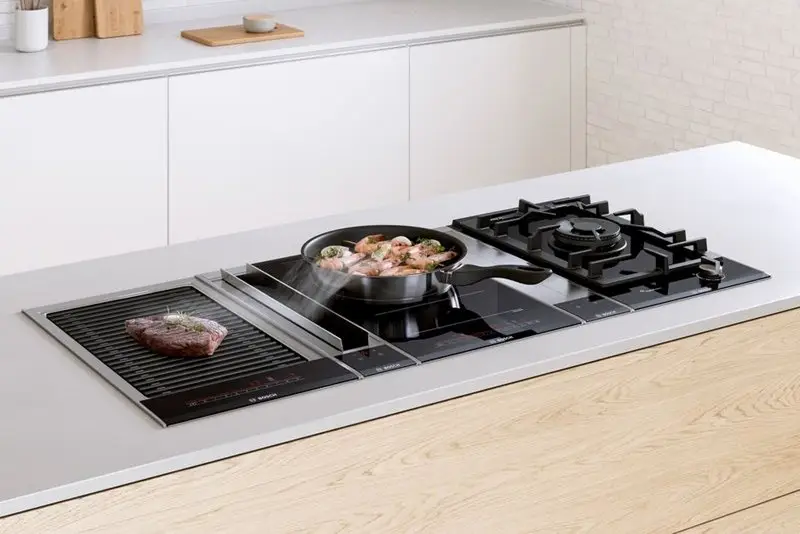
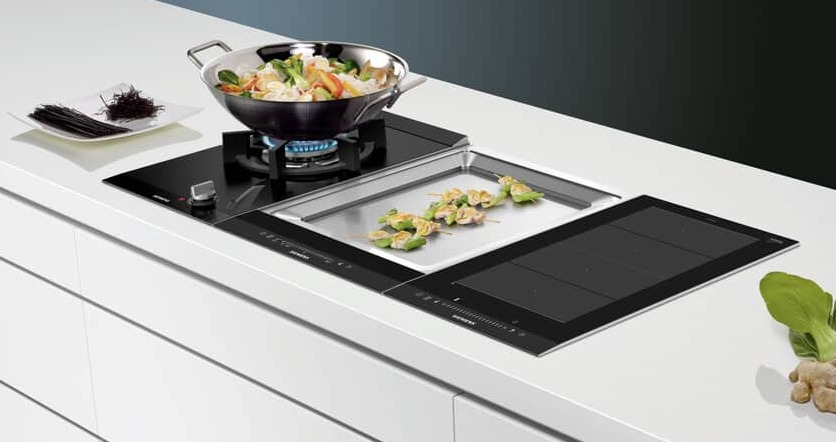
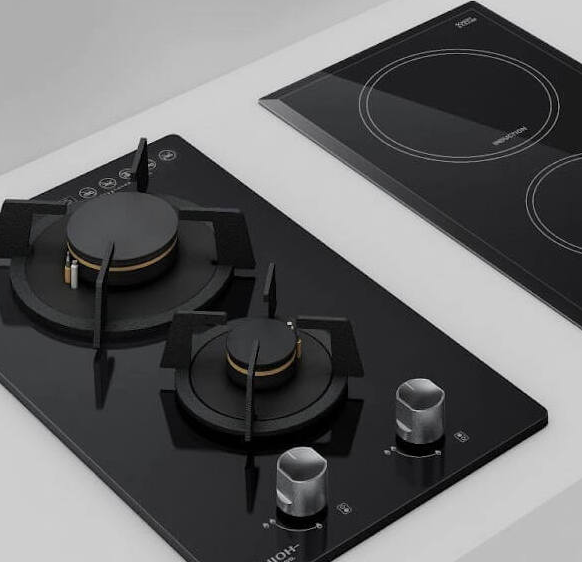
The five domino
module types.
Each module type serves a specific cooking function. The five types below cover the full UK domino market. All are available in 30cm format and most are also available in 35–40cm. Stick to modules from the same manufacturer where possible — depth dimensions, cutout sizes, and connector strip compatibility are designed to work as a matched set within a brand's range.
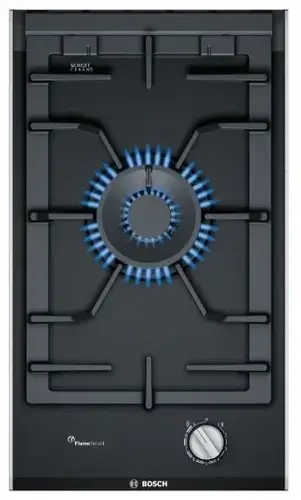
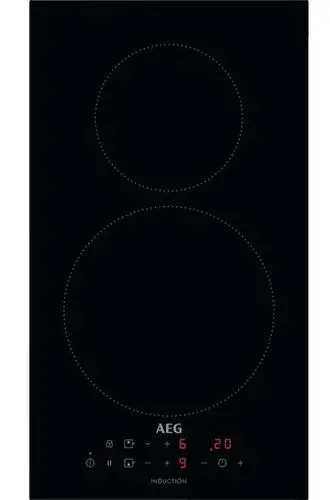
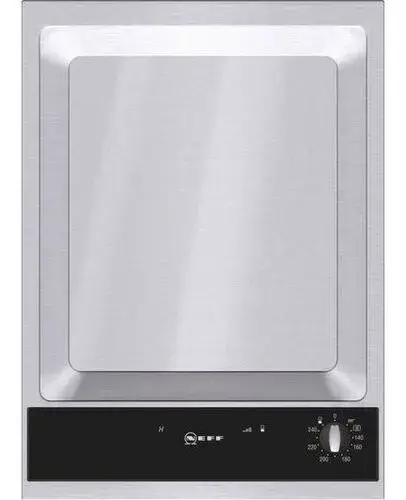
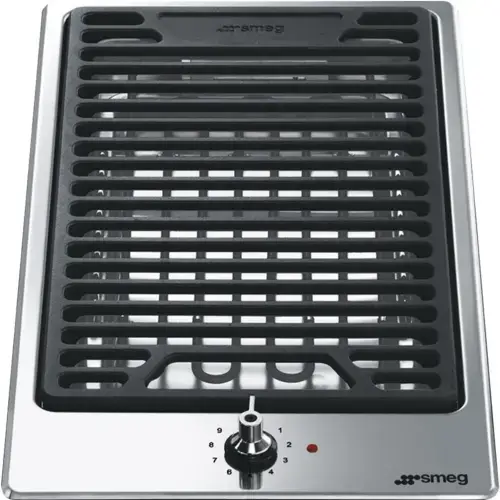
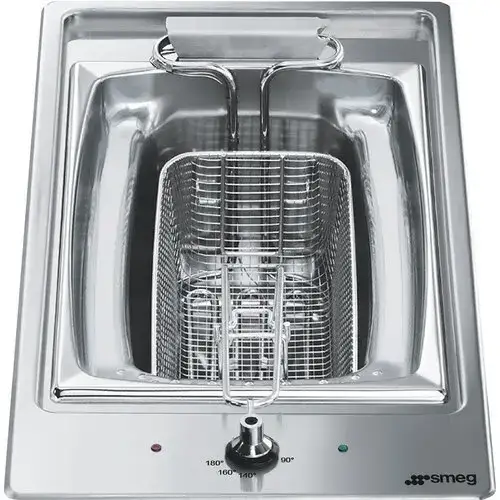
Stick to one manufacturer's range where possible. Depth dimensions, cutout sizes, and connector strip profiles are designed within a brand's domino range to produce a flush, level, gapless result. Mixing modules from different manufacturers risks an uneven surface where one module sits higher or lower than its neighbour, or where connector strips do not bridge the join correctly.
Combination examples.
How households build their cooking stations.
The combinations below cover the most common domino configurations specified in UK kitchens. The worktop total width is the sum of the individual module widths plus any connector strip clearance. Confirm the combined cutout dimensions with your worktop fabricator before templating.
Before you order.
Three things most buyers get wrong.
Domino hobs look simple to specify — a choice of modules placed side by side. In practice, three compatibility checks are essential before ordering. Getting any of these wrong after the worktop has been cut is expensive to correct.
- Verify the cutout depth of every module you intend to combine. Domino modules from the same manufacturer's range are designed to the same depth and sit flush with each other. Modules from different brands or different product generations within the same brand may have different depths.
- A difference of even a few millimetres means one module sits higher than its neighbour. On a flat worktop this produces a visible and tactile step between units — an unacceptable finish in any specification above entry level.
- Confirm the rebate depth and overall module depth from the installation guide for each unit before ordering. Do not rely on visual inspection of product photography.
- Not all modules from the same brand are designed to sit directly adjacent to each other. Some gas modules have heat or clearance restrictions that prevent an induction module being installed immediately beside them. Check the installation guide for each module for minimum distances to adjacent modules.
- Gas modules in particular may specify a minimum gap to any adjacent electrical module due to the heat generated around the burner area. This gap may need to be filled with a blank cover strip rather than an immediate module join.
- Confirm compatibility of each specific module combination with the manufacturer before purchasing. This is a specification check, not a visual one — the modules may physically fit side by side but still be incompatible per the installation requirements.
- Buy the manufacturer's connector strips at the same time as the modules. Connector strips are purpose-made bridging pieces that fill the gap between two adjacent domino modules, seal the join against spills running between units, and mechanically link the modules together so they do not shift independently on the worktop.
- Without connector strips, the gap between modules is an open channel where liquid, grease, and food debris enter the cabinet below. This is a hygiene problem that is difficult to remedy after installation.
- Connector strips are brand and sometimes model-specific. They are not interchangeable between manufacturers. Order them with the hobs, not as an afterthought — they are sometimes on longer lead times than the hobs themselves.
- Total worktop cutout width. The combined width of all modules plus connector strip clearances determines the worktop cutout. Give this exact dimension to the worktop fabricator before templating, not after.
- Service positions. Each module needs its own service connection below the worktop. Confirm the gas outlet and electrical circuit positions within the cabinet relative to each module's location before the carcasses are installed.
- Extraction capacity. A grill or fryer module produces significantly more smoke and steam than a standard induction or gas zone. Confirm your extractor is specified for the combined output of all modules running simultaneously.
Tell the worktop company the full combined cutout dimensions before they template. The worktop fabricator needs the cutout specification for the entire domino run — not the individual module cutouts separately. Give them the combined width, the position of each cutout, the depth, any rebate requirements for flush mounting, and the connector strip clearances. Bring the installation guides for every module to the template appointment.
Domino hobs vs
dual fuel hobs.
Both domino combinations and dual fuel hobs deliver gas and induction cooking from the same worktop zone. They achieve this in fundamentally different ways, with different implications for specification, installation, and long-term flexibility. The right choice depends on which characteristics matter most for your project.
| Aspect | Domino combination | Dual fuel hob |
|---|---|---|
| Construction | Separate individual modules installed side by side. Each is a distinct product with its own installation and service connection. | A single integrated appliance with gas burners and induction zones combined in one frame and one glass surface. |
| Zone flexibility | Full flexibility. Choose the type, number, and order of every module. Replace or add modules independently at any time. | Fixed layout. The manufacturer determines which zones are gas and which are induction. The configuration cannot be changed after purchase. |
| Module choice | Gas, induction, teppanyaki, grill, and fryer modules all available for inclusion in the same run. No standard dual fuel hob offers this range. | Gas burners and induction zones only. No teppanyaki, grill, or fryer option available in a dual fuel format. |
| Worktop cutouts | One cutout per module. A three-module configuration requires three separate cutouts, each to precise dimensions with correct gaps for connector strips. | A single cutout for the entire hob. Simpler for the worktop fabricator and less scope for error. |
| Service connections | One service connection per module. Multiple modules on the same worktop run require coordinated gas and electrical routes that must be planned before carcasses are installed. | One gas connection and one electrical circuit for the entire hob. Simpler service planning. |
| Cost per zone | Higher per zone when multiple specialist modules are included. Each module is priced as a standalone product. | Better value per zone. The integrated design reduces manufacturing and material cost relative to the zone count. |
| Failure and replacement | Replace the failed module only. The other modules continue to function. Lower long-term replacement cost when a single module fails. | Entire hob may need replacement if a key component fails, as gas and induction systems are integrated and not separately serviceable in the same way. |
| Specialist cooking | The only way to include teppanyaki, grill, or fryer functions in the same worktop zone as gas and induction. Suited to purpose-designed specialist cooking stations. | Limited to gas and induction only. A standard all-in-one format that covers the most common mixed-fuel cooking need without specialist additions. |
| Best suited to | Bespoke island and custom cooking station layouts where specific module combinations are required, flexibility to change the configuration in future has value, or specialist modules (teppanyaki, grill, fryer) are part of the brief. | Standard kitchens where gas and induction cooking is required in a single appliance at better value per zone, with simpler installation and a single product warranty. |
If your brief is gas plus induction only and you do not need teppanyaki, grill, or fryer functions, a dual fuel hob often delivers better value per zone with simpler installation. The domino route makes most sense when the combination goes beyond the gas-plus-induction pairing, or when the worktop layout genuinely requires independent module positioning. See the Dual Fuel Hob guide for the full comparison of that format.
Installation.
More planning required than a standard hob.
Brief your Gas Safe engineer and electrician together before first fix. The service routes for multiple modules must be coordinated in the same cabinet space. Gas pipework and electrical cabling must be routed separately and must not contact each other. Both tradespeople need to be aware of the full module plan and agree the routing before any floor, wall, or cabinet installation begins.
Module sizes.
Benefits and limits.
- Complete cooking station flexibility. You choose every module type and determine the order. No standard hob manufacturer locks you into a predetermined zone layout.
- The only format that combines gas, induction, teppanyaki, grill, and fryer functions in the same worktop run. Dual fuel hobs and standard hobs cannot offer this combination.
- Replace failed modules independently. The rest of the cooking surface continues to function while a failed module is serviced or replaced.
- Suits small kitchens and large islands equally. A single 30cm induction module in a compact kitchenette and a three-module specialist station in a large open-plan kitchen both use the same domino format.
- Secondary cooking position. A domino module added beside an existing standard hob extends cooking capacity for entertaining or batch cooking without replacing the primary appliance.
- Higher cost per zone than an equivalent dual fuel hob or standard wide hob. Each module is priced as a standalone product, and the combined cost of two or three modules typically exceeds the cost of a single integrated alternative covering the same total zone count.
- More complex installation planning. Multiple cutouts, multiple service connections, connector strip compatibility, and depth matching all require more pre-order work than a single-appliance installation.
- Limited total cooking surface compared to a wide 80–90cm hob. Three 30cm modules give the same total width but less individual zone size in most configurations.
- Requires careful brand and model matching for a flush, seamless result. Mixing manufacturers or mixing product generations within a brand risks visible steps or gaps at the joins.
UK cost guide.
These figures are per module and are indicative for 2025. A complete domino cooking station with two or three modules will have a combined unit cost that often reaches or exceeds the cost of a premium dual fuel hob. Include installation, connector strips, and service work in the total project budget.
Budget for connector strips, installation, and services separately. Connector strips are priced per join and are not included with the modules. Each gas module requires a Gas Safe engineer visit. Each electrical module requires circuit work. For a two-module gas-and-induction combination, the total installed cost including services and connector strips may add £400–£800 above the module purchase prices alone.
Is a domino hob
right for your project?
- Your brief includes module types beyond gas and induction — teppanyaki, grill, or fryer. Only the domino format delivers these alongside other cooking technologies in the same worktop run.
- You want a bespoke cooking station where you determine every zone type and position, rather than accepting a manufacturer's predetermined layout.
- You are fitting a secondary cooking position alongside an existing main hob, in a compact kitchenette, or in a utility room where a full-size hob is impractical.
- Long-term module independence has value — the ability to replace one module if it fails without touching the rest of the surface suits a high-specification kitchen where you plan to keep the installation for 15+ years.
- You have the budget for the higher per-zone cost and the project timeline accommodates the additional planning and installation complexity that multiple modules require.
- Your brief is gas and induction only with no specialist module requirements. A dual fuel hob delivers the same two-technology combination at better value per zone with simpler installation.
- Your budget is tight. The per-zone cost of a two-module domino combination typically exceeds the equivalent dual fuel hob. If cost is the priority, a dual fuel or standard wide induction hob is better value.
- Your kitchen is on a standard layout where a 60cm or wider hob fits naturally without requiring a custom worktop cutout plan. The simplicity of a single appliance and single cutout reduces both planning effort and fabrication cost.
- Your project timeline does not accommodate the depth-matching verification, connector strip specification, and multi-service coordination that a domino combination requires.
Return to the Hobs guide to compare domino hobs against all other types. The Dual Fuel Hob guide covers the integrated gas-and-induction alternative in full. The Induction Hob guide covers the standard format for the most common module type in domino configurations.