
Teppanyaki hobs.
The complete UK guide.
A teppanyaki hob uses a flat stainless steel plate as its cooking surface. Food sits directly on the plate rather than in a pan. Heat transfers from beneath the steel into the ingredients through direct contact — the same principle as the Japanese iron plate cooking tradition from which the appliance takes its name. Teppan is the iron plate. Yaki means grilled.
In a domestic kitchen, the plate is built into the worktop in a domino format, typically 30–40cm wide. It sits alongside a main induction hob on an island or worktop run. The combination gives you efficient everyday induction cooking for pans and the teppanyaki plate for grilled dishes, flatbreads, pancakes, and social cooking where guests see the food prepared in front of them.
A teppanyaki hob is a specialist appliance, not a replacement for an induction hob. It does not boil water, heat large stockpots, or handle most everyday cooking tasks. Its role is specific and deliberate: high-heat, flat-surface cooking of thin items in a single layer. Used for this purpose regularly, it earns its worktop space. Used rarely, it occupies valuable worktop area that a preparation surface would serve better.
How a teppanyaki hob works.
Beneath the stainless steel plate sit either resistive electric heating elements or induction coils, depending on the technology the manufacturer uses. When the plate is switched on and set to temperature, heat conducts upward through the steel and across the entire surface. The plate reaches cooking temperature across its face rather than only in zones. You use the full surface as one large continuous cooking area.
Most teppanyaki plates divide the surface into two heating zones — typically front and rear — that run at independent temperatures. This lets you hold cooked food at a lower temperature on one side while cooking fresh ingredients at higher heat on the other. A grease channel runs around the perimeter or along the edge of the plate, directing rendered fat and cooking liquid into a removable collection tray beneath or beside the hob unit.
You cook with spatulas, not pans. Food is moved, turned, and plated directly from the steel surface. The technique is different from pan cooking: portion sizes are smaller per session, cooking is visual and interactive, and timing requires attention because you cannot adjust by lifting a pan away. The plate stays hot after switching off — scraping the surface while it cools removes residue before it bakes on.
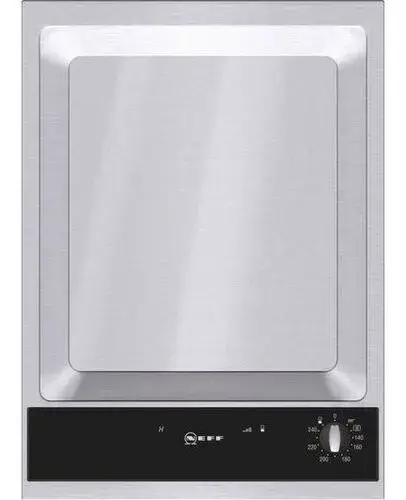
The flat stainless steel plate with surrounding grease channel. The plate reaches cooking temperature across its entire surface. Two independent heating zones let you hold and cook simultaneously.
What suits a teppanyaki hob.
The plate suits thin items that cook quickly at high heat with direct surface contact. It is not suited to dishes that need depth — soups, braises, large volumes of pasta water, or anything requiring a contained vessel. Every dish must fit in a single layer on the steel surface.
- Steaks and burgers
- Chicken strips and skewers
- Lamb cutlets
- Sliced pork and duck breast
- Salmon and tuna fillets
- Prawns and scallops
- White fish and sea bass
- Seafood mixed platters
- Asparagus, peppers, mushrooms
- Sliced courgette and aubergine
- Noodles and rice
- Hash browns and sliced potatoes
- Eggs, bacon, and sausages
- Pancakes and flatbreads
- Crêpes and blinis
- Toasties and pitta
Electric elements
vs induction-driven plate.
Teppanyaki hobs use one of two heating methods beneath the steel plate. The technology affects how quickly the plate responds to temperature changes and how much residual heat remains after shutdown. Both produce excellent results for teppanyaki cooking — the difference is most relevant for households who want faster cool-down between cooking sessions or very precise temperature control.
Flush or top-mounted.
Decide before the worktop is templated.
Like any built-in hob, a teppanyaki plate fits into the worktop either flush with the surrounding surface or sitting on top of it with a visible frame at the edge. This decision must be confirmed before the worktop company visits to template. The cutout specification — including any rebate depth for flush mounting — changes between the two methods. Changing the mounting choice after the worktop is cut means cutting a new worktop.
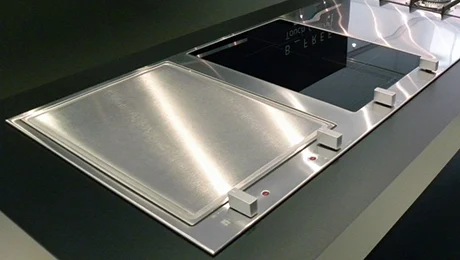
- Stone, quartz, porcelain, or Corian only — not laminate or timber
- Rebate depth and dimensions from the manufacturer's installation guide — not the overall plate dimensions
- Silicone sealing around the perimeter prevents water ingress
- Future replacement must use a hob with matching frame dimensions
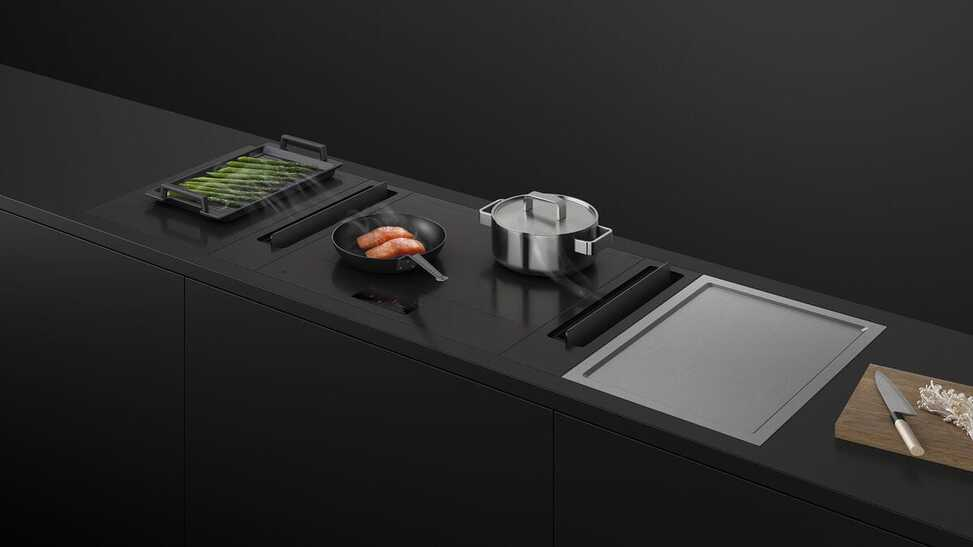
- Compatible with all worktop materials including laminate and wood
- Standard rectangular cutout — simpler for the fabricator
- Easier to replace at end of service life without worktop modification
- Small frame lip creates a minor cleaning detail at the join
What to tell the worktop company. Before the template visit, confirm: (1) flush-mounted or top-mounted, (2) the exact cutout dimensions from the installation guide for this specific plate model, (3) rebate depth specification if flush mounting, (4) the position of the teppanyaki cutout relative to any adjacent hob cutout, and (5) the connector strip clearance between the two units. Bring the installation instruction sheets for every hob module in the run. The worktop fabricator needs the manufacturer's cutout drawing, not a verbal description.
Fitting beside another hob.
Three checks before ordering.
A teppanyaki hob is almost always specified alongside an induction hob or other domino module. Three compatibility checks must be completed before ordering any of the modules. Getting these wrong after the worktop is cut is expensive to correct.
- Verify the cutout depth of every module you intend to combine. A teppanyaki module and an induction hob from the same manufacturer's range are designed to the same rebate depth and sit flush at the worktop surface. Modules from different brands or different product generations within the same brand may have different depths — even by a few millimetres.
- A depth mismatch produces a visible step between modules at the worktop surface. On a stone island where the hob run is a focal point of the kitchen, this is an unacceptable finish. Confirm the rebate depth from the installation guide for each unit before ordering.
- Confirm that the specific modules you intend to place adjacent are designed to be installed side by side. This is a specification check, not a visual one — modules may physically fit next to each other while still requiring a clearance gap or blank filler strip between them per the installation requirements.
- Teppanyaki plates in particular generate significant surface heat at the edges during cooking. Some manufacturers specify a minimum clearance to an adjacent induction glass surface to prevent thermal damage to the glass edge. Check both installation guides before confirming the layout.
- Ask the manufacturer directly whether the two specific model numbers you are ordering are confirmed compatible for adjacent installation. Do not rely on a general assumption that same-brand modules are always compatible.
- Order the manufacturer's connector strips at the same time as the hob modules. Connector strips are purpose-made bridging pieces that fill the gap between two adjacent modules, seal the join against spills running between units, and mechanically link the modules so they do not move independently.
- Without connector strips, the gap between a teppanyaki module and an adjacent induction hob is an open channel for cooking liquid, grease, and food debris to enter the cabinet below. During teppanyaki cooking, grease travels across the surface actively — a gap without a connector strip will fill with debris within a single cooking session.
- Connector strips are brand and model-specific. They are not interchangeable between manufacturers. Order them with the hobs — they are sometimes on longer lead times and should not be treated as an afterthought.
Stick to one manufacturer's range for the entire hob run. Depth dimensions, cutout sizes, and connector strip profiles are engineered within a brand's domino range to produce a flush, level, seamless result. Combining a teppanyaki plate from one brand with an induction hob from another introduces compatibility risks across all three checks above.
Extraction.
Size it for the teppanyaki, not just the induction.
Teppanyaki cooking releases significantly more steam, grease, and cooking odour than simmering a pan on an induction hob at equivalent heat settings. Fat renders directly onto the open plate surface and some becomes airborne. Strong aromas from searing meat and seafood disperse quickly in an open kitchen. The extraction system must be specified for the teppanyaki plate at full output, not for the induction hob beside it.
On an island kitchen, a ceiling-mounted island hood directly above the hob run covers both the teppanyaki plate and the adjacent induction hob. The hood must be positioned at the correct height above the cooking surface per the hood manufacturer's specification. A hood that suits a standard induction hob will often be undersized for the grease and steam output of a teppanyaki plate at full use — confirm the extraction capacity for the combined appliance output with your kitchen designer or ventilation supplier before ordering.
Downdraft extraction — where a slot in the worktop surface draws steam down and away rather than up to a ceiling hood — is also an option beside a teppanyaki plate. The effectiveness of downdraft at capturing the steam from a heavily loaded teppanyaki surface varies by unit and position. Confirm the specific downdraft unit's rated extraction performance covers the teppanyaki plate load before specifying it as the sole extraction solution.
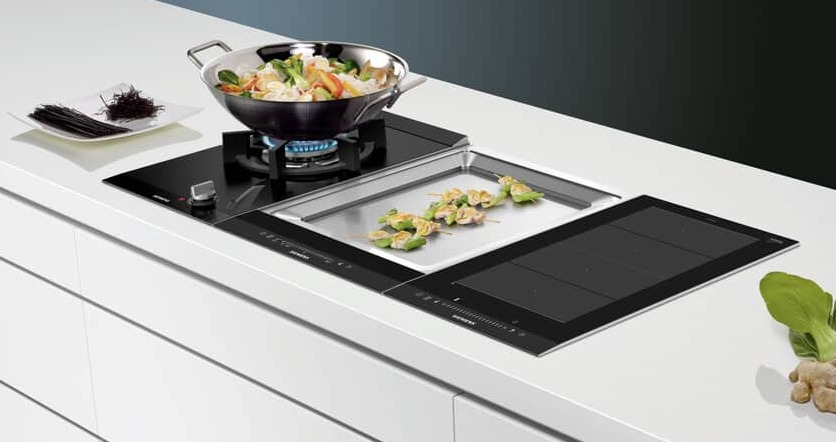
Island hob run with teppanyaki and induction modules. Extraction must be specified for the teppanyaki plate at full load. Treat the plate as a compact professional grill when sizing the extractor.
Ducted extraction is strongly preferred for a teppanyaki hob position. Recirculating extraction relies on grease filters and carbon filters absorbing the fat and odour from teppanyaki cooking. Under regular use, the filters saturate faster than with induction cooking and require more frequent replacement. Ducted extraction removes everything from the building directly and performs consistently regardless of filter saturation.
Teppanyaki vs induction.
Most UK households specify induction as their primary everyday hob and add a teppanyaki module as a specialist second cooking surface. The comparison below covers the functional differences that explain why both are needed and why teppanyaki does not replace induction.
| Aspect | Teppanyaki hob | Induction hob |
|---|---|---|
| Cooking method | Food sits directly on a heated steel plate. No pans. Direct contact between food and cooking surface. | Pans sit on glass. Electromagnetic coils heat the pan base. No food contact with the hob surface. |
| Everyday role | Specialist second hob for grilled dishes, flat food, and social cooking sessions. Not suited to most weekday cooking tasks. | Primary everyday hob for boiling, simmering, frying, sauce work, and all standard cooking tasks. |
| Cookware | No cookware required. Spatulas, tongs, and scrapers are the tools. All pan materials will work on a teppanyaki plate but are not needed for the primary cooking method. | Induction-compatible magnetic base pans required. Copper, aluminium, and glass pans will not work without a bonded steel base. |
| Portion capacity | Limited by plate surface area. Food must be in a single layer. A 30cm plate suits 2–3 portions simultaneously. A 40cm plate suits 4–6 portions. | Suited to large volumes in tall pots and pans. Stockpots, pasta, and bulk cooking all practical with no surface area constraint. |
| Heat control | Two independent front and rear zones on most models. No per-zone precision equivalent to induction's digital power settings. Temperature set by dial or touch control for the plate as a whole. | Individual digital power settings per zone with consistent precision at all power levels including very low simmer settings. |
| Extraction requirement | High. Grease and steam from direct-surface cooking are significantly greater than pan cooking. Extractor must be sized for teppanyaki output. | Standard. Steam from pan cooking. An extractor sized for induction use will typically not be sufficient for teppanyaki. |
| Cleaning | Scrape warm plate with a spatula after each session. Empty grease tray. Wipe down channel. More involved than wiping induction glass but manageable if done immediately after cooking. | Wipe flat glass with a cloth and hob cleaner once zones cool. Simplest cleaning of any hob type. |
| Social cooking | High. Food prepared visibly in front of guests. Multiple people cook simultaneously. The visual theatre of the cooking process is part of the experience. | Standard. Cooking from pans on a flat glass surface with no specific social element beyond the kitchen layout. |
Standard sizes.
For most UK renovations, a single 30 or 40cm teppanyaki plate beside a 60–80cm induction hob gives the best balance of cooking capability and worktop use. The combined run typically measures 90–120cm and fits a standard island or worktop run without requiring a custom cabinet width.
What to look for
when buying.
Benefits and limits.
- Strong, even searing across the entire plate surface. A teppanyaki plate delivers consistent high-heat browning on meat, fish, and vegetables that a pan on an induction hob cannot fully replicate at the same batch size.
- Social cooking capability. Food is prepared visibly in front of guests on an open surface. The cooking process becomes part of the event rather than something that happens behind closed doors or in a separate kitchen.
- No cookware required. Any food that suits flat-surface cooking goes directly onto the plate. Useful for households who want to expand cooking repertoire without purchasing specialist pans.
- Large flat food in batches. Pancakes, flatbreads, crêpes, and large portions of fish that would not fit in a single pan cook simultaneously on the plate surface.
- A clear focal point in an island kitchen that reflects serious interest in food and cooking — a visible feature that differentiates the kitchen.
- A specialist appliance only. A teppanyaki hob cannot replace an induction hob for everyday cooking. You still need a full induction hob beside it.
- Higher extraction requirement than induction. A teppanyaki plate at full use produces more airborne grease and steam than an equivalent induction session. The extractor must be sized for the plate, not just the adjacent induction hob.
- More cleaning effort than induction. Scraping the plate, clearing the grease channel, and emptying the tray after each session is a routine that requires immediate attention. Left until cold, cleanup is significantly harder.
- Higher energy use per session than equivalent induction cooking. The large heated plate surface radiates heat into the kitchen environment throughout the cooking session.
- Only justified with regular use. If teppanyaki cooking will happen once or twice a year, the worktop space, installation cost, and extraction upgrade are not justified. This appliance earns its place through weekly or fortnightly use.
UK cost guide.
These figures cover the teppanyaki plate unit only. Budget separately for the adjacent induction hob, electrical work, connector strips, extraction upgrade, and any additional worktop fabrication for the second cutout in the run.
Total installed cost is significantly higher than the unit price. The adjacent induction hob, electrical circuit for the plate, connector strips, any worktop rebating required for flush mounting, and an extraction upgrade to accommodate the plate's output all sit outside the teppanyaki unit price. For a typical installation with a 60cm induction hob alongside a mid-range teppanyaki plate, total installed appliance and installation cost routinely reaches £3,500–£6,000 before the worktop is included.
Is a teppanyaki hob
right for your household?
- You host friends or extended family for meals regularly and want the cooking to be a visible part of the occasion rather than something that happens separately.
- You enjoy grilled dishes, flat food, and direct-contact cooking technique and would use the plate at least weekly or fortnightly as a genuine cooking tool.
- Your kitchen includes an island with high-performance extraction already in the brief. The extraction upgrade required for teppanyaki is already being planned rather than added as an afterthought.
- Your budget accommodates the unit cost, the installation work for both hob modules, and the extraction specification without compromising on the quality of the furniture, worktop, or primary induction hob.
- You have enough worktop length that adding a 30–40cm plate module beside the induction hob does not reduce preparation space to below a comfortable working level.
- Worktop space is already tight. Adding a 30cm teppanyaki module reduces preparation area. A wider induction hob with more zones gives more cooking capability without the worktop footprint trade-off.
- Budget pressure sits on core items — furniture quality, worktop material, primary hob specification. A single high-quality induction hob delivers better everyday cooking value than a compromise induction hob plus a teppanyaki module.
- Your cooking is predominantly one-pot, sauce-based, or relies on deep pans. Teppanyaki adds nothing for these techniques. The extraction upgrade and cleaning effort would be wasted investment.
- You are uncertain whether you will use it regularly. Honest frequency of use matters more than whether the concept appeals. A teppanyaki plate used twice a year occupies worktop space and requires a cleaning routine for no meaningful benefit.
Return to the Hobs guide to compare teppanyaki against all other hob types. The Domino Hob guide covers all five domino module types and the full buying checklist for multi-module installations. The Induction Hob guide covers the primary hob specification that sits beside a teppanyaki plate in every UK kitchen installation.