
Granite worktops.
The complete UK guide.
Granite is an igneous rock formed deep beneath the earth as magma cools slowly over millions of years. The slow crystallisation creates a dense stone with visible mineral grains — quartz, feldspar, and mica — that produce the characteristic speckled and veined patterns. Every slab is unique. No two granite worktops look identical, which is what draws most buyers to it.
In a UK kitchen, granite handles everyday tasks well. It is hard — typically 6–7 on the Mohs scale — and resists scratches under normal use. It is heavy, permanent, and one of the few worktop materials genuinely suited to outdoor kitchens. It does need sealing. Most granite is porous, and without a sealed surface, oil, wine, and coloured liquids will penetrate and stain.
The heat picture is more nuanced than granite's reputation suggests. The stone itself tolerates high temperatures, but the sealant on the surface does not. Repeated exposure to very hot cookware damages the sealant over time, accelerating the need for resealing and eventually leaving the stone unprotected. Rapid temperature changes — hot pan placed on a cold surface near a sink — create thermal shock that can crack the stone. A trivet is the sensible habit, not just a recommendation.
What is granite.
Granite is an igneous rock — formed when magma cools slowly beneath the earth's surface. The slow crystallisation produces visible mineral grains. Quartz gives granite its hardness, feldspar gives it colour, and mica produces the glinting points of light visible in polished surfaces. The precise mineral mix varies by quarry, which produces the enormous range of colours and patterns available from different parts of the world.
In the worktop industry, the term granite is used loosely. Many stones sold as granite are technically different rock types — gabbro, anorthosite, and other igneous and metamorphic rocks are routinely grouped under the trade label. These stones often perform very similarly to geological granite in a kitchen context, and asking your supplier for the technical classification is worth doing if the distinction matters to you. Black Galaxy, one of the most widely used stones in UK kitchens, is commonly classed as a different rock type in geology despite being sold universally as granite.
The key practical characteristics are the same across this broad category: dense, hard, naturally porous, and unique in appearance. No other material offers the same combination of genuine natural variation and surface hardness at a comparable price point.
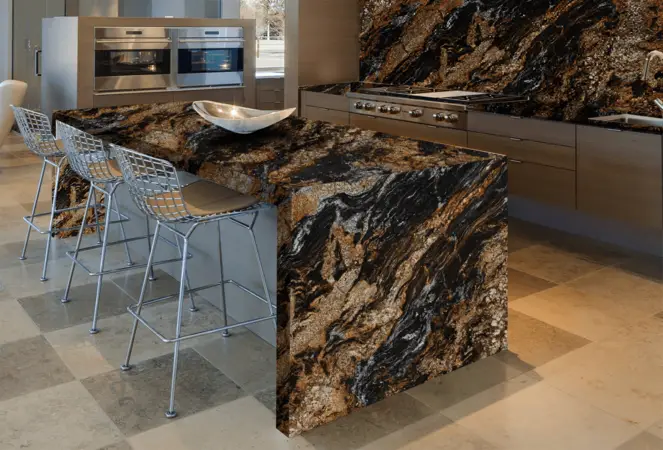
Granite's natural mineral content produces patterns that cannot be replicated in engineered materials. The polished surface reflects light differently across quartz, feldspar, and mica zones in the same slab.
Trade classification note. Many stones sold as granite are technically different rock types. Black Galaxy (a popular choice for black kitchens) is commonly gabbro rather than geological granite. Tan Brown, Kashmir White, and several Brazilian statement stones are similarly grouped under the granite trade label. Performance in a kitchen context is typically comparable, but ask your supplier for the stone's technical classification if you want full clarity on what you are buying.
Heat, sealing,
and thermal shock.
Granite's reputation for heat resistance refers to the stone itself. The rock tolerates high temperatures and will not burn or warp. The surface you interact with in a kitchen, however, is the sealed stone — and the sealant behaves differently to the stone beneath it.
Repeated exposure to very hot cookware damages the sealant over time. The sealant is an impregnating compound that fills the pores of the stone and provides stain resistance. High heat degrades this compound gradually, accelerating the loss of protection and requiring earlier resealing. A worktop regularly used without trivets under hot pans may need resealing significantly sooner than the 1–3 year guideline for typical use.
Thermal shock is a separate risk and more serious in consequence. It occurs when a rapid temperature differential is applied to the stone surface — placing a very hot pan on a cold granite surface near a sink is the most common cause. The stone expands and contracts unevenly, generating internal stress that can crack the surface. Thermal shock cracks are difficult to repair and in some cases require section replacement.
Use trivets as a permanent habit, not an occasional precaution. Very hot cookware placed directly on the surface degrades the sealant over time and creates thermal shock risk. This applies to all pans taken directly from the hob at full temperature and anything removed from the oven. The risk is highest on areas of the worktop that are cooler — near the sink, near external walls, or any area exposed to cold draughts.
Sealing explained. Most UK fabricators apply an impregnating sealer before installation. This sealer penetrates the pores of the stone rather than sitting as a coating on the surface. When the sealant is working correctly, water and liquid spills bead on the surface. When it is depleted, liquids are absorbed into the stone and visible darkening occurs at the point of contact.
The water drop test. Place a few drops of water on the granite surface and leave for 10–15 minutes. If the water beads and maintains its shape, the sealant is intact. If the stone darkens at the water contact point, the stone is absorbing moisture and resealing is due.
Sealing schedule. Most granites benefit from resealing every 1–3 years depending on use level and stone type. Dense dark granites are less porous and may need it less frequently. Lighter, more porous stones in heavily used kitchens may need annual resealing. Use a quality impregnating sealer designed for natural stone — not a surface coating or polish. Ask your fabricator what they applied at installation and their recommended interval for your specific stone.
- Lighter granites are typically more porous and need more frequent sealing
- Dense dark granites (Black Galaxy, Zimbabwe Black) often need sealing less frequently
- Avoid placing hot pans directly on sealed granite — the stone tolerates heat but the sealant does not
- Rapid temperature changes cause thermal shock. Risk is highest near sinks and in cool areas of the kitchen
- Thermal shock cracks are not repairable by polishing — section replacement is usually required
Design possibilities.
Granite colours range from near-white through greys, blacks, browns, golds, blues, and greens. Pattern scale ranges from fine, uniform speckle — almost consistent in appearance across the slab — to dramatic large-scale veining with bold mineral movement. The finish also changes the look significantly: a polished surface produces deep colour saturation and reflective shine, while a honed or leathered finish produces a more matt, tactile result.
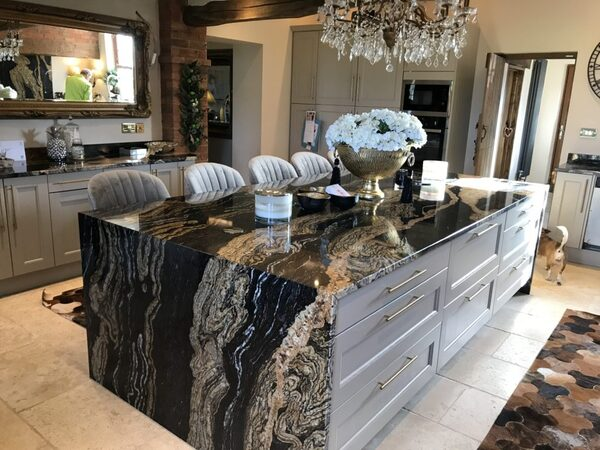
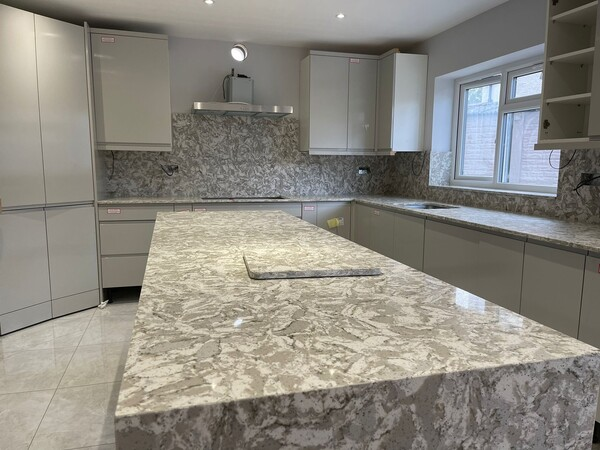
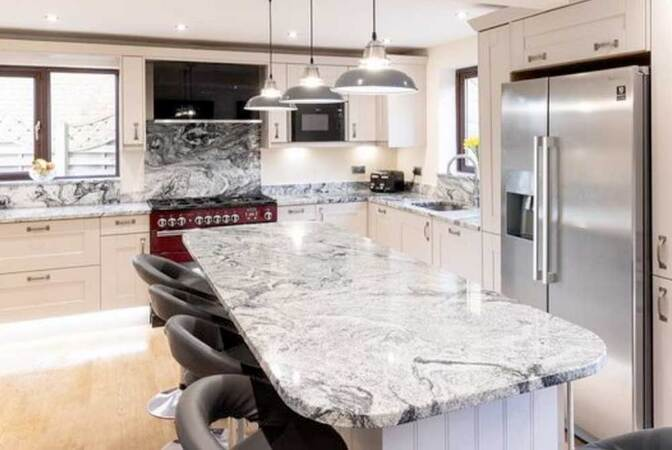
Left to right: dark granite with bold mineral veining; mid-tone speckled grey; Viscount White — one of the most widely used light granites in UK kitchens. Each finish shown is polished. Honed and leathered finishes produce a significantly different visual result on the same stone.
Colours, patterns,
and where stone comes from.
Stone appearance changes by geology and quarry location. Origin also affects supply consistency, lead times, and price. The same trade name can refer to stone from different quarries in the same country — quality, colour range, and porosity vary. Ask your supplier for the country of origin and the quarry name where possible, and always price the specific stone name and finish rather than the country alone.
Worktop thickness.
UK granite worktops are most commonly supplied in 20mm and 30mm. Some suppliers offer 40mm, though most thick-edge appearances at that dimension are achieved using build-up edging rather than a solid 40mm slab across the full surface area. The choice affects visual weight, cost, structural requirements, and the range of edge profiles available.
Weight and structural support. Granite density sits at approximately 2,700 kg per cubic metre. A 30mm slab weighs about 81 kg per square metre. A 2m × 1m island top in 30mm granite weighs roughly 162 kg before fabrication additions. Large islands, particularly those with breakfast bars cantilevering beyond the cabinet line, must have their floor and cabinet structure confirmed as suitable for the load before the stone is ordered.
Build-up edging.
Build-up edging is a fabrication method where a strip of stone bonds to the underside of the front edge, creating the visual appearance of a thicker worktop without using a full-depth slab across the entire surface. It is one of the most common techniques in UK granite fabrication and allows a 30mm slab to present as 60mm or 80mm at the edge.
Lamination bonds a flat strip to the underside of the edge. The join is visible from the side and end on close inspection, which is less noticeable on speckled or uniformly patterned granites and more noticeable on stones with bold directional veining. A good fabricator matches the strip from the same slab for the closest colour and pattern continuity.
Mitring joins two pieces at 45-degree angles to create a deeper front face with no visible horizontal join on the front. It costs more and requires skilled fabrication. Mitring is used most commonly on waterfall ends where the worktop surface continues down the side of an island.
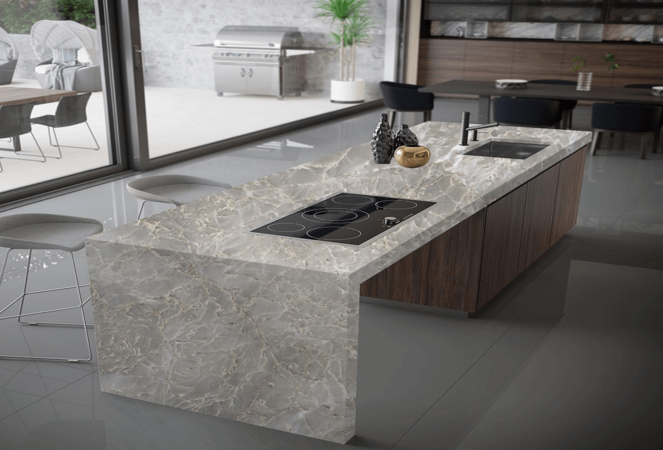
A build-up edge on granite. The laminated strip beneath the front face of this slab creates the visual presence of a much thicker stone. The join is typically 5–8mm from the base of the visible face on a standard lamination.
Ask for the build-up strip from the same slab. Named stones vary between quarry batches — even two slabs with the same trade name from the same supplier may differ noticeably in colour and pattern. Using a strip cut from the same slab as the main surface gives the closest possible match at the visible join.
Book matching.
Book matching places two consecutive slabs from the same block side by side so the cut faces mirror each other across a join. When the slabs were consecutive cuts from the same block, the pattern on the right half of one slab is the mirror of the left half of the adjacent slab — the same effect as opening a book and seeing both pages reflect the spine pattern.
The visual impact depends entirely on the stone pattern. Granites with bold directional veining and strong movement show a dramatic mirrored effect. Uniform speckled granites have no directional pattern to mirror and show almost no book match effect at all. Book matching is worth specifying for stones with clear flowing veins or strong directional mineral banding, and largely wasted on fine speckled stones.
Natural granite veining is random, which makes book matching more challenging than with quartzite or marble where veining is more consistent across a block. Visit the stone yard and view the actual consecutive slabs before committing to a book match specification.
Budget 20–40% extra material for book matched granite. Natural variation creates more waste when cutting for precise pattern alignment. Consecutive slabs from the same block are required — these cannot be sourced separately. The cost premium is typically worthwhile on islands and waterfall ends where the effect stays in a prominent sightline.
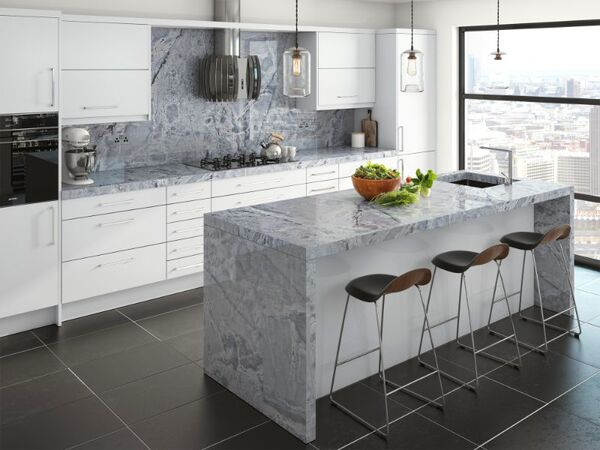
Granite in a kitchen setting. Book matching is most effective on stones with strong directional veining where the mirrored pattern creates a deliberate visual symmetry across the join line.
Drainer grooves
and recessed drainers.
Stone drainers are machined into the worktop surface beside the sink, sloping gently towards the sink bowl to direct water away from the work area. They come in two formats: surface grooves cut into the polished face, and recessed drainers where a shallow lowered area contains the grooves and holds water within a defined zone.
Drainer grooves are machined channels that slope gently towards the sink. The channels cut through the polished face, so the groove surface appears slightly different in finish from the surrounding polish — a normal result of the material being machined rather than polished to the face. The groove appearance varies by fabricator tooling and the specific stone being cut.
Recessed drainers add a shallow lowered area around the grooves. This recessed field contains water within the drainer zone rather than allowing it to travel across the surrounding worktop surface. The result looks cleaner in contemporary kitchen designs and performs better functionally. The additional machining time adds to fabrication cost.
Both formats are standard practice for UK stone fabricators. Confirm which format you want before the template visit — the decision affects how the stone is machined and cannot be changed after fabrication.
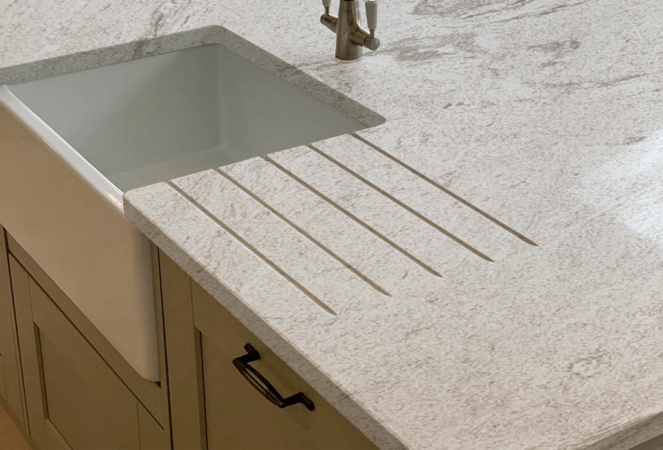
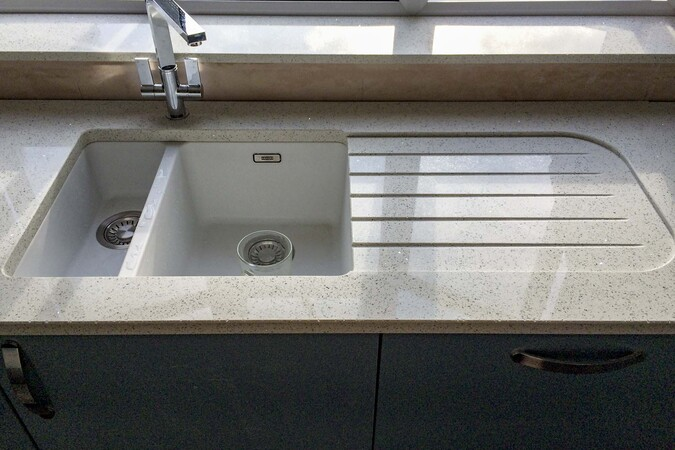
Standard drainer grooves (left) machined into the polished surface. Recessed drainer with grooves within a lowered field (right). The recessed format contains water more effectively and suits contemporary kitchen designs.
Edge profiles.
Granite machines well and accepts a wide range of edge profiles. The stone's hardness means edges hold their shape well over time and resist wear at the front face. Edge profile choice affects the visual character of the kitchen, the comfort of leaning against an island or peninsula, and the fabrication cost.
Straight or eased edges cost less and suit contemporary, handleless kitchen designs. Decorative profiles such as ogee add fabrication time and cost. Complex profiles like ogee and Dupont suit traditional and classic kitchen styles. Waterfall ends — where the stone continues vertically down cabinet sides — require the most skilled fabrication and the most careful slab selection for visible grain continuity.
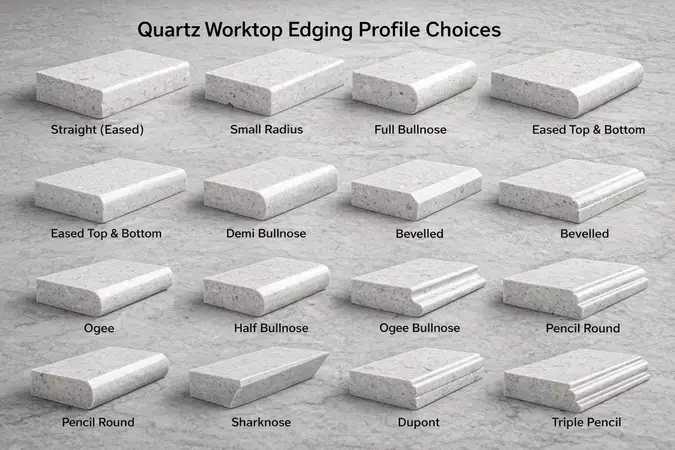
Common granite edge profile cross-sections. Straight and bevelled edges cost least. Decorative profiles like ogee add fabrication time. The waterfall end requires the most skilled execution and careful slab selection.
Advantages and limits.
- Unique natural patterns. No two slabs are identical. Granite gives a worktop with genuine character that manufactured materials cannot replicate.
- Hard wearing surface. At 6–7 Mohs, granite resists everyday scratches well. Normal kitchen use will not mark the surface.
- Good stain resistance when sealed correctly. A properly maintained seal protects against oil, wine, coffee, and coloured liquids in everyday use.
- Long service life. With sensible care and periodic resealing, granite outlasts most other worktop materials and often the cabinets beneath it.
- Suited to outdoor kitchens. UV stable and weather resistant. One of the few worktop materials genuinely suitable for covered outdoor cooking areas.
- Wide choice of edge profiles and finishes. Granite machines well and accepts decorative profiles that some engineered materials do not accommodate cleanly.
- High perceived value. Granite is widely recognised as a premium material and adds to the perceived quality of the kitchen.
- Needs sealing and resealing. Most granite requires an impregnating seal to resist staining. Resealing every 1–3 years is a maintenance commitment that some households overlook.
- Trivets are essential, not optional. Very hot cookware placed directly on the surface damages the sealant over time. Rapid temperature changes cause thermal shock, which can crack the stone.
- Edges and corners chip after sharp impact. Chips at cut-outs and corners are the most common damage in granite kitchens and difficult to repair invisibly.
- Heavy. 30mm granite weighs approximately 81 kg per square metre. Large islands require cabinet and floor confirmation before ordering.
- Visible joints on long runs. L-shaped and U-shaped layouts require joins that are visible to a greater or lesser degree depending on stone pattern and fabrication quality.
- Natural variation means samples are not guarantees. The slab selected at the stone yard is the slab installed. Samples from a showroom are indicative only.
- Professional installation required. Templating, cutting, and installation need a specialist stone fabricator. DIY installation is not practical or advised.
Granite vs
other worktop materials.
This comparison covers typical UK kitchen use. Exact performance depends on the specific stone grade, finish, installation, and maintenance. These are practical generalisations, not absolute specifications.
| Material | Granite | Quartz | Porcelain / sintered | Marble | Solid wood | Laminate |
|---|---|---|---|---|---|---|
| UK price guide (supply and install) | £150–£600+ per m² | £250–£700+ per m² | £250–£700+ per m² | £300–£800+ per m² | £100–£350 per m² | £40–£150 per m² |
| Heat performance | Stone tolerates heat. Sealant is damaged by repeated hot pan contact. Use trivets. | Low — resin binders mark under sustained heat. Consistent trivet use required. | Excellent. Fully heat resistant with no organic binders. | Good — stone tolerates heat but sealant requires same protection as granite. | Poor. Burns and scorches easily. | Poor. Blisters and separates under sustained heat. |
| Scratch resistance | Very good (6–7 Mohs). Resists everyday knife and pan contact. | Good. Quartz crystal filler resists everyday scratches. | Very good. One of the hardest worktop surfaces available. | Poor. Marble scratches easily in kitchen use. | Poor. Soft surface marks with normal use. | Moderate. Surface layer wears over time. |
| Stain resistance | Good when sealed. Porous without a seal. | Very good. Non-porous. No sealing required. | Excellent. Non-porous. No sealing required. | Poor. Etches and stains easily with acids. | Poor. Absorbs oil and liquid without oiling. | Good. Laminate surface resists most common spills. |
| Maintenance | Resealing every 1–3 years. Trivets required. Daily cleaning simple. | Very low. Wipe clean. No sealing. | Very low. Wipe clean. No sealing. | High. Regular sealing, acid avoidance, careful daily management. | Regular oiling. Avoids prolonged water contact. | Very low. Wipe clean. |
| Natural variation | Yes — each slab unique. Samples are indicative only. | No. Engineered for consistent patterns. Predictable results. | No. Manufactured product. Consistent within a batch. | Yes — significant variation between slabs and within a slab. | Yes — natural grain variation between boards. | No. Printed design. Consistent. |
Granite vs quartz. Quartz is the main competitor in UK kitchens. Quartz does not need sealing and handles most everyday stains without intervention. The trade-off is heat — the resin binders that bind quartz composite are sensitive to sustained high heat, making trivets equally necessary. Granite offers natural variation; quartz offers manufactured consistency. Both materials sit in a similar price range at mid and premium levels.
Granite vs porcelain. Porcelain and sintered surfaces outperform granite on heat and stain resistance and need no maintenance. Edge options are more limited and the visual result is thinner and less material-heavy in character. Granite gives a more substantial stone presence and suits kitchens where the look of natural material is part of the brief.
Granite vs marble. Marble scratches and etches far more easily than granite — acidic liquids (lemon, vinegar, wine) etch the calcite surface permanently. Granite suits everyday cooking kitchens far better. Marble suits low-use applications where the aesthetic is more important than practical performance.
Maintaining your
granite worktop.
Granite care is straightforward in daily use. The most important habits are using trivets consistently and resealing before the stone's absorption rate increases noticeably. Most granite maintenance problems develop from one of two causes: hot pans placed directly on the surface over months and years, or sealing that falls overdue and allows staining to become established in the stone.
Ask your fabricator at installation what sealer they applied, whether it is a topical coat or an impregnating sealer (impregnating sealers are generally preferred), and their recommended resealing interval for the specific stone. Record this and set a reminder.
- Clean with warm water and mild pH-neutral washing-up liquid. A soft cloth or microfibre is sufficient for daily cleaning.
- Avoid abrasive pads, bleach, and strong cleaning chemicals. These dull the polished finish and degrade the sealant.
- Blot spills rather than wiping — especially oil, wine, coffee, and anything acidic. Wiping spreads the liquid; blotting contains it.
- Use chopping boards. Granite resists scratches but a board protects both the surface polish and your knife edges.
- Use trivets under all hot pans and anything removed directly from the oven or hob.
- Reseal when the water drop test shows absorption. Do not wait until staining has already occurred.
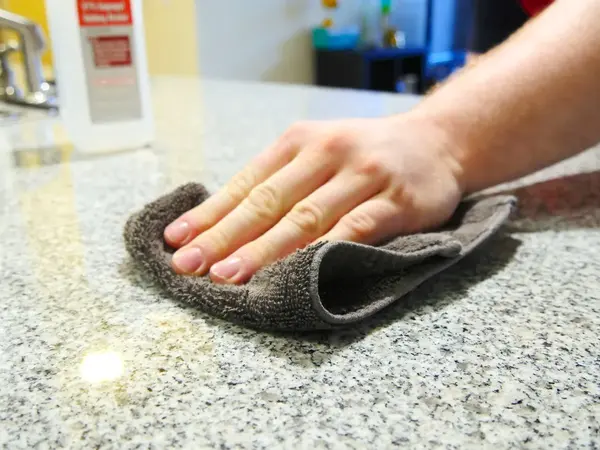
Daily granite cleaning uses warm water and a small amount of pH-neutral detergent with a soft cloth. Avoid abrasive products, bleach, and acidic cleaners — all of which degrade the sealant and can dull the polished surface over time.
UK cost guide.
Granite pricing varies significantly by stone name, grading, finish, thickness, and layout complexity. The figures below are broad guides for supply and installation combined. Always obtain quotes for the specific stone you have chosen by visiting a stone yard and confirming the full fabrication and installation scope.
What affects the final price. Cut-outs for sinks, hobs, and taps are priced per cut-out. Complex layouts with many joins, curved sections, or matching requirements across multiple slabs raise fabrication time and cost significantly. Build-up edging adds material and labour cost above the per-metre-squared rate. Prices typically exclude VAT. Visit a stone yard where possible to view actual slabs — a small sample does not show full slab movement, natural variation, or how the pattern will read across a large island.
Who granite suits.
- You want a natural stone surface with genuine character and variation that manufactured materials cannot replicate.
- You are willing to use trivets consistently and reseal the stone on schedule every 1–3 years.
- Your kitchen is planned for the long term. Granite outlasts most other worktop materials and often the cabinets beneath it.
- You cook regularly and want a scratch-resistant, hard surface that handles kitchen use without showing wear in the surface.
- You plan an outdoor kitchen or a covered cooking area where weather resistance matters.
- You appreciate random natural variation over a consistent, predictable pattern.
- You want zero maintenance with no sealing requirement. Quartz, porcelain, and sintered surfaces are non-porous and need no resealing.
- You prefer consistent patterns with predictable results from sample to finished worktop. Engineered materials offer this; natural stone does not.
- Your cabinets or floor cannot support heavy stone. Confirm structural suitability before specifying granite on large islands or long unsupported spans.
- Your budget sits below approximately £150 per square metre for supply and install. Laminate and solid surface options suit tighter budgets.
- You want the thinnest possible worktop profile without build-up edging. Porcelain at 12mm delivers a genuinely slim slab that granite cannot match without fabrication techniques.
Frequently asked questions.
Granite is one of several strong natural stone options for UK kitchens. See the Worktops hub to compare granite with quartz, porcelain, marble, quartzite, solid wood, and laminate across the same practical criteria.