
Glass worktops.
The complete UK guide.
Glass worktops use toughened safety glass — heat-treated to a specific temperature and cooled rapidly to increase strength and change how the glass breaks. Once toughened, glass is approximately four to five times stronger than standard float glass and fractures into small, relatively safe granular pieces rather than sharp shards. This toughening process also means the glass cannot be cut or drilled again after treatment. Every cut-out for a sink, hob, or tap, every notch, drainer groove, and edge profile must be planned and confirmed before production begins.
Glass worktops occupy a distinctive niche in the UK kitchen market. The material is non-porous — it absorbs nothing, requires no sealing, and resists stains from all common kitchen liquids. In high-gloss form, glass brightens darker kitchens by reflecting light across the room. Back-painted glass offers the widest colour range of any worktop material, including colour-matched RAL tones and bespoke printed designs that no natural stone or engineered surface approach.
Glass does scratch. The surface hardness of toughened glass sits below that of porcelain or granite, and abrasive contact from steel utensils, abrasive cleaning products, and rough cookware bases marks the surface over time. Scratches on glass worktops are not removable by re-polishing in the way stone scratches are — the damage is permanent without full panel replacement. Chopping boards and non-abrasive cleaning are essential, not optional.
Glass is a specialist product at a premium price point. It suits buyers who want a bold design statement, complete hygiene control, and a finish that sits outside the mainstream stone and engineered surface choices. It demands careful planning at the specification stage and consistent careful use thereafter.
What is a glass worktop.
A glass kitchen worktop is made from toughened safety glass — the same category of glass used in shower enclosures, glass doors, and architectural glazing. The toughening process involves heating float glass to approximately 620°C and then rapidly cooling it. This creates a surface layer under compression and an interior under tension, significantly increasing the glass's resistance to breakage.
When toughened glass does break — from a very heavy impact or severe thermal shock — it fractures into small granular pieces rather than the large sharp shards of untreated glass. This is a safety characteristic that distinguishes toughened glass from all other glazing types and is the reason building regulations require it in locations where breakage risk is significant.
For kitchen worktops, glass is typically supplied in thicknesses from 10mm to 25mm. The glass is manufactured to the exact kitchen dimensions before toughening. Colour is applied as a back-painted layer on the underside of the glass — the colour you see is viewed through the glass itself, which gives it the characteristic depth and luminosity of back-painted glass. Clear and low-iron glass are also available for applications where the glass itself is the feature rather than the colour.
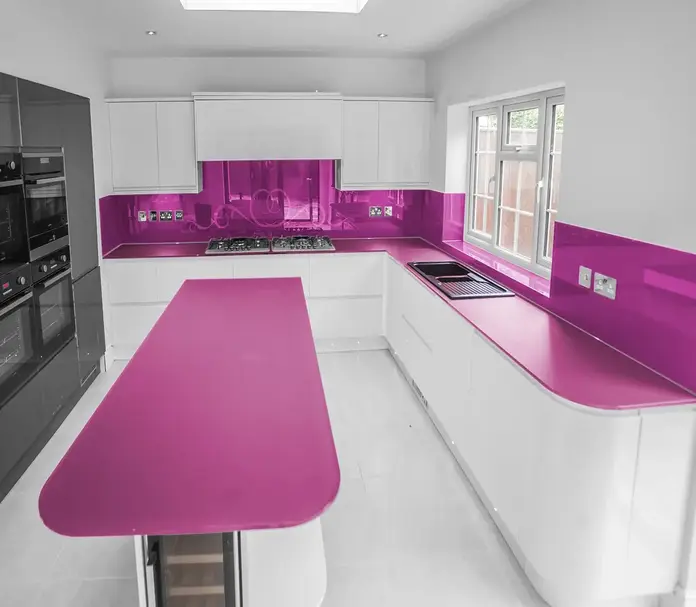
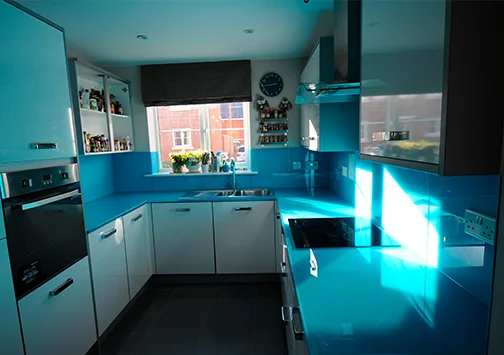
Toughened glass worktop in a contemporary kitchen. The back-painted colour is viewed through the glass itself, giving it the characteristic depth and luminosity that distinguishes glass from painted solid surfaces. Gloss finishes reflect light significantly and brighten darker kitchen schemes.
Types of glass worktop.
Glass worktops are available in several distinct formats depending on colour, finish, and production method. The format determines the visual character, maintenance requirements, and price point. Understanding the differences before specifying helps avoid choosing a finish that does not suit the daily use context.
Design possibilities.
Glass offers the widest colour range of any worktop material — any RAL colour, any Pantone reference, and any custom tone developed by the manufacturer. This makes glass the only material that colour-matches precisely to cabinet fronts, wall colours, or brand specifications without compromise. It suits German kitchens with handleless door profiles and glossy lacquer finishes, where a continuous high-gloss surface across doors, worktop, and splashback creates the seamless visual intent that defines the design style.
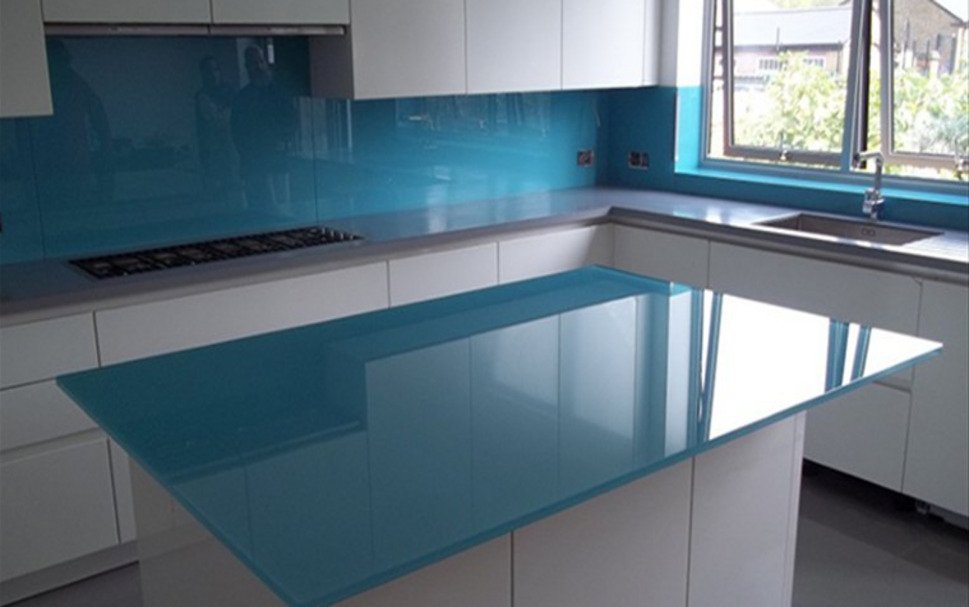
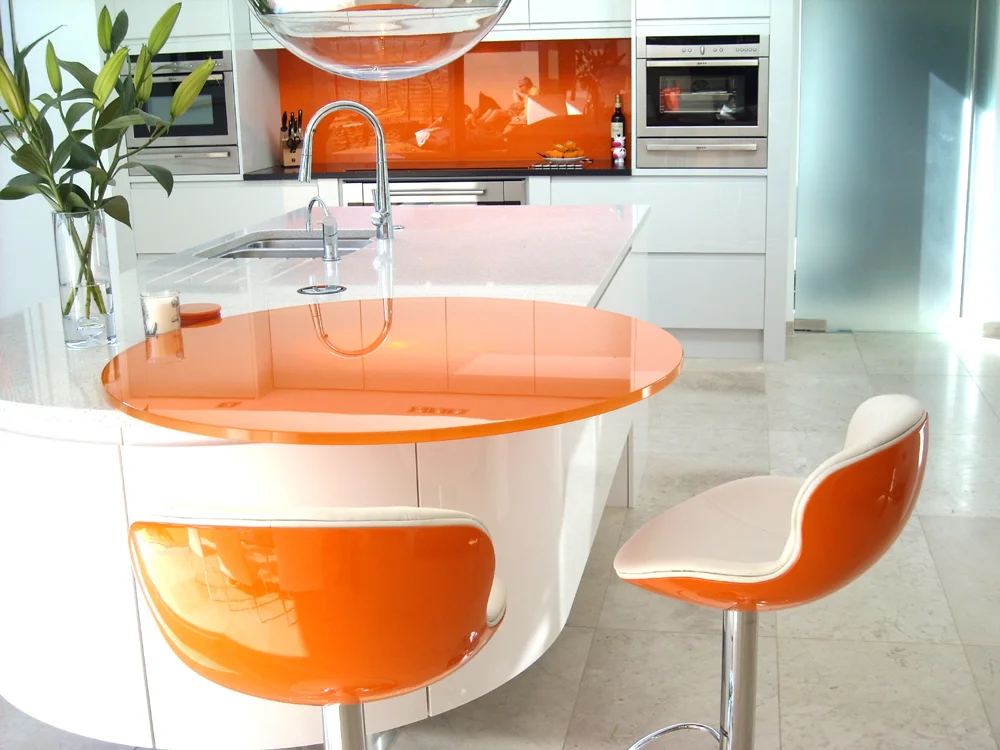
Glass worktops in UK kitchen settings. The high-gloss back-painted surface reflects light and creates a visual continuity with glass splashbacks and glossy cabinet fronts. Glass suits bold, design-led kitchens where the worktop is a deliberate visual statement rather than a background material.
Scratching and damage.
The most important limitation.
Glass's scratch behaviour is the most important practical consideration for a kitchen worktop. Toughened glass is harder than marble, limestone, and travertine, but softer than granite, quartzite, and porcelain. The surface Mohs hardness of glass is approximately 5–6. Under abrasive contact, the surface develops fine scratches that catch light and accumulate over time.
Unlike stone worktops, glass cannot be re-polished. A stone specialist can hone and re-polish accumulated scratches in marble, granite, and travertine. Glass does not permit this — the toughened surface cannot be ground without compromising the structural integrity of the panel. A scratched glass worktop either remains scratched or is replaced. This fundamental difference from stone is the most significant practical limitation of glass as a kitchen worktop material.
The causes of surface scratching in daily kitchen use include: steel knife blades slid across the surface, rough bases of cast iron or heavy stainless steel cookware, abrasive cleaning products and scourers, fine grit or debris from outdoor vegetables dragged across the surface, and hard water scale treated with abrasive limescale removers. All of these are common kitchen activities and most are avoidable with consistent use of chopping boards, protective mats under heavy cookware, and appropriate non-abrasive cleaning products.
Always use chopping boards. Never slide knives, steel utensils, or heavy cookware across the glass surface. Never use abrasive cleaning products, wire wool, or cream cleaners on glass — these scratch the surface immediately and the marks are permanent. A scratched glass panel cannot be repaired in the field. Full panel replacement is the only remedy for significant scratching.
Edge and corner vulnerability. The edges and corners of glass panels are more vulnerable to chipping than the flat surface. This is a common characteristic of glass in architectural applications and applies equally to worktops. A heavy pan knocked sharply against an exposed edge — most commonly at the overhang of an island or at a corner junction — can chip the arris. Chamfered or rounded edge profiles reduce this risk compared to square polished edges by removing the sharpest point of contact. Where glass overhangs a breakfast bar position, the exposed edge at stool height is the highest-risk area.
Thermal shock. Placing a very hot pan on a cold glass surface — particularly near a sink where the glass is cooler from water contact — creates a rapid temperature differential that generates stress in the toughened glass. In extreme cases this causes the glass to fracture. Trivets are required under all hot cookware, particularly near the sink zone and during cold weather when the glass surface is at lower ambient temperature.
Glass worktop edge detail. The colour depth viewed through the glass edge cross-section is a characteristic feature of back-painted glass. Chamfered edges (as shown) reduce chip risk on exposed corners versus square polished profiles.
Thickness, joints,
and specification details.
Involve the glass supplier before signing off the kitchen layout. The glass fabrication process requires confirmed dimensions, all cut-out positions, edge profile decisions, and substrate preparation details before production begins. Changes after order confirmation typically incur significant additional cost or require a new panel. Glass is unlike stone — it cannot be adapted on site after production.
Advantages and limits.
- Maximum hygiene. Fully non-porous surface absorbs nothing. No bacteria, no staining, no sealing required. The most hygienic kitchen worktop surface available.
- Widest colour range of any worktop material. Any RAL colour, any custom tone. Precise colour-matching to cabinet fronts, wall colours, and brand specifications is possible where no other material delivers the same accuracy.
- Bold design statement. Glass occupies a unique visual position — high-gloss reflectivity, depth of colour viewed through the surface, and the distinctive character of back-painted glass are not achievable in any other worktop material.
- Printed and backlit options. Digitally printed designs and backlit islands are glass-specific options with no equivalent in stone or engineered surfaces.
- Good resistance to common kitchen stains. Coffee, wine, oil, acidic liquids — none penetrate or stain a glass surface. Cleaning is simple with the right products.
- Suits contemporary German kitchen design. Handleless fronts, glass splashbacks, and high-gloss lacquer finishes find their natural worktop counterpart in glass.
- Glass scratches permanently. Unlike stone, scratches cannot be polished out. Serious scratching means full panel replacement. This is the most significant practical limitation of glass as a worktop material.
- Damage is not field-repairable. Chips, cracks, and significant scratching all require panel replacement. There is no equivalent of stone re-polishing or wood refinishing available for glass.
- Thermal shock risk. Very hot pans on cold glass can cause cracking. Trivets required at all times, particularly near sinks in cold weather.
- All cut-outs must be finalised before order. No on-site adjustments possible after toughening. Layout changes after delivery mean a new panel.
- High-gloss dark finishes show fingerprints, water marks, and smears very visibly. Frequent wiping is part of daily life with gloss glass in dark colours.
- Premium price point with no repair option. The combination of high initial cost and replacement-only damage resolution makes glass a higher-risk material choice than stone for busy family kitchens.
Glass vs
other worktop materials.
The original page compared glass only with porcelain. This table adds quartz and granite — the materials most commonly shortlisted alongside glass and porcelain in the same design-led UK kitchen projects.
| Aspect | Glass | Porcelain / sintered | Quartz | Granite |
|---|---|---|---|---|
| UK price guide (supply + install) | £350–£900+ per m² | £400–£950+ per m² | £250–£700+ per m² | £150–£600+ per m² |
| Hygiene / porosity | Fully non-porous. No sealing. No absorption. Maximum hygiene. | Fully non-porous. No sealing. Maximum hygiene. | Non-porous. No sealing. Very high hygiene. | Porous — needs sealing every 1–3 years. Good when sealed. |
| Scratch resistance | Moderate. Glass scratches from steel utensils and abrasive contact. Marks are permanent — cannot be re-polished. | Very good. One of the hardest surfaces available. Resists everyday scratch contact. | Good. Engineered surface resists everyday contact. Chopping boards recommended. | Very good. 6–7 Mohs hardness. Resists everyday kitchen contact. |
| Repairability | Not repairable. Chips, cracks, and significant scratching require full panel replacement. | Not repairable. Chips and cracks are permanent. Cannot be re-polished. | Limited. Small chips can be filled but often visible. Full resurfacing not possible. | Stone can be re-polished by a specialist. Chips at edges repairable. Better than glass or porcelain. |
| Heat performance | Good for normal temperatures. Very hot pans on cold glass can cause thermal shock cracking. Trivets required. | Excellent. No organic binders. Fully heat resistant. No thermal shock from hot pans. | Low-moderate. Resin binders mark under sustained heat. Trivets always required. | Stone tolerates heat. Sealant damaged by hot pan contact. Thermal shock risk near sinks. Trivets required. |
| Colour range | The widest of any worktop material. Any RAL colour, custom tones, digitally printed designs. Precise colour-matching possible. | Very wide. Stone-effect, concrete-effect, solid colours. Cannot match custom RAL tones precisely. | Very wide. Marble-effect, stone-effect, solid colours. Engineered consistency. | Wide natural range — black, white, grey, gold, green, blue, brown. Each slab unique. |
| Maintenance | Simple cleaning with neutral spray and soft cloth. Frequent wiping on dark gloss surfaces. No sealing. Chopping boards and trivets essential. | Very low. Wipe clean with neutral cleaners. No sealing. No special products. | Very low. No sealing. Wipe clean. Trivets required. | Moderate. Sealing every 1–3 years. Trivets required. Daily cleaning simple. |
Glass vs porcelain. The closest functional comparison. Both are non-porous, both require no sealing, both offer excellent hygiene. Porcelain is harder and more scratch-resistant, handles heat better with no thermal shock risk, and is repairable to a greater degree. Glass offers a wider colour range, deeper visual character through the back-painted surface, and the unique backlit and printed options that porcelain does not offer. Porcelain is the more practical choice for a high-activity kitchen; glass is the more distinctive design choice.
Glass vs quartz. Quartz is more scratch-resistant than glass and more widely available at a lower starting price. Quartz offers consistent patterning including marble-effect options that glass does not. Glass offers the back-painted colour depth and backlit options that quartz does not approach. Both require trivets but for different reasons — quartz because of resin binder heat sensitivity, glass because of thermal shock risk.
Maintenance and care.
Glass maintenance in daily use is simple — far simpler than natural stone or solid wood. No sealing, no oiling, no periodic professional maintenance. The daily routine is wiping down with the right products and consistently avoiding the two things that cause permanent damage: abrasive contact and heavy impacts on exposed edges.
UK cost guide.
Glass worktop pricing varies significantly by colour, finish, thickness, and cut-out complexity. Bespoke colours and printed designs require individual quotation. All prices below are indicative supply figures — installation costs are additional and depend on the complexity of the specification and regional labour rates.
Factor in the replacement cost position. Unlike stone worktops where damage is often repairable, serious scratching, chipping, or cracking of a glass panel typically requires a new panel — re-manufactured to the same specification and re-installed. Budget awareness of this replacement scenario is worth building into the total cost picture, particularly for high-activity kitchens.
Who glass suits.
- You want a bold, distinctive worktop finish that sits outside the mainstream stone and engineered surface options — a colour-matched back-painted surface, a digitally printed design, or a backlit island that no other material delivers.
- You need precise colour-matching to cabinet fronts or specific RAL tones that stone and quartz cannot achieve with the same accuracy. Glass is the only worktop material where exact custom colour specification is straightforward.
- You are specifying a contemporary German kitchen with handleless doors, glass splashbacks, and a high-gloss aesthetic where the worktop is an integral part of a unified surface language rather than a material contrast.
- You are committed to using chopping boards consistently, avoiding abrasive cleaning products, and treating the surface carefully enough that scratching and edge chipping are realistic to prevent in your household.
- Your kitchen layout is fully finalised before order — all appliance positions, sink, tap, socket, and hob cut-outs confirmed, with no anticipated changes to the plan after glass production begins.
- Scratch resistance is important. Families with children, households with heavy cooking activity, or buyers who want a surface that handles everyday contact without permanent marking will find porcelain or granite more practical than glass.
- You want a repairable surface. Stone re-polishing and solid wood refinishing are not available for glass. Any significant surface damage means a replacement panel at full production cost.
- Your kitchen layout may change after installation. Glass requires all cut-outs finalised before production. A kitchen that accommodates changes to appliance positions or sink type after glass delivery needs a new panel.
- Maximum heat resistance without trivets. Porcelain and sintered stone are the only common worktop materials fully immune to thermal shock from hot pans. If trivets are not a realistic daily habit, porcelain is more forgiving than glass.
- You want natural stone character. Glass does not approach the natural variation and depth of granite, quartzite, or marble. If natural material character is part of the brief, glass is not the right category.
Frequently asked questions.
See the Worktops hub to compare glass with porcelain, quartz, granite, and other materials. The Porcelain guide covers the most practical non-porous alternative with similar hygiene properties and better scratch resistance.