
Limestone worktops.
The complete UK guide.
Limestone is a sedimentary rock formed primarily from the skeletal remains of marine organisms — shells, coral, and other calcium carbonate material — compacted and cemented over millions of years. The resulting stone has a fine-grained, relatively uniform structure compared to the more dramatic crystalline patterns of marble or granite. Many limestone slabs contain visible fossil fragments, which give the material an individual, organic character that no manufactured surface replicates.
In UK kitchen worktops, limestone appeals to buyers who want natural stone warmth without the dramatic veining of marble or the bold mineral patterns of granite. The soft cream, beige, grey, and buff tones suit classic, country, traditional, and soft contemporary kitchen designs. Limestone's cool surface temperature is valued by bakers for pastry and dough preparation.
Limestone is the most maintenance-demanding of the natural stone options. It is softer than granite, quartzite, and marble, more porous, and equally reactive to acid. Kitchen acids — lemon, vinegar, wine, tomato — etch the calcite surface permanently. The etching is not preventable by sealing and cannot be cleaned off; only professional re-polishing removes etch marks. Combined with the need for sealing every 6–12 months, limestone demands consistent daily habits and a realistic commitment to periodic professional restoration.
The heat picture carries the same nuance as all sealed natural stone. The stone itself tolerates high temperatures. The sealant does not. Repeated hot pan contact degrades the sealant over time. Rapid temperature changes between a hot pan and a cold surface — most commonly near a sink — cause thermal shock that can crack the slab. Trivets are the correct permanent habit.
What is limestone.
Limestone forms over millions of years from the accumulation and compaction of marine organism remains — shells, coral, algae, and other calcium carbonate material that settled on the floors of ancient seas. The resulting stone is fine-grained and relatively homogeneous compared to the more complex mineral structures of granite and quartzite. Many limestone slabs contain visible fossil fragments embedded in the stone — a natural inclusion that contributes to limestone's individual character and distinguishes it visually from both marble and engineered surfaces.
The high calcium carbonate content that gives limestone its soft, warm appearance is also what makes it chemically reactive to acid. When acidic liquids contact limestone, the acid dissolves the calcium carbonate at the surface, leaving a dull etched mark where the polished or honed surface has been disrupted. This is the same mechanism that affects marble and travertine — all calcite-based stones share this sensitivity. No sealer changes the surface chemistry. You seal limestone to prevent staining from absorbed liquids; etching from acid contact occurs regardless.
Limestone's hardness typically sits at 3 or below on the Mohs scale — equal to or softer than marble. In practical kitchen terms this means it accumulates surface marks more readily than any other stone option in a kitchen worktop context. Fine scratches from cutlery, abrasive contact, and preparation activity are part of the daily experience with limestone.
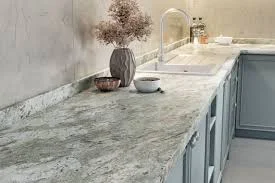
Limestone's fine-grained texture and warm neutral tones suit classic and traditional kitchen designs. Many slabs contain visible fossil inclusions that add individual character. The honed finish shown is more practical for kitchen use than polished — etch marks are less visible on a matt surface.
Heat, sealing,
and thermal shock.
Limestone is sometimes described as having "good heat resistance for everyday cooking". This is accurate for the stone itself — calcium carbonate is a mineral and the rock will not scorch, blister, or warp. The surface you interact with in a kitchen is a sealed stone, and the sealant behaves differently from the stone beneath it.
The impregnating sealant that fills the pores of limestone and provides stain resistance does not have the same heat tolerance as the stone. Repeated hot pan contact degrades the sealant compound gradually. This is cumulative — a single incident is unlikely to cause a visible problem, but regular direct contact across months of kitchen use depletes the sealant faster than the 6–12 month resealing schedule assumes. A kitchen where trivets are used inconsistently may need resealing significantly sooner.
Thermal shock is the more acute risk and more serious in consequence. When a very hot pan is placed on a cold limestone surface — most commonly near a sink where the stone is cooler from water contact — the stone expands and contracts unevenly under the rapid temperature differential. The internal stress generated can crack the slab. Limestone's relative softness does not make it more resistant to thermal shock. Cracks from thermal shock are not repairable by polishing and typically require section replacement.
Use trivets as a permanent kitchen habit. The limestone stone tolerates heat; the sealant protecting the porous surface does not. Repeated hot pan contact degrades the sealant over time. Rapid temperature changes between a hot pan and a cold stone surface cause thermal shock that can crack the slab. The risk is highest near sinks and in cool areas of the kitchen. This applies to all pans from the hob and anything from the oven.
Sealing and etching are completely separate issues. This distinction is critical for understanding limestone's maintenance requirements. The impregnating sealer fills the pores of the stone and prevents staining from liquids that would otherwise penetrate and discolour it. The sealer has no effect on the surface chemistry. Acid still reacts with the exposed calcite crystals at the surface regardless of whether the stone has been sealed that morning or not sealed for three years. You seal limestone to prevent staining. Etching from kitchen acids happens regardless of seal condition.
The water drop test. Place a few drops of water on the limestone surface and leave for 10–15 minutes. If the water beads and holds its shape, the seal is intact. If the stone darkens where the water sits, the stone is absorbing moisture and resealing is due. Reseal before staining has established itself — do not wait for visible marks to form in the stone.
- Stone tolerates heat; sealant does not — trivets required permanently
- Hot pan contact depletes the sealant gradually over repeated use
- Thermal shock from rapid temperature changes can crack the slab
- Thermal shock risk highest near sinks and cold areas of the kitchen
- Sealing prevents staining; it does not prevent acid etching. These are separate.
- Etching from kitchen acids is permanent — only professional re-polishing removes etch marks
Design possibilities.
Limestone's appeal is rooted in its quiet, understated natural character. Unlike the dramatic veining of marble or the bold mineral patterns of granite, limestone offers a softer, more uniform surface with subtle tonal variation and the occasional fossil inclusion. This suits kitchen designs where the worktop complements rather than dominates — traditional kitchens with painted furniture, country kitchens with handmade cabinetry, and classic designs where material warmth and natural texture are the brief.
Finish choice significantly affects both the visual result and the practical experience. Honed limestone — matt and smooth — shows etch marks less visibly than polished, making it the more practical choice for any kitchen zone where acid contact is likely. Many UK buyers choose honed specifically for this reason. Polished limestone shows acid etching more dramatically because the contrast between the etched dull area and the surrounding polished surface is greater.
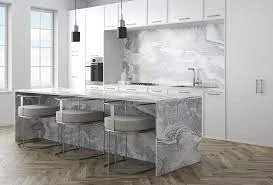
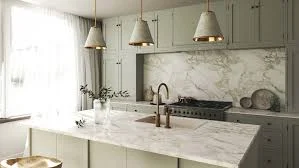
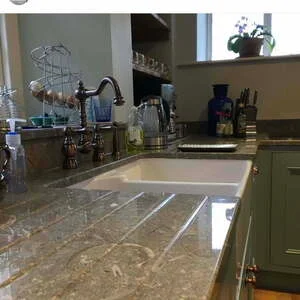
Limestone in UK kitchen settings. The warm, quiet surface character suits classic and traditional kitchen designs. Fossil inclusions visible in many slabs add individual character. Honed finish is strongly recommended for active kitchen use — etch marks are far less visible on a matt surface than on polished limestone.
Key features.
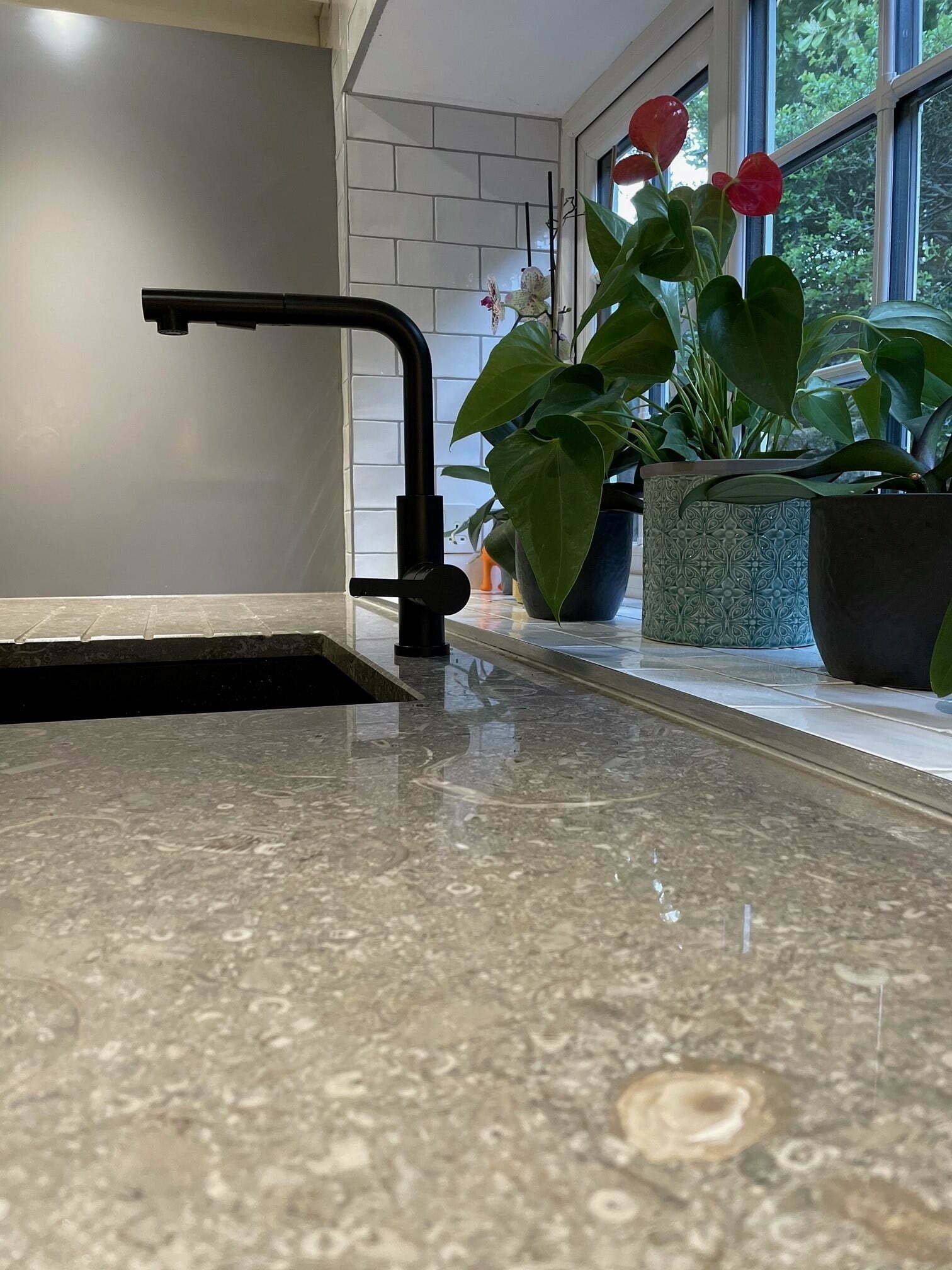
Limestone installed in a traditional kitchen. The warm tone and fine grain of the stone complement painted furniture and natural material kitchens where the worktop's character works with the overall scheme rather than dominating it.
Where limestone works best in a kitchen layout. The best results come from treating limestone as a feature material rather than the sole worktop in a high-traffic kitchen. Many UK homeowners place limestone on an island, baking counter, or breakfast bar and use a harder, non-reactive surface around the primary sink, hob, and high-preparation zones.
This split approach gives you the warm natural stone character of limestone in the positions where it is appreciated most, while protecting the zones where acid contact is most frequent and immediate cleaning is not always possible. It is the most practical way to specify limestone in an active family kitchen.
Full-kitchen limestone specifications are possible but demand consistent immediate acid management, regular sealing, and realistic planning for professional restoration on a more frequent cycle than a split specification requires.
What damages limestone.
Common kitchen causes of etching.
Etching occurs when any acidic substance contacts the polished or honed limestone surface. The acid reacts with calcium carbonate at the surface, dissolving a thin layer and leaving a dull area where the surface crystal structure has been disrupted. Etching shows as a lighter, slightly matt patch against the surrounding surface — more visible on polished limestone than on honed. It cannot be cleaned off. It is a surface change, not a stain, and only professional re-polishing at the stone level removes it.
Etching happens immediately on contact. A lemon half rested on polished limestone for 30 seconds leaves a visible etch mark. Quick blotting reduces the extent of etching but does not prevent it if the acid has contacted the polished or honed surface. The speed of the reaction surprises most owners who have not worked with calcite stone before. This is why limestone requires consistent immediate acid response as a daily kitchen habit rather than an occasional precaution.
Advantages and limits.
- Quiet natural character. The warm, fine-grained surface and fossil inclusions give limestone a material authenticity that manufactured surfaces cannot replicate.
- Cool surface temperature. The thermal mass of limestone keeps the surface cool, which suits baking, pastry, and dough preparation.
- Individual character. Fossil inclusions, subtle tonal variation, and natural surface movement mean no two limestone worktops look identical.
- Professional restoration possible. Limestone's softness makes honing and re-polishing by a stone specialist feasible after years of accumulated etching and scratches — a genuine long-term advantage.
- Ages with character. Buyers who accept patina find limestone develops a genuine lived-in quality over time that complements classic and traditional kitchen designs.
- Accessible entry price. Standard limestone starts at a lower material price per square metre than premium quartzite, Calacatta marble, or branded engineered surfaces, though lifetime maintenance costs affect the total picture.
- Etching from kitchen acids is unavoidable and permanent. Common acids etch the surface immediately. Sealing does not prevent etching. Only professional re-polishing removes etch marks — they cannot be cleaned off.
- The softest common kitchen stone. At 3 Mohs or below, limestone accumulates scratches, chips, and surface marks more readily than any other natural stone option for kitchens.
- Sealing every 6–12 months required. Pale limestones in busy kitchens may need resealing more frequently. Unsealed stone absorbs liquids rapidly.
- Trivets required permanently. The sealant is damaged by hot pan contact. Thermal shock from rapid temperature changes can crack the slab.
- Narrow colour range. Soft neutrals only — cream, beige, buff, grey. Does not suit kitchens with darker, cooler, or more dramatic design briefs.
- Highest maintenance natural stone option for kitchens. Not suited to high-activity primary cooking zones without very consistent immediate care.
Limestone vs
other worktop materials.
The original page compared limestone only with quartz. This table expands the comparison to include granite, marble, travertine, and porcelain — the materials most commonly shortlisted alongside limestone in UK kitchens at a similar design brief.
| Aspect | Limestone | Marble | Travertine | Granite | Quartz | Porcelain |
|---|---|---|---|---|---|---|
| UK price guide | £200–£500+ per m² | £400–£1,100+ per m² | £200–£500+ per m² | £150–£600+ per m² | £250–£700+ per m² | £400–£950+ per m² |
| Hardness | 3 Mohs or below. Softest kitchen stone. Scratches and chips readily. | 3–4 Mohs. Similar. Also scratches in normal use. | 3–4 Mohs. Similar softness. Same vulnerability. | 6–7 Mohs. Very good scratch resistance. | Good. Engineered surface resists everyday contact. | Very good. One of the hardest surfaces available. |
| Acid / etching | Etches immediately and permanently with all common kitchen acids. Sealing does not prevent etching. | Same acid sensitivity. Etches permanently with lemon, vinegar, wine. | Same acid sensitivity. Etches permanently. Sealing does not prevent etching. | Does not etch. Good acid resistance. | Does not etch. Resin surface is acid resistant. | Fully acid resistant. Does not etch under any kitchen conditions. |
| Heat and sealant | Stone tolerates heat. Sealant damaged by hot pan contact. Thermal shock risk. Use trivets permanently. | Same. Stone tolerates heat. Sealant damaged. Thermal shock risk. Trivets required. | Same. Stone tolerates heat. Sealant damaged. Thermal shock risk. Trivets required. | Stone tolerates heat. Sealant damaged. Thermal shock risk. Trivets required. | Low heat tolerance. Resin binders mark under sustained heat. Trivets required. | Fully heat resistant. No sealant. No organic binders. No thermal shock from hot pans. |
| Maintenance | Highest of all natural stone options. Sealing every 6–12 months. Immediate acid blotting always. Trivets. Periodic professional restoration. | High. Sealing every 3–12 months. Immediate acid blotting. Trivets. Periodic restoration. | High. Sealing every 6–12 months. Immediate acid blotting. Trivets. Periodic restoration. | Moderate. Sealing every 1–3 years. Trivets. Daily cleaning simple. | Very low. No sealing. Wipe clean. Trivets required. | Very low. No sealing. No special products. No maintenance requirements. |
| Character | Quiet natural warmth. Fine grain. Fossil inclusions. Ages with gentle patina. Narrow neutral colour palette. | Dramatic veining. Wide colour range. Ages with patina. | Warm, layered texture. Earthy tones. Narrow palette similar to limestone. | Bold mineral patterns. Very wide colour range. Unique per slab. | Engineered consistency. Wide colour range including marble-effect. | Manufactured. Very wide range including stone-effect patterns. |
Limestone vs marble. The closest natural stone comparison. Both are calcite-based stones with the same acid sensitivity — both etch immediately and permanently with kitchen acids. Marble is typically slightly harder and offers more dramatic veining and wider colour choice. Limestone offers a quieter, more understated character and the unique presence of fossil inclusions. Both carry essentially the same maintenance demands. The decision between the two comes down to aesthetic preference rather than practical performance difference.
Limestone vs quartz. The most practical comparison for buyers who want the limestone aesthetic with lower maintenance. Quartz does not etch, does not scratch as easily, requires no sealing, and handles hot pans better (though still requires trivets due to resin binder sensitivity). Marble-effect and stone-effect quartz products closely approximate the limestone look in photography. Under the hand at close range, the materials differ — quartz does not have limestone's cool temperature, fossil character, or natural surface variation.
Maintenance and care.
Limestone is the most maintenance-demanding natural stone option for UK kitchen worktops. Two separate ongoing requirements apply: sealing to prevent staining from absorbed liquids, and immediate acid management to minimise etching. Both are permanent daily habits throughout the life of the worktop. Neither eliminates surface change — limestone develops a patina as part of its normal use in a kitchen.
Maintenance schedule summary.
UK cost guide.
Limestone material pricing sits at the more accessible end of the natural stone market. The total cost of ownership — including sealing, cleaning products, and periodic professional restoration — is higher than the unit price suggests. Always obtain itemised quotes specifying the stone name, grade, finish, and all cut-outs separately.
Long-term cost picture. Limestone's lower material entry price is partially offset by higher ongoing maintenance costs — more frequent sealing than granite, the same professional restoration costs as marble and travertine, and the daily cleaning product requirement of a pH-neutral stone cleaner. These costs should be factored into the total kitchen project budget alongside the material and installation figures.
Who limestone suits.
- You want the quiet warmth and natural character of limestone — including fossil inclusions and soft tonal variation — in a classic, country, or traditional kitchen where the material's understated character complements painted furniture and natural material schemes.
- You understand that etching is unavoidable and you accept it as part of the material's character. You are committed to immediate acid blotting, pH-neutral cleaners only, sealing every 6–12 months, and trivets as permanent kitchen habits — not aspirational ones.
- You are specifying limestone for a feature zone — an island, baking counter, breakfast bar, or pantry — rather than as the sole worktop in a high-traffic kitchen. A mixed specification with a harder surface around the sink and hob is the most realistic approach.
- You value a surface that ages with gentle patina and individual character over a surface that maintains a uniform, showroom finish throughout the life of the kitchen.
- Your household will follow the maintenance schedule and basic rules about boards, trivets, and cleaners consistently — not occasionally when convenient.
- Etching concerns you. Limestone etches faster and more visibly than any other common kitchen stone. If permanent acid marks are a dealbreaker, no other natural stone material etches more readily. Granite and engineered quartz do not etch.
- Your kitchen is active with frequent acid spills and immediate cleaning is not always realistic. Limestone in this context will show etching quickly and require professional restoration significantly sooner than the maintenance schedule suggests.
- You want a surface that maintains a consistent appearance without periodic professional intervention. Quartz and porcelain both deliver long-term uniformity without restoration costs.
- Your design brief calls for darker tones, dramatic veining, or a wider colour palette. Limestone's neutral, narrow palette does not suit these schemes. Granite offers the widest natural stone colour range; quartz the widest engineered range.
- Maximum heat resistance matters. Porcelain is the only common worktop material that handles hot pans without any sealant degradation or thermal shock concern.
Frequently asked questions.
See the Worktops hub to compare limestone with granite, marble, travertine, quartz, and porcelain. The Travertine guide covers the closest practical alternative with similar maintenance requirements and a comparable warm, earthy character.