
Quartz worktops.
The complete UK guide.
Quartz worktops are engineered slabs made from approximately 90–95% crushed natural quartz aggregate blended with polymer resin binders and colour pigments, compressed under high pressure into a dense, low-porosity surface. The quartz component provides hardness and stain resistance. The resin binder makes the slab workable, allows consistent patterns, and is also the material's most important limitation: it sets the heat tolerance ceiling.
Unlike granite, marble, or quartzite — which are quarried natural stones with random natural variation — quartz is a manufactured product. The colour, veining, and finish you see in a showroom sample is what you receive in the kitchen. This consistency is one of the primary reasons people choose quartz: no surprises between sample and installation, no pattern drift across a long run, and no natural colour variation to manage around furniture and fittings.
The practical trade with quartz is heat. The resin binder softens and discolours under sustained direct heat. A pan at 200°C placed directly on the surface risks leaving a permanent dull patch or discolouration ring. This is not a warranty defect — it is a characteristic of all quartz products at this price point. Trivets and heat-resistant boards are permanent kitchen tools, not optional accessories, on a quartz worktop. Used correctly, quartz is a durable, attractive, and genuinely low-maintenance kitchen surface.
Quartz is not the same as quartzite. Quartzite is a natural metamorphic stone quarried from the earth. Quartz worktops are manufactured products. The two materials have different heat properties, sealing requirements, and appearance characteristics.
What is quartz.
Composition and heat limits.
Quartz worktops contain approximately 90–95% crushed natural quartz aggregate — one of the hardest minerals on earth at 7 on the Mohs scale — blended with a polymer resin binder, typically polyester or acrylic, and colour pigments. The mixture is compressed under intense pressure into slabs typically 3000mm x 1440mm or 3200mm x 1600mm, depending on the manufacturer. The exact slab dimensions vary between brands and production facilities. Always confirm the specific slab size with your supplier before planning a large kitchen layout.
The quartz aggregate delivers hardness, scratch resistance, and stain resistance. The resin binder is what makes the slab manufacturable, workable, and consistent — and it is also the material's primary limitation. Resin softens and degrades at sustained high temperatures. This is why porcelain, which has no resin content, handles direct hot pan contact without marking, while quartz does not.
UV sensitivity. The resin binder also yellows, fades, or shifts colour under prolonged UV exposure. This rules out quartz for outdoor installations and limits its suitability for kitchens with strong, sustained direct sunlight across the worktop surface. Most manufacturer warranties explicitly exclude UV-related colour change.
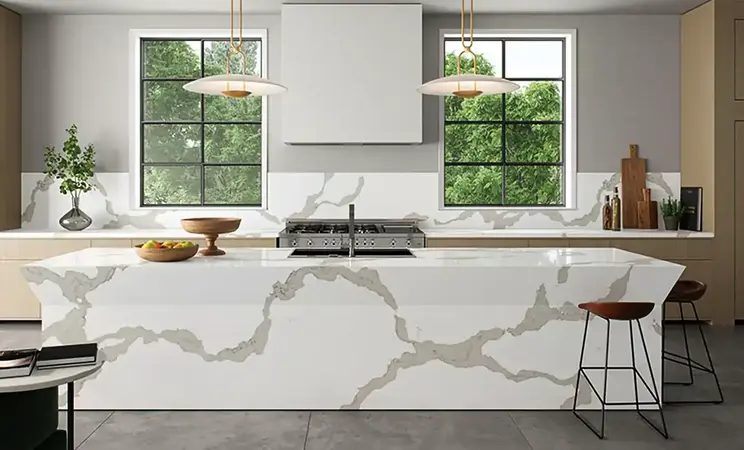
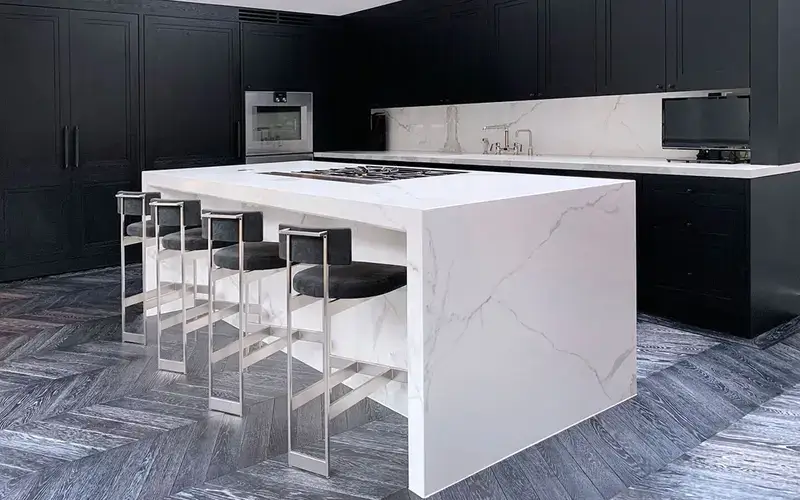
Premium quartz slab in a contemporary kitchen. The consistency of colour and veining from one section to the next is a characteristic advantage of engineered quartz over natural stone — the pattern visible in the showroom sample is the pattern you receive in the finished kitchen.
Heat damage is permanent. A pan straight from the hob at 200°C placed directly on quartz can leave a dull patch or permanent discolouration ring. The resin binder does not recover once it has been damaged by heat. No quartz warranty covers heat damage from direct contact with hot pans or appliances. Use trivets consistently near the hob and oven, and place heat-resistant boards under air fryers, slow cookers, and toasters.
Crystalline silica. Quartz worktops contain high levels of crystalline silica. Cutting and shaping releases respirable silica dust, which causes silicosis — a serious, incurable lung disease — with prolonged exposure. Australia banned engineered stone in July 2024 due to fabricator health concerns. The UK has not introduced the same ban. Ask your fabricator about their dust control practices (wet cutting, on-tool extraction) and request the product safety data sheet from your supplier.
Design possibilities.
Quartz is available across a wide design range including clean whites, warm creams, mid and dark greys, concrete effects, and marble-style veining. The manufacturing process allows the veining, colour depth, and finish to be controlled precisely, producing patterns that closely replicate Calacatta marble, Carrara marble, concrete, and stone effects. Finish options include polished/gloss, satin, honed, and textured surfaces. Polished finishes amplify light but show fingerprints and fine scratches more visibly. Honed and textured finishes are more forgiving in daily use.
Unlike porcelain where most patterns are printed at the surface, quartz aggregate through the body of the slab gives the material a degree of visual depth that surface printing cannot replicate. This depth is most visible at the edge — a quartz edge typically shows the material character better than a standard surface-print porcelain edge.
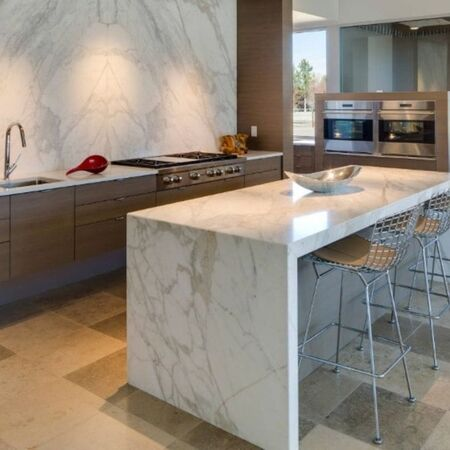
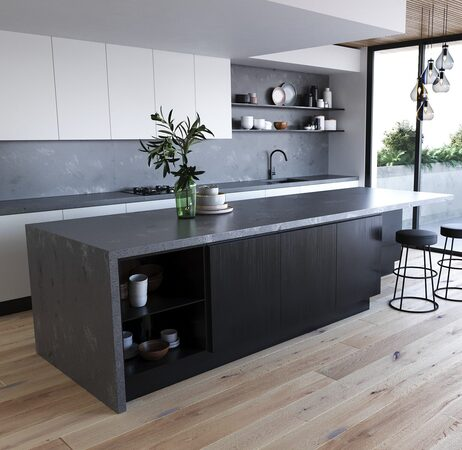
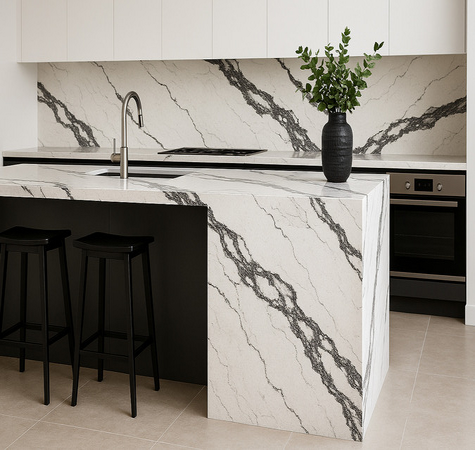
Quartz design range: Calacatta marble-effect white with bold veining (left), dark grey concrete effect (centre), bold waterfall island end (right). The consistency of the pattern across the full surface run is a key advantage of engineered quartz over natural stone.
Book matching and
vein coordination.
Book matching places two consecutive quartz slabs side by side so the veining mirrors symmetrically across the join — the same visual effect as opening a book and seeing the two pages reflect the spine. For quartz ranges with strong directional veining, book matching produces a dramatic result on large islands, L-shaped runs, and waterfall ends where the pattern continues down the vertical face of the island panel.
Quartz manufacturers produce some ranges with book matching in mind — slabs are manufactured in sequential pairs with the pattern intentionally mirrored. This makes quartz book matching more predictable than natural stone book matching, where continuity depends on how the block was quarried. Confirm with your supplier whether the specific range you are specifying is designed to be book-matched, as not all quartz patterns support it effectively.
Vein matching maintains the same veining direction across joins without mirroring. For long kitchen runs where visual continuity matters but symmetry is not the intent, vein matching is the lower-cost alternative. Random lay — placing slabs without specific pattern alignment — is the most economical option and suits uniform or lightly patterned quartz ranges where deliberate alignment adds little value.
Budget 15–30% extra material for book-matched designs. The fabricator must cut from specific slab positions to achieve the mirror, producing waste at positions where the pattern does not align. The exact additional material depends on island size, the waterfall end panels involved, and how bold and directional the veining is. Confirm the material uplift with your fabricator before the slab order is placed.
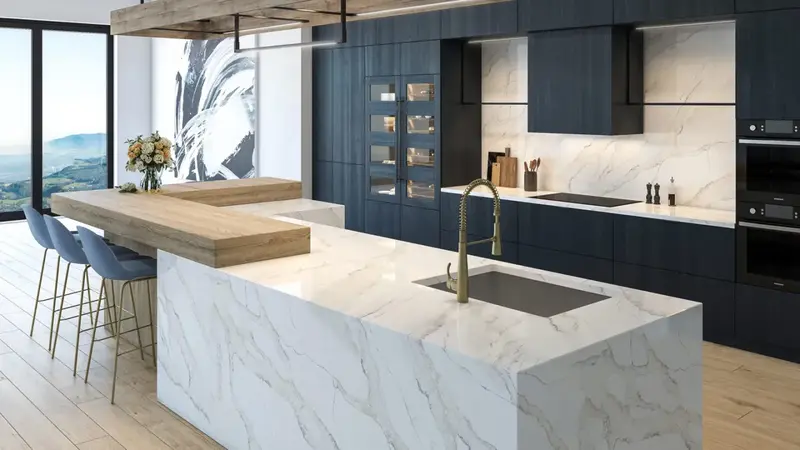
Book-matched quartz on a kitchen island. The veining mirrors symmetrically from the centre join outward. This effect is most powerful on quartz ranges with bold, directional veining — subtle or uniform patterns gain little from deliberate book matching.
Thickness options.
Quartz is commonly available in three principal thicknesses for UK kitchen worktop applications. The choice affects appearance, cabinet load, cost, and support requirements. Most UK kitchen installations use 20mm as the standard specification. Thinner 12mm slabs suit contemporary minimal aesthetics but require careful support planning around cut-outs and overhangs. 30mm slabs add visual weight and presence but are heavier and more expensive — many 30mm edge looks are achieved through build-up lamination on a 20mm base slab rather than a solid 30mm slab throughout.
| Thickness | Characteristics | Best for |
|---|---|---|
| 12mm | Slim, contemporary look. Lighter weight. Requires correct support around sink and hob cut-outs. Overhangs need careful planning. | Minimal contemporary kitchens. Furniture-style islands. |
| 20mm | The most common UK kitchen choice. Good balance of cost, weight, and visual presence. Self-supporting across standard cabinet spans. | Standard kitchen worktops, islands, peninsulas. |
| 30mm | Premium appearance and feel. Heavier cabinet loading. Higher cost. Many 30mm looks achieved via build-up on 20mm base — not all 30mm is solid throughout. | Statement kitchens, traditional layouts, thick edge profiles. |
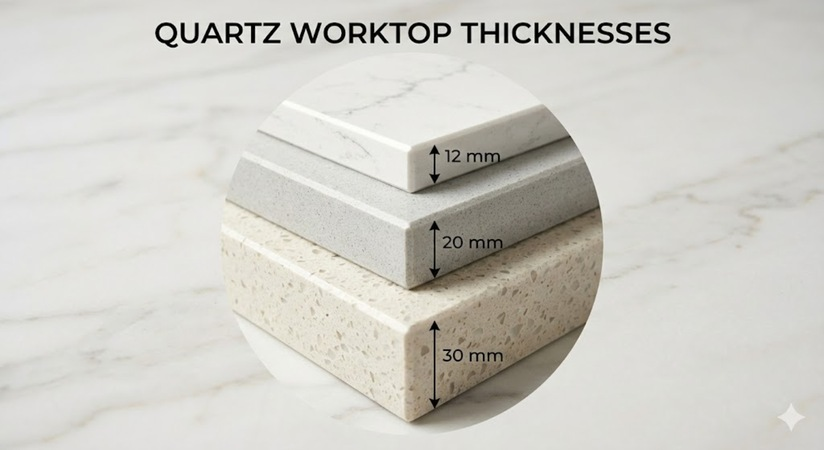
Quartz thickness comparison. 20mm is the UK standard. 12mm suits minimal contemporary designs. 30mm adds visual weight — confirm with your fabricator whether the 30mm profile is a solid slab or a build-up of thinner material at the edge.
Build-up edges
and lamination.
A build-up edge creates a thicker visible edge profile without using a full-thickness slab throughout the kitchen. The fabricator bonds a strip of quartz to the underside of the front edge face, increasing the visible depth at the front of the worktop while the main slab remains at its standard thickness. This approach achieves a premium, chunky edge look without the weight, cost, and cabinet load of a solid thick slab throughout.
Lamination bonds strips of matching quartz to the underside of the front edge. The join line runs horizontally across the front edge face. In practice, a well-executed lamination join is nearly invisible — the quartz material on both pieces reads as continuous. Most 40mm and 50mm edge profiles in UK quartz kitchens are achieved through lamination on a 20mm base slab.
Mitring joins two pieces at 45-degree angles to create a deeper edge face with no visible horizontal join line on the front. The two pieces join at the middle of the edge face in a V-shaped internal joint. Mitring costs more than lamination but produces a visually cleaner result on the front face, particularly on patterned quartz where the absence of a horizontal line across the veining matters. Mitring is standard for waterfall island ends where the worktop face is vertical and highly visible.
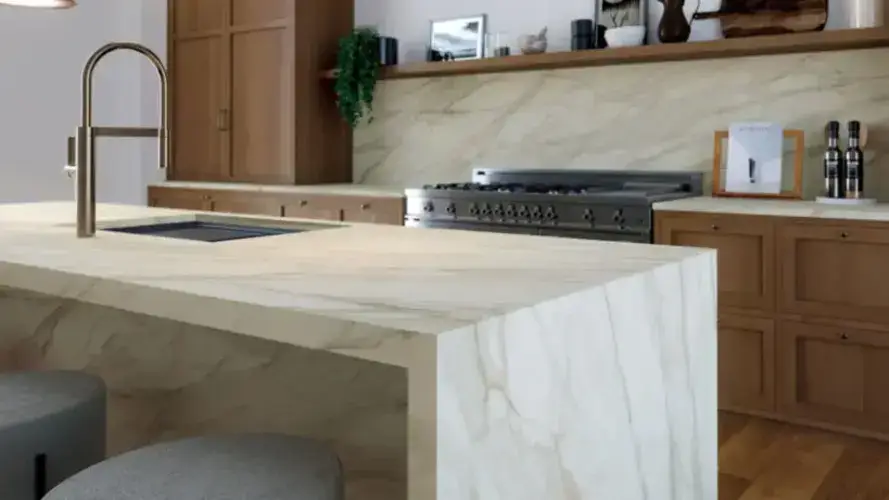
Build-up lamination on a worktop edge. A strip of matching material bonds to the underside of the front face, creating the visual presence of a much thicker slab. The horizontal join line is visible on close inspection — a well-matched material and precise fabrication minimise its visibility in daily use.
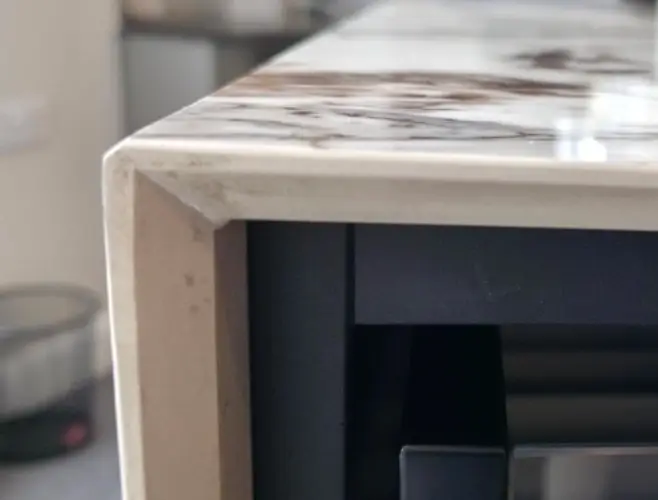
Mitre edge. Two pieces join at 45 degrees to create a deep edge face with no horizontal line visible on the front. The internal V-joint is hidden inside the slab. Mitring costs more than lamination but produces a cleaner result, particularly on waterfall ends where the full edge face is visible.
Build-up edges increase fabrication cost. Each lamination or mitre requires additional material, cutting time, adhesive, and finishing. The cost premium depends on edge depth, the number of linear metres, and whether the quartz pattern requires precise matching across the join. Get an itemised quote specifying the edge type, depth, and linear metres before committing.
Edge profiles.
Quartz machines well and accepts a wider range of decorative edge profiles than porcelain, which is restricted by its extreme hardness to simple straight, chamfered, and arris edges. This is a meaningful practical advantage for kitchens where an ornate or distinctly shaped edge is part of the design brief — traditional kitchens, in-frame designs, and any scheme where the worktop edge is a visible design element.
Edge profiles affect both cost and kitchen character. Straight eased and pencil round edges are the lowest cost options. Ogee, full bullnose, and complex decorative profiles add machining time and therefore cost. Discuss edge choice at specification stage, not after the slab has been templated — some profiles require additional material at the edge position.
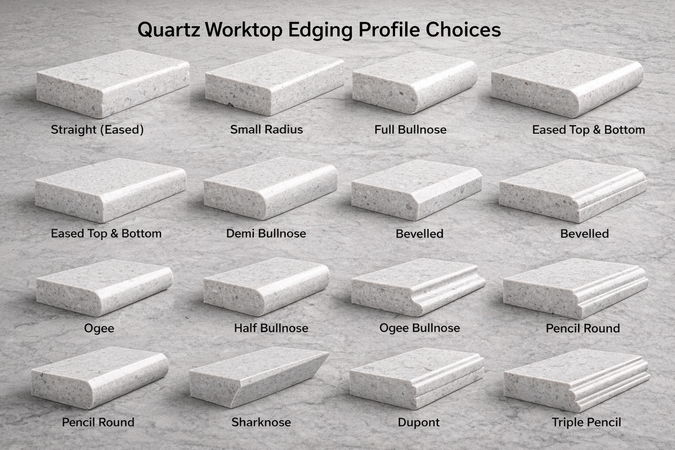
Quartz edge profiles from simple (top) to decorative (bottom). The hardness of quartz supports a wide range of machined profiles, giving quartz an advantage over porcelain for kitchens where edge detail is part of the brief. Edge profile adds fabrication cost — confirm the profile and linear metres in the quote.
Drainer grooves
and recess drainers.
Drainer features are machined into the worktop surface beside the sink to direct draining water back towards the bowl, keeping the worktop area dry and reducing standing water. Two main configurations are used in UK quartz kitchen installations: machined drainer grooves and a recessed drainer area.
Machined drainer grooves are parallel channels cut into the quartz surface at a slight slope running toward the sink bowl. The grooves carry water off the surface and into the sink. The depth and width of the grooves varies by fabricator, but a standard groove is typically 3–4mm deep and 6–8mm wide, with multiple grooves spaced evenly across the drainer zone.
On standard quartz, the groove walls show the quartz material character — the aggregate content and colour of the slab body. On most quartz, this matches the surface appearance closely enough that the grooves read as a clean, integral feature rather than a contrast element. This is different from standard surface-print porcelain, where grooves expose a plain base material that contrasts with the patterned surface.
Drainer grooves add to the fabrication cost and are typically priced per linear metre of groove or as a fixed addition to the sink cut-out price. Confirm with your fabricator whether drainer grooves suit the specific thickness you are specifying — on slabs below 20mm, the groove depth reduces the remaining material between the groove base and the underside of the slab to a point where fracture risk increases.
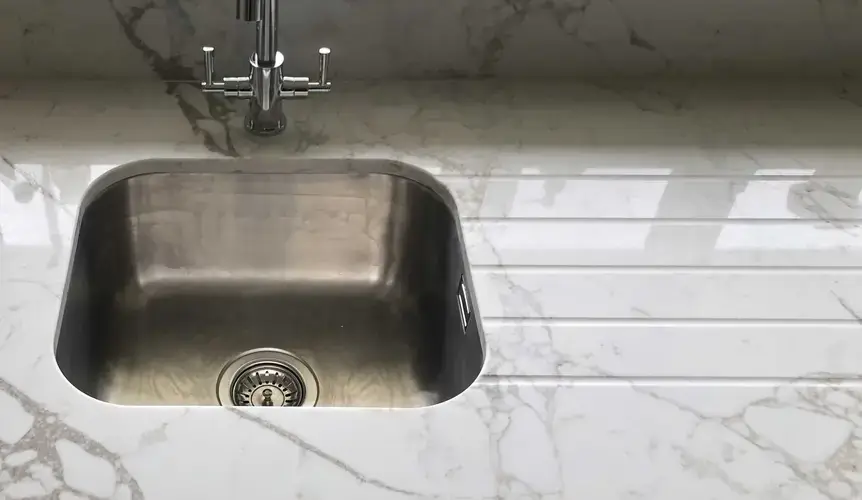
Machined drainer grooves in a quartz worktop. The parallel channels cut into the quartz surface slope gently toward the sink bowl. On most quartz, the groove walls match the surrounding surface closely — unlike standard surface-print porcelain where grooves expose a contrasting plain base material.
Recess drainer (also called a sunken or recessed drainer) creates a shallow flat depression in the quartz surface beside the sink, typically 3–5mm lower than the surrounding worktop. The entire drainer zone is recessed rather than grooved, presenting a smooth, flat surface that sits slightly below the main worktop level. Water drains toward the sink bowl from the recessed area by gravity.
The recess drainer gives a very clean, contemporary appearance — no groove lines, no pattern interruption. It is a popular choice on quartz worktops where visual simplicity is the brief, particularly in handleless kitchens and contemporary German kitchen designs where every visual element is reduced to its minimum.
The recess drainer area is typically outlined by a step or slope at the boundary between the main worktop level and the recessed zone. The transition edge is clean and sharp. Fabricators machine the recess after the main slab is templated and cut, using a CNC router or water jet to achieve the specified depth and boundary geometry.
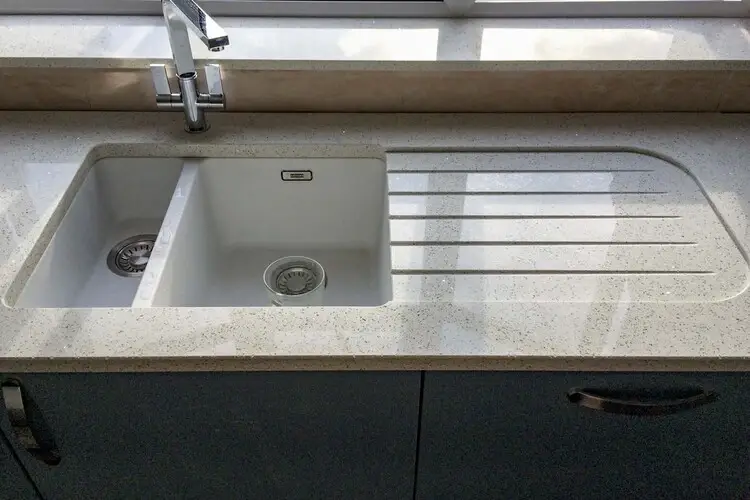
Recessed drainer in a quartz worktop. The shallow flat depression sits slightly below the main worktop level, directing water toward the sink without any groove lines. The clean, uninterrupted surface suits contemporary and handleless kitchen designs where a minimal aesthetic is the brief.
Choose your drainer feature at specification stage, not after templating. Both drainer grooves and recess drainers require specific positioning relative to the sink cut-out and the worktop edge. The fabricator needs this information when producing the cutting layout and CNC programme. Requesting drainer features after the slab has been cut adds cost and may not be possible without cutting a new piece.
Wrapping an island
in quartz.
Wrapping a kitchen island in quartz — where the worktop surface continues down the visible sides of the island — creates a dramatic, monolithic appearance. The quartz reads as a single material from the top surface down the vertical faces, producing the waterfall end look popular in contemporary kitchen design. The result eliminates the visible cabinet carcass and door faces on the island sides, replacing them with a continuous quartz surface from countertop height to floor level.
A structural frame is required. Quartz panels do not self-support on vertical faces. The builder or joiner must construct a timber or steel substrate frame inside and around the island to give the vertical quartz panels a solid, continuous backing surface to bond onto. This frame must be square, plumb, and rigid — any movement or flex in the substrate after installation risks cracking the quartz panels. The frame design and construction should be confirmed with both the kitchen installer and the quartz fabricator before work begins.
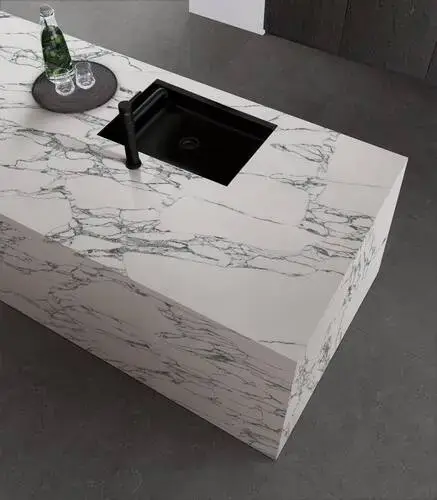
Left: a finished quartz-wrapped island showing the continuous material from worktop surface down the vertical faces. Right: the internal timber substrate frame required to support the vertical quartz panels — without a solid, rigid, plumb frame the vertical panels have no structural backing and cannot be installed.
Quartz panel thickness for vertical faces. Vertical wrapping panels are typically 12mm or 20mm thick. Thinner 12mm panels are lighter and easier to handle on vertical faces, but require a very flat, continuous substrate surface to bond onto evenly. Any gaps or undulations in the substrate will show as irregularities in the finished quartz face. Confirm the substrate flatness tolerance with your fabricator before the frame is built.
Advantages and limits.
- No sealing required at any stage. Low-porosity surface resists staining from common kitchen spills including wine, coffee, oil, and curry without any maintenance chemicals.
- Consistent patterns from sample to installed kitchen. The manufactured surface matches the showroom sample precisely — no natural variation between slabs or across a long run.
- Wide design range including marble-effect whites, concrete greys, and plain colours, all in a surface that performs better than natural marble in daily use.
- Wide edge profile choice. Quartz machines well, supporting profiles from simple eased edges through full bullnose, ogee, and decorative details unavailable in porcelain.
- Good scratch resistance for everyday kitchen use. Steel utensils and normal food preparation do not mark the surface under normal conditions.
- Long guarantee from reputable UK fabricators. A minimum 10-year guarantee covers workmanship and the product. Short guarantees signal lower quality.
- Book matching, drainer grooves, recess drainers, build-up edges, and island wrapping all achievable in quartz with the right fabricator.
- Heat sensitivity. The resin binder marks permanently under direct hot pan contact. Heat damage is not covered by warranty. Trivets are a permanent, non-negotiable kitchen requirement.
- Indoor use only. UV exposure yellows or fades the resin over time. Most warranties explicitly exclude outdoor installations and UV-related colour change.
- Visible joins on large layouts. Quartz joins on long island runs and L-shaped or U-shaped layouts are visible even with colour-matched adhesive. This is unavoidable — unlike solid surface, quartz cannot be chemically bonded to invisibility.
- High crystalline silica content raises fabricator health concerns. Ask for dust control information and the product safety data sheet from your supplier.
- Edges and corners chip on sharp impact. Heavy cast iron dropped onto an exposed corner is the most common damage type. Chips are fillable but rarely invisible.
- More uniform appearance than natural stone. Some buyers prefer the random variation of granite, quartzite, or natural marble. Quartz cannot replicate the depth and translucency of natural stone.
Quartz vs
other worktop materials.
Quartz vs porcelain. Porcelain wins on heat (no resin binder), UV stability, and outdoor suitability. Quartz wins on edge profile options and the visual depth of the pattern — quartz aggregate through the slab body gives more dimensional quality than most surface-printed porcelain. Both are non-porous with no sealing requirement. Both sit at comparable price points. Both require specialist fabrication.
Quartz vs granite. Granite requires periodic sealing and carries thermal shock risk from sealant degradation. Quartz needs no sealing. Granite offers natural variation through the full body of the stone that quartz cannot replicate. For buyers who want low maintenance without sealing but prefer stone-look aesthetics, quartz is typically the easier daily choice.
Quartz vs solid surface. Solid surface delivers seamless invisible joins, thermoformed curves, and integrated sinks without silicone joints — none of which quartz achieves. Quartz is harder, more scratch-resistant, and handles heat better than solid surface. For kitchens where seamless design continuity is the primary brief, solid surface is stronger. For kitchens where surface hardness and pattern options are the priority, quartz is the better fit.
Quartz vs laminate. Laminate is significantly lower cost but handles heat poorly and has limited longevity compared to quartz. Quartz's visual quality, stain resistance, and long-term durability are substantially better. For any kitchen above an entry-level budget, quartz delivers meaningfully better performance and longer service life.
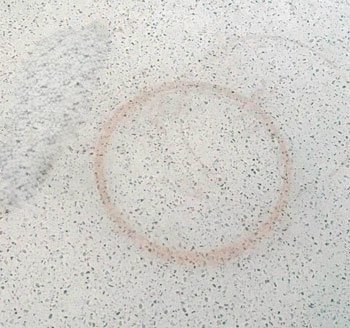
Heat damage on a quartz worktop from direct hot pan contact. The dull ring and discolouration patch are permanent — the resin binder does not recover once damaged. This is why trivets are non-negotiable on quartz, and why porcelain (no resin binder) handles heat differently.
| Aspect | Quartz | Porcelain | Granite | Solid surface | Laminate |
|---|---|---|---|---|---|
| UK price guide | £300–£600+ per m² | £250–£700+ per m² | £150–£600+ per m² | £300–£700+ per m² | £50–£150 per m² |
| Heat resistance | Moderate. Resin binder marks permanently under sustained heat. Trivets essential. | Excellent. No resin. Hot pans on flat surface tolerated without marking. | Good. Stone tolerates heat but sealant degrades. Thermal shock risk. | Low. Marks from very hot pans and appliances. Trivets essential. | Poor. Blisters and marks from any direct heat contact. |
| Scratch resistance | Good. Everyday kitchen use does not mark. Glass and grit can scratch. | Excellent (7–8 Mohs). Matte finishes more practical than gloss. | Very good (6–7 Mohs). | Low-moderate. Softer surface. Marks renewable by sanding. | Moderate. Surface layer wears over time. Not renewable. |
| Sealing required | No. Non-porous surface. | No. Non-porous surface. | Yes. Every 1–3 years depending on finish. | No. Non-porous surface. | No. Surface layer provides barrier. |
| UV stability | Moderate. Resin binders yellow and fade in sustained sunlight. Not outdoor-recommended. | Excellent. No organic content to degrade. Outdoor suitable. | Good. Natural stone stable under UV. | Good in most conditions. Some formulations fade in direct sustained sun. | Moderate. Fades with prolonged moisture and UV exposure. |
| Seamless joins | Visible on long runs and around islands. Colour-matched adhesive reduces but does not eliminate the line. | Visible. Cannot be chemically bonded to invisibility. | Visible. Natural variation makes joins more noticeable. | Near-invisible. Chemical bond sanded and polished to a continuous surface. | Visible at all joins. |
| Edge profiles | Wide. Most decorative profiles achievable. Good choice for ornate and traditional kitchens. | Limited. Square, chamfer, and arris only. No ornate profiles. | Very wide. Stone machines well for decorative profiles. | Very wide. Thermoformed curves and shaped edges achievable. | Limited to straight profiles in most installations. |
| Repairability | Moderate. Small chips fillable. Heat damage and large chips often need section replacement. | Limited. Edge chips fillable. No surface restoration possible. | Good. Stone re-polishing by specialist possible. | Excellent. Sanding and re-polishing restores surface. Unique advantage. | Good for surface marks. Major damage requires strip replacement. |
Maintenance and care.
Quartz is one of the lowest-maintenance worktop materials available. No sealing, no oiling, no specialist cleaning products, no periodic professional care. The low-porosity surface resists absorption of common kitchen spills. Most marks wipe away with warm water and mild detergent. The key daily habits are protecting the surface from heat and wiping spills before they have time to dry on the surface.
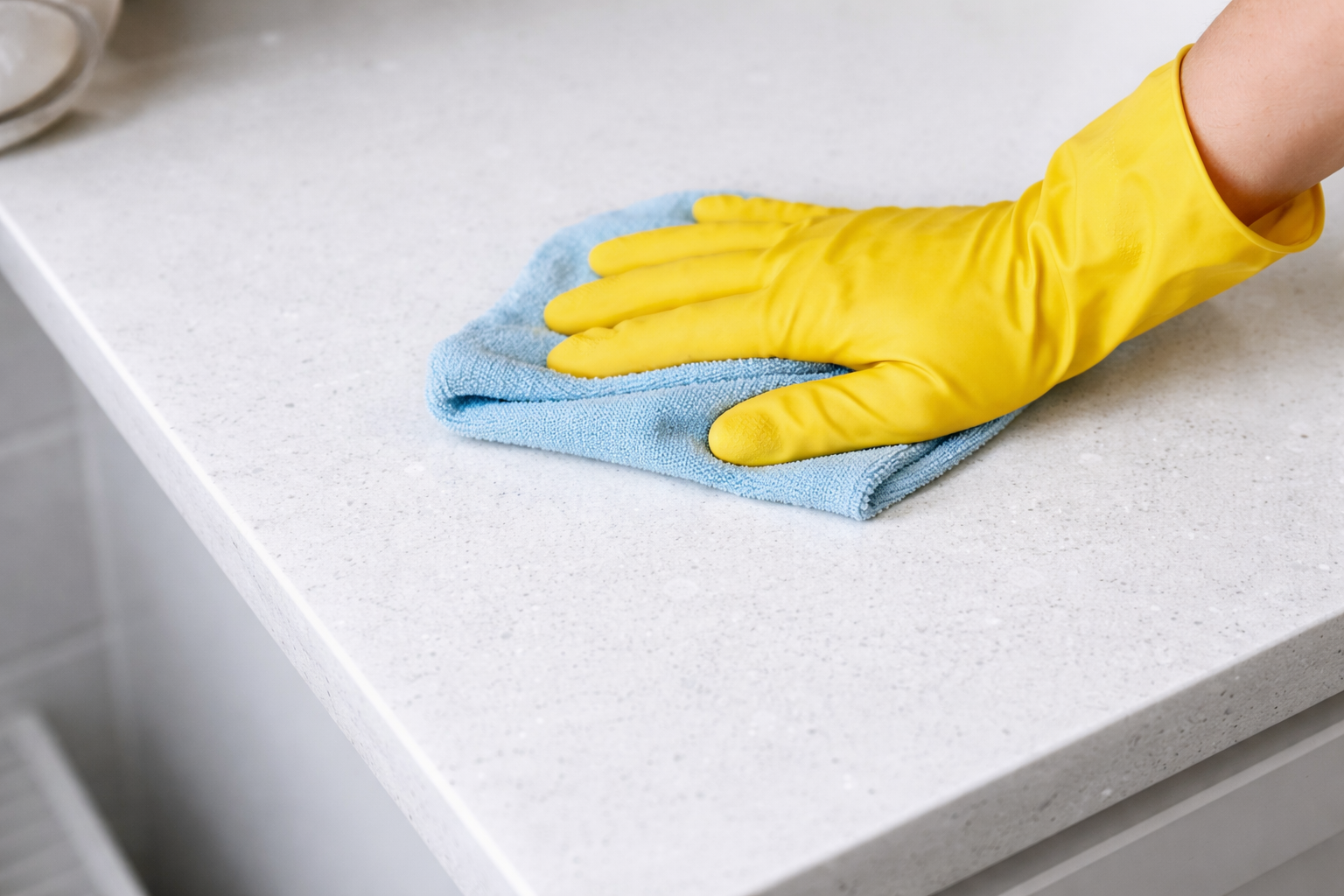
Quartz daily cleaning — warm water and mild detergent, no specialist products, no sealing, no periodic professional treatment. The low-porosity surface keeps daily maintenance to a wipe-down. The investment is in protecting the surface from heat, not in chemical maintenance.
Guarantees.
What to expect and what to look for.
A guarantee period is one of the clearest signals of quartz quality and fabricator confidence. Reputable UK quartz fabricators offer a minimum of 10 years on both the product (the quartz material itself) and the workmanship (the fabrication and installation). Some premium quartz products carry 15-year or lifetime guarantees. A guarantee significantly below 10 years is a signal to ask questions — either the product quality is lower, the fabricator is less confident in their work, or both.
The guarantee period alone is not the full picture. Read what the guarantee covers. Most quartz guarantees exclude heat damage (burns or scorching from hot pans), UV-related colour change, and damage caused by incorrect cleaning products, physical impact, or structural movement beneath the worktop. These exclusions are standard and expected. What matters is that the guarantee covers manufacturing defects, premature surface deterioration, and workmanship failures under normal use conditions.
Ask for the guarantee document before you sign any order. The guarantee should be in writing, name the manufacturer or fabricator providing it, specify the product and installation address, and clearly state the coverage period and exclusions. A verbal guarantee or a vague promise of "long-term cover" is not the same as a written guarantee document. Keep the signed document with your kitchen paperwork for the life of the kitchen.
UK cost guide.
Quartz pricing varies by pattern complexity, slab size, thickness, edge profile, number of cut-outs, and fabricator rates. The figures below reflect typical UK market pricing. Book-matched designs, drainer features, build-up edges, island wrapping, and waterfall ends all add to the base fabrication cost. Always obtain an itemised quote specifying the quartz product, thickness, edge profile, number of cut-outs, and any special features separately from the per-metre-squared rate.
What to add to the per-metre-squared rate. Hob and sink cut-outs are typically £50–£150 each. Drainer grooves and recess drainers add to the sink cut-out price. Build-up edges add per linear metre of edge. Book matching and pattern coordination require additional material — budget 15–30% extra slab allowance. Island wrapping requires additional material for vertical panels plus substrate frame work. Prices typically exclude VAT.
Who quartz suits.
- You want consistent patterns and predictable results. The manufactured surface gives you exactly what you saw in the showroom, across every section of the kitchen.
- Low maintenance is the priority. No sealing, no oiling, no specialist products. Warm water and mild detergent for the life of the kitchen.
- You want marble-effect aesthetics without marble's etching and sealing requirements. Quartz delivers the look with significantly lower maintenance commitment.
- Decorative edge profiles matter. Quartz machines to ogee, bullnose, and other ornate profiles that porcelain cannot achieve.
- You are committed to using trivets consistently, without exception, at every hot pan position in the kitchen.
- You want long guarantee terms. A 10-year minimum from a reputable UK fabricator is achievable at all price points above entry level.
- Heat performance without trivets is the priority. Porcelain has no resin binder and handles direct hot pan contact without marking. It is the correct choice for kitchens where trivets are unlikely to be used consistently.
- Your kitchen has strong sustained direct sunlight across the worktop. UV exposure yellows quartz resin over time. Porcelain or granite are more stable options in this situation.
- You want an outdoor kitchen or garden room worktop. Almost all quartz warranties exclude outdoor installation.
- Seamless joins on a long run, integrated sinks, or thermoformed curves are the brief. Solid surface is the only material that achieves these — quartz cannot.
- You want the natural depth and random variation of real stone through the body of the material. Granite, quartzite, and marble each offer this in ways engineered quartz does not replicate.
- Your supply budget sits below £300 per square metre. Laminate is the practical alternative at that price point.
Frequently asked questions.
See the Worktops hub to compare quartz with porcelain, granite, solid surface, and other materials. The Porcelain guide covers the alternative with superior heat performance and UV stability for kitchens where trivets are not practical or where outdoor suitability is required.