
Solid wood worktops.
The complete UK guide.
Solid wood is the only common worktop material that is genuinely renewable. Scratches, stains, scorch marks, and surface wear accumulated over years of kitchen use can be sanded out and the surface re-oiled to near-original condition. No other material offers this degree of long-term repairability. This is solid wood's defining practical advantage and the reason many buyers return to it despite the maintenance commitment it requires.
Wood is an organic material. It expands and contracts with changes in humidity, absorbs moisture unless properly sealed with oil, and marks from hot pans, standing water, and prolonged contact with food or drink. Quality matters significantly in solid wood. Premium hardwood worktops — properly dried, manufactured to close tolerances, and finished with quality oil — perform very differently from budget solid wood products. The cheapest end of the solid wood market is also the most vulnerable to the material's weaknesses: a thin, poorly dried oak worktop will stain, warp, and crack faster than a premium-grade version of the same species. Budget wood demands exactly the same maintenance as premium wood, but starts from a weaker position.
Premium solid wood worktops sit at a price comparable to mid-range quartz or engineered stone when custom-made to fit the kitchen. The custom manufacturing process — where boards are jointed and finished to the exact dimensions of the kitchen — is a significant part of what justifies the cost and what produces a worktop that performs well over time. Budget off-the-shelf wood worktops trimmed to fit are a different product category with different expectations.
What is a solid wood worktop.
A solid wood kitchen worktop is made from real timber — hardwood or softwood — jointed and laminated into the required dimensions. The term "solid wood" distinguishes the material from wood-effect surfaces and from MDF or chipboard cores with a veneer. The board you see is the board all the way through.
UK kitchen worktops are most commonly supplied in three construction types: stave (narrow vertical boards jointed side by side), block (smaller horizontal pieces jointed to create a butcher-block appearance), and full-stave (wider boards jointed side by side for a more prominent grain pattern). The construction affects the worktop's visual character, dimensional stability, and suitability for different kitchen zones.
The species of timber determines colour, hardness, grain character, and moisture tolerance. Oak is the dominant choice in UK kitchens for its combination of warmth, hardness, and wide availability. Walnut is popular for premium specifications. Iroko is specified where moisture tolerance is a higher priority — around Belfast sinks and wet zones — because its natural oils offer better water resistance than most species.
All solid wood worktops require finishing with oil before use and regular maintenance thereafter. The oil penetrates the wood fibres rather than sitting on the surface as a film. It feeds the wood, provides some water resistance, and is the starting point for how well the worktop performs and how long it looks good. An un-oiled or poorly maintained solid wood worktop is the most vulnerable version of the material.
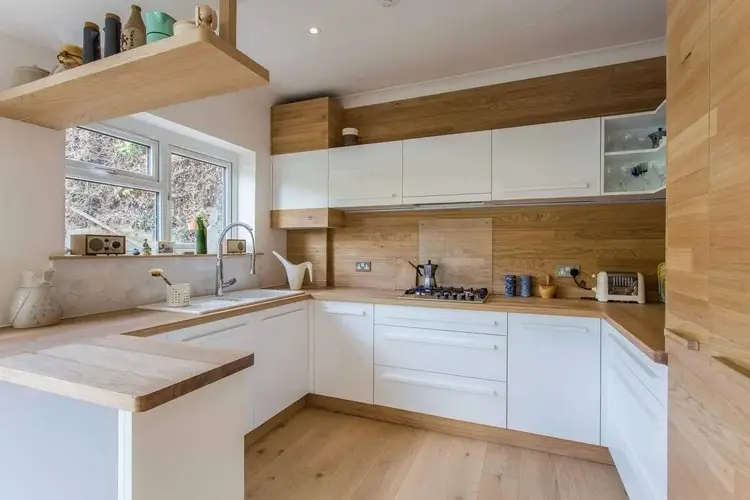
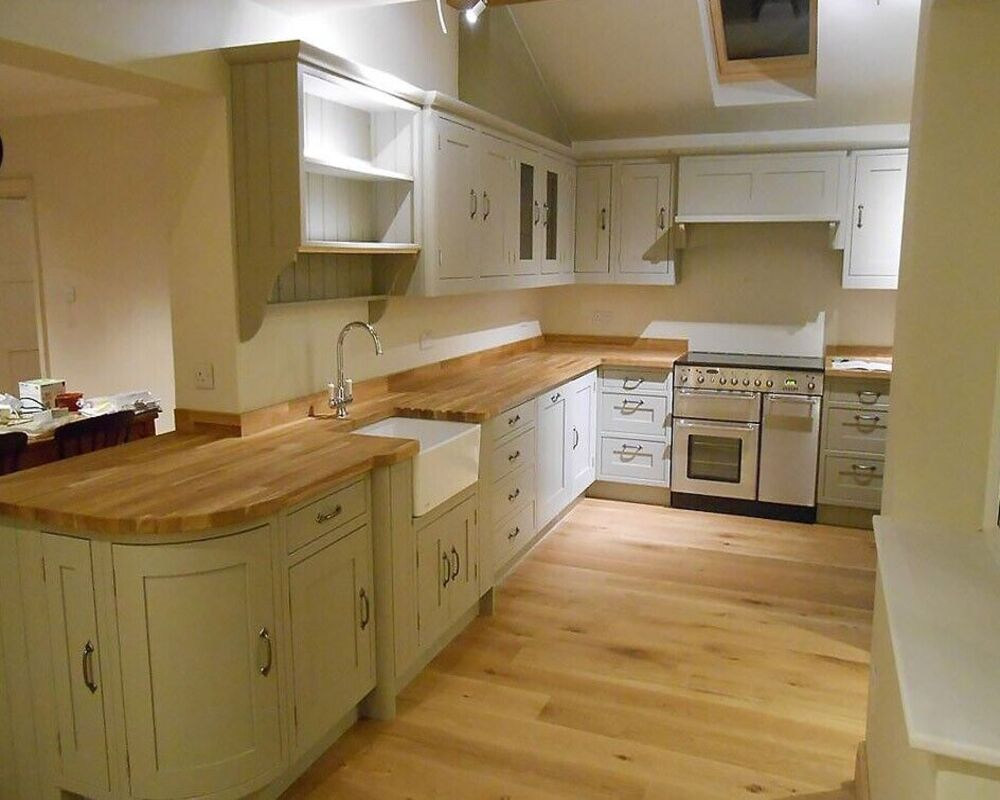
Premium solid oak worktop in a kitchen setting. The warm grain and natural variation of real wood are qualities that printed or manufactured surfaces approach but do not match. The oiled finish feeds the wood fibres and provides the primary protection against moisture and staining.
Quality and price tiers.
What the difference costs.
Solid wood worktops span a wider quality range than most other kitchen materials. Budget and premium solid wood are both real wood, but they are not equivalent products. The gap between them is large enough to affect how the worktop performs from the day of installation and how it ages over the following decade.
- Lower purchase price — entry oak starts around £100–£200 per m²
- Requires the same maintenance as premium wood but starts from a less controlled baseline
- More vulnerable to movement, gapping at joints, and surface issues if maintenance slips
- Trimming and cutting on site can expose end grain that needs immediate and thorough oiling
- Suits buyers with a tighter budget who commit fully to the maintenance routine
- Price comparable to mid-range quartz or engineered stone — £300–£700+ per m² depending on species
- Custom dimensions produce a seamless, furniture-quality result that off-the-shelf cannot match
- Better dimensional stability from controlled moisture content before and during manufacture
- Thicker construction is more forgiving of moisture and more resistant to warping
- Long-term investment equivalent to other premium materials — suited to kitchens planned for a 15-year life
Budget wood with poor maintenance fails faster than any other worktop material. A cheap solid wood worktop that is under-oiled, regularly exposed to standing water, or dried out in a centrally heated kitchen will stain, develop black patches at joints, grey at the surface, and crack within 2–3 years. This is not inherent to wood as a material — it is the consequence of specifying budget wood without fully committing to the care routine it needs. Premium wood with good maintenance will outlast the kitchen. Budget wood without maintenance will not reach the next renovation.
Design possibilities.
Solid wood is the most versatile worktop material in terms of design fit. It suits traditional country kitchens, painted Shaker designs, modern Scandi schemes with pale timbers, industrial kitchens with dark walnut, and mixed-material island specifications where the warm grain of wood contrasts with stone or ceramic surfaces in other areas of the kitchen. The natural grain variation of real wood means no two worktops look identical, which gives the material a visual authenticity that printed surfaces approach but do not replicate.
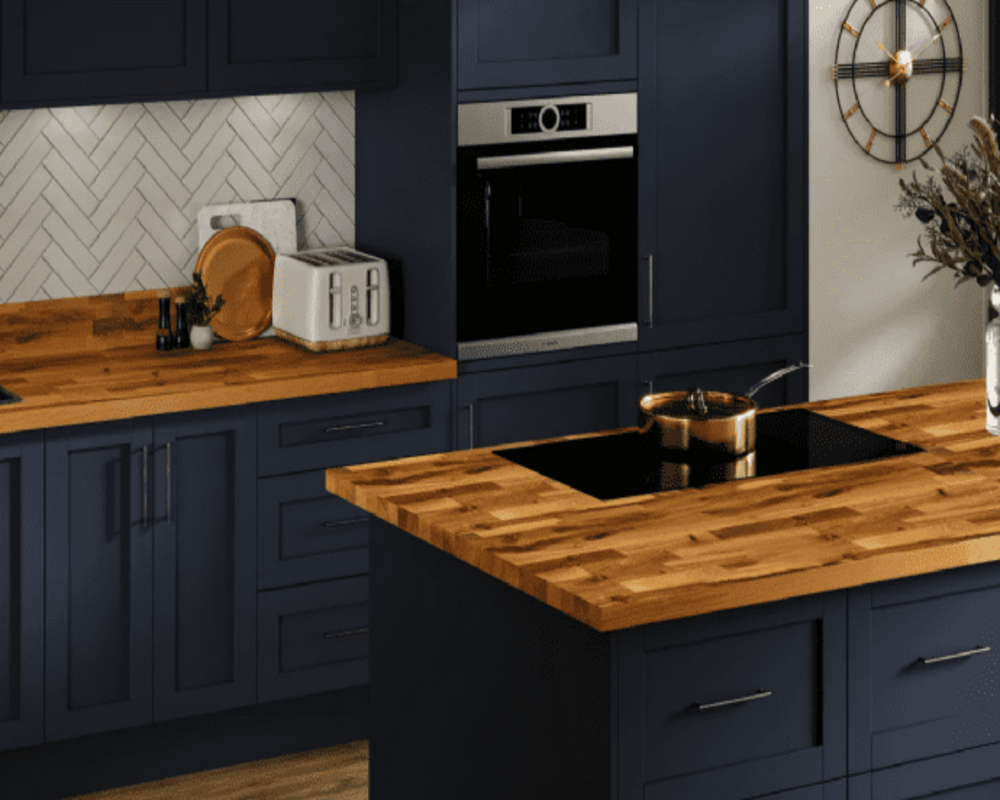
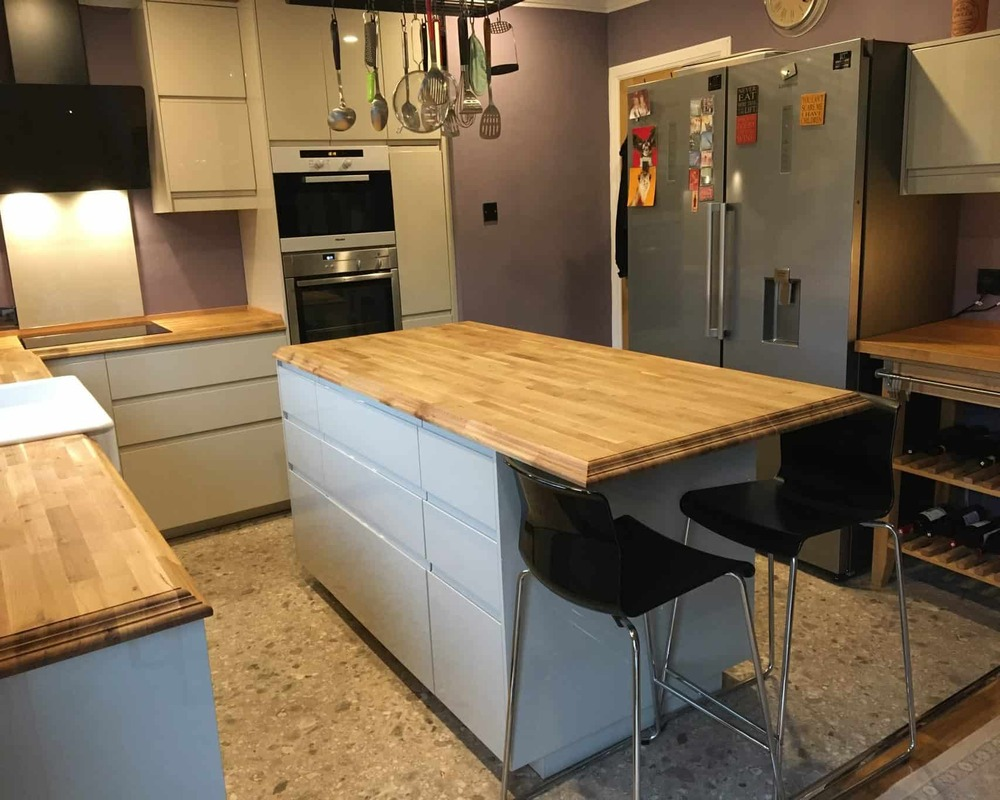
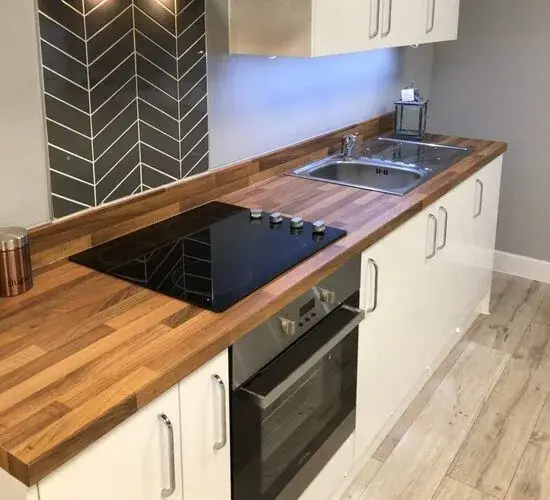
Solid wood in UK kitchen installations. Oak in a country kitchen (left), full-stave with visible end grain (centre), butcher block island construction (right). Wood adapts to traditional, transitional, and contemporary kitchen styles more flexibly than any other worktop material.
Popular wood species
for UK kitchens.
Wood species comparison showing the range of natural tones available. Species choice affects hardness, colour, grain character, and moisture tolerance — all of which affect daily kitchen performance alongside visual preference.
Water, heat,
and the main risks.
Water is the primary risk for solid wood worktops. The material absorbs moisture when it contacts the wood surface or end grain without an adequate oil layer. The consequences of poor moisture management are: black staining (from iron in water reacting with tannins in the wood), swelling and warping at joints, and — in dry conditions — cracking as the wood loses moisture unevenly. All of these are more severe and more rapid at lower quality levels and with insufficient oiling.
The sink zone is the highest-risk area. Standing water from washing up, drips from taps, and wet items left on the surface accumulate over time regardless of how careful the household is. Many UK buyers now specify solid wood on islands and breakfast bars only, and use stone, quartz, or porcelain around the main sink and hob. This mixed-material approach gives you the warmth and character of wood in the positions where it works best while protecting the zones where moisture risk is highest.
End grain — the cross-section of the wood visible at cut edges and joints — absorbs water significantly faster than face grain. Any cut made on site must be immediately and thoroughly oiled, and joints around sinks and hobs need regular inspection and prompt resealing with oil when any dry or grey patches appear.
Heat and scorching. Solid wood scorches when hot pans or baking trays are placed directly on the surface. Scorch marks are permanent until sanded out — they cannot be removed by cleaning or re-oiling. Always use a trivet or heat pad under hot cookware. This applies equally to cast iron, stainless steel pans, and anything removed directly from the oven. Unlike stone surfaces, wood does not crack from thermal shock — the risk is surface burning rather than structural damage.
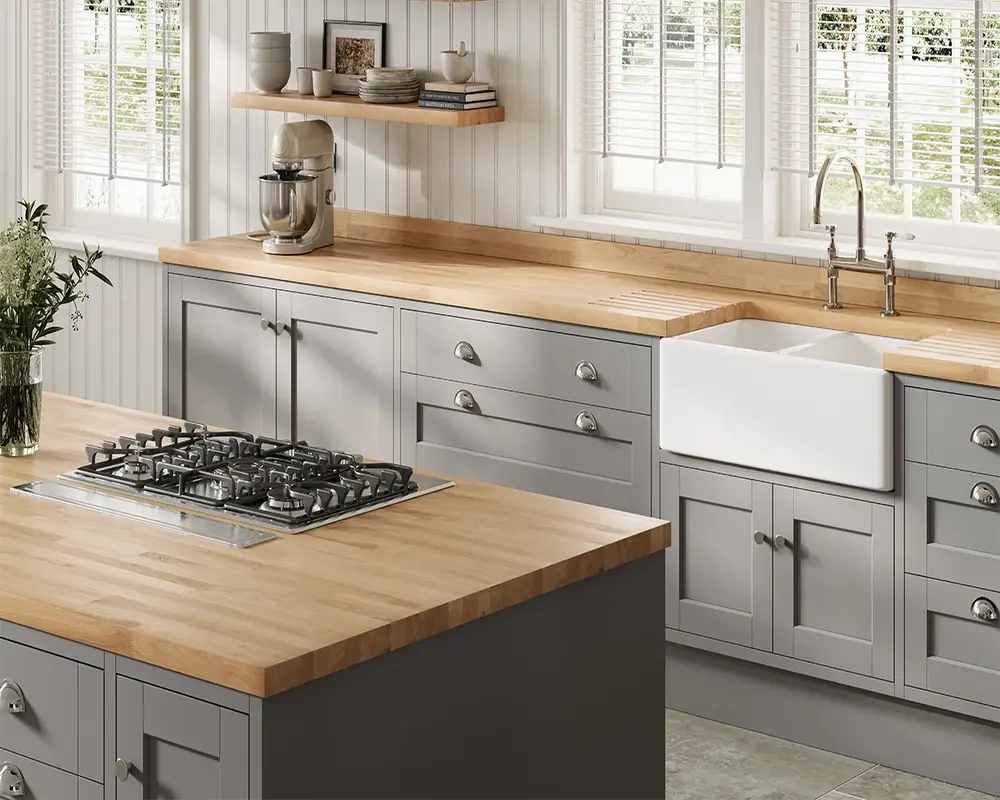
The sink zone is the highest-risk area for solid wood. Many UK households now use wood on islands and away from sinks, specifying harder non-porous materials around wet zones.
- Standing water causes black staining — especially where iron (steel items) contacts wet wood
- Repeated wetting near sinks leads to swelling, warping, and splits at joints
- End grain absorbs moisture faster than face grain — all cut edges need immediate thorough oiling
- Dry, under-oiled wood in centrally heated homes cracks as the wood loses moisture unevenly
- Hot pans scorch the surface permanently — trivets required at all times
- Mixed-material kitchens (wood on islands, stone near sinks) are the most practical full-kitchen approach
What makes wood different.
Advantages and limits.
- Renewable surface — the only kitchen worktop material where accumulated damage can be fully reversed by sanding and re-oiling. A full professional refinish brings the worktop close to new condition.
- Natural warmth and tactile quality. Wood feels warmer under the hand than any stone, ceramic, or engineered alternative and produces less impact noise from cookware and crockery.
- Genuine natural character with unique grain per board. No two worktops look identical. Ages with a deepening, richer character rather than simply wearing out.
- Kinder on dropped crockery. Wood absorbs impact where stone shatters it — a practical advantage in family kitchens.
- Premium custom-made wood competes on price with mid-range quartz and delivers a furniture-quality result that off-the-shelf materials cannot match.
- Sustainable when sourced from certified managed forests. Biodegradable at end of life.
- High maintenance compared to any other worktop material. Oiling in the first months, regular top-ups, daily moisture management, and trivet use are all non-negotiable throughout the life of the worktop.
- Water risk is severe near sinks. Standing water causes black staining, swelling, and joint splitting. The sink zone is a high-risk position for solid wood.
- Hot pans cause permanent scorch marks until sanded out. Trivets are required every time — not just for very hot cookware.
- Scratches and dents accumulate faster than on stone or quartz. Most are removable by sanding but this takes time and requires the surface to be re-oiled.
- Budget wood without proper maintenance fails faster than any other worktop material. Staining, mould at joints, cracking from drying out, and grey surface discolouration all develop quickly in under-maintained wood.
- Seasonal movement with changes in humidity. Joints can open slightly in dry winter conditions and close again in summer. Premium manufacture and adequate oiling minimise this, but it cannot be entirely eliminated.
Solid wood vs
other worktop materials.
This table expands the original comparison beyond just quartz to include granite and porcelain — the most commonly shortlisted alternatives alongside solid wood in UK kitchen projects.
| Aspect | Solid wood | Quartz | Granite | Porcelain |
|---|---|---|---|---|
| UK price guide | £100–£700+ per m² (quality varies enormously) | £250–£700+ per m² | £150–£600+ per m² | £400–£950+ per m² |
| Daily maintenance | High. Wipe spills immediately. Keep dry near sinks. Use trivets for hot pans. Check oil condition regularly. | Very low. Wipe clean with mild cleaner. Trivets required for sustained heat. | Moderate. Wipe spills. Sealing every 1–3 years. Trivets required. | Very low. Wipe clean. No sealing. No special products. |
| Water resistance | Low without adequate oiling. Standing water near sinks causes staining, swelling, and cracking. | Excellent. Non-porous. Stable in all normal kitchen conditions. | Good when sealed. Porous without seal. | Excellent. Non-porous. Fully water resistant. |
| Heat performance | Low. Hot pans scorch the surface permanently until sanded. Trivets essential at all times. | Low-moderate. Resin binders mark under sustained heat. Trivets essential. | Stone tolerates heat. Sealant damaged by hot pan contact. Thermal shock risk near sinks. Trivets required. | Excellent. No organic binders. Fully heat resistant. No thermal shock from hot pans. |
| Scratch resistance | Low to moderate. Scratches in normal use. Most are removable by sanding and re-oiling. | Good. Resists everyday contact. Chopping boards still recommended. | Very good. 6–7 Mohs hardness. | Very good. One of the hardest surfaces available. |
| Repairability | Excellent. Scratches, stains, and scorch marks sand out. Professional refinish every 5–10 years restores surface close to new. Unique advantage. | Limited. Small chips are repairable but often visible. Full resurfacing not possible. | Chips at edges repairable by specialist. Grinding and re-polishing for etching and deep scratches. | Not repairable. Chips and cracks are permanent. |
| Character | Natural grain unique per board. Warm, tactile surface. Ages with deepening character rather than simply degrading. | Engineered consistency. Wide colour range. Predictable but not unique. | Natural variation unique per slab. Bold mineral patterns. Wide colour range. | Manufactured. Very wide range including stone-effect. Consistent within a batch. |
Maintenance and care.
Solid wood maintenance is not complex, but it is consistent. The routine does not reduce over time — wood requires the same care at ten years as it did in the first month. The single most common cause of solid wood worktop failure is an oiling routine that was strong initially but tapered off. A well-oiled wood surface handles most kitchen use well. An under-oiled surface is vulnerable to everything.
Maintenance timeline summary.
UK cost guide.
Solid wood pricing spans a wider range than any other worktop material. Entry-level budget wood starts below £100 per square metre; premium custom-made hardwood in premium species reaches £700 or above. These are different products with different performance expectations. Total cost of ownership — including oiling products, any professional repairs, and the eventual full refinish — brings the long-term cost closer to mid-range stone when the wood is properly maintained.
Who solid wood suits.
- You enjoy caring for natural materials and will commit to a consistent oiling routine from day one — not occasionally or when the worktop starts to show problems.
- You value the renewable surface advantage — the knowledge that accumulated damage sands out and the surface restores, making wood a genuinely long-term investment rather than a material that degrades to replacement.
- You want warmth, tactile quality, and individual grain character that no engineered surface replicates — on an island, breakfast bar, or baking area where the material is appreciated and the maintenance load is realistic.
- You are specifying premium custom-made wood at the right quality level for the kitchen's planned lifespan. You understand the difference between budget and premium wood and are buying the version that suits a 15-year kitchen.
- You are comfortable with a mixed-material specification — wood on the island and lower-activity zones, a harder non-porous material around the sink and primary hob.
- You want minimal maintenance. Wood's oiling requirement is a permanent commitment. Quartz and porcelain need no oiling, no sealing, and no special products — they are the practical low-maintenance choice.
- Your household is very busy with children, high cooking frequency, and limited time for immediate spill response and daily care. Budget wood under these conditions fails faster than any other worktop material.
- Your kitchen has no protected island or lower-activity zone for the wood — if the primary sink and hob are the only worktop positions, solid wood carries high risk throughout.
- You want maximum heat resistance with no trivet requirement. Porcelain is the only common worktop material that handles hot pans directly without any sealant degradation concern.
- Your budget is at the very entry level. Very cheap solid wood with full maintenance commitment will perform better than very cheap solid wood with inconsistent care, but it starts from a weaker position than premium wood from day one.
Frequently asked questions.
See the Worktops hub to compare solid wood with granite, quartz, porcelain, and other materials. The Granite guide and Quartzite guide cover the natural stone alternatives that are most commonly specified alongside wood in mixed-material UK kitchens.