
In-Frame Kitchens.
Furniture quality. Built-in character.
An in-frame kitchen places a solid front frame on every cabinet. Doors and drawers sit inside that frame with small, even gaps all around the opening. From the front you see a border around each door and drawer, which gives the cabinet the quality and presence of a piece of furniture rather than a run of flat panels.
This is the defining distinction between in-frame and every other kitchen construction method. In a frameless German kitchen, doors hang off the cabinet side panels and cover the front edge. In an in-frame kitchen, the front frame is a structural element that is part of the cabinet. The door sits within it. The result is deeper shadows, more visible craftsmanship, and a quality that reads differently from across a room.
Most German and European kitchen systems use frameless construction for the storage and ergonomic advantages it delivers. In-frame appears more often in British, Irish, and bespoke joinery workshops, and in the upper tier of German kitchen brands that serve the UK heritage and period property market. It is not the default. It is a deliberate choice that comes with specific advantages and specific trade-offs.
This guide covers in-frame construction in full, plus a dedicated section on mock in-frame, which delivers the visual character of the style without the access or cost penalties of true construction. Separate guides cover Shaker doors, Skinny Shaker, and handled kitchens.
What is an in-frame kitchen?
The face frame is the defining structural element of an in-frame kitchen. Vertical stiles and horizontal rails form a rigid frame on the front of each cabinet. Doors and drawer fronts sit within the openings of this frame, inset rather than overlaying it. The gaps between the door and the frame on all four sides are called reveals. Consistent reveals are the mark of quality in-frame construction. Uneven reveals signal either poor fitting or unstable materials that have moved after installation.
In North American kitchen terminology this construction is called inset or face-frame. In the UK market, in-frame is the standard term. The principle is identical in both cases.
The shadow line created by the reveal at each cabinet opening is what gives in-frame its distinctive character. The depth of the shadow changes with light direction across the day, giving the kitchen a visual quality that flat overlay doors do not produce. From across a room, the frame lines give the kitchen the reading of a piece of furniture rather than a row of panels.
Timber doors expand and contract slightly with seasonal humidity changes. Good in-frame systems account for this movement in the reveal dimensions. Inset hinges allow fine adjustment so reveals stay even as the kitchen settles. A kitchen installed in summer with the right reveals should still look right in winter. If it does not, either the reveals were too tight at installation or the materials are not stable enough for the application.
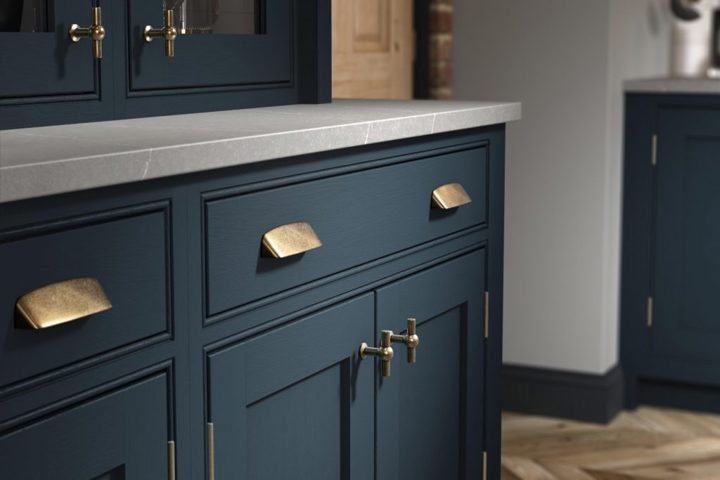
Face frame with consistent reveals. The shadow line at each opening is what gives in-frame its furniture character. Even reveals all round signal quality fitting and stable materials.
How in-frame cabinets
are built.
True in-frame cabinetry relies on a rigid front frame, stable carcasses, quality hinges, and paint systems that hold up across frame joints. The aim is a piece of fitted furniture that performs and looks right for many years without significant maintenance beyond occasional touch-in work on the painted surfaces.
Frames and carcasses. Face frames are typically made from hardwood such as ash, oak, or tulipwood. These timbers are stable, paint well, and hold hinge fixings securely under daily use. Carcasses are built from high-density MFC (melamine-faced chipboard), plywood, or veneered board depending on the maker and price tier. The joints between frame and carcass are a critical detail. A rigid connection produces consistent reveals. A loose or poorly glued joint leads to movement over time.
Hinges and runners. Inset doors use either traditional surface hinges, visible on the face of the frame and door, or concealed inset hinges that sit within mortised pockets in the frame and door. Concealed inset hinges allow three-way adjustment and soft-close action. Drawer runners on in-frame cabinets are full-extension soft-close as standard on quality systems, the same hardware used in frameless German kitchen carcasses.
Painting and finishing. Most quality in-frame makers spray frames and doors with two-part paints or hard lacquers. Two-part paints cure to a hard, durable film that resists marks and cleaning chemicals better than water-based single-component paints. Good primer selection is critical at frame joints where two pieces of timber meet under paint. A micro-crack at a joint reads as a visible line through the colour and is the most common failure point in a painted in-frame kitchen over time.
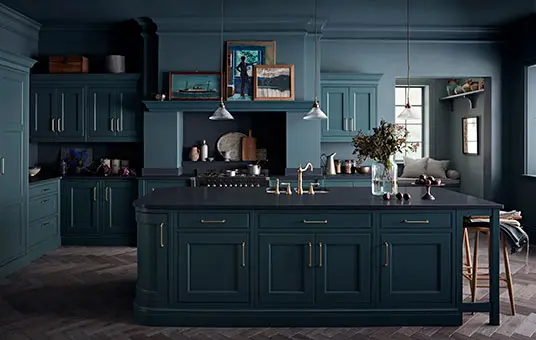
Face frame, inset hinge, and reveal detail. The quality of the frame joint and hinge setting determines how the reveals look after the kitchen has been in use for several years.
Ask before you order. Confirm whether frames sit on full carcasses or on ladder bases with separate ends. Full carcasses with framed fronts provide more robust structure and a more straightforward installation. Ask whether the face frame is hardwood or engineered timber, and which hinge system is used. The answers tell you a great deal about the quality level of the offer.
- Hardwood frames hold hinge fixings more securely than softwood alternatives
- Full carcasses with framed fronts are more robust than ladder-base constructions
- Frame-to-carcass joint quality determines long-term reveal consistency
- Three-way adjustment available on concealed inset hinges
- Traditional surface hinges are part of the design character in period-style kitchens
- Hinge adjustment keeps reveals even as the kitchen settles over its first year
- Two-part paints cure harder than water-based single-component products
- Joint priming prevents the most common long-term failure point
- Colour-matched touch-in paint should be supplied at installation
- Furniture skirting replaces standard kitchen plinths for a freestanding look
- Framed end panels finish open sides of runs and islands
- Cornices and light pelmets are proportioned to the frame weight
Door styles and materials
for in-frame kitchens.
In-frame describes the cabinet construction. The door style within the frame is a separate design decision. Most in-frame kitchens use Shaker doors because the square, recessed panel of a Shaker front suits the framed opening naturally. Other options include raised and fielded panels, plain slab inset doors, and beaded fronts for more decorative schemes.
Door material influences the look, the maintenance commitment, and how the kitchen ages over time. Real wood is the most authentic choice for in-frame construction and the most refinishable. Painted MDF is the most consistent and the most colour-accurate. Wrapped MDF is the most price-accessible but the least suited to the heat and humidity exposure common in in-frame kitchens near cookers and sinks.
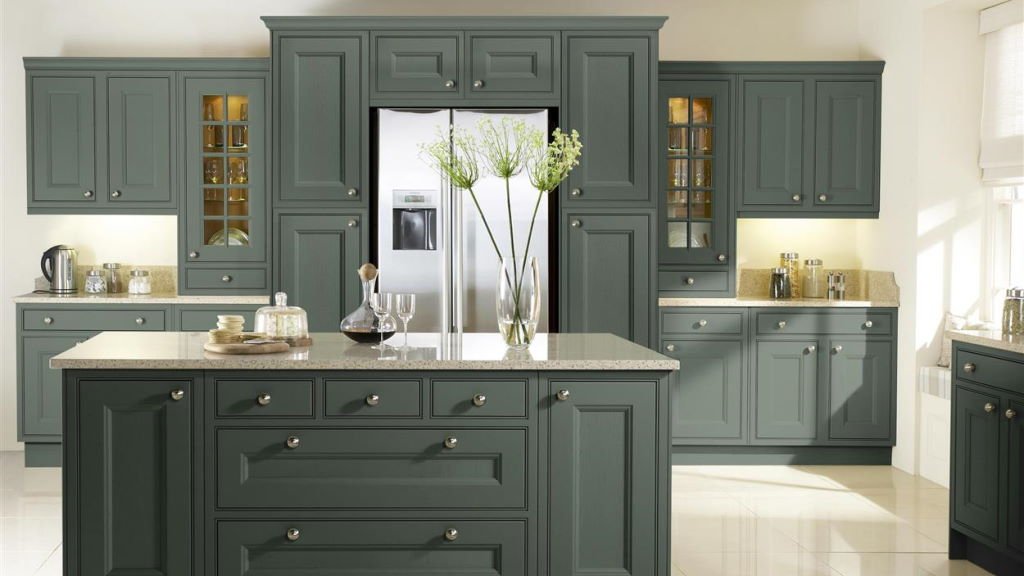
Shaker inset doors within the face frame. The frame shadow and the door panel rebate produce layered depth that a frameless Shaker kitchen does not replicate.
When reviewing door samples, confirm which elements are solid timber, which are MDF, and whether any wrapped fronts appear in high-heat or high-moisture zones. Material at the frame joint under the paint influences durability more than the door panel specification on its own.
Colour and finish.
Where in-frame character is completed.
Painted timber is the defining finish of in-frame kitchens. The colour applied to the frames and doors determines more of the kitchen's final character than almost any other single decision. In-frame holds colour differently to a flat slab or a Shaker door on a frameless carcass, because the shadow lines of the reveals and the depth of the panel rebate change how a colour reads across a room.
Deep colours work particularly well on in-frame kitchens. The shadow depth of the frame makes a rich colour look more resolved and intentional than the same shade applied to a flat slab door. Greens, navies, blacks, and deep greys all carry exceptionally well on an in-frame face. The frame detail gives the colour structure that a flat panel cannot provide on its own.
Most quality in-frame suppliers offer a wide paint programme. Standard colour ranges cover the most common UK choices. Better suppliers extend this to RAL Classic colours for precise colour matching. Some offer colour matching against Farrow and Ball and SIKKENS, which allows the kitchen colour to match joinery, walls, or furniture elsewhere in the property. This matters particularly in period homes where the kitchen is one part of a larger decorative scheme.
Two-tone in-frame kitchens, with a deeper colour on base units and a paler or contrasting colour on wall units, work very well because the frame lines on both levels give the colour transition a visual anchor. The reveals on the base run and the reveals on the wall unit run read as the same construction language even when the colours are different.
Always view a full door sample in your room. In-frame cabinets with deep colours look very different in showroom lighting versus natural daylight in a north-facing UK kitchen. Request a painted door sample in your chosen colour and live with it in the space for a week before confirming the order.
Mock in-frame.
The visual result without the access penalty.
Mock in-frame uses applied beading or planted frame strips on a standard frameless carcass to create the visual impression of in-frame construction. There is no structural face frame. The door overlays the carcass as normal. Thin timber or MDF profiles are applied around each cabinet opening to suggest the frame reveal. The shadow line is created by the applied profile rather than by the structural depth of a true frame.
The practical advantage is significant. The frameless carcass opening is not reduced. Full-width drawer boxes, wide pull-outs, and corner access all remain exactly as they would be on any frameless German kitchen. Mock in-frame gives the visual character of traditional frame construction with the storage performance of a modern system.
The visual difference between true in-frame and mock in-frame is visible at close range to an experienced eye. The reveal in mock in-frame is shallower. The shadow line is less deep. The applied beading sits on the surface of the carcass rather than forming a structural frame around the opening. From across a room, particularly in a busy open-plan kitchen, the difference is far less apparent.
Mock in-frame typically sits in price between standard frameless and full true in-frame. It is a legitimate and increasingly common choice in the mid-market, particularly where buyers want the period character of the in-frame look on a German frameless carcass system with the full range of storage solutions included.
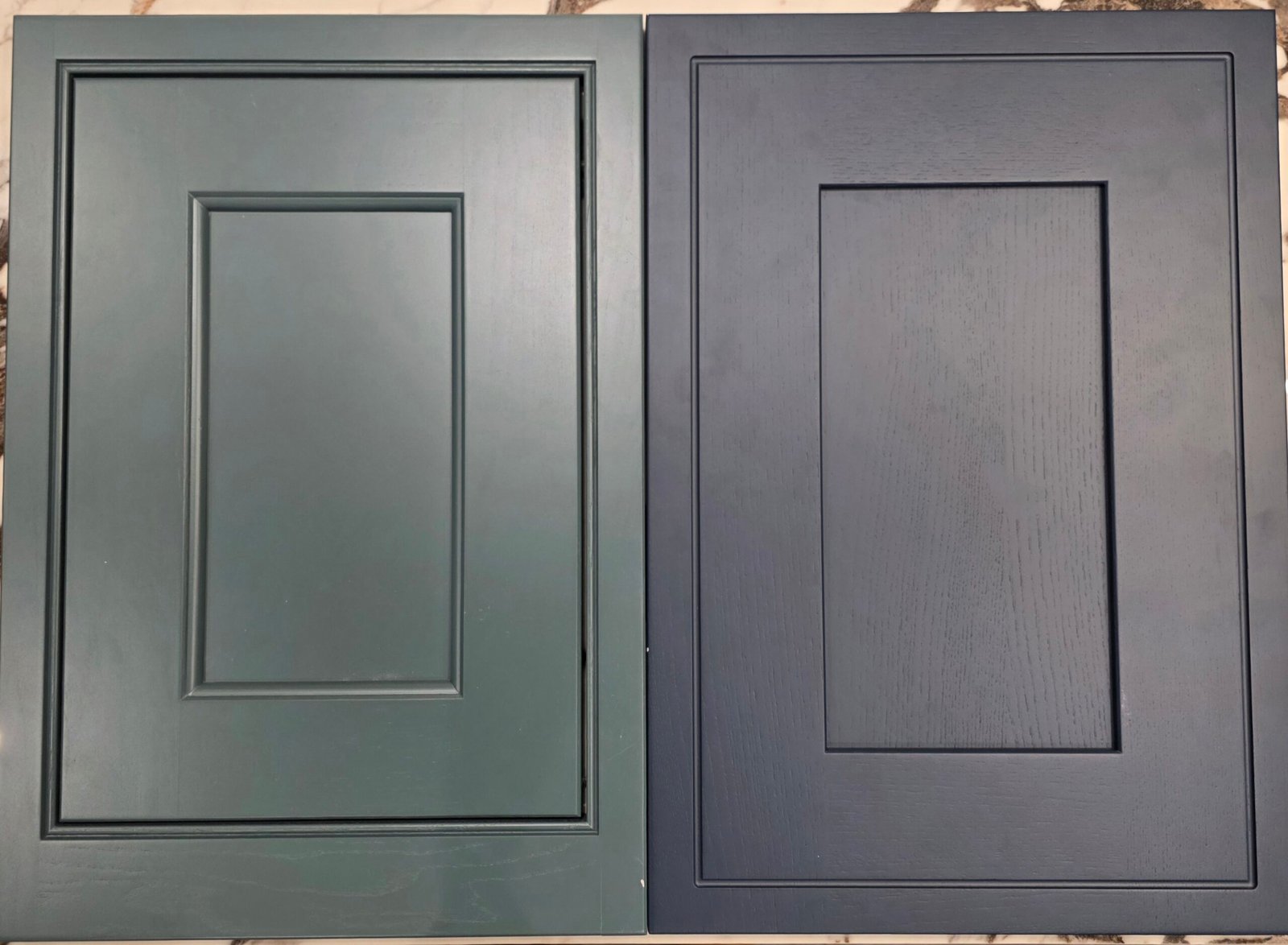
True in-frame vs mock in-frame. The structural depth of the reveal is different at close range. From across the room, the visual character is closely similar.
The question to ask every supplier. Ask explicitly whether their offer is true in-frame with a structural face frame, mock in-frame with applied beading on a frameless box, or frameless with framed-look styling. The word in-frame appears in marketing material for all three. The construction method determines how the kitchen performs, ages, and is serviced. Confirm it in writing on the specification sheet.
- The authentic craftsmanship and structural depth of a real face frame matters to you and you are prepared to accept the reduced opening width and the higher project cost.
- The property is a significant period home where the joinery quality of the kitchen needs to match the quality of the original building fabric.
- Long-term refinishing rather than replacement is a priority and you want a kitchen that will be repainted rather than replaced in twenty years.
- You want the visual character of in-frame on a German frameless carcass with the full range of storage solutions, pull-outs, and wide drawer boxes included without compromise.
- The budget falls between standard frameless and full true in-frame and mock in-frame delivers the aesthetic difference you are looking for within that constraint.
- The kitchen is in an open-plan space viewed from a distance where the shadow depth of a true frame versus applied beading is not visible in daily use.
Planning layouts
with in-frame cabinets.
Layout rules for in-frame kitchens are broadly the same as any fitted kitchen. The face frame places more emphasis on symmetry, alignment, and the relationship between unit widths than a frameless system does, because the frame lines highlight each opening individually rather than allowing doors to flow across a run without breaks.
Symmetry and run balance. Balanced unit widths help frame lines meet neatly around hobs, sinks, and tall units. An uneven run of widths, which barely registers on a frameless kitchen, reads more clearly when frames highlight each opening. At design stage, review the frontal elevation specifically for run balance and unit width relationships.
Tall units and larders. Face frames on tall housings draw attention to floor and ceiling lines. Good scribing at the top and base scribing at the bottom keeps the kitchen looking contained and intentional. Tall in-frame units also reduce the clear opening at the front slightly on each side. Confirm clear access to pull-out larder baskets and appliance doors before the order is placed.
Islands and peninsulas. In-frame islands read as freestanding furniture pieces, which is one of their strongest design qualities in open-plan spaces. Framed panels on the back and sides, furniture-style skirting, and matching cornice detail complete the island from every angle. The result is a piece of furniture in the room rather than a kitchen unit in the middle of it.
Handle alignment. Agree handle height and spacing at design stage. In-frame kitchens are less forgiving of inconsistent handle placement than frameless, because the frame lines provide a visual reference that immediately highlights anything out of alignment. Request the frontal elevation with handle positions marked before signing the order.
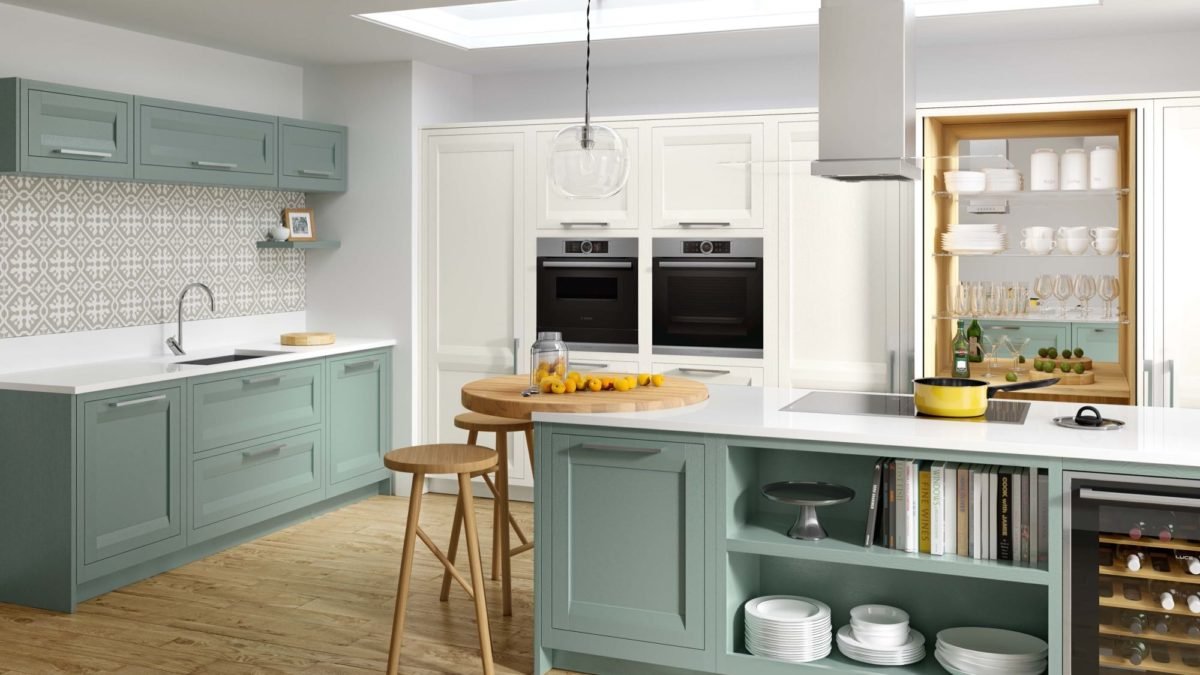
Balanced unit widths across the run. Frame lines highlight each opening. Handle alignment is consistent from one end of the layout to the other.
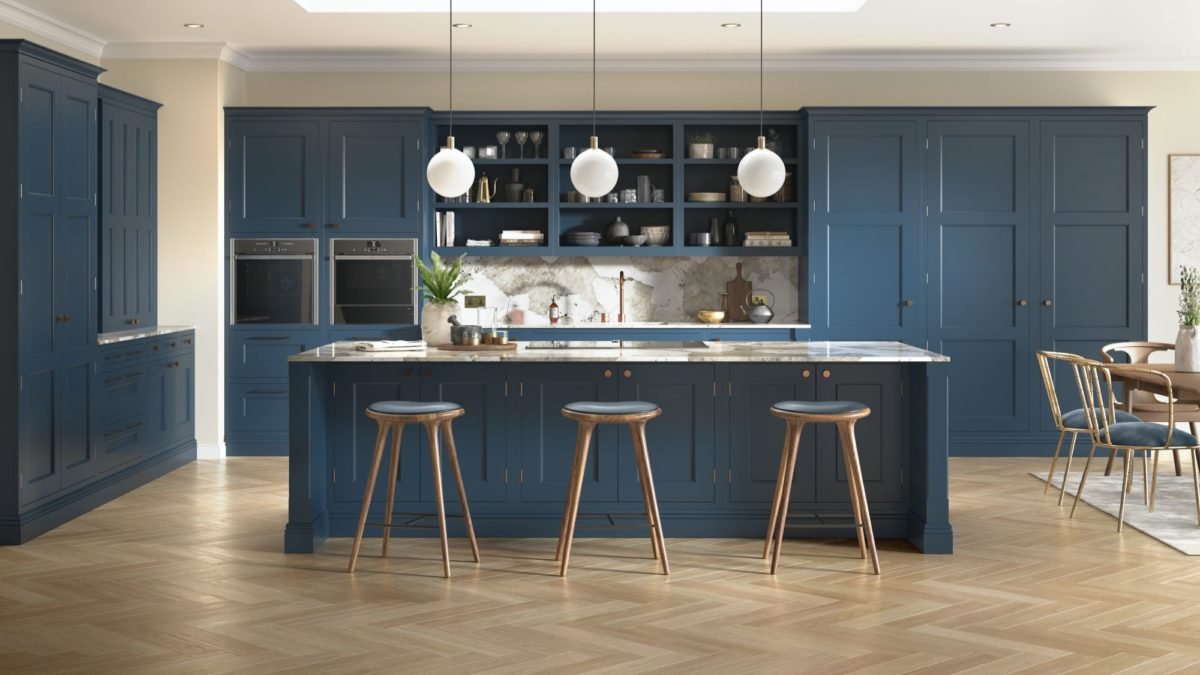
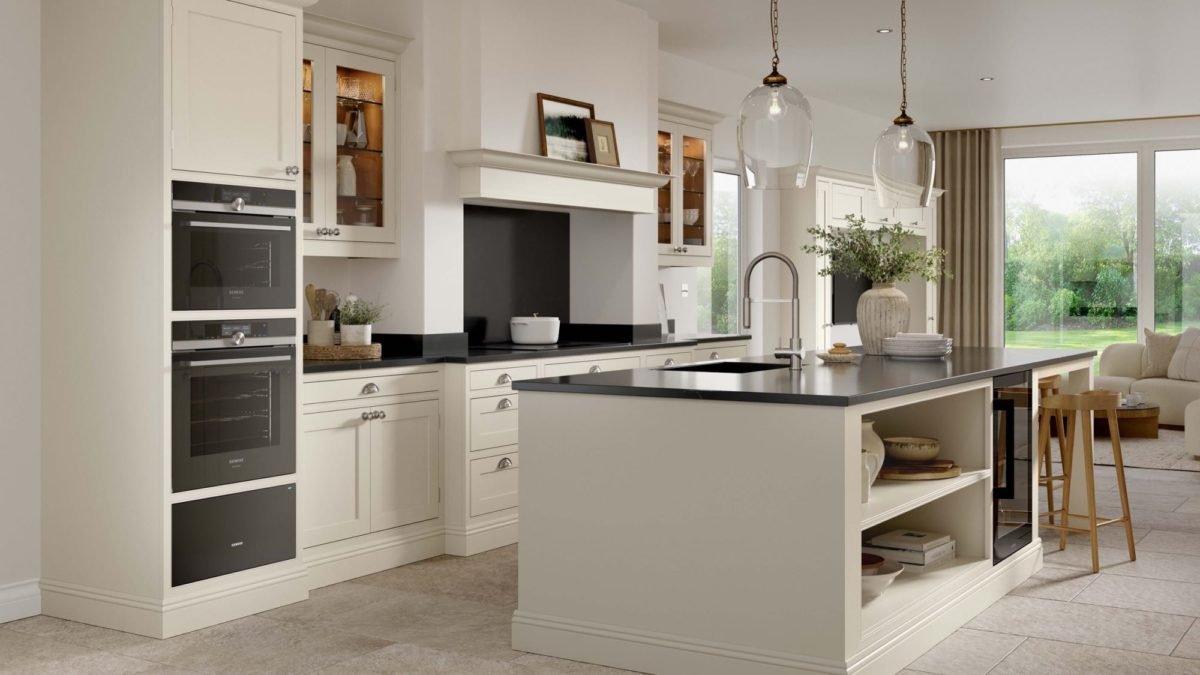
In-frame island with framed side panels and furniture skirting. The island reads as a piece of furniture, not a kitchen unit placed in the middle of the room.
Benefits and limits.
- A furniture-quality look that suits period, cottage, and character properties where the kitchen is expected to reflect the quality of the building it sits in.
- Visible craftsmanship through frames, reveals, joints, and detail work. The construction method itself communicates quality in a way that overlay doors do not.
- Strong perceived quality that supports resale appeal, particularly in the mid-to-upper end of the UK property market where buyers expect joinery-quality kitchens in character homes.
- Painted and timber fronts allow repair, repainting, and colour change over time. The kitchen is refinished rather than replaced. The joinery investment has a longer useful life than a system kitchen at a similar initial spend.
- Deep colours and heritage paint programmes carry exceptionally well on in-frame faces. The structural shadow depth makes any colour more resolved and intentional.
- Higher material and labour cost than frameless systems at an equivalent specification. The face frame, inset hinge system, and more complex painting process all add to the project cost.
- Frames reduce the clear access at the front of each cabinet opening. The effect is most pronounced on wide drawers and tall larder units where the frame projects into the opening on each side.
- More corners, edges, and joints to clean than a frameless kitchen. The reveal rebate at each opening collects dust. Frame corners near the floor collect more than flat slab fronts do.
- Painted timber near sinks, bins, and busy drawers needs occasional touch-in work. Having colour-matched paint available from the day of installation makes this straightforward rather than a problem.
- Timber doors expand and contract with seasonal humidity. Well-made in-frame kitchens with adequate reveal dimensions accommodate this movement. Poorly made ones do not, and sticking doors are the result.
In-frame vs frameless
and mock in-frame.
The comparison below covers the three main construction routes for UK kitchens. The carcass materials and hardware within each route can vary widely. The differences described are structural and visual, not about brand or price tier. Dedicated pages on this site cover Shaker doors and handled kitchens in full detail.
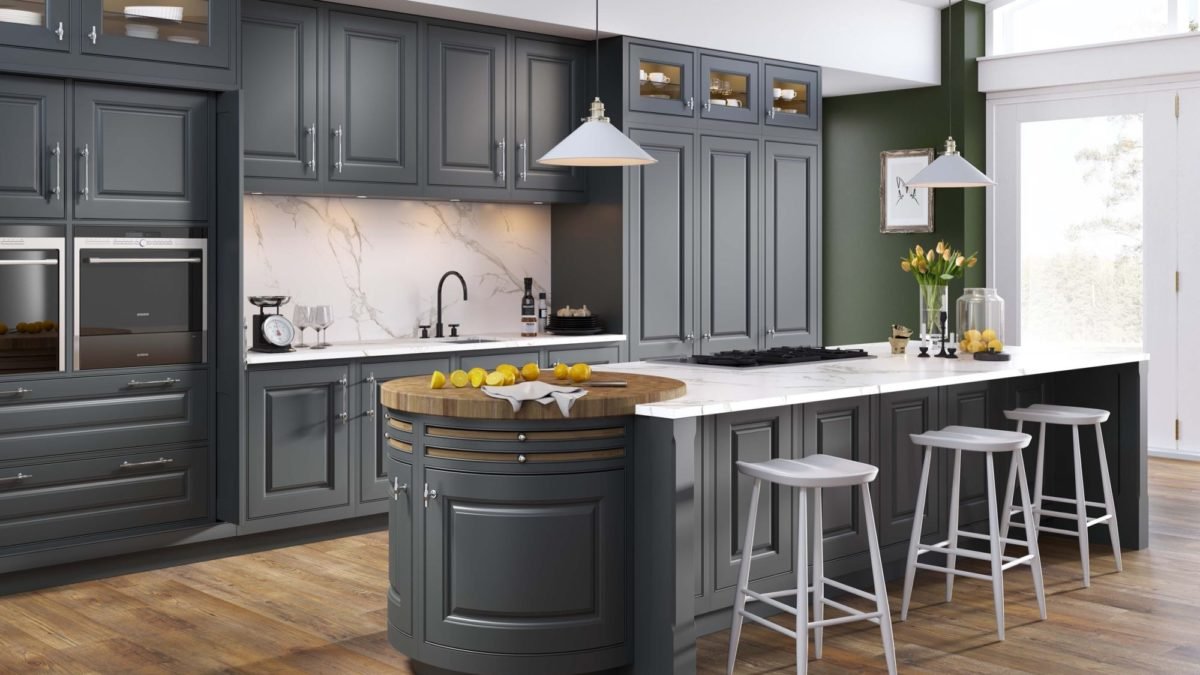
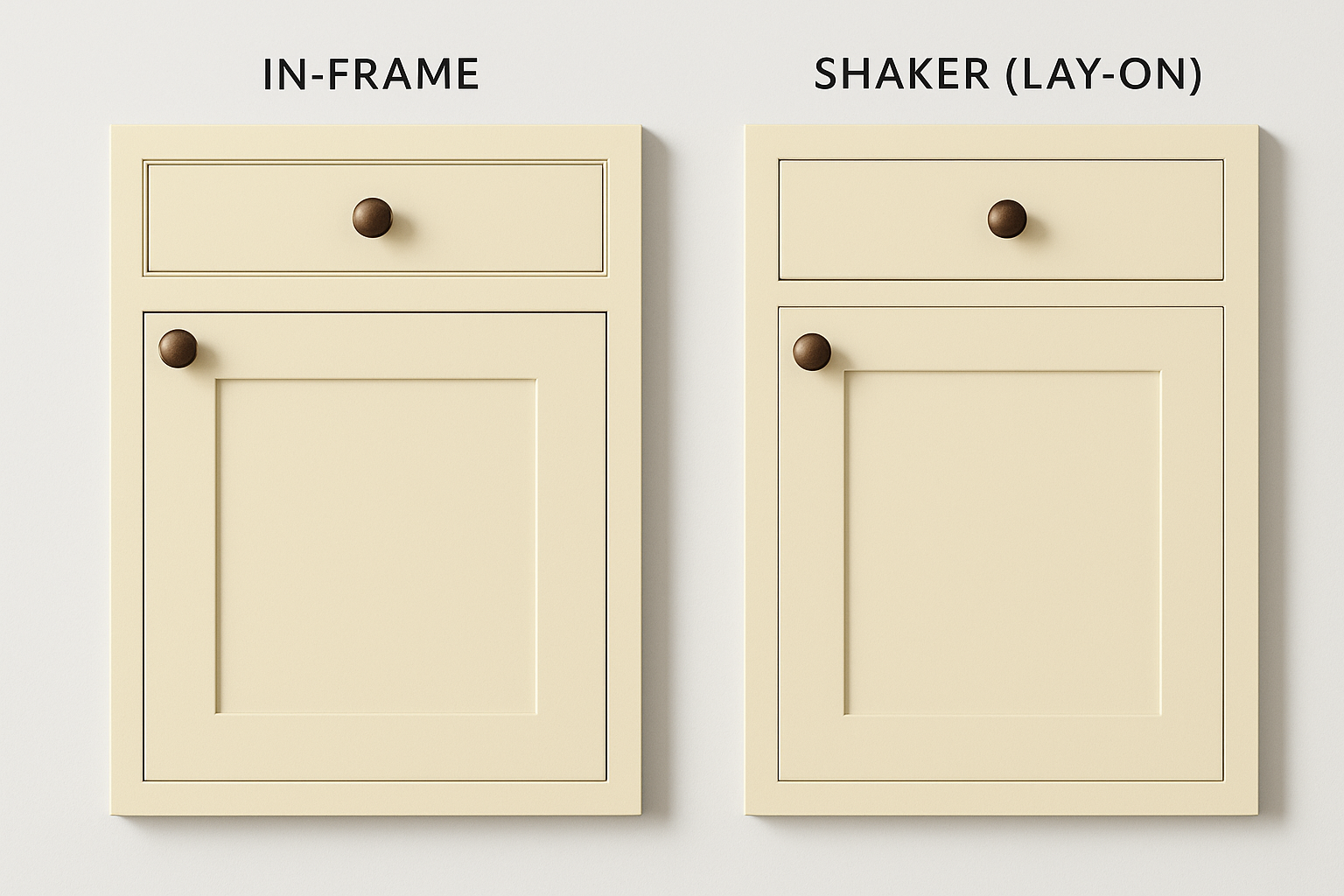
| Aspect | True in-frame | Frameless system | Mock in-frame |
|---|---|---|---|
| Cabinet structure | Structural face frame with inset doors and drawers. Frame is part of the cabinet construction. | No front frame. Doors hang off the carcass side panels and overlay the front edge. Maximum opening width. | Frameless carcass with applied beading or planted frame strips. Frame effect is visual, not structural. |
| Storage access | Frame reduces clear opening width on each side. Most noticeable on wide drawers and tall larder units. | Maximum opening width and height on every unit. Full-width drawer boxes standard. | Same access as frameless. The applied profile does not project into the opening. |
| Visual character | Deep shadow lines and structural reveals. The most furniture-quality visual of the three routes. | Clean, contemporary lines with no frame breaks. Suits slab, Shaker, and handleless doors equally. | Shadow line and reveal impression from applied profiles. Less depth than true in-frame at close range. Similar from a distance. |
| Colour programme | Full paint programme including RAL, Farrow and Ball, and SIKKENS on quality makers. Refinishable over time. | Same colour range on German systems. Wide programme including RAL and specialist palettes. | Typically follows the frameless carcass colour programme of the manufacturer. |
| Price position | Mid to premium. Higher material, fitting, and paint cost than frameless at equivalent specification. | Wide spread from entry-level to premium German systems. Lowest entry price of the three routes. | Typically between standard frameless and full in-frame. A mid-position option. |
| Best suited to | Period properties and statement kitchens where joinery character and long-term refinishing matter more than storage optimisation. | Projects focused on storage performance, ergonomics, handleless styling, and value per pound spent on cabinetry. | Homes that want in-frame character on a frameless system with full storage flexibility and a mid-position budget. |
When collecting quotes, ask each designer to label their offer explicitly as true in-frame, mock in-frame, or frameless. The term in-frame appears in marketing material for all three routes. The construction method determines how the kitchen performs, how access works, and what the long-term maintenance involves. Confirm it in writing on the specification sheet before signing.
Typical UK cost bands.
Exact figures depend on room size, specification, region, and building work required. In-frame cabinetry and fitting typically takes a larger share of the total project budget than equivalent frameless systems. When comparing quotes, ask each supplier to split the cost into cabinets, worktops, appliances, fitting, and building work. This makes it possible to identify whether an uplift comes from the in-frame joinery or from another part of the specification.
Care and maintenance.
Is an in-frame kitchen
right for you?
- You live in a period or character property and want the kitchen joinery to reflect the quality and craft of the building it sits in.
- Visible craftsmanship matters to you. Deep frame shadows, visible reveals, and the construction quality of a face-framed cabinet is part of what you are buying.
- You plan to stay in the property for many years and prefer the idea of refinishing the kitchen in fifteen years rather than replacing it. The joinery investment earns its cost over a longer service life.
- You want to use deep, considered colours from a heritage paint programme matched to the joinery and decorative scheme elsewhere in the property.
- Storage access is not the primary concern. The slightly reduced opening width at each cabinet is an acceptable trade-off for the construction quality and visual character you are buying.
- You need to maximise every centimetre of internal cabinet width. A compact footprint where full-width drawer boxes and wide pull-outs are a priority favours frameless construction.
- You prefer a very clean, contemporary, or handleless look with fewer joints, edges, and details to maintain. Frameless systems with slab or handleless doors deliver this more completely.
- You want the in-frame visual character without the access penalty or the full in-frame project cost. Mock in-frame on a frameless carcass is the practical mid-ground.
- Value per pound is the primary driver. Frameless German kitchen systems deliver more storage hardware, wider drawers, and more internal fitment options per pound spent on cabinetry than true in-frame at an equivalent price level.
Visit a showroom with both routes on display. Open tall larders, test drawers, and look closely at the reveals on the in-frame display. Then open the same units on a high-quality frameless Shaker display. The practical difference in access and the visual difference in character are both immediately clear in person in a way no guide fully conveys. Also see the Shaker kitchen guide, mock in-frame guide, and handled kitchens guide on this site before booking a design appointment.