
Why German kitchens
are built differently.
When you open a drawer in a German kitchen, the difference is immediate. The weight of the box, the deceleration in the final few centimetres of travel, the silence as it closes. These are not accidents of design. They come from the hardware specification, board thickness, joint method, and testing regime behind the product before it leaves the factory.
German kitchen manufacturers build to DIN standards. DIN is the German Institute for Standardisation, and its specifications for kitchen furniture set measurable benchmarks for heat resistance, load capacity, cycle testing, and moisture resistance. These are not self-declared quality claims. They are independently audited, and manufacturers hold third-party certification to prove compliance.
This guide explains what those standards mean in practice. It covers carcass construction, board specifications, hardware, drawer options, glass units, door colours and finishes, and the flexibility in heights and plinths German modular systems offer. No brand is promoted here. Kitchen Selections is an independent editorial resource, and all information applies to the German kitchen market as a whole, with variations noted where they differ between manufacturers and price tiers.
Carcass construction.
How the box is actually built.
The carcass is the structural box forming each cabinet. Every door, drawer front, hinge, runner, and worktop attaches to it or sits on top of it. If the carcass is weak or poorly assembled, the kitchen will not perform well regardless of how expensive the door finish is.
German kitchen carcasses are built using a glue-and-dowel method in a factory jig. Each joint uses 8x30mm hardwood dowels bonded with adhesive and held in a precision jig until cured. The result is a rigid box with no joint movement and no visible fixings on the exterior. UK flat-pack ranges typically use cam-and-dowel assembly on site, where metal cam locks hold panels together. These joints loosen over time as the metal wears against the chipboard.
Side panels are available in 8mm, 10mm, 16mm, 25mm, and 50mm. The standard carcass side panel is 16mm. Board material is chipboard or MDF with melamine resin facing on both sides.
The horizontal panels carrying load step up to 19mm. This covers construction shelves and top cross-beams. The bottom shelf carries the weight of everything stored in the cabinet. The top cross-beam holds the unit together under the pressure of the worktop and any loads placed on it.
Front edges are laminated with 1.2mm PP edging. This is an impact-resistant profile with a soft rounded finish, resisting knocks and moisture at the most vulnerable part of any panel.
Back panels range from 2.8mm to 8mm depending on the manufacturer and price tier. Entry-level German manufacturers use a 2.8mm back panel. Mid-range and upper-tier manufacturers specify 8mm. In both cases, the back panel is lacquered on both sides and screwed directly to the carcass rather than slotted into grooves. A standard UK flat-pack back panel is 2.8mm chipboard pressed into side panel slots. Under lateral load it slides free and provides almost no structural contribution to the box.
A service gap of 30mm to 40mm sits between the back panel and the wall depending on the manufacturer. This allows pipes, cables, and service runs to pass behind the units without cutting into the carcass structure and provides air circulation to prevent moisture build-up.
What to check in a showroom. Push the side of an assembled cabinet firmly. On a glue-and-dowel unit, nothing moves. On a cam-and-dowel unit, the joints flex. Ask what thickness the back panel is, confirm it is screwed rather than slotted, and ask to see a cross-section drawing showing panel thicknesses.
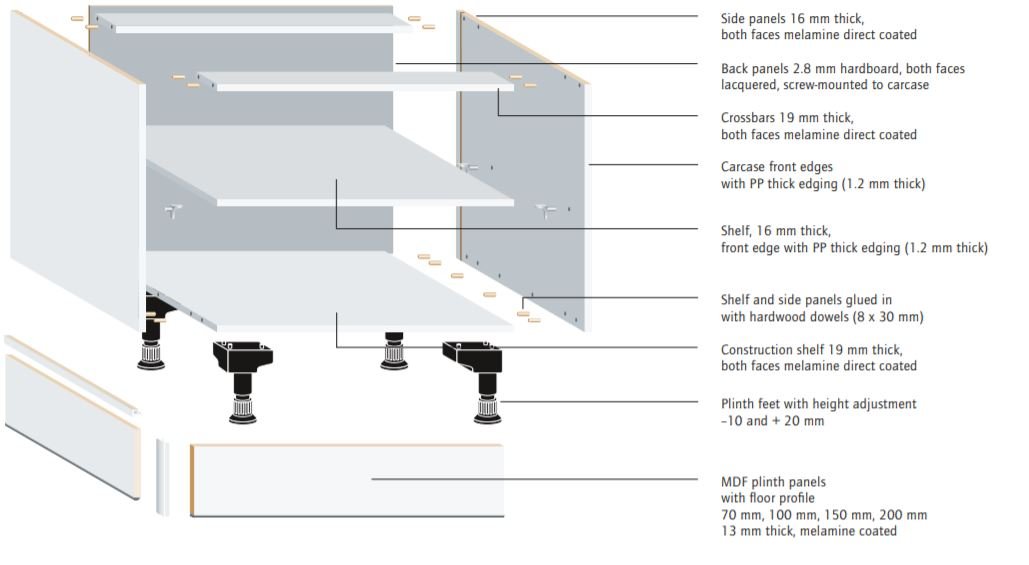
16mm side panels standard. 19mm on load-bearing horizontals. Back panel screwed, lacquered both sides.
Service gap of 30–40mm between back panel and wall. Allows pipes and cables to run behind units.
| Panel | Spec | Notes |
|---|---|---|
| Side panels | 16mm standard | Also available: 8mm, 10mm, 25mm, 50mm |
| Construction shelves | 19mm | Load-bearing horizontal surfaces |
| Top cross-beams | 19mm | Rigidity under worktop load |
| Front edge | 1.2mm PP | Impact-resistant, rounded, moisture-resistant |
| Back panel | 2.8mm–8mm, screwed | Entry-level 2.8mm. Mid/upper-tier 8mm. Lacquered both sides. |
| Service gap | 30–40mm | Air circulation, service runs, moisture prevention |
| Joint method | 8×30mm dowels + glue | No joint movement. No visible fixings. |
How German kitchens
are tested before they reach you.
German kitchen manufacturers do not describe their quality: they test it. The tests run to DIN 68930, the German Institute for Standardisation's furniture specification. Tests cover heat resistance, load capacity, moisture, chemical resistance, abrasion, UV exposure, and mechanical cycle performance. Results are independently audited for certification purposes.
The cycle test numbers tell you most about real-world durability. A drawer rated to 60,000 load cycles, opened 11 to 15 times per day, gives approximately 11 to 15 years of use. A door on a hinge rated to 80,000 cycles at the same rate exceeds 15 years. These are results from robotic test equipment in the manufacturer's own QM lab, run before any unit enters series production.
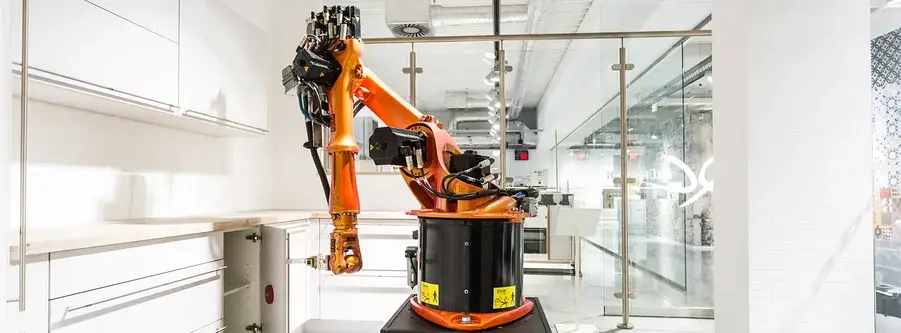
Factory QM labs use robotic equipment to simulate years of kitchen use before any unit enters production.
Climate chamber testing cycles products between high humidity, heat, dry conditions, and cold. This simulates the temperature and humidity swings a kitchen experiences over its lifetime.
Chemical resistance testing exposes surfaces to red wine, coffee, acetone, olive oil, and household cleaning agents. Each substance sits on the surface for a set period before visual inspection for discolouration or damage.
UV and sunlight simulation uses xenon arc lamps to replicate years of sun exposure on door and carcass surfaces. Checks colour and surface integrity in kitchens with significant natural light.
Abrasion and scratch testing uses a diamond tip at increasing pressure. Results verify whether the surface finish holds up to 15 years of real-world use.
Carcass heights.
260mm to 900mm. Your choice, not a default.
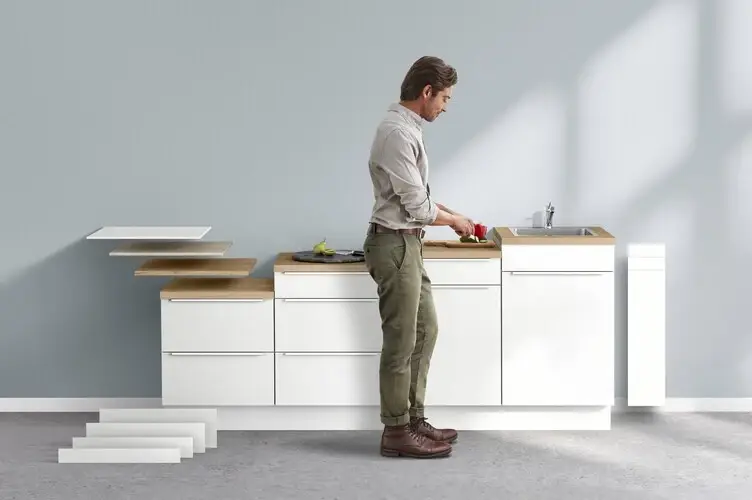
German kitchen manufacturers work to a modular grid system. Each manufacturer uses their own height increments, but the principle is consistent: cabinet heights, door fronts, drawer configurations, and appliance fascias follow defined steps so the whole layout aligns cleanly without filler strips or awkward gaps. As an example, one major manufacturer uses a 13cm grid, giving heights of 260mm, 390mm, 520mm, 650mm, 780mm, and so on up to 900mm. Other manufacturers use different increments. Every system is designed so height combinations produce clean, full-height door and drawer arrangements.
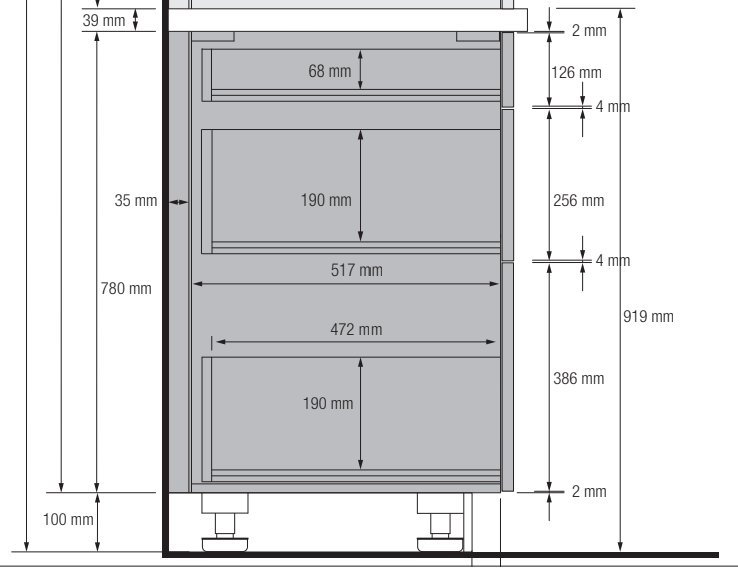
Base unit carcass heights run from 260mm to 900mm. The most widely specified combination in the UK market is a 780mm carcass with a 100mm plinth. Add a worktop and your working surface height is set by those three numbers. Laminate worktops are typically 38mm thick. Thinner engineered and stone worktops start from 20mm upward. Confirm the worktop thickness with your designer before the order is placed, as it directly affects the finished working height.
Base unit carcass depth varies by manufacturer from 555mm to 705mm. A deeper carcass gives more usable internal storage without extending the kitchen footprint. Working depth is slightly less than carcass depth once the back panel offset and service gap are accounted for.
The range of heights allows levels to be mixed across a layout without disrupting the visual alignment. A lower run for food preparation, a raised section for a taller user, a seated island at a lower height. Because heights follow the same grid across the manufacturer's range, door and drawer lines remain aligned across the room even where levels change.
On corner base units and wide sink units, integrated metal cross-beams are standard, providing structural stability across wider spans where wooden panels carry more load.
Carcass height + plinth + worktop = working surface height. Confirm all three on the section drawing.
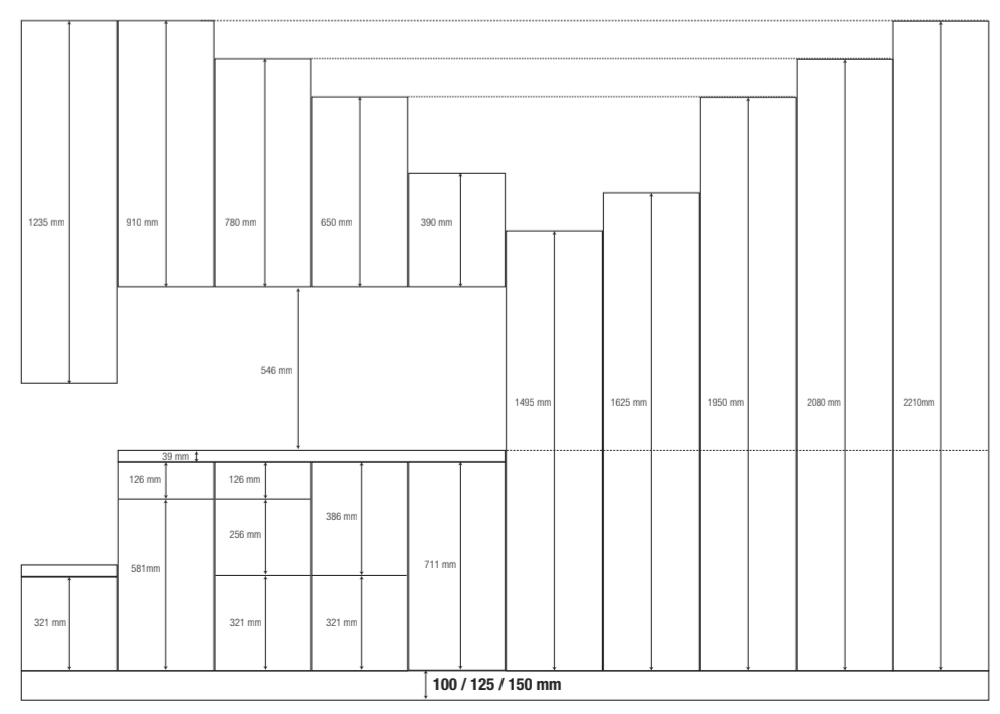
Height grids vary by manufacturer. Every system keeps door fronts and drawer lines aligned across the layout.
Calculating your working height. Carcass height + plinth height + worktop thickness = finished surface. UK standard: 780mm carcass + 100mm plinth + 38mm laminate worktop = 918mm. Confirm this on the section drawing before the order is placed. It costs nothing to adjust at planning stage.
| Specification | Range |
|---|---|
| Carcass height range | 260mm – 900mm |
| Most common UK height | 780mm |
| Carcass depth (varies) | 555mm – 705mm |
| Service gap (rear) | 30mm – 40mm |
| Laminate worktop | 38mm |
| Stone/engineered worktop | From 20mm |
Plinth heights.
20mm to 200mm. Standard is 100mm.
The plinth, or kickboard, runs along the base of floor units. It covers the adjustable levelling feet and finishes the gap between the cabinet bottom and the floor. Most UK kitchen ranges offer one standard plinth height. German systems offer a range from 20mm to 200mm, with 100mm as the standard across most UK installations.
Each plinth foot is independently fine-adjustable by ±10mm to ±20mm on site. This covers floors that are not perfectly level without shimming individual cabinets. Older UK properties with screeded floors, timber subfloors, or flagstone all present irregularities, and the plinth foot system handles them without compromising the cabinet structure. Load capacity is up to 200kg per cabinet on four feet, well above any realistic kitchen load including granite worktops.
A 20mm plinth creates a near-invisible floating base, used in handleless and contemporary layouts where the cabinet appears to hover above the floor. A 200mm plinth provides maximum clearance for service runs or heavily uneven floors. The standard 100mm suits most UK kitchens and most floor conditions.
Plinth panels are manufactured from 13mm MDF or 16mm MFC depending on the brand. MDF panels are directly coated. MFC panels carry the same melamine facing as the carcass interior. A soft PVC sealing profile attaches along the base of each panel to provide a clean join with the floor and prevent moisture ingress at floor level. Plinth corners, both external 90° and internal 135°, are formed by matching corner profiles so no raw panel edges are exposed.
Ventilation grilles in matching colour are included with appliance base units at no extra cost, allowing hot air from ovens and dishwashers to circulate freely behind the plinth.
Before you confirm the order. Ask to see a section drawing with carcass height, plinth height, and worktop thickness stacked, and the finished working surface height confirmed. Changing the plinth height after installation means removing every floor unit in the run.
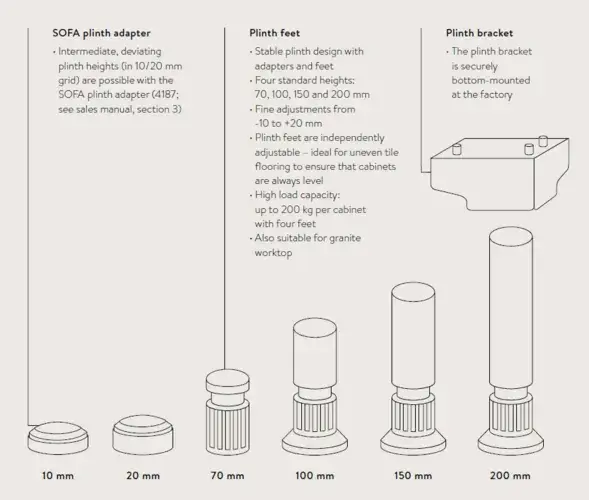 PLINTH HEIGHTS
| Height | Typical use |
|---|---|
| 20mm | Floating base aesthetic. Handleless and contemporary layouts. |
| 70mm | Low modern profile. Level floors. |
| 100mm | UK standard. Most widely specified. |
| 150mm | Uneven floors. Older UK properties. |
| 200mm | Maximum clearance. Service runs. Heavily uneven floors. |
Drawer systems.
Certified hardware. Three box finishes.
Drawers are the most used moving component in any kitchen. A household cooking daily opens drawers thousands of times per year. The runner system, box construction, and load rating determine whether those drawers close smoothly after ten years or start to catch, sag, and require effort to shut.
German kitchens specify drawer hardware from certified manufacturers. The most common systems come from Blum, Hettich, and Grass, all established hardware manufacturers with independently tested products. Soft-close damping is built into the runner architecture on all three systems, decelerating the drawer in the final few centimetres of travel. It closes under its own mechanism with no manual push required. This is standard from mid-range upward, not a premium add-on.
Load capacity is rated by carcass depth and drawer width. At standard depths, drawers carry up to 40kg. On deeper carcasses the rating increases to up to 70kg. These are continuous working loads carried over the full cycle life, not peak figures.
German kitchen drawers are available in three standard box finishes. Standard box uses a steel or aluminium frame as the drawer side. Glass-sided box uses a glass insert on the sides, allowing the contents to be seen from the front when the drawer is open. Wooden box uses a timber-veneered or solid wood panel on the drawer sides, giving a warmer, furniture-quality interior. Wooden box is typically available at additional cost on mid and upper ranges.
Internal organiser systems including cutlery trays, plate holders, and dividers are manufactured by the same hardware suppliers and sized to fit the exact drawer dimensions.
Test in the showroom. Load a pan drawer fully, then release. It should close completely under its own soft-close mechanism with no manual push. If it stops short, the damper is either wrong for the load or substandard.
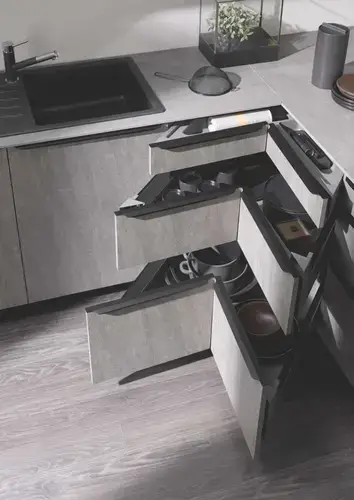
Full extension standard. Soft-close built into the runner on all certified systems.
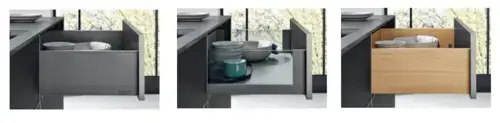
| Box type | Description |
|---|---|
| Standard box | Steel or aluminium frame sides. Standard across all ranges. |
| Glass-sided box | Glass insert on sides. Contents visible from front when open. |
| Wooden box | Timber-veneered or solid wood sides. Furniture-quality interior. Mid/upper ranges. |
Wall units.
340–350mm deep as standard.
German wall units are 340mm or 350mm deep as standard, depending on the manufacturer. Standard UK flat-pack wall units are 300mm. The additional depth means a full-size dinner plate, at approximately 270mm to 280mm in diameter, sits inside the unit without protruding. On a 300mm UK wall unit, full-size dinner plates cannot stand upright without overhanging the shelf front.
Hinges are specified from certified hardware manufacturers: Blum, Hettich, and Grass. Opening angles of 110°, 95°, and 165° cover every layout requirement. The 95° hinge is used on diagonal corner wall units to prevent the door hitting adjacent cabinets. The 165° wide-angle hinge is for cabinets with interior pull-outs where maximum clearance is needed. All hinges feature integrated soft-close and are adjustable in three dimensions on the installed cabinet.
Wall unit installation uses steel mounting rails sized to the unit width. Height and depth adjustment are available through a covered mechanism inside the unit. Anti-tip safety brackets are included as standard and confirmed automatically at order stage.
Opening systems extend beyond hinged doors. Folding doors, fold-and-lift doors, hinge-up flaps, sliding doors, roll-up fronts, and open climbers are available. Electric motor assistance is an option on flap systems for heavy wall units, allowing full-size doors to open and hold with one touch.
Wall unit shelves are 16mm, laminated with 1.2mm PP edging and mounted on metal shelf supports with anti-slip protection. Safety pins prevent the shelf from moving under load. Glass shelves are available in glass-door units.
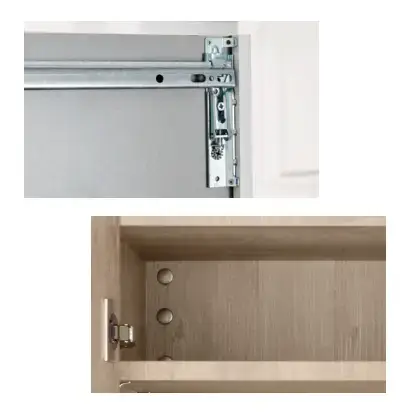
Hidden mounting rail behind back panel. Height and depth adjustable after installation through the unit interior.
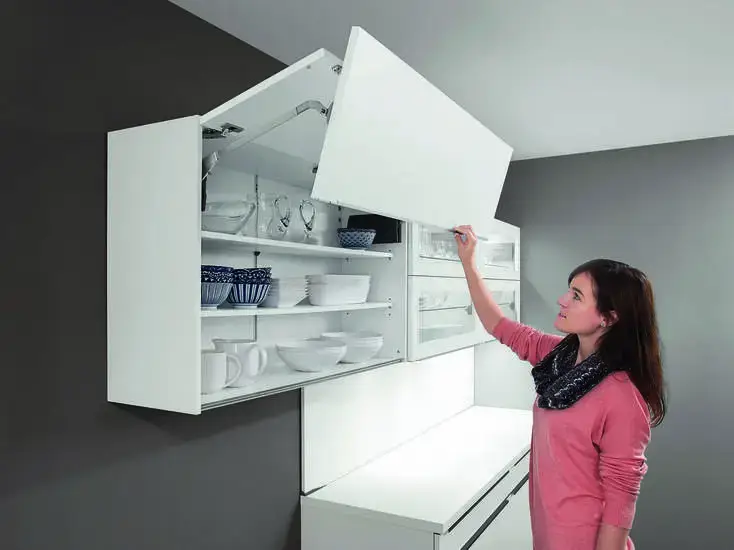
340–350mm depth vs 300mm UK flat-pack. Full-size dinner plates stand upright. No overhanging shelf front.
| Specification | Detail |
|---|---|
| Carcass depth | 340–350mm (varies by manufacturer) |
| Side panels | 16mm, melamine both sides |
| Shelves | 16mm, 1.2mm PP edging, anti-slip supports |
| Back panel | 2.8mm–8mm, lacquered both sides, screwed |
| Hinge manufacturers | Blum, Hettich, or Grass |
| Opening angles available | 95°, 110°, 165° |
| Soft-close | Built into hinge. Standard from mid-range up. |
Built-in lighting.
Factory-routed. Not retrofitted.
Integrated lighting in a German kitchen is not a retrofit. Dedicated cable channels are routed through the carcass panels at the factory stage. When the kitchen arrives on site, the wiring infrastructure is already part of the cabinet. No surface-run cables, no on-site drilling through panels, no visible conduit.
The visible difference between factory-routed and retrofitted lighting is significant. A cable routed inside a panel channel is completely invisible. A cable clipped along the inside edge of a shelf is visible regardless of how neatly it is dressed.
LED systems on German kitchens adjust colour temperature, from cool white for task lighting during food preparation to warm white for ambient evening use. Cool white in the 4000K to 6000K range maximises visibility at the worktop. Warm white in the 2700K to 3000K range changes the atmosphere of the room.
On upper-tier ranges, the lighting system connects via Wi-Fi to a smartphone app or smart home platform. Scenes are programmable, brightness is remotely adjustable, and colour temperature shifts automate by time of day. These systems must be specified at order stage and integrated into the cabinet build. They are not available as retrofits after the kitchen is installed.
Specify at order stage. Cable channels are routed at the factory. If you want integrated lighting, it must be on the order before the kitchen is built. Ask for the full lighting zone plan, colour temperature range, and whether app connectivity is available on your chosen range.
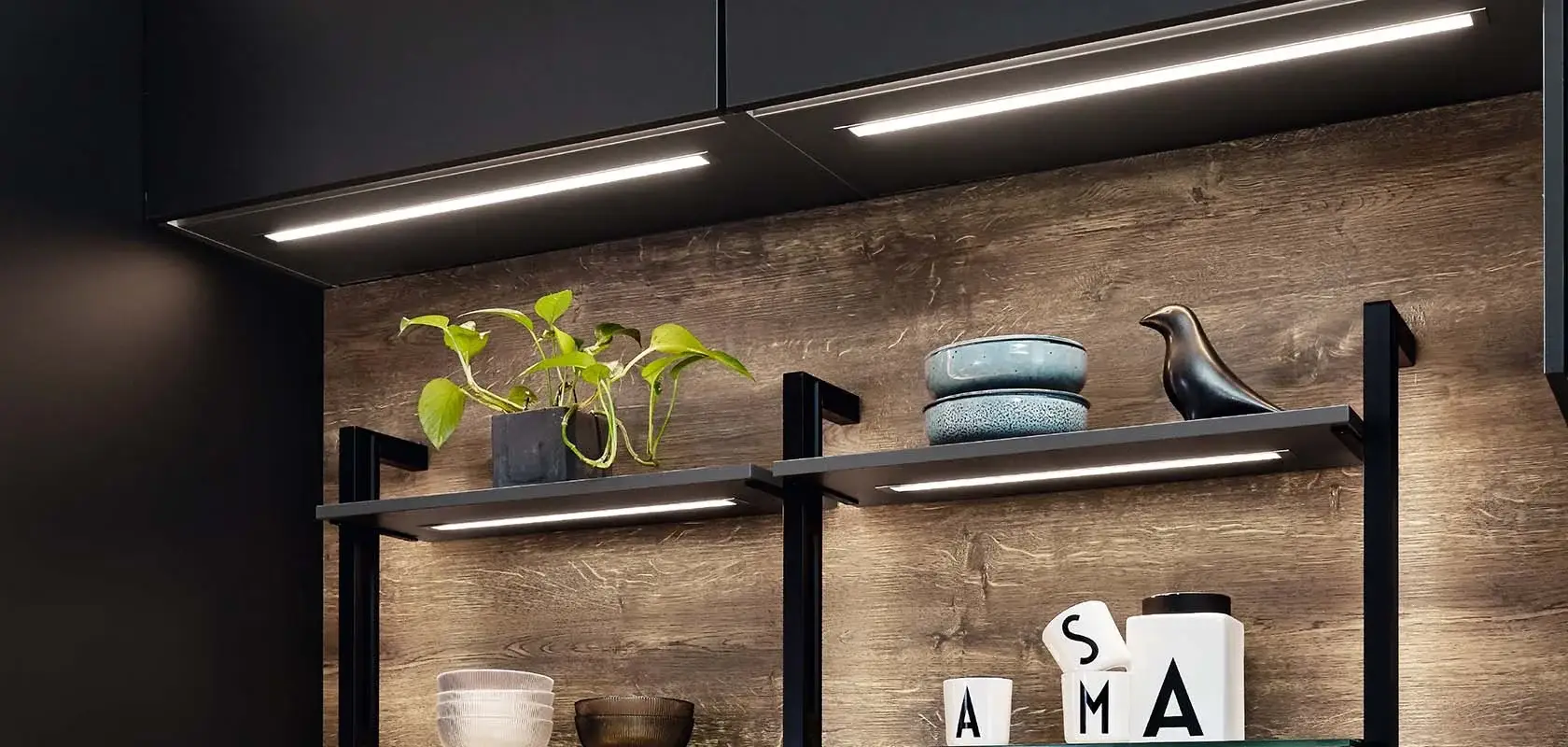
Cables routed at factory stage. No surface conduit. No on-site drilling through panels.
| Feature | Detail |
|---|---|
| Cable routing | Factory-built into carcass panels |
| Colour temperature | Adjustable, warm to cool white |
| Cool white (task) | 4000K – 6000K |
| Warm white (ambient) | 2700K – 3000K |
| Smart control | Wi-Fi and app on upper ranges |
| Retrofit available? | No. Specify at order stage. |
Doors, colours, and finishes.
More choice than any showroom will show you.
The door is the most visible element of any kitchen. German manufacturers offer a wider range of door styles, finishes, and colours than most UK showrooms display. What you see in a showroom is a fraction of what is available to order. The full range is accessed through the manufacturer's sample programme and your retailer's ordering system.
Door finishes cover matt lacquer, high-gloss lacquer, velvet lacquer, woodgrain laminate, high-pressure laminate, veneer, glass, and in-frame styles. Each finish carries its own surface characteristics, maintenance requirements, and price position. For a full breakdown of every door finish type and what to consider before specifying, see the Door Finishes guide on Kitchen Selections.
Colour choice goes well beyond the standard palette shown in a showroom. In addition to the manufacturer's own colour range, most German kitchen brands offer doors in RAL colours, giving access to over 200 standardised shades across the RAL Classic system. Selected ranges extend this to Farrow and Ball and SIKKENS colour matching, bringing in the heritage and contemporary paint palettes from those two systems. If you have a specific colour in mind that is not in the standard range, ask your retailer which custom colour programme your chosen manufacturer supports.
Two-tone layouts, where base units and wall units are specified in different colours, are a common choice in current UK kitchen design. This is straightforward to order on German kitchen systems because every colour is available across every door style in the range.
Handle options range from full-length bar handles in aluminium, steel, and brass to integrated J-pull profiles, recessed grip handles, and push-to-open mechanisms requiring no visible handle at all. Handle and door style combinations are a design decision, and the choice affects the visual weight of the kitchen as much as the colour does.
Colour advice. RAL, Farrow and Ball, and SIKKENS matching availability varies by manufacturer and range. Confirm with your retailer which custom colour programmes apply to the specific range you are specifying, and ask to see a physical door sample before the order is placed. Screen colours and brochure printing do not accurately represent lacquer finishes.
| Colour programme | Notes |
|---|---|
| Standard range | Manufacturer's own palette. Shown in showroom samples. |
| RAL Classic | 200+ standardised colours. Available on most ranges. |
| Farrow & Ball | Heritage and contemporary palette. Selected ranges and manufacturers. |
| SIKKENS | Professional colour matching system. Selected ranges. |
Glass units.
Display, light, and visual space.
Glass wall units serve a different purpose to solid-door storage. Used in the right positions, they create visual breaks in an otherwise solid run of cabinetry, allow display of tableware and glassware, and let internal lighting become visible from across the room. German kitchen ranges offer several distinct glass unit types, each suited to different layouts, zones, and design intent.
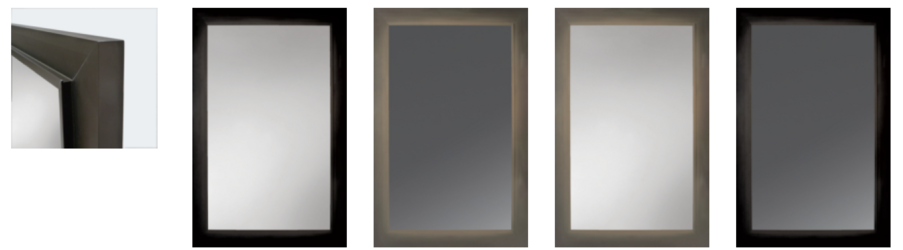
Glass units integrate directly into the carcass system. Heights and widths match the rest of the run.
Where glass units work well. A single glass-door unit on the end of a wall unit run breaks the visual weight of solid doors. Two glass units framing a window with open shelves between them creates a considered, designed-looking section without a significant cost increase. Full-height glass display cabinets work best in open-plan layouts where the kitchen meets a dining or living zone.
Practical note. Glass-fronted units require the contents to be presentable at all times. Consider whether the items you intend to store are items you want on display before specifying glass over the zone.
German kitchen vs UK flat-pack.
The same numbers, side by side.
The comparison below covers like-for-like specifications where they exist. It does not compare price points directly: a budget German kitchen and a budget UK kitchen are different products at different price levels. The comparison is between what is standard specification on a German kitchen and what is standard on a UK flat-pack range at a broadly equivalent position in the market.
| Specification | German kitchen | UK flat-pack |
|---|---|---|
| Carcass assembly | Factory glue-and-dowel in precision jig. Rigid box on delivery. | Cam-and-dowel assembled on site. Joints loosen over time. |
| Back panel | 2.8mm–8mm HDF, lacquered both sides, screwed to carcass. Entry-level 2.8mm. Mid/upper-tier 8mm. | 2.8mm chipboard, slotted and unglued. Slides free under lateral load. |
| Side panel | 16mm standard. Also: 8mm, 10mm, 25mm, 50mm. | 15–16mm on most ranges. |
| Front edge | 1.2mm PP edging, impact-resistant, soft rounded profile | 0.4–1mm ABS edging on most ranges |
| Base unit carcass depth | 555mm–705mm (varies by manufacturer) | 500mm on most ranges |
| Wall unit depth | 340–350mm. Full dinner plates fit upright. | 300mm. Full dinner plates protrude. |
| Carcass height range | 260mm to 900mm across a modular grid | Typically 1–2 standard heights. No grid system. |
| Plinth height options | 20mm to 200mm. Standard 100mm. Each foot ±10–20mm adjustable. | Typically one standard height, usually 150mm. |
| Door hinge testing | 80,000 cycles. Blum, Hettich, or Grass certified hardware. | Not independently tested or cycle-rated in most flat-pack ranges. |
| Drawer system | Blum, Hettich, or Grass. Soft-close standard. Full extension standard. Up to 40–70kg load rated. | Own-brand runners. Soft-close often an upgrade. Load rating unspecified. |
| Shelf load | 50kg/m² (base). 16kg per shelf (wall units). | Varies. Rarely published or independently tested. |
| Door colours | Standard range plus RAL, Farrow and Ball, SIKKENS on selected ranges. | Fixed palette. No custom colour programmes. |
| Integrated lighting | Factory-routed cable channels. Smart control on upper ranges. | Surface-fixed retrofit only. No factory wiring. |
| Warranty | 5 years on carcasses and hardware (manufacturer) | Typically 1–2 years |
Awards and certifications.
Independent verification, not self-promotion.
German kitchen manufacturers hold a range of third-party certifications and industry awards. These are not marketing badges. They are independently audited standards, applied for through external bodies, that verify specific claims about quality, environmental practice, and safety performance.
The certifications most relevant to a UK kitchen buyer are those covering construction quality, board material emissions, environmental chain of custody, and product safety. They provide an independent reference point beyond what a manufacturer states about its own products.
For a detailed breakdown of the certifications held by German kitchen brands and what each one covers, see the Awards and Certifications guide on Kitchen Selections.
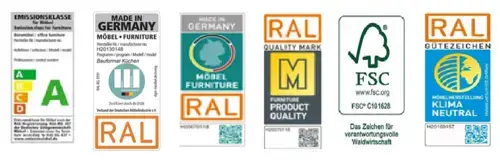
Third-party certifications independently verify quality, emissions, and environmental claims.