
Ceramic worktops.
The complete UK guide.
Ceramic worktops are sintered mineral surfaces — compressed blends of natural clays, feldspar, silica, and pigments fired at high temperature to produce a dense, low-porosity slab. The same fundamental production process creates both ceramic and porcelain worktops. The difference is refinement: porcelain uses purer kaolin-rich clays and higher firing temperatures, producing a denser material with lower water absorption and better edge strength. Ceramic is produced from a broader blend of minerals at slightly lower temperatures, delivering excellent practical performance in the kitchen at a more accessible price point.
For daily kitchen use, ceramic is one of the most capable worktop materials available. No resin binder means no heat sensitivity — hot pans from the hob do not mark the surface the way they would on quartz or solid surface. No porosity means no sealing, no staining from common kitchen liquids, and no maintenance chemicals throughout ownership. UV stability means ceramic performs equally well in bright south-facing kitchens and in outdoor-adjacent garden room applications. The practical performance gap between ceramic and porcelain in a kitchen context is smaller than the price gap suggests.
The limitation shared with porcelain is edge vulnerability. The same hardness that makes ceramic scratch-resistant makes the material brittle at thin exposed corners. Dropped cast iron onto a sharp edge is the most common damage cause. Chamfered or rounded edge profiles reduce this risk.
Ceramic vs porcelain vs sintered stone. All porcelain is ceramic. Not all ceramic is porcelain. Sintered stone is an umbrella term covering ultra-compact mineral surfaces including porcelain and high-pressure alternatives. For worktop specification purposes, the key questions are density, water absorption, and slab format — confirmed from the product technical data sheet rather than from the marketing category name.
What is ceramic.
Production and material properties.
Ceramic worktops are produced by blending natural clays, feldspar, silica quartz, and mineral pigments, pressing the mixture under high pressure into large-format slabs, and firing them in a kiln at high temperatures. The heat causes the clay minerals to vitrify — to fuse into a dense, semi-crystalline matrix with significantly reduced porosity and high surface hardness. The result is a slab with no organic or resin content, good stain resistance, and excellent heat performance.
Porcelain is produced by the same fundamental process but uses more refined kaolin-rich clays, higher compaction pressures, and higher firing temperatures. This produces a denser, harder material with lower water absorption (below 0.5% for porcelain, compared to 0.5–3% for ceramic) and better edge resistance. For most kitchen worktop applications, the practical difference in daily use between a good quality ceramic and an entry porcelain is modest. The price difference between the two categories is more significant.
Ceramic worktops are available in two structural configurations: solid-body slabs (similar to porcelain) and sandwich construction (see Section Two). Standard solid ceramic slabs are most common in the UK market at 12mm and 20mm thicknesses. Thicker edge appearances are achieved through build-up lamination or mitring, exactly as with porcelain.
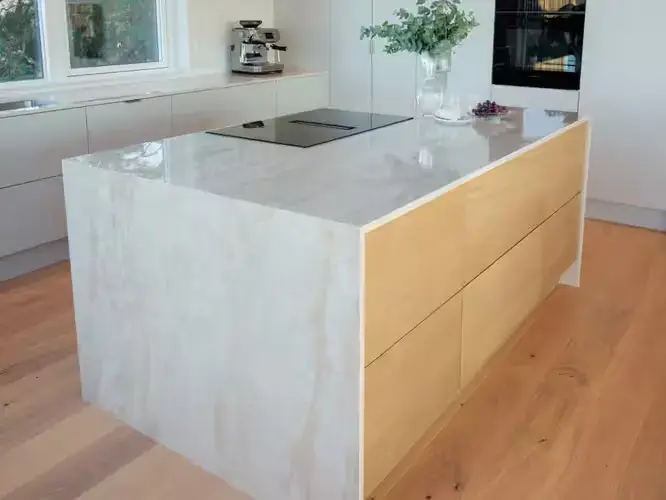
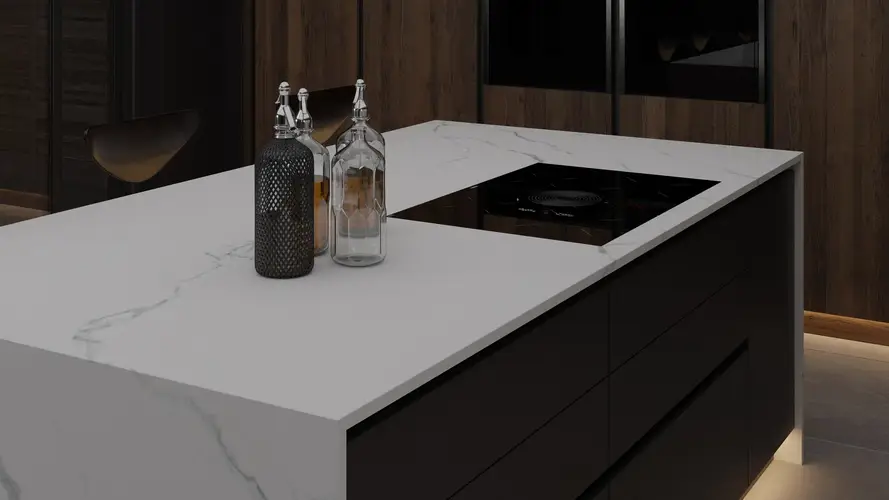
Ceramic worktop in a contemporary kitchen. The surface pattern and aesthetic quality are comparable to porcelain at the equivalent price point. The material difference — slightly higher absorption, slightly lower hardness — rarely presents itself in normal kitchen use.
Ceramic vs porcelain in the showroom. The two materials can look identical on a showroom slab. Confirm which material you are specifying from the product technical data sheet, not from the product name or marketing description. The water absorption figure (EN ISO 10545-3) and breaking strength figure are the most reliable technical differentiators. Ask your supplier for these before ordering.
Sandwich structure.
Ceramic on recycled PET backing.
Certain manufacturers produce ceramic worktops in an innovative sandwich configuration. Rather than a solid ceramic slab throughout, these products bond a layer of solid ceramic material to a lightweight backing layer, creating a composite slab that delivers ceramic surface performance at significantly lower overall weight.
A common specification is a total worktop thickness of 16mm comprising 6mm of solid ceramic material on a 10mm lightweight backing layer of recycled PET (polyethylene terephthalate). The ceramic surface layer provides all the performance properties — heat resistance, stain resistance, scratch resistance, UV stability — while the PET backing layer provides structural support and dramatically reduces the weight of the finished slab.
The weight reduction is practically significant. A solid 20mm ceramic or porcelain slab can weigh 45–55kg per square metre. A 16mm sandwich slab typically weighs 20–25kg per square metre — roughly half. This makes the material easier and faster to install, reduces the structural loading on kitchen cabinets, and makes handling on site safer for installers.
The recycled PET backing is also an environmental consideration. The backing layer diverts recycled plastic bottles from landfill — each square metre of worktop uses a meaningful quantity of post-consumer recycled material.
Confirm cut-out handling with your fabricator. On sandwich construction slabs, cut-outs for sinks and hobs expose the backing layer at the cut edge. Most fabricators apply a finishing treatment or bonding strip to the exposed backing edge for a clean appearance. Confirm the standard of cut-out finishing before ordering, particularly if the underside of the worktop near the sink position is visible.
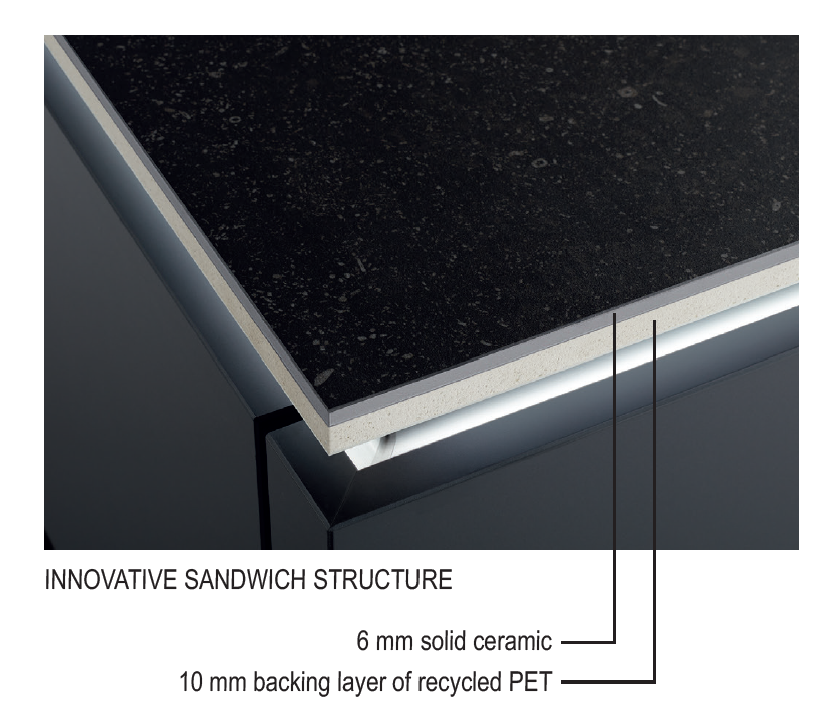
The ceramic sandwich construction. 6mm of solid ceramic provides the full surface performance of a ceramic worktop. The 10mm recycled PET backing provides structural support at half the weight of a solid slab. Total thickness: 16mm. This construction makes the material notably easier to handle and install compared with solid 20mm ceramic or porcelain slabs.
Design possibilities.
Ceramic worktops are available across a strong design range including marble-effect whites and creams, concrete greys, stone textures, and plain colours. Modern digital printing technology applied to ceramic surfaces produces realistic marble veining, granite movement, and concrete textures comparable in visual quality to lower-tier porcelain products. Finish options include polished, satin, honed, and textured surfaces. Matte and textured finishes are more forgiving in daily use — fine marks and fingerprints are less visible than on polished surfaces.
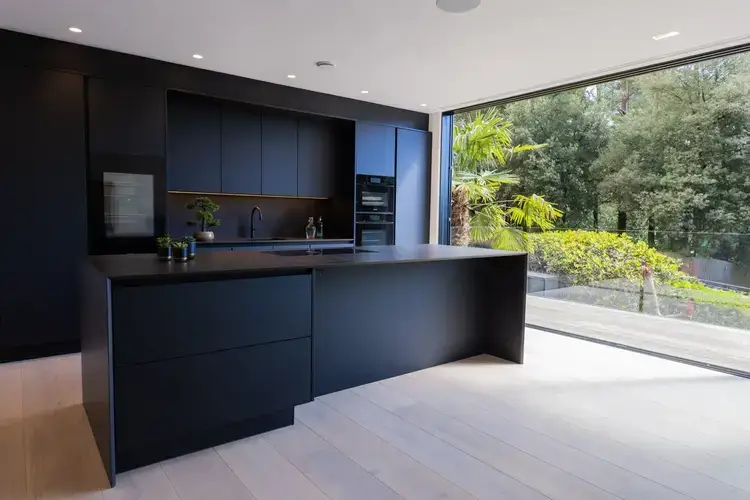
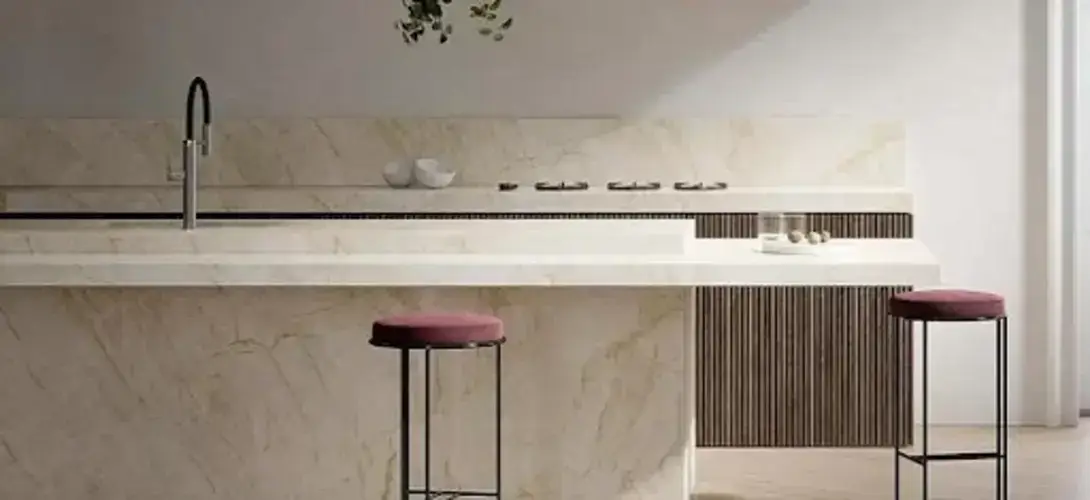
Ceramic design range: stone texture (left), contemporary honed surface (centre), Classic Calacatta marble-effect (right). The marble-effect and stone-effect ranges perform significantly better in daily use than the natural materials they replicate — no etching, no sealing, no staining from acid contact.
Thickness options.
Ceramic worktops are available in the same principal thicknesses as porcelain — 12mm and 20mm solid slabs are most common in the UK market, with thicker edge appearances achieved through build-up lamination or mitring on a standard-thickness base slab. The sandwich construction (Section Two) adds a 16mm composite option that sits between 12mm and 20mm in terms of structural behaviour and weight profile.
20mm is the most common UK kitchen specification for solid ceramic and provides good self-supporting rigidity across standard cabinet spans. 12mm slabs suit contemporary minimal designs but require careful substrate support planning, particularly around cut-outs and long unsupported overhangs. The 16mm sandwich slab suits the same applications as 20mm with the benefit of significantly lower weight.
| Thickness | Construction | Best for |
|---|---|---|
| 12mm solid | Full-depth solid ceramic. Slim, contemporary profile. Requires backing substrate at cut-outs and long overhangs. | Minimal contemporary kitchens. Furniture-style islands. |
| 16mm sandwich | 6mm ceramic on 10mm recycled PET backing. Lightweight — approx. half the weight of a solid 20mm slab. Good rigidity. | Standard worktop applications. Easier installation. Lower cabinet loading. |
| 20mm solid | Full-depth solid ceramic. Self-supporting across standard spans. Classic material presence. | Standard kitchen worktops, islands, peninsulas. Most common UK choice. |
| Mitred / built-up | 12mm or 20mm base slab with laminated front edge strip. Achieves 30mm, 40mm, or deeper front face profile. | Kitchens requiring visual edge weight without solid thick-slab cost and weight. |
Edge build-up in ceramic. Like porcelain, ceramic supports both lamination (horizontal strip bonded to the underside of the front edge) and mitring (two pieces joined at 45 degrees) for thicker front-face profiles. Mitring costs more but produces a cleaner front face with no visible horizontal join line. Both approaches are standard fabrication techniques in the UK ceramic worktop market.
Edge profiles. Ceramic hardness restricts decorative edge machining more than quartz does. Most UK ceramic installations use simple square, eased, chamfer, or arris profiles. Some fabricators offer pencil round profiles. Ornate profiles such as ogee or full bullnose require specialist equipment and carry a meaningful cost premium in ceramic compared with quartz.
Drainer grooves and recess drainers. Both are achievable in ceramic using CNC machining. On slabs below 20mm, drainer groove depth is limited by the available material thickness — particularly relevant for the 16mm sandwich slab where the 10mm backing layer below the 6mm ceramic face constrains groove depth. Confirm drainer feature specifications with your fabricator for the exact product and thickness you are specifying.
Key features.
Advantages and limits.
- Excellent heat resistance with no resin binder. Hot pans from the hob do not damage the surface. Better heat performance than quartz, comparable to porcelain and granite.
- No sealing required at any stage. Low-porosity surface resists staining without any maintenance chemicals throughout the life of the kitchen.
- UV stable. Colour-fast in bright, south-facing rooms. Suitable for garden room applications where quartz and solid surface degrade from UV exposure.
- 20–30% lower price than equivalent porcelain. Strong practical performance for less cost — the correct choice when porcelain specification is not justified by budget.
- Available in sandwich construction (6mm ceramic on recycled PET backing) that is approximately half the weight of a solid 20mm slab. Easier installation and lower cabinet loading.
- Wide design range including marble-effect, concrete, and stone textures. Suitable for contemporary, handleless, and transitional kitchen designs.
- No maintenance chemicals, no periodic professional treatment, no sealing schedule. Warm water and mild detergent for the life of the kitchen.
- Edge chip risk at corners and thin exposed sections. The hardness that resists scratching makes ceramic brittle at edges under impact. Dropped heavy cookware onto a corner is the most common damage cause.
- Higher absorption than porcelain (0.5–3% vs under 0.5%). Marginally more susceptible to staining from very aggressive or prolonged spills. Rarely presents in normal kitchen use but worth noting for particularly challenging applications.
- Limited edge profile options. Ceramic hardness restricts complex edge machining. Ornate profiles require specialist equipment. Simple square, chamfer, and arris edges are standard.
- Specialist installation required. All cutting, drilling, and shaping needs diamond tooling and experienced operators. Not adaptable with standard tools after installation.
- Chip repairs are difficult and rarely invisible. Unlike solid surface (which re-polishes to near-original), ceramic chip damage typically requires section replacement or colour-matched filler that shows on close inspection.
- Quality varies more than porcelain at the budget end. Entry-level ceramic from less established sources can show variation in density, pattern consistency, and edge finish. Confirm the technical specification before ordering.
Ceramic vs
other worktop materials.
The most important comparison for most buyers is ceramic vs porcelain — two similar materials at different price points. Beyond that, ceramic competes with quartz (at comparable price points) and is clearly superior to laminate for demanding kitchen applications.
| Aspect | Ceramic | Porcelain | Quartz | Granite | Laminate |
|---|---|---|---|---|---|
| UK price guide | £200–£500+ per m² | £250–£700+ per m² | £300–£600+ per m² | £150–£600+ per m² | £50–£150 per m² |
| Heat resistance | Excellent. No resin. Hot pans tolerated on flat surface. Avoid thermal shock near cold water. | Excellent. No resin. Slightly more thermally stable than ceramic. | Moderate. Resin binder marks permanently under hot pans. Trivets essential. | Good. Stone tolerates heat but sealant degrades. Thermal shock risk. | Poor. Blisters and marks from any direct heat contact. |
| Scratch resistance | Good (6–7 Mohs). Everyday contact does not mark. Slightly lower than porcelain. | Excellent (7–8 Mohs). Among the hardest slab surfaces available. | Good. Engineered surface resists everyday use. | Very good (6–7 Mohs). | Moderate. Surface layer wears over time. Not renewable. |
| Porosity and sealing | Low (0.5–3%). No sealing required. Practical stain resistance good for normal use. | Near-zero (under 0.5%). The most stain-resistant slab surface available. No sealing. | Very low. No sealing. Good stain resistance. | Porous. Sealing every 1–3 years required. | Good stain resistance on intact surface. No sealing. |
| UV stability | Excellent. Suitable near large glazing. No organic content to degrade. | Excellent. Outdoor suitable. No organic content. | Moderate. Resin binders yellow under UV. Not outdoor-recommended. | Good. Natural stone stable under UV. | Moderate. Fades and lifts with prolonged moisture and UV exposure. |
| Price vs porcelain | 20–30% lower. Practical performance gap in normal kitchen use is modest. | Full price. Justified for demanding applications or maximum specification. | Comparable or slightly higher than ceramic. Lower heat performance. | Variable. Budget granite can undercut ceramic. Premium granite exceeds it. | Significantly lower. Lowest cost option. Lowest performance ceiling. |
| Edge profiles | Limited. Square, chamfer, arris. No ornate profiles without premium cost. | Limited. Same restrictions as ceramic. | Wide. Most decorative profiles achievable. Advantage over ceramic and porcelain. | Very wide. Stone machines well for decorative profiles. | Limited to straight profiles in most installations. |
Maintenance and care.
Ceramic maintenance is as simple as any worktop material. No sealing, no oiling, no specialist cleaning products, no periodic professional treatment. The low-porosity surface resists absorption of common kitchen liquids and cleans easily with standard household products. The key daily habits are wiping spills before they dry and protecting the surface from thermal shock near the sink.
No sealing, ever. Unlike granite (requiring sealing every 1–3 years), marble (every 3–12 months), or travertine (every 6–12 months), ceramic requires no periodic sealing throughout its life. The low-porosity surface maintains its stain resistance without any maintenance treatment. This is one of ceramic's most practical daily advantages over natural stone in the kitchen.
Sandwich construction and cleaning. The 16mm sandwich slab (6mm ceramic on recycled PET backing) has the same surface maintenance requirements as solid ceramic — the ceramic surface layer behaves identically in daily use. Confirm with your fabricator whether the exposed backing at any cut-out edges has been treated, and clean those areas with care to avoid moisture infiltrating the PET layer over time.
UK cost guide.
Ceramic worktop pricing sits 20–30% below equivalent porcelain for comparable design and thickness. This makes ceramic the most cost-effective sintered mineral surface in the UK market. Budget end ceramic overlaps with mid-range laminate on supply cost but delivers significantly better performance. Premium ceramic with complex patterns and larger slab formats overlaps with entry-level porcelain pricing.
What affects the final price. Sink and hob cut-outs are typically £50–£150 each. Build-up edges and mitred profiles add per linear metre. Drainer grooves add to the sink cut-out price. Book-matched designs require 15–30% additional material. Prices typically exclude VAT. At the premium ceramic price point, always compare like-for-like with porcelain specifications — the performance and price difference narrows significantly at the top of the ceramic range.
Who ceramic suits.
- You want sintered-surface heat and stain performance without the premium price of porcelain. The practical performance gap between ceramic and porcelain in normal kitchen use is modest. The price gap is meaningful.
- You want minimal maintenance — no sealing, no specialist products, warm water and mild detergent for the life of the kitchen. Ceramic requires no periodic professional treatment.
- You want a lighter-weight worktop. The 16mm sandwich construction is approximately half the weight of a solid 20mm slab — an advantage for installation ease and cabinet loading.
- Your kitchen gets strong natural light or opens to the garden. UV stability gives ceramic an advantage over quartz and resin-bound surfaces in bright rooms.
- You want marble-effect or stone-effect aesthetics without the etching and sealing commitments of natural marble or granite. Ceramic delivers the look with none of the natural stone maintenance.
- Maximum surface hardness and the lowest possible water absorption are the priority. Porcelain is harder, denser, and more resistant at the expense of a 20–30% price premium. Justified for demanding applications.
- You want ornate decorative edge profiles — ogee, full bullnose, classical moulding. Quartz machines to a wider range of profiles than ceramic and porcelain. Granite offers an even wider edge option set.
- Surface repairability is important. Ceramic chips are not invisibly repairable. Solid surface is the only worktop material that sands and re-polishes to near-original condition after surface damage.
- Your budget is below £200 per square metre for supply and installation combined. Laminate is the correct alternative at the lower end of the budget range.
- You want seamless invisible joins, thermoformed curves, or an integrated sink without a silicone joint at the rim. Solid surface is the only material that achieves these — ceramic cannot.
Frequently asked questions.
See the Worktops hub to compare ceramic with porcelain, quartz, granite, and other materials. The Porcelain guide covers the premium sintered surface alternative for buyers who want the maximum specification at a higher price point.