
Compact ovens.
The complete UK guide.
A compact oven fits a 45cm appliance niche — compared with the 60cm niche used by a full-size single oven. This size difference is the starting point for everything that follows. It means you stack a compact oven in a tall housing at eye level, combine it with a warming drawer or microwave below, or pair two compact units to create a flexible cooking tower without the footprint of a double oven. The cavity is smaller, but the height of the appliance opening to your kitchen is more useful.
Compact ovens are available in three functional types: a standard compact oven with the same core functions as a full-size model (fan cooking, conventional heat, grill, defrost); a compact combination oven that adds microwave heating in one built-in unit; and a compact combination steam oven that adds steam injection for moist cooking and improved reheating. The right type depends entirely on how you cook, not on which type looks most impressive in a showroom.
This guide covers everything needed to specify a compact oven correctly: niche sizes, internal capacity, fan cooking terminology, installation requirements, cleaning options, and the specific checks that prevent the most common fitting mistakes. All content is written without reference to specific brands — the questions and specifications covered here apply equally across all manufacturers offering compact ovens in the UK market.
What is a compact oven.
Size, niche, and why it matters.
A compact oven is defined by its niche height: 45cm rather than the 60cm used by a full-size single oven. This 15cm difference creates a specific installation logic. A compact oven fits into a tall appliance housing where multiple built-in units stack vertically — an oven at eye level above a warming drawer, a microwave unit at eye level beside a full-size oven below, or two compact ovens one above the other for independent temperature cooking without the single-column double oven format.
The eye-level position is the defining practical advantage. You open the door, check food, and lift hot dishes at working height rather than bending to floor level. For tall housings in contemporary handleless German kitchen designs, the compact oven is the standard upper appliance in an appliance tower. The full-size oven goes below; the compact oven or warming drawer goes above at eye level.
The cavity inside a compact oven is smaller than a full-size oven — typically 35–50 litres versus 65–80 litres in a full-size model. This is the trade. Eye-level convenience and tower flexibility at the cost of usable cooking space. For couples and smaller households, the compact cavity is sufficient for most cooking. For households that regularly cook large roasts, batch bake across multiple shelves, or use extra-wide roasting tins, the compact cavity requires checking against specific measurements before purchase.
Compact oven vs combination oven. Retailers and manufacturers sometimes use the term "combination oven" to describe compact models that include microwave or steam functions. A standard compact oven has conventional oven functions in a 45cm niche only — no microwave, no steam. If a compact oven is described as a combi, confirm exactly which combination is included (microwave or steam) before ordering.
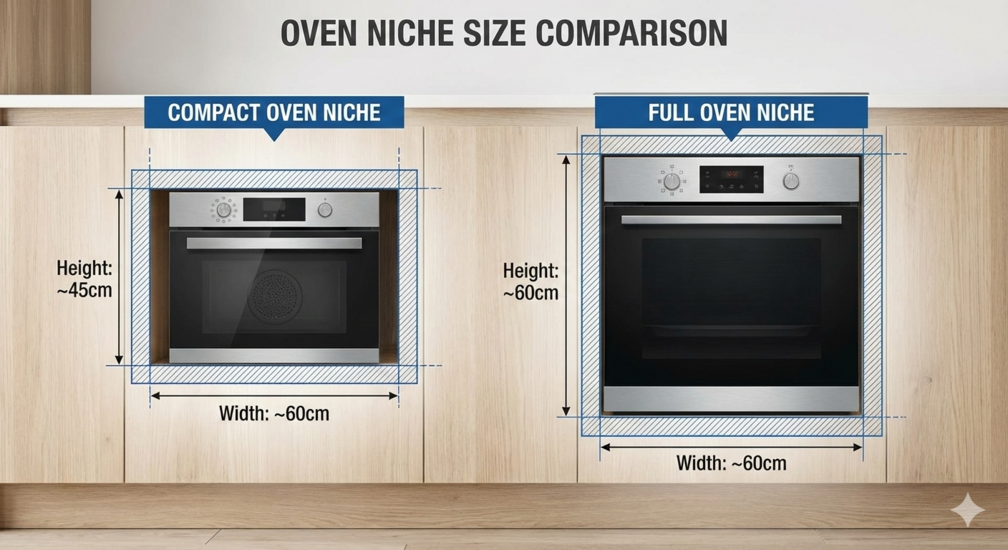
Compact oven niche diagram. The 45cm niche (upper position) versus the 60cm niche (lower or full-height position). In an appliance tower, the compact oven typically occupies the upper niche at eye level. A warming drawer, second compact oven, or coffee machine occupies the 45cm niche below.
Types of compact ovens.
Compact ovens fall into three functional types. The type determines what the oven does, not just its size. Choosing the wrong type for your cooking habits is the most common compact oven purchase mistake — it is easier to correct before purchase than after installation.
A conventional oven with all standard functions — fan cooking, conventional top and bottom heat, grill, half grill, and defrost — in a 45cm niche. The same core oven experience as a full-size single oven, at smaller cavity size and eye-level height. The correct choice if you already own a worktop microwave or do not need microwave at eye level. Lowest purchase price of the three types. Best suited to couples, smaller households, and households adding a second oven in a larger kitchen tower.
Combines oven functions and microwave heating in one built-in 45cm unit. You operate microwave only for reheating, oven only for baking and roasting, or a combined programme for specific recipes. Replaces a worktop microwave with a built-in unit at eye level. Some models use a flatbed design (no turntable); others use a turntable. Flatbed gives a clear floor space and easier wiping. Turntable designs work well for everyday reheating. Note: some full-size 60cm single ovens also include a microwave function — these give more oven space if the niche allows.
Adds steam injection to oven cooking. Steam helps food retain moisture and improves reheating quality significantly — reheated food stays moist rather than drying out. The most effective type for fish, vegetables, delicate proteins, and reheating portions. Two water supply configurations: tank-fill (a removable water container you fill before cooking, no plumbing required) and plumbed (connected to the water supply, no refilling needed during cooking). Tank models suit most domestic installations. Plumbed models suit frequent steam cooking and need planning during the kitchen build stage.
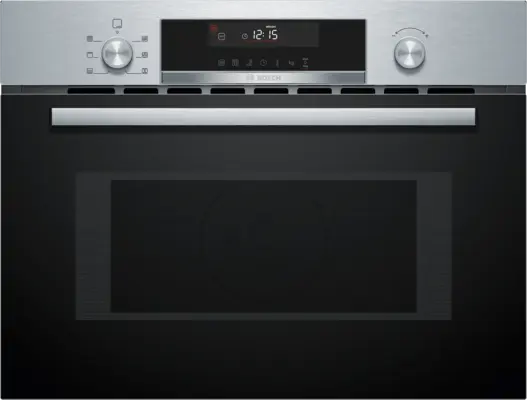
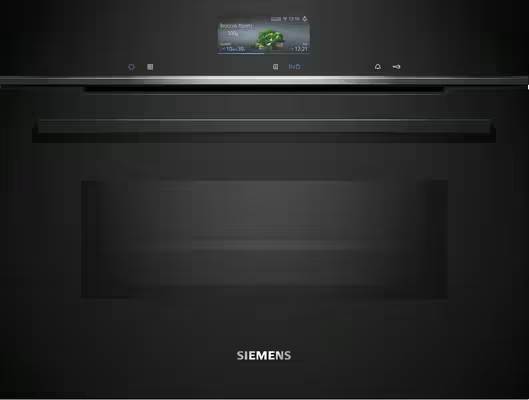
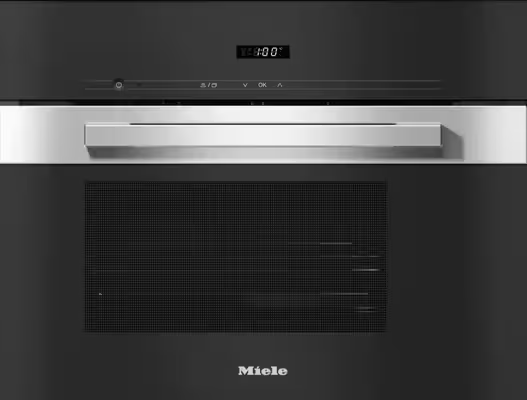
Left to right: standard compact oven, compact combination microwave, compact combination steam oven. All three fit the same 45cm niche. The functional difference between the three types is what you cook, not where they fit.
Recommendation. If you want one compact unit to cover oven and microwave, choose a compact combination microwave. If you want better reheating quality and moist cooking for fish, vegetables, or portions, choose a compact combination steam oven. If you already have a worktop microwave and want the simplest, lowest-cost compact oven, choose a standard compact oven.
Quick choice guide.
- You want oven access at eye level in an appliance tower. The ergonomic advantage over a floor-level oven is significant for daily use.
- You are building a compact kitchen where two appliances stacked vertically replace a full double oven column.
- You cook for one or two people most of the time and a 35–50 litre cavity is sufficient for your typical meal sizes.
- You want to add a second oven to a larger kitchen without a major layout change — a compact oven in a tall housing beside the main oven tower.
- You specifically want microwave at eye level (choose the combination microwave type) or moist cooking for fish and vegetables (choose the combination steam type).
- You regularly bake across two full-size trays simultaneously. The compact cavity typically fits one full tray at a time, not two.
- You use extra-wide roasting tins for large joints or whole birds. Measure your largest tin before purchasing a compact oven — it may not fit.
- You cook large family meals regularly in a single cavity. The 35–50 litre capacity is a genuine constraint for high-volume cooking.
- Your kitchen layout does not include a tall appliance tower housing. A compact oven in an undersized or poorly positioned niche does not gain the eye-level advantage.
Built-in vs built-under.
Compact ovens are designed primarily as built-in appliances — installed in a tall housing at eye level in a 45cm niche. This is the standard installation for the vast majority of compact oven models in the UK market. Built-under installation (below a worktop, as used for full-size single ovens in traditional kitchen layouts) applies mainly to 60cm full-size models. Most 45cm compact ovens are not designed for built-under installation.
The practical consequence: if you are planning a traditional kitchen layout with an oven under the hob, a compact oven is not the appropriate appliance. A 60cm full-size single oven — which fits the standard base cabinet oven housing — is the correct choice for that position. The compact oven belongs in the tall appliance tower.
| Feature | Built-in (eye level) | Built-under (under worktop) |
|---|---|---|
| Typical use | Standard for 45cm compact ovens in tall appliance towers | Common for 60cm full-size ovens. Limited or no options for 45cm compact models. |
| Access and ergonomics | Easy loading and viewing at working height. Hot dishes lifted at chest height. | Requires bending to floor level. Higher lifting risk with heavy dishes. |
| Best for | Appliance towers, safer lifting, faster checking during cooking. The designed purpose of compact ovens. | Traditional kitchens with oven under hob. Not generally appropriate for compact ovens. |
| Planning risk | Lower when the 45cm niche specification is followed correctly from the installation diagram. | Higher for compact ovens — most models are not rated for built-under installation. |
Common mistake. Buyers order a 45cm compact oven assuming it fits under a worktop. Most 45cm compact ovens are not rated for under-counter installation — the ventilation requirements, door clearances, and installation type specified in the manual do not support it. Check the installation type in the product specification before ordering. If you need an oven under a worktop, specify a full-size 60cm model designed for that position.
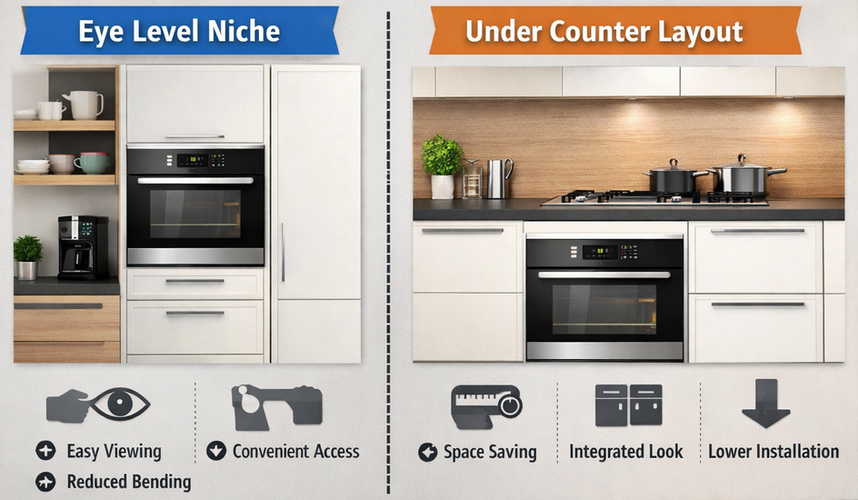
Eye-level built-in niche (left) versus under-counter installation (right). The compact oven belongs in the eye-level position. An under-counter oven requires a 60cm full-size model specified for that installation type. These are different appliances for different positions — not interchangeable.
Sizes, niche, and capacity.
Three measurements matter when specifying a compact oven: the appliance niche dimensions (the furniture opening), the appliance external dimensions (the oven body), and the internal cavity dimensions (what you cook in). Buyers frequently confuse these — particularly the difference between internal capacity in litres and whether their specific trays actually fit. Litres as a measure of cooking space is almost meaningless without checking internal width, depth, and shelf runner spacing against your actual cookware.
| Measurement | Typical compact oven figure | Why it matters |
|---|---|---|
| Appliance niche (housing cut-out) | H 450mm x W 560mm x D 550mm | Kitchen units are built to this. Always confirm the exact tolerances from the specific oven's installation diagram — minor variations exist between models. |
| Appliance front height | Approximately 455–460mm | The trim and door must clear adjacent shelves, worktops, and handles in the appliance tower. |
| Appliance depth | Approximately 545–570mm | Affects how far the oven body protrudes into the niche. The power cable and plug need space directly behind the oven. See installation section. |
| Internal cavity capacity | Often 35–50 litres | Capacity in litres alone does not confirm your trays fit. Check internal width, usable depth, and the distance between shelf runners for your largest tin. |
The fit check to do before ordering. Measure your largest roasting tin — width and depth. Download the installation diagram from the manufacturer's website for the specific model you are considering. Compare your tin dimensions against the internal cavity dimensions shown in the diagram. Do not assume capacity in litres equates to your tin fitting.
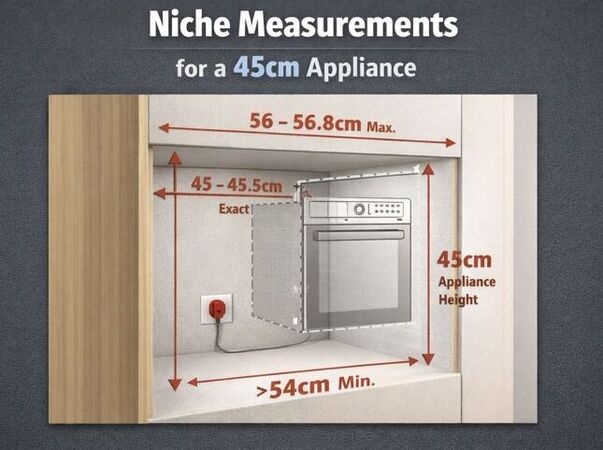
Compact oven niche measurement diagram. The three key dimensions are height (450mm), width (560mm), and depth (550mm). The appliance body sits within these tolerances — always confirm the specific model's tolerances from the manufacturer's installation document rather than assuming a standard fit.
Depth and the plug position. A common installation problem: the power cable and plug sit directly behind the oven at the back of the niche. If the plug is bulky, it prevents the oven from sliding fully into the niche and the fascia does not sit flush. Follow the manufacturer's guidance on socket position carefully. In most UK installations, the socket or fused spur should be positioned to the side of the niche or at a specific point at the rear that the installation diagram specifies.
What fits inside.
Internal capacity in litres is a widely used but poorly understood specification for compact ovens. A 42-litre compact oven and a 48-litre compact oven may not differ meaningfully in practical terms for your cooking. What matters is whether the specific trays, tins, and dishes you use regularly fit inside comfortably. These checks give a more accurate picture than capacity alone.
Fan cooking names.
What the terminology means.
Manufacturers use different names and numbering systems for their fan cooking technology. You will encounter terms like 2D, 3D, 4D hot air, and similar branded designations. These are proprietary labels, not a standardised classification system. The number generally refers to the manufacturer's claim about airflow distribution — the number of directions from which heated air circulates within the cavity. Treat these as marketing descriptors and focus instead on the practical specification: what function modes are available and how many shelf positions does the cavity offer.
For most domestic cooking — roasting, baking, grilling — standard fan oven performance is entirely sufficient. Enhanced airflow systems provide more consistent temperatures across multiple shelf levels, which matters most for households that bake across two or more shelves simultaneously. For single-shelf use, the difference between standard and enhanced fan systems is minimal in practice.
| What you will see | What it means in practice | Who benefits most |
|---|---|---|
| Standard fan cooking | A rear-mounted fan and heating element circulate hot air around the cavity. Even cooking on a single shelf in most conditions. | Most households for standard roasting, baking, and everyday cooking on one shelf at a time. |
| Enhanced / multi-directional fan | Refined airflow design claiming more consistent heat distribution across all shelf levels simultaneously. Proprietary names vary by manufacturer. | Households baking across two or more shelf levels regularly — biscuits, multiple bread tins, batch cooking on separate shelves. |
| Fan-assisted grill | Fan runs simultaneously with the grill element to circulate heat around the cavity. Produces more even browning on thicker items than grill alone. | Whole chicken, thick chops, stuffed vegetables. Items where the top browns faster than the interior cooks through with grill alone. |
Buying tip. Rather than comparing brand fan terminology, look at the number of shelf positions in the specification and whether even results on multiple shelves is stated in the product description. Then check how many shelf levels the compact cavity actually offers — most 45cm ovens have 3–4 shelf positions maximum.
Key features to look for.
Cleaning options.
The cleaning system determines how much effort the oven requires to keep it looking and performing well over its life. Four cleaning approaches are common in compact ovens at different price points. Choose the method that matches how you cook and how often you are willing to clean.
A practical note on pyrolytic. Pyrolytic cleaning runs at temperatures far above normal cooking use and uses a meaningful amount of electricity per cycle. Running pyrolytic every week is neither necessary nor efficient. For most households, running a pyrolytic cycle every 4–8 weeks and doing brief wipe-downs after heavy cooking sessions produces better results than either approach alone. Steam cleaning is well suited to the regular wipe-down intervals between pyrolytic cycles.
Installation requirements.
Three factors determine the installation plan for a compact oven: the electrical connection, the niche ventilation specification, and for steam models, the water supply arrangement. Planning these before the kitchen is built prevents expensive retrofits and common installation problems.
Electrical connection. UK mains power runs at 230V. A standard 13A connection supports appliances up to approximately 3.0kW. Most compact ovens operate within this range, though some models — particularly those with pyrolytic cleaning — draw more. Check the power rating in the product specification and confirm whether the oven arrives with a moulded plug or requires a fixed hardwired connection.
| What you might see | What it means | What to plan |
|---|---|---|
| Plug supplied | Designed to connect to a 13A socket in a standard UK installation | Plan a socket or fused spur positioned so the plug does not protrude into the back of the niche. See depth guidance. |
| No plug supplied | Typically requires a hardwired fixed connection | Plan a fused connection unit (FCU) and an accessible isolation switch. Requires a qualified electrician. |
| Higher power rating (3.0kW+) | May draw more than a standard 13A connection supports reliably | Plan a dedicated circuit. Common on pyrolytic models. Confirm with electrician before installation. |
Socket position. A bulky 13A plug positioned directly at the back centre of the niche can prevent the oven body from sliding fully into position — the plug stops the oven reaching the required depth. The fascia does not sit flush and the installation looks and functions poorly. Always follow the manufacturer's installation diagram for socket or connection point positioning. In most cases the socket should be positioned to the side of the niche or at a specific rear position the diagram specifies.
Steam oven water supply. Compact combination steam ovens require either a removable tank to be filled before cooking or a plumbed cold water connection. The choice affects both installation planning and daily use.
| Type | Advantages | What to plan |
|---|---|---|
| Removable tank | No pipework required. Flexible placement in the kitchen. Easy to fill with filtered water for scale reduction. | Clear access to remove and replace the tank — confirm the tank access position does not conflict with adjacent appliances or doors. Establish a descaling routine based on your local water hardness. |
| Plumbed connection | No refilling during cooking. Better for frequent or professional-level steam use. | Cold water supply pipework to the exact oven position planned before kitchen installation begins. Filtration strongly recommended in hard water areas. Service access for future maintenance. |
Descaling steam ovens. All steam ovens accumulate limescale from the water supply over time. Tank models should be filled with filtered or low-hardness water to reduce scale build-up. Most steam ovens have a built-in descale programme — follow the manufacturer's recommended descale frequency for your local water hardness. In hard water areas (London, the South East, and parts of the Midlands), more frequent descaling is required. Neglecting descaling shortens the life of the steam generation system significantly.
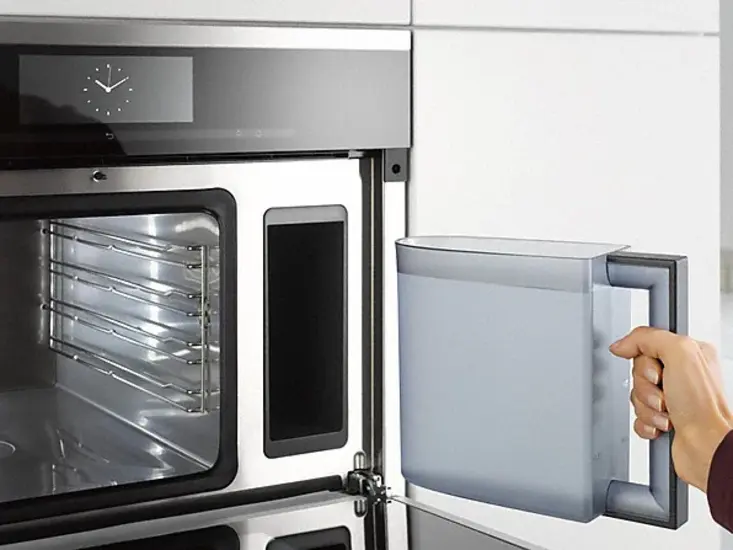
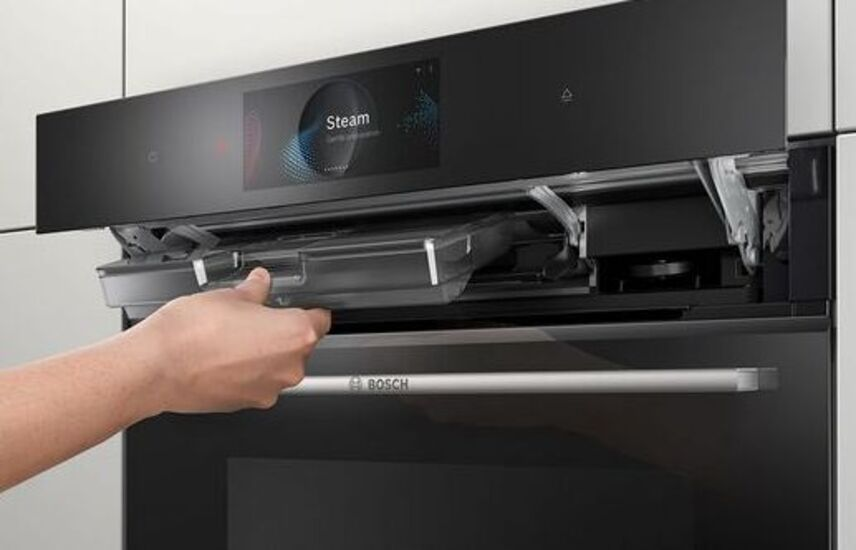
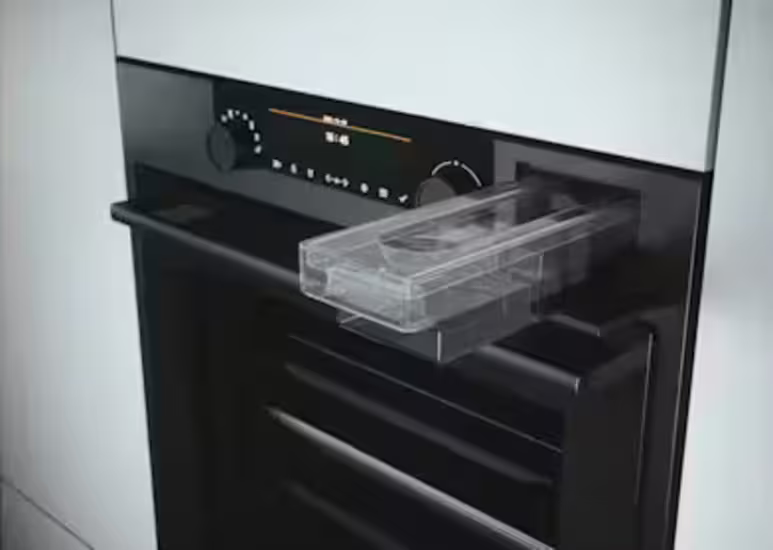
Compact combination steam ovens in built-in installations. All three require either tank access for filling before each cooking session or plumbed cold water connection planned during the kitchen build. The installation position — eye level in a 45cm niche — is consistent across all models.
Colour options.
Compact ovens are available in a limited set of standard finishes. In a built-in appliance tower, all appliances in the column should ideally share the same finish for a coherent, intentional appearance. Mixing finishes across appliances in the same tower — stainless steel oven above a black microwave, for example — looks unplanned and diminishes the fitted quality of the kitchen.
Finish availability narrows in premium product ranges, where the choice is often stainless steel or a specific manufacturer's black glass only. Entry and mid-range products offer more colour options. If you are specifying an unusual finish, confirm availability across all appliances in your tower configuration before ordering any individual unit.
Matching across manufacturers. Different manufacturers describe similar finishes with different names. Two products both described as "graphite grey" may read as different colours in a finished installation. If mixing manufacturers in one appliance tower, request physical finish samples or view the appliances side by side in a showroom before ordering. The difference is most visible when the tower is lit from the side or has a raking light source above.
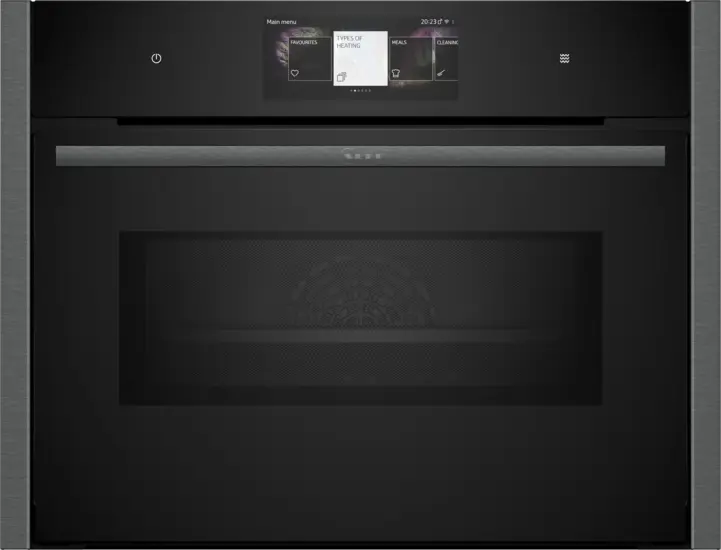
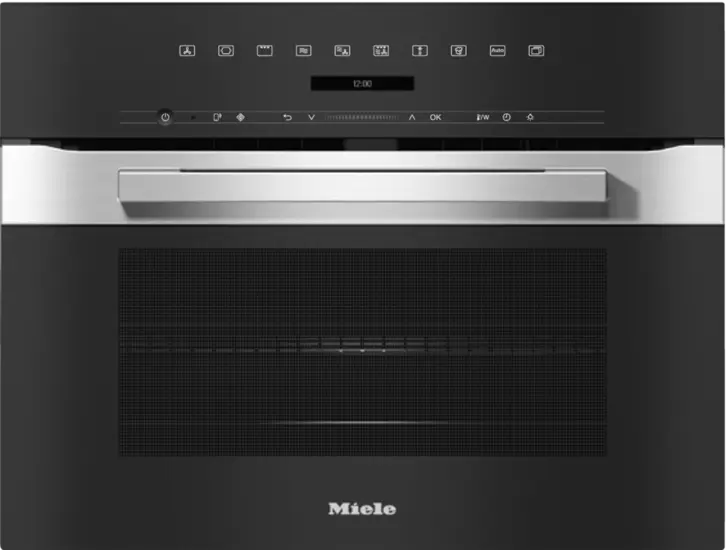
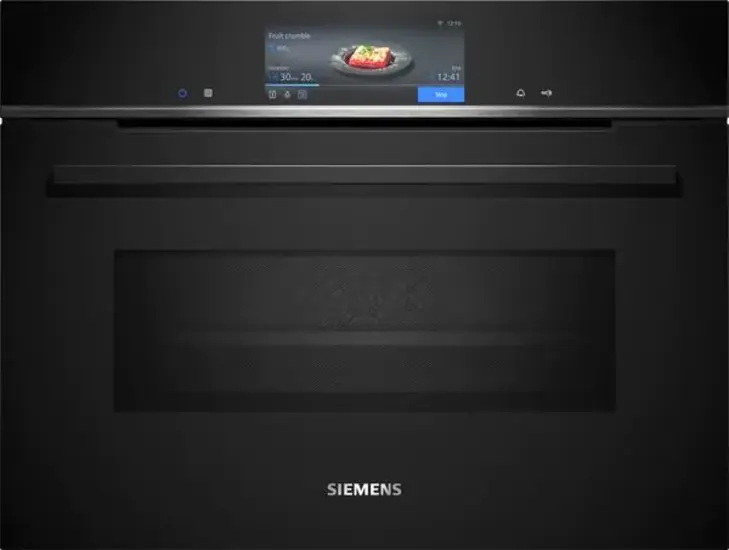
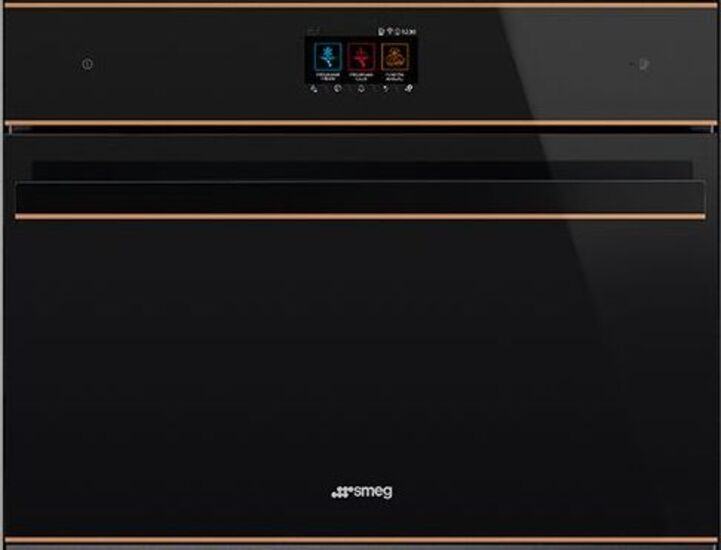
Compact oven finish options in built-in installations. Stainless steel is the most widely available finish across all types and price points. Black glass suits contemporary handleless kitchens. Distinctive finishes are available from some manufacturers for period or colourful kitchen schemes.
Price guide.
Compact oven pricing varies by type, cleaning system, control quality, and connectivity. The price ranges below reflect UK market supply prices in 2025 and exclude installation. Combination microwave and steam combination models are typically more expensive than standard compact ovens at equivalent quality levels.
Installation costs. Installation cost varies by electrical connection type, access, and whether additional wiring is required. A standard 13A plug connection to an existing socket is the simplest scenario. Hardwired fixed connections requiring a qualified electrician add cost. Steam ovens requiring plumbing add further cost. Budget installation separately from the appliance purchase and confirm the electrical specification before ordering.
Buying checklist.
Checks before you order.
Use these checks before committing to a purchase. Most compact oven buying mistakes — wrong size, fitting problems, unexpected installation costs — are preventable with this list completed before the order is placed.
Frequently asked questions.
See the Ovens hub to compare all oven types or use the Which oven guide to work through the specific questions that lead to the right oven choice for your kitchen layout and cooking habits.