
Concrete worktops.
The complete UK guide.
Concrete worktops are cast rather than cut. A fabricator mixes cement, aggregates, pigments, and reinforcing fibres — or in some cases steel bar or mesh — pours the mixture into a mould shaped to your exact kitchen specification, and allows it to cure under controlled conditions. What comes out is a worktop shaped and coloured precisely for your kitchen, with no standard pattern and no two surfaces alike. This is what distinguishes concrete from every other worktop category: it is not a manufactured slab cut to size, it is a bespoke object made for a single kitchen.
The aesthetic this produces is unique. Concrete has visual weight, depth, and texture that no manufactured surface replicates convincingly. Small aggregate particles, colour variation from the cement and pigment interaction, slight tonal differences across a large slab, and a surface that develops a subtle patina with age — these are characteristics buyers choose concrete for. If you want perfection, uniformity, and consistency, concrete is not the right choice. If you want a surface with genuine material character and a look that is entirely your own, no other worktop comes close.
The practical profile of concrete is important to understand clearly. It is a heavy material — typically 60–80kg per square metre at 50mm thickness — that requires cabinet reinforcement in most installations. It is porous and requires sealing to prevent staining. The seal requires periodic reapplication throughout the life of the worktop. Hairline cracks can develop over time as the material responds to thermal and structural movement. These are not defects — they are the behaviour of a natural material in a dynamic environment. A buyer who understands and accepts this will live happily with a concrete worktop for decades. A buyer expecting the low-maintenance consistency of quartz will be disappointed.
Concrete worktops are a premium bespoke product in the UK market. They suit design-led projects where the surface is a deliberate design statement. They work well in contemporary, industrial, and minimalist kitchen schemes, and are particularly effective on islands and peninsula surfaces where the material's visual mass makes an impression.
What is a concrete worktop.
How it is made.
A concrete worktop is made from a mix of Portland cement, fine aggregates (sand, granite dust, or glass), water, and colour pigments. The mix is poured or packed into a mould — either in a workshop (precast) or directly on the cabinets in your kitchen (cast in place) — and left to cure under controlled conditions for a minimum of 28 days before final finishing. Reinforcement — typically polypropylene fibres, glass fibres, or steel mesh — is embedded in the mix to reduce the risk of structural cracking.
Once cured, the surface is ground and polished to the specified finish. Grinding removes the top layer of cement paste to reveal the aggregate within — the depth of grinding determines how much aggregate is exposed and how rough or smooth the final texture is. Polishing further refines the surface through progressively finer abrasive stages. The finished surface is then sealed with a penetrating sealer, an epoxy coating, or a wax, depending on the appearance and performance specification.
The production process is time-intensive and skill-dependent. The mix design, curing environment, finishing sequence, and sealing method all affect the final result. No two mixes produce identical surfaces. Colour variation between the sample and the finished worktop is inherent to the material — expect the overall tone and character to match, not every detail.
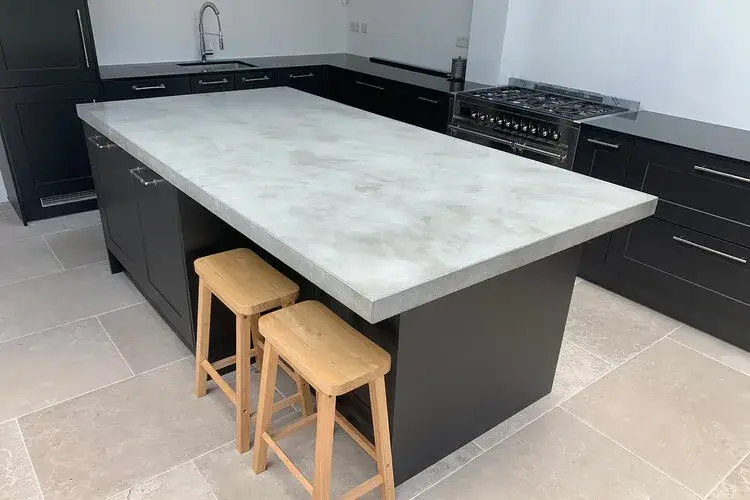
Concrete worktop in a contemporary kitchen. The natural variation in tone, texture, and aggregate distribution is part of the material's character. No two concrete worktops look the same — the slight irregularities visible at close range are what distinguish concrete from manufactured surfaces.
GFRC (Glass Fibre Reinforced Concrete). Some UK fabricators use GFRC — a concrete mix with alkali-resistant glass fibres — which allows thinner, lighter worktops (typically 20–30mm) with comparable structural strength to thicker conventional concrete. GFRC worktops are significantly lighter than solid concrete at equivalent visual thickness. If weight is a concern, ask your fabricator whether GFRC is available in the finish you are specifying.
Precast vs poured in place.
Two production methods.
Concrete worktops are produced by one of two methods. The method matters for surface quality, logistics, and timing. Most UK specialist fabricators use precast production. Poured in place is less common in the UK but remains an option for certain project types.
- Cast in a controlled workshop environment. Curing conditions are managed for consistent results. Most UK concrete worktop specialists work precast only.
- Higher surface quality. Workshop production allows grinding and polishing on flat, stable surfaces with better equipment and more precise control over the finish.
- Precise templating required before casting. The fabricator templates the kitchen, produces the moulds from the template, casts, cures, and delivers completed sections to site.
- Sections are delivered to site and positioned on the cabinets. Joins between sections are filled and ground to blend. Complex kitchen layouts involve multiple sections joined on-site.
- Lead times of 4–8 weeks from template to delivery are typical. The curing period alone requires a minimum of 28 days before grinding and finishing.
- Final sealing is typically completed on-site after installation to protect the surface in the kitchen environment from delivery day onward.
- Cast directly onto the cabinets in the kitchen. The mould is built in place, the mix is poured, and curing happens in the kitchen over several weeks.
- Seamless for complex layouts. Long runs and awkward shapes can be cast as one piece without on-site joins. Good for U-shaped and unusual geometry kitchens.
- More disruptive to the kitchen during production. The space is unusable for the full curing period. Kitchen installation must be sequenced around the concrete work.
- Surface quality is harder to control on-site. Grinding and polishing in a kitchen environment is less precise than in a workshop. Finish quality varies.
- No delivery risk. Large precast sections can crack or chip during transport. Poured in place eliminates this logistical challenge for very large or complex one-piece layouts.
- Specialist UK contractors for poured in place are less common. Finding an experienced practitioner for this method requires more research than sourcing a precast fabricator.
Most UK buyers specify precast. The controlled production environment, better surface quality, and more predictable lead times make precast the default choice for most domestic UK kitchen projects. Poured in place is worth considering only where the kitchen layout makes on-site joins impractical or where very large seamless sections are a priority. Confirm the method and its implications with your fabricator at specification stage.
Design and finish.
Colour, texture, and surface options.
Concrete's design range is wide — but it requires more buyer involvement than specifying a manufactured slab. You are not selecting from a product range; you are specifying a material. The colour, aggregate, texture, and finish are all variables your fabricator will interpret and produce. What you see in reference images and sample pieces gives the direction. What arrives in your kitchen will have its own character within that direction.
Colour. Concrete is naturally grey — the grey of Portland cement. Pigments added to the mix shift the base colour toward warmer tones, cooler tones, lighter values, and darker values. The cement reaction affects how pigments appear when cured — light, wet-looking samples darken as they dry. Always assess concrete colour samples in their fully cured, dry state. Colours that look identical wet often read differently when dry.
Aggregate. The aggregate visible in a polished concrete surface determines much of the surface character. Fine sand-based aggregates produce a smooth, relatively uniform texture. Larger granite, marble, or quartz chips produce a terrazzo-like appearance with visible mineral inclusions. Glass aggregate produces light-reflective inclusions. The depth of grinding determines how much aggregate is exposed — light grinding leaves most aggregate beneath the cement paste, producing a smoother, more uniform face. Deep grinding exposes more aggregate, producing a more textured, patterned surface.
Surface finish. Polished finishes (high sheen) amplify colour depth and make aggregate more visible but show fingerprints and water marks more readily. Honed finishes (low sheen) are more forgiving in daily use and are more commonly specified for UK kitchen worktops. Raw or formwork-texture finishes retain the marks and texture of the casting surface — a distinctive industrial look that suits specific design briefs only.
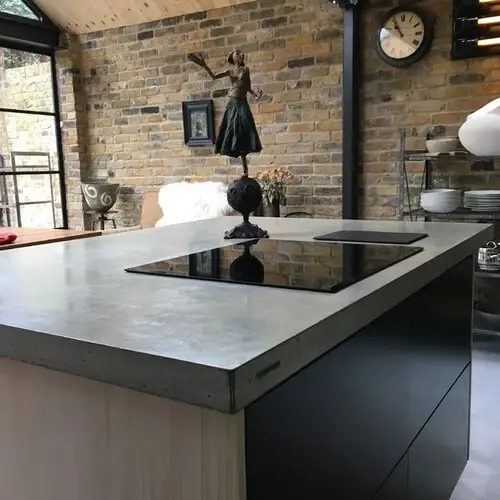
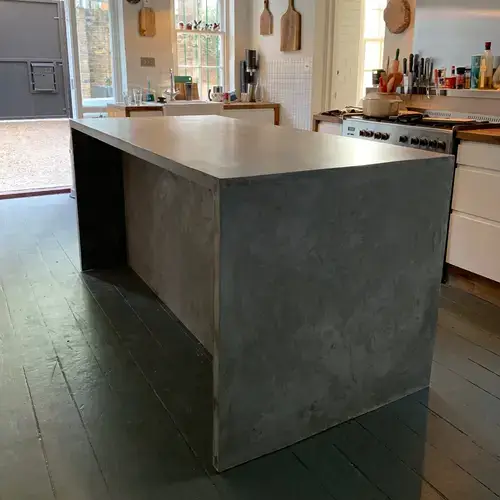
Left: polished concrete showing aggregate character and tonal variation. Right: honed matte finish — smoother surface texture, less aggregate visible, more forgiving in daily use. Both are the same material at different grinding and finishing stages.
Bespoke capabilities.
What concrete makes possible.
The cast production method gives concrete a practical design freedom that no other worktop material offers. Shape, thickness, edge detail, integrated features, and colour are all fully variable at the specification stage. This is the defining practical argument for concrete in a kitchen where a standard slab worktop simply cannot produce the result required.
Integrated sinks and drainers. A sink bowl, drainer channels, and an upstand can all be formed as part of the single cast — the same continuous material from worktop surface to sink interior, with no silicone joint at the rim. The sink bowl is formed into the mould before casting. The result is structurally integral to the worktop and looks like a single cast object, because it is. This is also achievable in solid surface (acrylic), but in concrete the material weight and visual presence produce a distinctly different and more architectural result.
Shapes and geometry. Curved islands, angled corners, non-rectangular islands, circular sections, and any geometry the mould accommodates. The mould is made from the template of your kitchen — it is not selected from a catalogue of available shapes.
Thickness variation. The worktop can be thicker at the edge face than across the main slab, creating a false thick-edge profile without carrying the weight of a solid thick slab throughout. Edge thicknesses of 100mm or more on a 50mm base slab are achievable through mould design and are used to create a visual presence comparable to a chunky stone slab.
Inlays and embedments. Steel strips, wood sections, glass inclusions, and other materials can be embedded in the concrete before casting. These become part of the slab structure when the concrete cures around them.
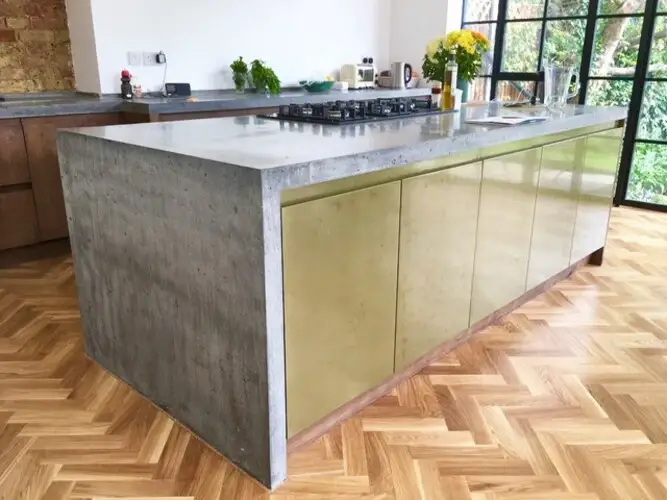
Concrete on a kitchen island. The material's visual mass and architectural presence are most effective at this scale. The island surface becomes a design focal point in the room rather than a background element — the defining characteristic of concrete in a kitchen context.
- Integrated cast sink bowls with no silicone joint at the rim
- Curved islands and shaped sections cast as one piece
- Drainer channels and drainer zones formed into the cast
- Upstands and splashbacks in the same material as the worktop
- Thick false-edge profiles without full-thickness heavy slabs
- Material inlays — steel strips, wood, glass — embedded during casting
- Custom aggregate selection for specific visual effects
- Colour matching to a specific architectural reference
Advantages and limits.
- Completely bespoke. Every aspect — shape, colour, texture, thickness, edge, integrated features — is specified for your kitchen. No other worktop material offers this degree of design freedom.
- Unique appearance. Natural variation in tone, texture, and aggregate character means no two concrete worktops look the same. The surface develops a subtle patina with age that adds character rather than wear.
- Integrated sinks, drainers, and upstands all in the same material. No silicone joints at the bowl rim. Architecturally seamless in a way that no slab-cut material achieves.
- Design freedom for complex shapes. Curved islands, angled sections, unusual geometries, and thick false-edge profiles — achievable in concrete when they are not possible in any slab material without multiple joins.
- Long lifespan when properly maintained. A well-made, correctly sealed concrete worktop lasts 20–40 years. Hairline cracks and minor surface damage are repairable in a way that is not possible with ceramic or porcelain.
- Strong visual presence. The material's weight, density, and texture give it an architectural quality that manufactured surfaces cannot replicate. Particularly effective on islands and peninsula surfaces where the worktop is visible from multiple angles.
- Requires sealing and periodic maintenance. Concrete is porous. Without sealing it stains quickly. The seal requires reapplication every 1–3 years depending on the sealing product and kitchen use intensity. This is a lifetime maintenance commitment.
- Very heavy. A 50mm concrete worktop weighs 60–80kg per square metre — significantly more than quartz (approximately 25kg/m² at 20mm) or porcelain (approximately 25–30kg/m² at 12mm). Cabinet reinforcement is required in most installations.
- Hairline cracks can develop. Concrete responds to thermal movement and structural settlement. Hairline surface cracks are normal and repairable, but they are part of the material's behaviour. Not acceptable to buyers expecting a perfect, uniform surface.
- Colour variation between sample and installation. Concrete colour is affected by the curing environment, aggregate distribution, and pigment behaviour. The finished surface will reflect the reference — it will not match it exactly.
- Higher cost and longer lead times. Bespoke casting, curing, and finishing mean concrete costs significantly more than manufactured slab worktops and takes 4–8 weeks from template to installation.
- Specialist fabricator required. The quality of a concrete worktop depends almost entirely on the skill of the fabricator. Finding an experienced concrete worktop specialist in the UK is not as straightforward as sourcing a quartz or porcelain supplier.
Concrete vs porcelain.
Two very different approaches.
Concrete and porcelain are the two most architecturally distinctive worktop materials available in the UK market. They share nothing in production, material behaviour, or maintenance profile. The comparison matters because both are specified for design-led contemporary kitchens — concrete for its bespoke character and organic variation, porcelain for its precision and consistency. Buyers sometimes compare them directly when the kitchen brief is contemporary and the budget is at the premium level. Understanding where each is genuinely superior prevents a misspecification.
| Aspect | Concrete | Porcelain |
|---|---|---|
| UK price guide | £500–£1,200+ per m² (supply and install) | £250–£700+ per m² (supply and install) |
| Production | Cast to order from cement, aggregate, and pigment. No two surfaces alike. Lead time 4–8 weeks. | Manufactured slab, pressed and fired. Consistent pattern and colour. Available in large format from stock. |
| Surface character | Natural variation, aggregate texture, tonal differences across the slab. Patina develops with age. No two surfaces identical. | Manufactured consistency. Pattern is identical across every section. No natural variation. What you see in the showroom is what you receive. |
| Heat resistance | Good. Concrete itself tolerates heat well. The sealant may be affected by very hot pans — use trivets to protect the seal surface rather than the concrete. | Excellent. No resin binder. Hot pans on the flat surface do not mark the material or degrade any coating. |
| Stain resistance | Requires sealing. Without seal, stains rapidly. With good seal, moderate stain resistance. Red wine, coffee, and oil require prompt wiping. | Near-zero porosity. No sealing required. Excellent stain resistance from common kitchen spills without any treatment. |
| Maintenance | Sealing required every 1–3 years. Surface must be resealed after abrasive cleaning or heavy use. Annual oil or wax treatment recommended on some sealant types. | No sealing. No specialist maintenance products. Warm water and mild detergent for the life of the kitchen. The simplest maintenance profile of any worktop material. |
| Weight | 60–80 kg/m² at 50mm. Cabinet reinforcement required. Significant structural consideration. | 25–30 kg/m² at 12mm. Lightweight for a slab surface. No cabinet reinforcement required in standard installations. |
| Integrated sinks | Yes. Sink bowl cast as part of the slab — same material, no silicone joint at rim. Most seamless sink integration available. | No. Undermount bowl with silicone joint at cut-out perimeter. Pattern does not continue into the bowl. Standard limitation of slab materials. |
| Bespoke shapes | Yes. Any geometry the mould accommodates. Curved sections, unusual island shapes, integrated features all achievable as one cast. | Straight-cut slab only. Complex shapes require multiple pieces joined on-site. Curves not achievable in a single porcelain piece. |
| Hairline cracking | Normal over time as concrete responds to movement. Repairable. Not the same as structural failure. | Does not crack under normal use. Brittle under sharp localised impact — chips rather than cracks. |
| Repairability | Good. Cracks and chips can be filled with matching concrete or epoxy. Colour matching is imperfect but significantly better than porcelain repair. | Limited. Edge chips fillable but visible. Surface damage not restorable. Large damage requires section replacement. |
| Who it suits | Design-led projects where bespoke character, visual mass, and integrated features are the brief. Buyers who accept maintenance in exchange for uniqueness. | Buyers who want low maintenance, heat performance, consistent patterns, and UV stability. No tolerance for ongoing sealing schedules. |
Concrete and porcelain serve different briefs. If you want the simplest maintenance, consistent patterns, and no sealing schedule, porcelain is the correct choice. If you want a surface that is entirely unique to your kitchen, capable of integrated sinks and complex geometries, and willing to engage in periodic sealing maintenance, concrete produces results that porcelain cannot. Neither is superior overall — they are different answers to different questions about what a kitchen worktop should be.
Weight and installation.
Weight is the most important practical consideration in specifying a concrete worktop. Standard concrete at 50mm thickness weighs approximately 120kg per square metre (density roughly 2,400kg/m³). Most UK kitchen concrete worktops are specified at 40–60mm, producing a finished worktop weight of approximately 60–80kg per square metre after grinding and finishing. A 3-metre kitchen run at 600mm depth and 50mm thickness weighs approximately 180kg — three times the weight of an equivalent quartz slab. This loading must be planned for before installation begins.
Standard kitchen base cabinets are designed to carry worktop loads appropriate for laminate, quartz, or stone slab worktops. They are not designed for the weight of cast concrete at domestic kitchen thicknesses. Before concrete is specified, the structural support method must be agreed between the fabricator, the kitchen installer, and in some cases a structural engineer. Solutions typically involve either steel angle brackets fixed to the wall studs across the full worktop run, a structural plywood layer across all cabinet tops, or both. This work must be completed before the concrete is installed and the kitchen should not be used to bear the worktop weight on standard cabinet carcasses alone.
GFRC (glass fibre reinforced concrete) is lighter — typically 20–30mm with equivalent strength, at approximately 30–45kg/m² — and requires less structural intervention. If weight is a significant constraint, GFRC is worth discussing with your fabricator. The surface character and finish options are comparable to conventional concrete.
Lead times. Concrete worktops take significantly longer than manufactured slab worktops. From the initial site visit and templating through to delivery and installation, allow a minimum of 6–8 weeks for a standard precast project. Complex castings, custom aggregate specifications, and specialist finishes may extend this further. Concrete curing alone requires a minimum of 28 days before grinding and finishing begin. Plan the kitchen installation programme around this lead time from the start of the project, not as an afterthought after the cabinetry has been ordered.
On-site finishing. Even precast concrete worktops typically require on-site finishing after installation. The joins between sections are filled, ground, and polished on-site. Final sealing is applied in the kitchen to protect the surface from the delivery day onward. The kitchen should not be fully operational until the sealing is complete and cured — typically 24–72 hours depending on the sealant type.
Sealing and maintenance.
The lifetime commitment.
Concrete maintenance is the most significant ongoing commitment of any standard kitchen worktop material. Concrete is porous — it will absorb liquids and stain without sealing. The seal is a protective barrier that must be maintained throughout the life of the worktop. No seal is permanent. Understanding the sealing requirement before committing to concrete is essential — buyers who discover it after installation are often frustrated by a requirement they did not anticipate.
If you want low maintenance, concrete is not the right choice. Quartz, porcelain, and ceramic all require no sealing, no annual reapplication, and no specialist maintenance products throughout their life. Concrete requires all three. This is not a solvable problem — it is a characteristic of the material. A buyer who selects concrete knowing and accepting the maintenance requirement will be satisfied. A buyer who selects concrete expecting the maintenance profile of manufactured slab worktops will not.
UK cost guide.
Concrete worktops are priced as a bespoke fabrication, not as a per-square-metre rate from a product catalogue. The variables affecting final price include worktop area, thickness, number of sections and joins, integrated features (sinks, drainers, upstands), aggregate and pigment specification, finish level, structural reinforcement work, and delivery and installation logistics. The figures below are indicative ranges for UK domestic kitchen projects in 2025.
Compare total project cost, not material rate. Concrete is a premium material in the context of the total project. A similar kitchen area in porcelain at £400–£600 per m² will cost approximately 40–60% less than equivalent concrete and will require significantly less structural preparation. Budget the total project — material, fabrication, reinforcement, installation, and ongoing maintenance — before comparing to alternatives.
Who concrete suits.
- The kitchen surface is a deliberate design statement and you want something that is entirely unique to your home. Manufactured slab worktops — however well-specified — cannot produce the visual character of cast concrete.
- You want an integrated cast sink with no silicone joint at the rim, or a complex geometry island that would require multiple joins in any slab material. Concrete's cast production is the only worktop process that achieves these as single pieces.
- You are comfortable with the maintenance commitment — sealing every 1–2 years, prompt spill wiping, avoidance of acidic cleaners. The maintenance is manageable but genuine. It is not comparable to quartz or porcelain.
- You accept natural variation. The colour, texture, and character of the finished worktop will reflect your specification but will not match a sample exactly. This is the nature of the material and is the source of its appeal.
- Budget and timescale support a premium bespoke product. Concrete costs more than any manufactured slab at equivalent area and takes 6–8 weeks from template to installation. These are not negotiable constraints — they are characteristics of the production process.
- Low maintenance is a priority. Quartz and porcelain require no sealing and no periodic specialist treatment. If a worktop that cleans with warm water and nothing else throughout its life is what you need, concrete is not the right material.
- You want a consistent, predictable surface finish. Concrete variation is inherent and not a defect — but if consistency, pattern matching, and visual uniformity matter, a manufactured slab (quartz, porcelain, or solid surface) is more appropriate.
- The kitchen renovation has a tight timescale. Six to eight weeks from template to installation is a minimum — it cannot be shortened. If the renovation programme does not accommodate this, a manufactured slab material is the correct choice.
- Cabinet reinforcement is not feasible. If the cabinets are already installed and structural reinforcement would be prohibitively disruptive or expensive, concrete at standard thicknesses is not appropriate. Consider GFRC at lighter weights, or choose a lighter slab material.
- The kitchen receives very active wet use and staining is a frequent concern. Concrete's porosity means it requires more vigilance around staining than any slab material. If the kitchen is heavily used for cooking with oils, spices, and acidic ingredients, porcelain or quartz are more practical long-term choices.
Frequently asked questions.
See the Worktops hub to compare concrete with porcelain, quartz, granite, and other materials. The Solid surface guide covers the alternative bespoke worktop material — integrated sinks, seamless joins, and design freedom without the weight and sealing commitment of concrete.