
Double ovens.
The complete UK guide.
A double oven is one built-in appliance with two separate cavities. Each cavity has its own temperature control, so you roast at one temperature in the main cavity and bake at a different temperature in the top cavity at the same time. This is the defining practical advantage: two temperatures simultaneously without requiring two separate oven appliances in the kitchen.
Most UK double ovens position a smaller top cavity above a larger main cavity. The top cavity typically houses the grill and serves as a second oven for side dishes and smaller portions. The main cavity handles roasting tins, large baking trays, and everyday cooking. The cavities are not equal in size. The total capacity figure shown in product specifications is split between two separate spaces, and the main cavity of a double oven is typically smaller than the single large cavity of a full-size single oven.
This guide covers what a double oven is, the current UK market context, how double ovens compare to single ovens and compact oven combinations, built-in versus built-under installation, the two cavities in detail, sizes, gas versus electric, features, installation requirements, finishes, costs, and the pre-purchase checklist that prevents fitting problems.
What is a double oven.
A double oven is a single built-in appliance containing two completely separate oven cavities stacked vertically. Each cavity operates independently with its own temperature control, timer, and heating elements. You set the top cavity to 200°C for gratins and the main cavity to 160°C for a slow roast and both run simultaneously without any thermal interaction between them.
The top cavity is typically the smaller of the two and usually contains the grill element. In most UK double oven designs the top cavity is 30–45 litres — suited to side dishes, smaller portions, and grilling. The main cavity below is larger, typically 45–65 litres in a built-in format, and handles roasting trays, baking, and the primary cooking load.
A double oven is not the same as two single ovens stacked. Two single ovens give two full-size cavities of approximately 70–75 litres each. A double oven splits a smaller overall space into two separate cavities. The combined litre figure can appear larger than a single oven, but the usable main cavity for large roasting tins is typically smaller than a large single oven. Check internal dimensions rather than relying on total litre figures when your cooking regularly involves large trays.
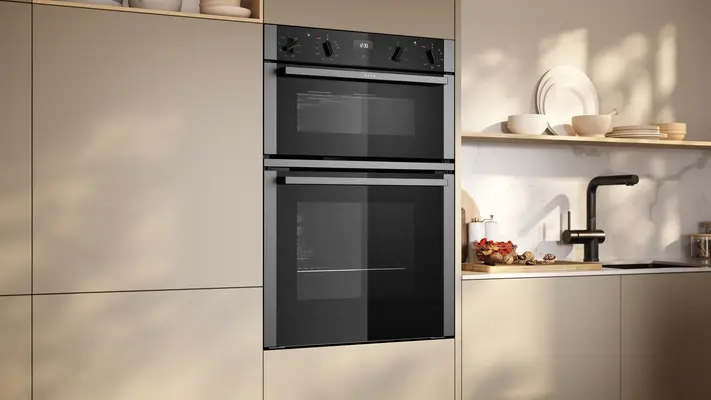
A typical UK built-in double oven. The smaller top cavity houses the grill and serves as a second cooking space. The main cavity below handles the primary cooking load. Each cavity has independent temperature and timer controls.
The changing
double oven market.
Double ovens remain a popular and practical choice in UK kitchens. The market has changed, however, and buyers planning a new kitchen should understand the current context before specifying one.
Most appliance brands have shifted their new feature development to single ovens and compact ovens. Double ovens tend to receive simpler specifications — fewer cooking modes, less sophisticated cleaning systems, and fewer connectivity features compared to equivalent single oven models at the same price point. Pyrolytic cleaning, steam cooking, and WiFi control are standard on many mid-range single ovens but remain rare exceptions in double ovens.
Many new kitchen designs in the premium and mid-premium market now use an appliance tower: a single full-size oven in a tall housing with a compact oven above or below it. The compact oven adds microwave, steam, or combination cooking capability — giving two cooking temperatures simultaneously while also adding cooking modes that no double oven format offers. This configuration is worth comparing directly before committing to a double oven specification.
For direct replacement. If you are replacing an existing double oven like-for-like, match the installation type (built-in or built-under) and confirm the cutout height before ordering any model. These are not interchangeable. Cutout heights differ and the wrong type will not fit without cabinet modifications.
Double oven vs single oven + compact tower
The compact oven tower has become the dominant alternative to the double oven in new premium UK kitchen specifications. The comparison matters for buyers planning a new kitchen from scratch rather than replacing an existing oven.
Double oven advantage: one appliance, one cutout, simpler planning. Two temperatures simultaneously in a familiar format.
Tower advantage: two temperatures simultaneously, plus steam, microwave, and combination cooking modes. Better feature access at the same price point. The single oven main cavity is typically larger.
If two temperatures at the same time is the only requirement, a double oven is the more straightforward specification. If cooking modes beyond conventional and fan matter, the tower configuration delivers more.
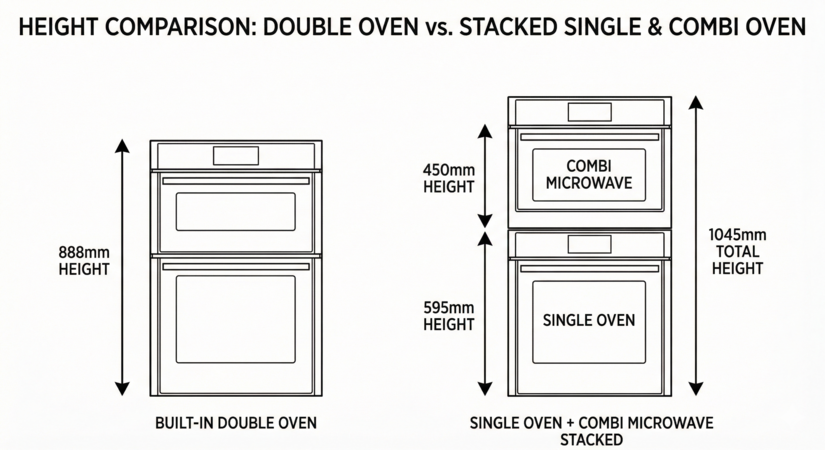
Double oven niche height (88–90cm) versus single oven plus compact oven tower. Both configurations deliver two cooking spaces. The tower configuration adds cooking modes.
Double oven vs
single oven.
The comparison focuses on the practical differences in daily use. The headline distinction is two simultaneous temperatures. Beyond that, cavity space, feature availability, and flexibility in cooking modes differ significantly.
| Aspect | Single oven | Double oven |
|---|---|---|
| Number of cavities | One large cavity. All cooking at one temperature at a time. | Two separate cavities. Two independent temperatures simultaneously. |
| Main cavity size | Typically 65–80 litres. Suited to large roasting tins, full baking loads, and a large turkey. | Main cavity typically 45–65 litres in built-in format. A large roasting tin may not fit — check internal dimensions before ordering. |
| Grill | Grill element in the single cavity. Grilling and oven cooking cannot happen simultaneously. | Grill sits in the separate top cavity. Grill operates independently while the main cavity cooks at a different temperature. |
| Overall height | Approximately 59cm. Fits a standard single oven housing. | Built-in approximately 88–90cm. Built-under approximately 72cm. Requires a taller housing or a larger under-counter space. |
| Feature availability | Widest range of modern features including pyrolytic cleaning, steam, WiFi, air fry mode. Available across the full price range. | Narrower feature set. Pyrolytic cleaning and steam cooking rare. Most models offer fan, conventional, and grill modes only. |
| Typical price range | Entry level from approximately £300. Premium from approximately £1,200. Wide spread across all tiers. | Entry level from approximately £300. Premium from approximately £900. Most models sit in the entry to mid-market range. |
| Choose when | You want the largest possible single cavity, access to modern cooking features, or you will pair with a compact oven for two-temperature cooking. | Two simultaneous temperatures matter more than one large cavity and you prefer all cooking in a single integrated appliance. |
Built-in vs built-under.
Double ovens come in two installation formats that are not interchangeable. The cutout height differs substantially and the ventilation design differs too. Confirm which format your cabinet space requires before ordering any model.
- Fits in a dedicated tall housing column or appliance tower unit
- No bending to load the main cavity — oven is at a comfortable working height
- Grill position at a practical height for daily use
- Wider range of models and finishes than built-under
- Main cavity typically larger than built-under equivalent
- Requires a tall housing unit — not suitable for under-worktop installation
- Fits under a worktop — typically positioned below a hob
- Suits kitchens without a tall housing column
- Good option for direct like-for-like replacement of an existing under-counter double oven
- Both cavities require bending to load and unload
- Main cavity typically smaller than built-in equivalent
- Narrower model and finish choice than built-in
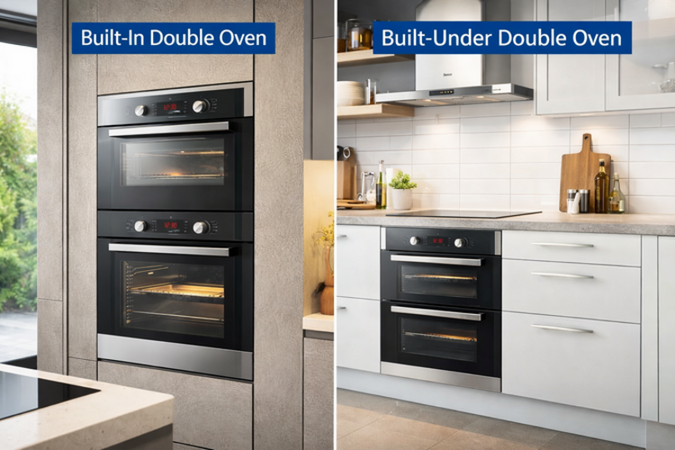
Built-in (left) in a tall housing column at approximately 88–90cm niche height. Built-under (right) below the worktop at approximately 72cm. The two formats require different cabinet cutouts and are not interchangeable.
Built-in and built-under models are not interchangeable. The niche height required differs by approximately 16–18cm. Installing a built-in model in a built-under space (or vice versa) is not possible without modifying the cabinet. For a direct replacement, measure the existing niche height and confirm the installation type before shopping.
Understanding
the two cavities.
The two cavities in a double oven are not equivalent in size, function, or capability. The top cavity is smaller, typically shorter in internal height, and primarily designed as a grilling and supplementary cooking space. The main cavity handles the primary cooking load and is the larger of the two.
Before ordering a double oven, check two things: whether your largest roasting tin fits the main cavity's internal dimensions, and whether the top cavity's internal height is sufficient for what you plan to use it for. Many double oven buyers discover after delivery that their standard roasting tin does not fit the main cavity of their chosen model.
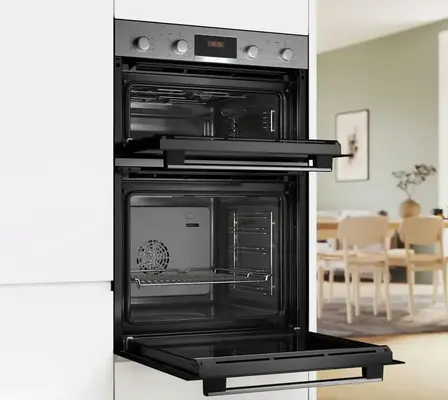
The top cavity is typically 30–45 litres with limited internal height. The main cavity is 45–65 litres in a built-in format. Both figures are significantly lower than the 65–80 litres of a large single oven cavity.
Do not rely on litres alone. The total capacity figure across both cavities of a double oven can appear similar to or larger than a single oven. The individual cavities are what matter for real cooking use. Measure your largest roasting tin and compare with the main cavity's internal width and depth dimensions from the product specification before ordering.
Sizes and dimensions.
| Format | Top cavity | Main cavity | Total capacity |
|---|---|---|---|
| Built-in double oven | Approximately 30–45 litres | Approximately 55–65 litres | Approximately 90–110 litres total |
| Built-under double oven | Approximately 30–40 litres | Approximately 45–55 litres | Approximately 75–95 litres total |
| Single oven (for comparison) | Not applicable | Approximately 65–80 litres | Approximately 65–80 litres |
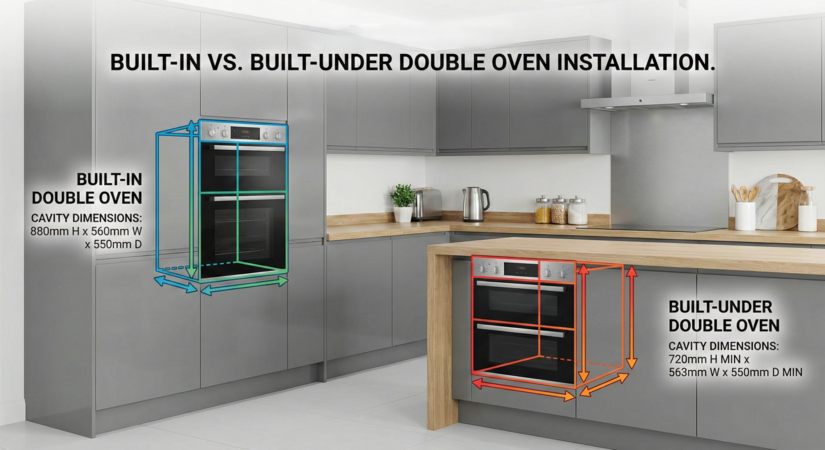
Built-in double oven (left) requires an 88–90cm niche height. Built-under (right) requires approximately 72cm. Depth requirements include clearance for ventilation behind the oven carcass — always follow the installation guide dimensions.
Gas vs electric.
Electric double ovens dominate the UK market. Gas double ovens exist but the range of available models is significantly smaller and features are generally simpler. For new kitchen installations, electric is the practical default.
| Aspect | Electric double oven | Gas double oven |
|---|---|---|
| UK availability | Wide choice across all price points and formats. | Limited choice. Model range has been reducing as the market moves to electric. |
| Heat distribution | Fan cooking in the main cavity gives even heat distribution. Consistent temperatures at all shelf positions. | Heat rises in gas ovens, producing less even temperature distribution. Hotter at the top of the cavity. |
| Controls | Digital timers, clear temperature settings, and programmable start and end times are standard. | Controls are often simpler. Fewer timer and programming options. |
| Grill | Electric element grill. Consistent, controllable heat. Standard across all models. | Gas grill on some models. Less consistent than electric grills. Not available on all gas double ovens. |
| Installation | Electrical connection to a dedicated cooker circuit. No Gas Safe work required for the oven. | Requires installation by a Gas Safe registered engineer. More complex if gas pipework requires any rerouting. |
| Market direction | All new UK build properties from 2026 use electric cooking. Electric is the straightforward long-term specification. | Available for existing gas properties. The UK market moves steadily towards electric. Fewer new gas oven models released annually. |
Gas oven installation requires a Gas Safe registered engineer. This is a legal requirement. Keep the Gas Safe certificate with the kitchen documentation.
Features and functions.
Double ovens cover the everyday cooking essentials. Feature choice is narrower than single ovens — pick the layout first, then choose the features. If specific cooking modes beyond fan, conventional, and grill are important, compare directly with a single oven plus compact oven combination before committing.
Features often absent in double ovens. Many modern cooking and cleaning features are rare or unavailable in double oven formats. If any of the following are important, compare with a single oven and compact oven tower before ordering.
| Feature | Availability in double ovens | Alternative to consider |
|---|---|---|
| Pyrolytic self-cleaning | Rare. Available on a small number of premium models only. | Standard on mid-range to premium single ovens. Consider single oven plus compact oven tower. |
| Steam cooking | Not available in standard double oven formats. | Steam compact oven as the second cavity in an appliance tower alongside a single oven. |
| WiFi and app control | Rare. Available on a very limited number of models. | Standard on many mid-range modern single ovens from German brands. |
| Air fry mode | Not generally available in double oven formats. | Single ovens from some brands. Countertop air fryer as a separate appliance. |
| Microwave combination | Not available. The top cavity of a double oven is an oven, not a microwave. | Compact combination microwave oven as the second appliance in a tower specification. |
Installation requirements.
Installation planning prevents the most common fitting problems with double ovens. The three key areas are the electrical connection type, the cabinet cutout dimensions, and the ventilation clearances specified in the installation guide.
Electrical connection. Most double ovens require a dedicated hardwired cooker circuit connected to a cooker connection unit with an accessible isolation switch. Some lower-powered models connect on a standard 13-amp plug. Confirm which applies from the product specification sheet before ordering. The isolation switch must be positioned where it is reachable without moving the oven.
Ventilation. Double ovens generate significant heat during both cavities running simultaneously. The installation guide specifies minimum clearances at the rear, sides, and above the oven within the housing. Follow these exactly. Blocking ventilation routes leads to overheating, tripped circuit breakers, and in serious cases, damage to adjacent cabinetry.
- Confirm the cutout height from the installation instructions before ordering. Built-in and built-under have different heights. The cutout dimensions in the installation guide differ from the overall oven dimensions listed in sales materials.
- Confirm the electrical connection method — hardwired or plug-in — and whether a dedicated circuit or an existing socket is required. Budget for an electrician visit if a new circuit is needed.
- Plan the isolation switch position before the kitchen is installed. It must be accessible without moving the oven for safety compliance.
- Check the ventilation clearances in the installation guide and ensure the cabinet housing design accommodates them. These are minimum safe distances, not guidelines.
- Check the door clearance when the oven door is fully open. The door drops forward and must not clash with adjacent kitchen doors, a hob above, or any island seating opposite the oven position.
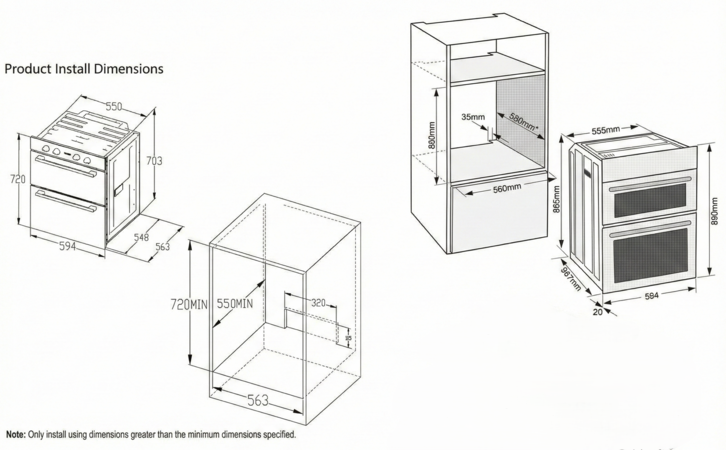
Double oven installation requirements. Ventilation clearances must be met at the rear and above the oven. The cable route to the cooker connection unit and the isolation switch position must be planned before the housing column is assembled.
Use a qualified electrician for fixed wiring. Hardwired oven connections fall under Part P of the Building Regulations in England and must be installed and certified by a qualified electrician. This is a legal requirement, not optional guidance.
Colours and finishes.
Finish choice in double ovens is narrower than in single ovens. Stainless steel and black are the dominant options across most brands. Confirm stock availability for your preferred finish before finalising the kitchen order — some finishes are only available to order and carry longer lead times.
Match brands when colour consistency across appliances matters. Finish shades — particularly between stainless steel, graphite, and black — vary between manufacturers. If the double oven sits in a column alongside other built-in appliances, source all appliances from the same brand where possible to ensure a consistent colour result.
UK cost guide.
These figures cover the oven unit only. Installation costs — electrical circuit work, an electrician's labour, and gas connection if applicable — sit outside the unit price and must be budgeted separately.
Installation costs sit outside the unit price. If a new dedicated circuit is required, budget approximately £200–£400 for electrical work. Get an electrician's quote before finalising the kitchen order, particularly when replacing an older oven that may not have had a dedicated cooker circuit.
Pre-purchase checklist.
These checks prevent the most common fitting problems and buying disappointments with double ovens. All dimensional and electrical information is found in the installation instructions, not the product sales page or box dimensions.
- Confirmed built-in or built-under installation type
- Measured the niche height, width, and depth in the cabinet
- Confirmed the cutout dimensions from the oven's installation instructions (not the overall oven dimensions)
- Measured your largest roasting tin and compared with the main cavity's internal width and depth
- Checked the top cavity's internal height for your grill pan and any dishes planned for that space
- Checked the oven door clearance when fully open against adjacent doors, worktop edges, and any seating opposite
- Confirmed the power rating and electrical connection method (plug or hardwired cooker circuit) from the specification sheet
- Planned an accessible isolation switch position if hardwired
- Checked ventilation and clearance requirements from the installation guide
- Compared with a single oven plus compact oven tower configuration if modern cooking features (steam, microwave, pyrolytic) are important
- Confirmed finish availability and lead time before finalising the kitchen order
- Confirmed warranty length and UK service support availability
See the Single Oven guide for the full single oven specification including pyrolytic cleaning, heating types, and finishes. The Compact Ovens guide covers the 45cm format for appliance tower specifications alongside a single oven.