
Dual fuel hobs.
Gas flame and induction. One appliance.
A dual fuel hob combines gas burners and induction zones in a single appliance on one continuous glass surface. The gas side delivers open flame heat with the immediate, visible control that experienced cooks value for wok cooking, charring, and high-heat searing. The induction side provides precise digital power for simmering, reductions, and everyday cooking at significantly better energy efficiency than gas.
The appeal is straightforward: you do not have to choose between two cooking technologies. You choose the fuel and the zone that suits each task. A dual fuel hob is not a compromise between gas and induction — it is a deliberate specification for households where both cooking approaches are genuinely used. If your cooking is predominantly one type or the other, a dedicated hob in that technology will serve you better.
This guide covers what dual fuel hobs are, the zone configurations available, how they compare to dedicated gas and induction, installation requirements (both services are needed at the same position), sizes, costs, and the buying decisions that matter. Read the installation section carefully before finalising your kitchen plan — two services running to the same hob position requires more coordination with tradespeople than a single-fuel installation.
What is a dual fuel hob.
A dual fuel hob, also called a mixed fuel hob, integrates gas burners and induction zones on a single glass-ceramic surface. The gas burners sit on one section of the surface with cast iron pan supports above them. The induction zones sit on another section with the same flat glass appearance but with electromagnetic coils beneath rather than gas outlets.
The controls are typically split by type: rotary metal knobs govern the gas burners because they need physical adjustment for flame control. Touch or slider controls on the glass surface govern the induction zones. On most designs, both control types run along the front edge of the hob.
The gas and induction systems operate entirely independently of each other. The induction zones draw power from the electrical supply. The gas burners draw from the gas connection. You use each zone on its own terms, and using one system does not affect the other. You run all gas burners and all induction zones simultaneously if the cooking session requires it.
The alternative to a dual fuel hob — for households who want both technologies — is a domino format: a separate 30cm gas module positioned alongside a separate 30–60cm induction hob in the same worktop cutout zone. The domino approach gives complete flexibility in brand and specification but results in two separate units with two separate interfaces. A dual fuel hob is a single integrated product with one interface and one cutout.
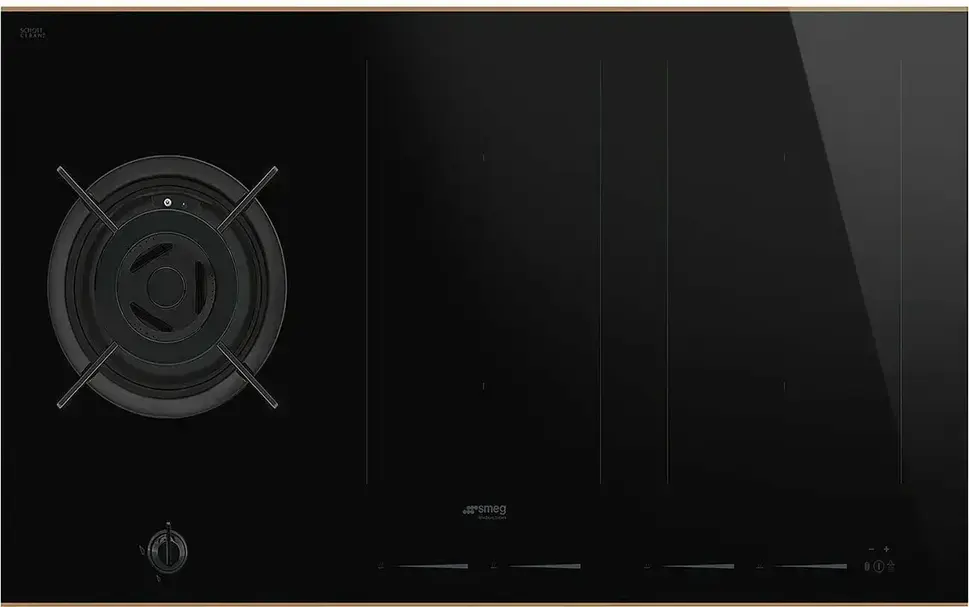
A dual fuel hob combines gas burners with cast iron pan supports and induction zones on a single glass surface. Both technologies are controlled from the same front edge.
Zone configurations.
Match the split to how you cook.
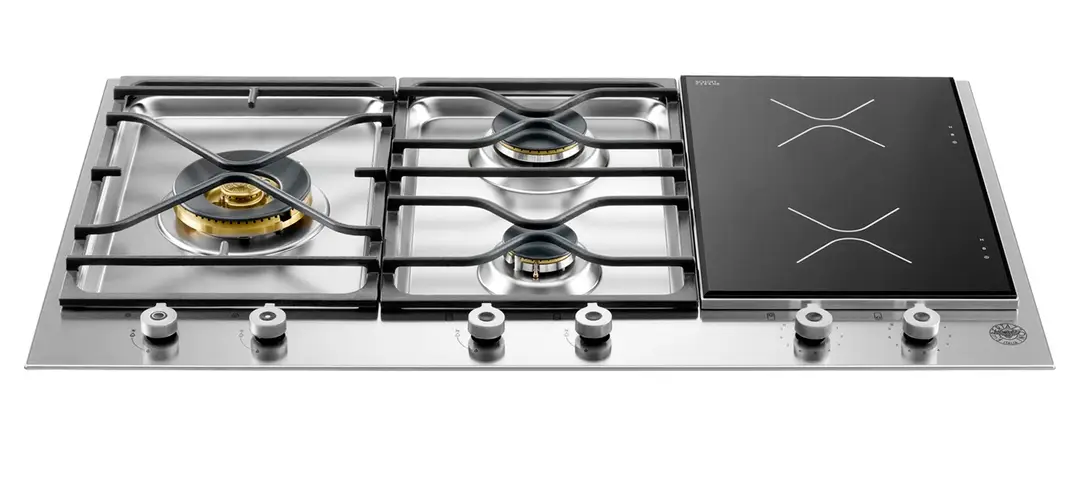
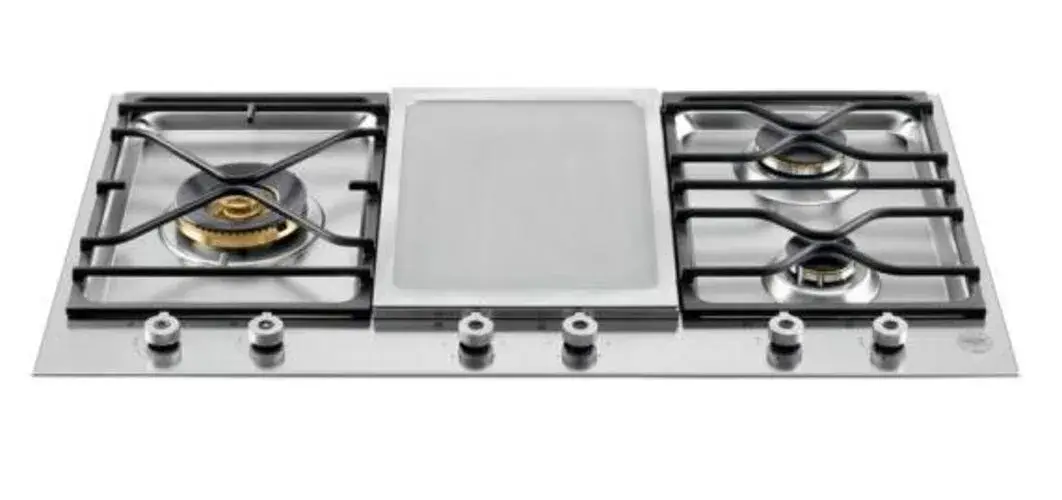
Dual fuel hobs come in several zone splits. The balance between gas and induction varies by model, and choosing the right configuration depends on which technology you use more often and for which tasks. The three most common splits are shown with images below. A fourth format — the wider five-zone layout — covers larger hobs.
Dual fuel vs gas
vs induction.
Dual fuel hobs sit between gas and induction in most practical respects. Understanding where each technology has an advantage helps confirm whether the dual fuel option justifies its higher price against the two single-fuel alternatives.
| Aspect | Dual Fuel | Gas only | Induction only |
|---|---|---|---|
| Technologies | Gas burners and induction zones combined in one appliance. | Gas burners only. One technology, one service required. | Induction zones only. One technology, one service required. |
| Heat control | Gas flame for immediate visual control on gas zones. Precise digital settings on induction zones. | Immediate flame response across all zones. Fully analogue and visual. | Precise digital control across all zones. Consistent low-heat settings with no flame drift. |
| Energy efficiency | High efficiency on induction zones. 40–55% on gas zones. Mixed overall depending on usage pattern. | 40–55% efficiency across all zones. Significant heat lost into the kitchen environment. | 85–90% efficiency across all zones. Minimum heat lost to the surrounding area. |
| Cookware | All cookware works on gas zones. Magnetic-base pans required for induction zones. | All cookware types compatible. No requirements. | Magnetic-base cookware only. Copper, aluminium, and glass pans require a bonded steel base. |
| Services at the hob | Gas connection and a dedicated electrical circuit. Both services required at the same position. | Gas connection only. No electrical circuit needed for the hob itself. | Dedicated electrical circuit only (32A minimum). No gas connection needed. |
| Cleaning | Gas section requires burner caps and pan supports to be removed and scrubbed. Induction section wipes flat. | All zones require burner cap and support removal for cleaning. More effort overall. | Entirely flat glass. Wipes clean with a cloth and hob cleaner. Simplest of the three. |
| Safety | Open flame and hot supports on gas section. Cool glass on induction section. Mixed profile. | Open flame and hot cast iron supports across the full cooking surface. | Glass surface stays cool away from active zones. Residual heat indicator. Auto shut-off and child lock. |
| Power cuts | Gas burners continue working (light with a match). Induction zones stop. | Continues with a match. Fully independent of electricity for cooking. | Stops completely. No cooking capability during a power cut. |
| UK availability from 2026 | Existing properties only. Not available in new builds without a gas connection. | Existing properties only. Not available in new builds. | Available in all properties including new builds. |
| Purchase price | Higher than equivalent single-fuel hobs due to two integrated systems and more complex manufacturing. | Wide range. Strong value at entry and mid levels. | Wide range from entry level to premium. Competitive at all price points. |
| Best suited to | Households who genuinely use both cooking approaches regularly and want one integrated product rather than separate modules. | Properties with an existing gas supply where experienced cooks prefer flame control and cookware compatibility without change. | Most UK households. New builds, open-plan kitchens, safety-conscious households, and buyers prioritising efficiency and easy cleaning. |
Installation.
Two services. Both required. Plan them together.
A dual fuel hob requires two services at the same position: a gas connection and a dedicated electrical circuit. Neither is optional. The gas burners will not function without the gas supply. The induction zones will not function without the electrical supply. Both services need to reach the hob cabinet without obstructing drawer boxes, internal dividers, or appliance housings. Coordinate both tradespeople early in the project, before first fix. Discovering a service routing conflict after the kitchen is built is expensive to resolve.
- Gas Safe registration is mandatory — not optional
- Confirm LPG or natural gas and correct jets before ordering
- Minimum 750mm clearance from hob to overhead extractor
- Carbon monoxide detector recommended in the same room
- Not available in new UK builds from 2026
- Dedicated circuit — not a standard ring main socket
- Circuit rating depends on the number of induction zones and their combined wattage — confirm with the hob specification sheet
- Budget approximately £200–£400 if a new circuit is not already in place
- Electrician and Gas Safe engineer must coordinate the service routes within the cabinet
Cabinet and worktop checks before ordering. Each model has a specific cutout drawing. The fabricator and installer must follow this closely. Check the space available under the hob: the gas components and electrical wiring reduce the usable depth of the cabinet below the hob, which affects drawer sizes. Some manufacturers also specify ventilation gaps in the cabinet front or rear panel for the electrical components — confirm these requirements before the carcasses are ordered.
Extraction. A dual fuel hob does not change the fundamental extraction requirement. Gas produces grease-laden fumes and combustion gases that must be removed from the kitchen. The extractor must be appropriately sized for the gas output of the burners as well as the steam from the induction zones. A 750mm minimum clearance from hob cooking surface to extractor is the standard requirement for gas. Check the hob installation guide for the specific model.
LPG or natural gas. Confirm your fuel type before ordering. Most dual fuel hobs are supplied configured for natural gas. LPG requires different jets, which must be fitted by a Gas Safe engineer. Some manufacturers include LPG conversion kits in the box. Verify this on the product specification sheet before purchase.
Do not mix up the service routes. Gas pipework and electrical cabling must be routed separately within the cabinet and must not come into contact with each other. Both services passing through the same cabinet panel require specific separation. Your Gas Safe engineer and electrician must be aware they are working at the same position and must review the routing together before installation begins.
Standard sizes.
Benefits and limits.
- Maximum cooking flexibility on one appliance. Gas flame for high-heat work and charring. Induction precision for simmering, reductions, and controlled cooking. No need to compromise on one technique to gain the other.
- Broad cookware compatibility. Your existing collection works on the gas zones without replacement. You upgrade key pieces for induction as needed rather than replacing everything at once.
- Single appliance instead of two modules. One glass surface, one cutout, one control interface. Cleaner visually and simpler to specify than a gas domino module alongside a separate induction hob.
- Gas burners function during a power cut (with a match). The induction zones stop, but the gas side continues.
- Strong appeal for households who entertain regularly and need the full range of cooking techniques available simultaneously.
- Higher purchase price than a single-fuel hob at the same width. Two integrated systems and more complex manufacturing mean the price premium is real at all tiers.
- Two services at one position. Gas Safe engineer and electrician both required. More coordination, more tradespeople, and more planning than a single-fuel installation.
- Gas connection required. Not available in new UK builds from 2026. Only viable in existing properties with an active gas supply.
- Cleaning is more demanding than a pure induction hob. The gas section requires burner cap and pan support removal and scrubbing. The induction section wipes flat, but the mixed surface means you never have a completely flat cleaning area.
- Cabinet storage is reduced. The gas components and electrical wiring below the hob reduce usable drawer depth compared to a standard hob installation.
- Induction boost performance on some dual fuel models sits slightly below dedicated induction hobs of the same width. The shared electrical supply can limit peak output on the induction zones.
UK market context: the move towards all-electric
UK energy policy continues to move towards lower-carbon electricity. Gas connections are not available in new builds from 2026. For households renovating an existing property, a dual fuel hob is a valid choice today. For a kitchen expected to last 15–20 years, it is worth considering whether the gas side will remain desirable — or simply viable — over the full life of the kitchen.
If you install a dual fuel hob, ask your electrician to size the supply so a full induction hob becomes possible later without additional electrical work. This costs little during a renovation and avoids a return visit in future if you decide to move to all-electric cooking.
Buying decisions.
Zone balance. Start with an honest assessment of how you currently cook. If most daily meals are cooked on a single technique — predominantly gas or predominantly induction — the dominant technology should have the most zones. If you genuinely switch between the two regularly across a typical week, a balanced two-plus-two or three-plus-two split makes sense.
Controls. Check the physical control layout before purchasing. Rotary knobs for gas should sit in a position that makes sense for the gas zone locations. Touch controls for induction should be accessible without reaching over the gas burners during cooking. Ask to see the model in a showroom if possible, and note which controls you will use most often and whether they fall naturally to hand.
Safety features. Confirm flame-failure devices on each gas burner, residual heat indicators on the induction zones, and a child lock for the induction controls. Automatic switch-off on induction zones if a pan is removed is standard on mid-range and above.
Cleaning design. On the gas section, flush or low-profile pan supports and sealed burner bases reduce the number of places where grease and food residue accumulate. Continuous cast iron supports (one-piece rather than individual per burner) are easier to lift and wash. On the induction section, the glass surface is the same as any standard induction hob.
Reliability and parts support. Dual fuel hobs have more components than single-fuel models. Choose a manufacturer with strong UK parts availability and a clear UK warranty. Reputable European brands — Siemens, Neff, Bosch, Miele, AEG, and Smeg — all offer good service networks. Verify the warranty period covers both the gas and induction sections.
- LPG or natural gas confirmed before ordering. Check whether conversion jets are included or need to be ordered separately.
- Cutout dimensions from the installation guide given to the worktop fabricator before templating. Not the overall hob dimensions.
- Gas Safe engineer and electrician booked and briefed together before first fix. Service routing must be coordinated.
- Extractor clearance confirmed. Minimum 750mm from cooking surface to lowest point of overhead extractor. Check the specific hob installation guide.
- Induction circuit sized for future upgrade to full induction if you decide to remove the gas connection later.
UK cost guide.
These figures are indicative for 2025 and cover the hob unit only. Gas Safe installation, electrical work, and worktop fabrication are additional costs. Use them to frame a budget before speaking with a retailer or designer.
Additional costs to include in your plan: Gas Safe engineer connection (£150–£300 typical), dedicated electrical circuit (£200–£400 if a new circuit is not already in place), worktop cutout fabrication, and any new induction-compatible pans if your existing cookware is not magnetic. Both tradespeople visiting the same kitchen requires coordination — budget time as well as money.
Is a dual fuel hob
right for your household?
- You genuinely use both gas and induction cooking techniques regularly — not occasionally. The flexibility advantage only justifies the premium if both technologies see regular use.
- You have an active gas connection at the property and the pipework is in good condition. Confirm this with a Gas Safe engineer before ordering.
- You cook a wide range of dishes including high-heat wok and charring work (gas) as well as precise simmering, reductions, and controlled cooking (induction) across a typical week.
- You have non-magnetic cookware you want to keep using and do not want to replace the full collection. The gas zones preserve that investment while the induction zones give you the efficiency and precision advantage on the zones you upgrade.
- Your budget stretches above the equivalent single-fuel hob at the same width and you are prepared to arrange and coordinate both gas and electrical installation work.
- You cook predominantly on one technology. If 90% of your cooking suits induction and you only occasionally want a gas burner, a standard induction hob with a small gas domino module addresses this more flexibly and at lower total cost.
- You are in a new build or a property without a gas connection. Dual fuel is not possible. Induction is the correct choice.
- You want a simple cleaning routine above all else. A pure induction hob with a completely flat surface is significantly easier to maintain than the mixed gas-and-induction surface on a dual fuel unit.
- Your appliance budget is tight and the price premium for dual fuel would be better allocated to ovens, refrigeration, or worktop quality.
- You are planning a kitchen with a 15–20 year lifespan and are concerned about the long-term viability of gas in the context of UK energy policy.
Return to the Hobs guide to compare dual fuel against all other hob types. The Induction Hob guide covers the full induction specification in detail. The Gas Hob guide covers the practical considerations and clearance requirements for gas hobs in UK kitchens. The Domino Hob guide covers the modular alternative for mixing technologies in the same worktop cutout zone.