
Integrated fridge freezers.
The complete UK guide.
An integrated fridge freezer sits inside a tall housing behind a full furniture door, making the appliance disappear into the kitchen run. The refrigeration becomes part of the cabinetry rather than a visible freestanding appliance alongside it. This matters most in open-plan kitchens and design-led renovations where visual continuity is part of the brief.
Integrated fridge freezers are no longer limited to one standard format. The familiar 60cm wide, 177cm tall model is still widely available but the market now includes taller 193cm models offering significantly more fresh food space, wider premium options at 70cm, 76cm, 80cm and 91cm including French-door formats, and large integrated refrigerator-freezer combinations with built-in ice makers, filtered water dispensers, dual independent cooling circuits, and smart connectivity — all behind flush furniture doors.
The decisions that matter most in specifying an integrated fridge freezer are: height and width against available housing space; the split between fridge and freezer capacity; the frost management system; the hinge type (fixed or sliding) and its compatibility with the furniture door weight; ventilation planning in the housing; and whether premium features like ice making require plumbing connections that need planning before the kitchen is built.
This guide covers each of these decisions clearly, with the practical detail needed for a kitchen renovation or extension specification. All technical information applies generically — the same principles govern all manufacturers in this category.
Built-in vs built-under.
Two different appliance categories.
These two terms describe different appliance categories, not variations of the same product. A built-in tall integrated fridge freezer sits inside a full-height housing behind full-height furniture doors — typically in a tall appliance housing unit of 200cm or more. The appliance is the main kitchen refrigeration. A built-under appliance fits below a worktop in a standard base cabinet space, similar to a dishwasher or undercounter refrigerator. It supplements a main fridge rather than replacing it.
For a kitchen renovation or extension where this is the primary refrigeration, a tall built-in integrated fridge freezer is the appropriate choice in almost every case. Built-under integrated fridge freezers are used in secondary spaces — utility rooms, annex kitchens, bar areas, and smaller kitchens where no tall housing is available. They offer less storage, less flexibility, and a more restricted freezer section than any full-height alternative.
The practical distinction also matters for installation: built-in tall models require a correctly dimensioned tall housing with appropriate ventilation at the plinth and top. Built-under models use a standard 820mm undercounter niche similar to a washing machine. Confirm which category applies to your kitchen layout before specifying any appliance.
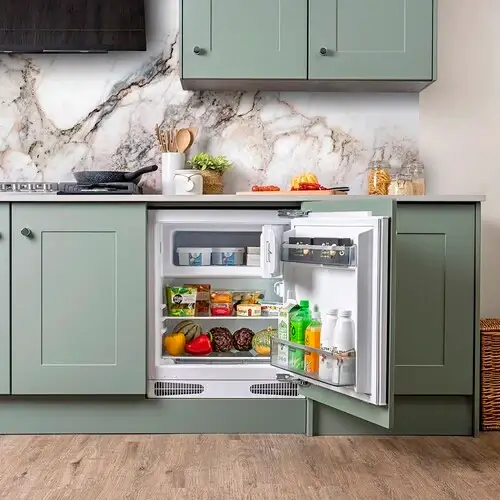
Built-under integrated fridge freezer in the standard undercounter position. The built-under format suits secondary refrigeration spaces — utility rooms, annexes, and kitchens without a tall housing. For a main family kitchen, a tall built-in integrated fridge freezer provides significantly more storage and better long-term practicality.
- Heights: 177cm and 193cm standard
- Widths: 60cm, 70cm, 76cm, 80cm, 91cm
- Full split type choice: 50/50 through 80/20
- Standard niche: 820mm high, 600mm wide
- Smaller fridge and freezer sections
- Not suitable as sole kitchen refrigeration for families
Heights.
177cm vs 193cm.
Integrated fridge freezers are available in two standard heights: 177cm and 193cm. The height determines the housing unit specification, so this decision must be made before the kitchen furniture is ordered — changing the housing height after cabinet manufacture is an expensive and disruptive retrofit.
The 177cm height is the original standard for integrated refrigeration in UK kitchens. It remains widely available and suits many households. The 193cm height is now offered by most major manufacturers and provides significantly more internal volume — particularly more fridge space — within the same kitchen footprint. For a family kitchen planned from scratch, the 193cm option is worth specifying if the ceiling height and housing design allow it.
The practical benefit of 193cm over 177cm is more fresh food storage: wider shelves, an additional shelf level, and more drawer space for vegetables and soft fruit. This is the most practical difference for busy households who shop weekly and cook regularly. The freezer section also typically gains one additional drawer in the 193cm format.
Housing height for a 193cm fridge freezer must account for the appliance height plus the required clearance above and any top ventilation grille. Confirm the total housing column height required from the installation guide before the kitchen is specified. Most 193cm models fit within a standard 210cm tall housing column, but this varies by model.
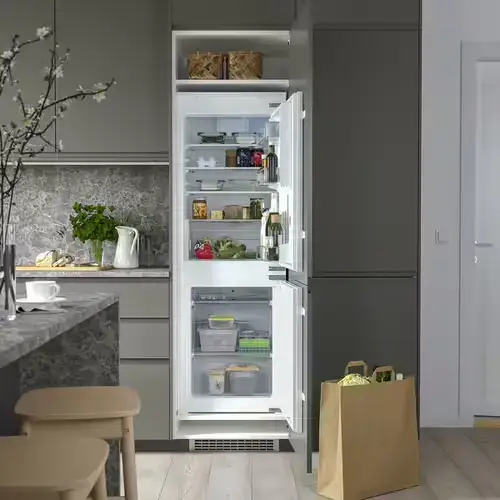
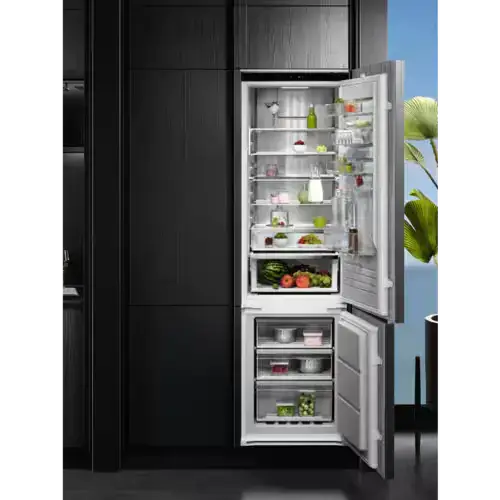
Left: 177cm standard height integrated fridge freezer. Right: 193cm taller model. The 193cm format provides significantly more fresh food storage within the same kitchen footprint — the additional height translates directly to extra shelf levels and drawer space. Specify the housing height before ordering the furniture.
Widths.
60cm to 91cm.
Integrated fridge freezers are available in five width classes: 60cm, 70cm, 76cm, 80cm, and 91cm. The 60cm class is the standard in most UK kitchen renovations — it fits within a standard 600mm cabinet module and the widest range of appliances is available in this format. The wider classes are premium products aimed at larger kitchens, households who want more internal shelf width, and buyers specifying French-door or integrated refrigerator-freezer combinations with luxury features.
60cm: Standard integrated width. By far the most common in UK kitchens. Fits all standard housing units. The best-supported format for replacement in future.
70cm: A step up in internal width providing noticeably wider shelves for platters and wide dishes. Requires a 700mm furniture module or a purpose-specified wider housing.
76cm: Often associated with premium French-door integrated formats. Provides a wide refrigerator section with French-door opening that gives visual access to the full width of the fridge in one opening. Suited to larger kitchens and entertaining-focused households.
80cm: Premium integrated format with substantial internal width. Suited to large kitchen renovations where the footprint is available and a wide, generous refrigerator is part of the design brief.
91cm: The widest standard integrated format. Associated with the most ambitious integrated refrigerator-freezer combinations, including models with built-in ice and water dispensers. Requires significant housing width and careful ventilation planning. See the Special Features section for the 91cm ice and water format.
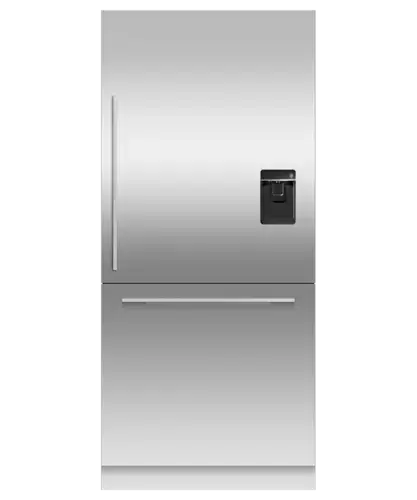
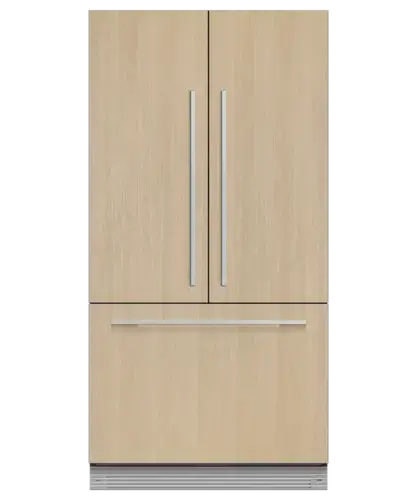
Left: 91cm integrated fridge freezer with built-in ice and water. Right: integrated French-door format giving full-width visual access to the fridge section. Both formats require significant housing width and advance plumbing planning for ice and water models.
Before specifying a wider format: confirm the kitchen layout has sufficient run width for a 700mm, 800mm, or 910mm housing column; confirm the housing can be constructed with the required ventilation provision for a wider and typically more powerful appliance; and for any model with ice or water, confirm a plumbing connection point is in the build plan before the kitchen is ordered.
Split types.
50/50, 60/40, 70/30, 80/20.
The split describes the proportion of the total internal volume allocated to the fridge versus the freezer. This is a fixed characteristic of the appliance — it cannot be adjusted after purchase. Choose the split around how your household actually shops and cooks, not around what is most familiar. Most households significantly underuse their freezer section and would benefit from more fridge space. The split decision is one of the most regretted buying mistakes in integrated refrigeration.
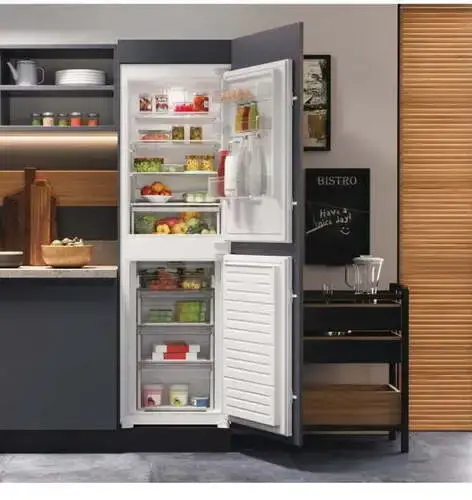
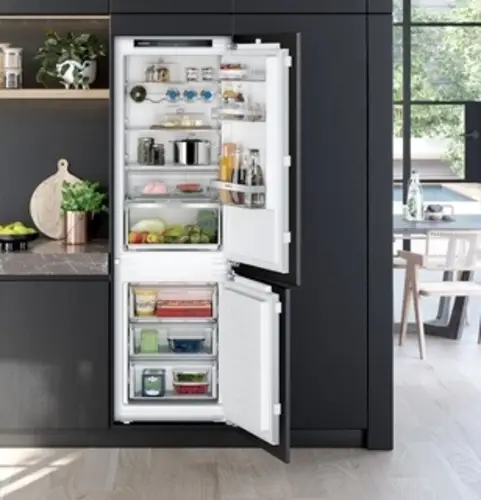
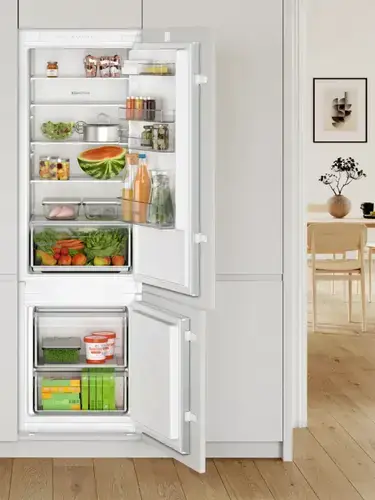
Left to right: 50/50 split (equal fridge and freezer), 60/40 split (more fridge), 70/30 split (predominantly fridge). The proportions visible here reflect the relative heights of the fridge and freezer sections within the appliance. The 80/20 split reduces the freezer section further still — primarily suited to households with a separate freezer elsewhere.
The most common split regret. Buyers who choose 50/50 or 60/40 frequently wish they had chosen 70/30 after a year of use, because the freezer section is larger than they actually need. If you are unsure, start with 70/30. Move towards 60/40 only if you have a specific reason — regular batch cooking and freezing, a household member who relies heavily on frozen meals, or a deliberate choice to replace separate appliances with one that stores more frozen food.
Frost systems.
Static, low frost, and frost free.
The frost management system determines how the freezer handles ice build-up and how much maintenance the appliance requires over its life. There are three systems in the current market, and they differ significantly in convenience and long-term ownership experience.
Static cooling is the most basic system. The evaporator cools the cabinet passively without a fan circulating air. Ice gradually builds up in the freezer section and requires periodic manual defrosting — typically once or twice a year. This is the lowest cost option at purchase. The ownership trade is the manual maintenance cycle and less even temperature distribution. Static systems are now increasingly rare in built-in integrated fridge freezers, where they are viewed as an entry-level characteristic rather than a meaningful specification choice.
Low frost systems reduce the rate of ice build-up significantly but do not eliminate it entirely. The evaporator has a heater that periodically runs a partial defrost cycle, reducing ice accumulation on the freezer walls. Some manual defrosting is still required over time, but the interval is longer and the build-up less significant than with a static system. Low frost is a meaningful step up from static and still found on mid-range integrated models.
Frost free (NoFrost) systems use a fan to circulate air through the freezer and an automatic defrost cycle that runs regularly to prevent any ice accumulation. The freezer never requires manual defrosting. Drawer space is consistent over time (ice build-up does not gradually reduce usable depth), and the system operates more evenly throughout the cabinet. Frost free is the standard specification across mid to premium integrated fridge freezers and is the most practical choice for most households.
Frost free and energy use. Frost-free systems run a fan motor alongside the compressor, which uses slightly more energy than equivalent static models. In practice, the difference is modest and modern frost-free integrated fridge freezers are available with strong energy ratings. The long-term convenience of no manual defrosting typically outweighs the marginal energy difference for most buyers.
Sliding hinge vs fixed hinge.
How the furniture door connects to the appliance.
The hinge system determines how the kitchen furniture door connects to and moves with the integrated fridge freezer door. There are two systems in common use: sliding hinge and fixed hinge. They behave differently in use, suit different furniture door weights, and are not interchangeable in an existing installation without modifications to the cabinet and appliance mounting.
When replacing an integrated fridge freezer in an existing kitchen: always buy the same hinge type as the appliance being replaced. Changing hinge type typically requires new door brackets, different furniture door modifications, and in some cases adjustment to the housing cabinet itself. Fitting the same hinge type is straightforward for a kitchen fitter. Changing hinge type mid-renovation adds cost and complication that is avoidable.
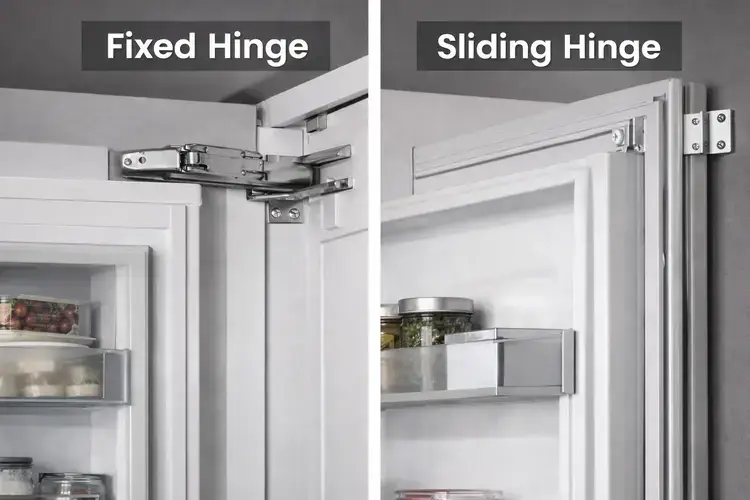
Always specify the same hinge type as the appliance being replaced. Changing from sliding to fixed (or vice versa) requires new hardware, different cabinet modifications, and additional fitting time. The hinge type should match — not just the appliance dimensions.
Fixed hinge versus sliding hinge shown side by side. The fixed hinge attaches the furniture door directly to the appliance door frame — one solid connection. The sliding hinge uses a rail bracket system between furniture and appliance that allows the two doors to move in relation to each other as they open.
With a fixed hinge, the furniture door is attached directly to the appliance door using a hinge bracket that creates a single solid connection. When you open the furniture door, the appliance door moves with it as one unit. The door opens to a wider angle than sliding hinge designs, giving clear, unobstructed access to the full width of the fridge cavity.
- Supports heavier hardwood and solid furniture doors — suited to kitchens with substantial door weights
- Wider door opening angle gives better, more direct access to the full refrigerator interior
- More solid, direct door action — no movement between furniture door and appliance door
- Simpler mechanism with fewer moving components
- Not compatible with all appliance models — confirm fixed hinge availability for the specific model before purchasing
- Changing from sliding to fixed hinge in an existing kitchen requires new hardware and cabinet modification
A sliding hinge system uses brackets mounted between the furniture door and the appliance, connected by a sliding rail mechanism. As the furniture door opens, the rail slides and pulls the appliance door open simultaneously. The two doors move in relation to each other through the sliding mechanism rather than as one fixed unit.
- Most common hinge system for UK integrated kitchens — the widest appliance range uses sliding hinge as standard
- Compatible with standard furniture door weights across most kitchen ranges
- Relatively straightforward replacement — most kitchen fitters are familiar with sliding hinge installation
- Not suitable for very heavy hardwood or solid stone-effect furniture doors — the sliding mechanism has a weight limit
- Slightly less open access angle than fixed hinge
- More components in the mechanism — bracket, rail, and multiple attachment points — require correct initial installation
Ventilation.
The most overlooked planning requirement.
Integrated refrigeration generates heat as part of the cooling process. In a freestanding fridge freezer, this heat dissipates into the room from the back and sides of the appliance. In an integrated fridge freezer enclosed within a furniture housing, the heat must have a designed escape route — otherwise it builds up inside the housing, forces the compressor to work harder, reduces energy efficiency, increases noise levels, and shortens the appliance's operational life.
The standard ventilation path for an integrated fridge freezer is: cold air in through the plinth grille at the bottom of the housing, circulation around the appliance body, and warm air out through the top of the housing. This convection path must not be obstructed by the furniture design, any additional decorative panels, or solid plinth boards without grilles. Many installation problems with integrated refrigeration trace back to inadequate ventilation rather than appliance failure.
The plinth grille at the base of the housing allows cool air to enter from the kitchen floor level. The grille must be maintained — a plinth grille blocked by accumulated dust significantly reduces the airflow available to the appliance. Clean it periodically as part of kitchen maintenance.
At the top of the housing, the warm air exhaust route varies by model. Some appliances vent through the top panel of the housing into the void above the ceiling of the kitchen units. Others require a grille or vent panel at the top of the housing face. If the kitchen design has a pelmet or closed-top cabinet run above the fridge freezer housing, confirm the ventilation route with the specific model's installation guide before the cabinetry is ordered — sealed top housings without any exhaust route are a common installation error.
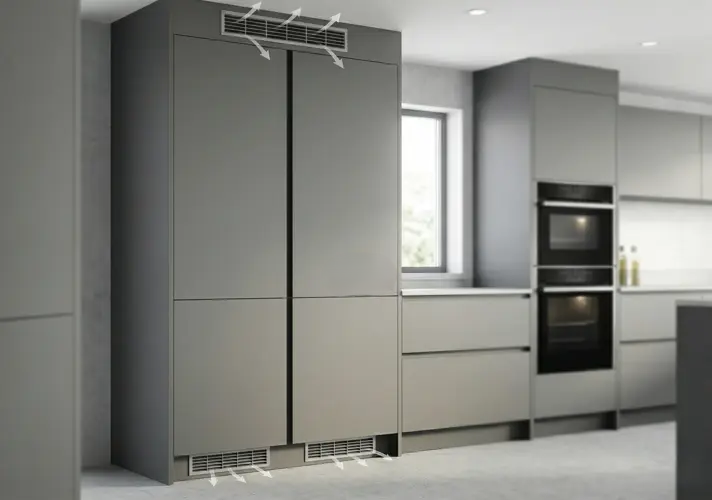
Ventilation diagram showing the two key points: plinth grille at the base (cool air in) and top ventilation grille or vent panel (warm air out). Both must be specified in the furniture design and kept clear during ownership. The specific ventilation requirements — grille sizes, clearances, and vent positions — vary by appliance model and are detailed in the installation guide.
Always follow the installation guide ventilation specification, not a general assumption. Ventilation requirements vary between appliance models and manufacturers. The required plinth grille size, clearances around the appliance body, and top exhaust method are all specified in the installation instructions. Using a generic ventilation approach without checking the specific model is one of the most common causes of poor long-term performance in integrated refrigeration.
Special features.
Ice makers, water, French doors, and more.
Premium integrated fridge freezers now include features that previously existed only in freestanding American-style refrigerators. These are worth understanding before specifying, both for the genuine benefits they provide and for the planning implications they create.
Energy efficiency, noise, and longevity.
Energy efficiency. A fridge freezer runs every day for its entire operational life. The energy it consumes is not a one-off cost — it compounds over 10–15 years of continuous operation. Integrated refrigeration tends to run less efficiently than equivalent freestanding models because the appliance is enclosed within cabinetry that reduces the natural convection around it. This makes the ventilation provision even more important: a well-ventilated integrated fridge freezer uses significantly less energy than an identically specified model with blocked airflow.
When comparing energy ratings, look at the annual energy consumption figure in kWh rather than only the letter grade. Two appliances with the same letter grade can have meaningfully different actual annual consumption. Over a 10-year ownership period, a difference of 50kWh per year at 28 pence per kWh represents £140 — worth comparing at purchase.
Noise levels. A fridge freezer in a closed larder or utility room is inaudible in the rest of the house. The same appliance integrated into an open-plan kitchen-diner — where it sits 2–3 metres from the dining table and seating — is a different matter. Compressor noise, fan noise during defrost cycles, and ice maker operation all become noticeable in quiet open-plan spaces. Check the dB rating for any integrated fridge freezer specified for an open-plan position. A quieter model at 35–38dB makes a meaningful difference to everyday living in open-plan designs.
Longevity. The longest-lived integrated fridge freezers are typically those with correct initial installation (particularly ventilation), frost-free systems that reduce internal stress, and well-maintained compressors operating at normal load rather than under constant elevated stress from inadequate airflow. Premium build quality — better door seals, more robust drawer runners, higher-quality compressors — contributes to longevity but correct installation matters more than the specification tier.
Climate class. Built-in fridge freezers are rated for an ambient temperature range. Most UK kitchen integrated models are climate class SN-T (10–43°C) or N-T (16–43°C). Confirm the climate class from the specification sheet — appliances installed in utility rooms or garages that get cold in winter need to cover the low end of the ambient range to maintain correct freezer operation.
Comparison.
Key decisions side by side.
| Aspect | Standard specification | Premium specification | What to consider |
|---|---|---|---|
| Height | 177cm. Standard housing. Wider model availability. | 193cm. More fresh food space. Confirm housing height before ordering furniture. | If the ceiling height and housing design allow 193cm, it is worth choosing. More fridge space is the practical gain. |
| Width | 60cm. Standard kitchen module. Best replacement availability. | 70cm, 76cm, 80cm, 91cm. Wider shelves. French-door and ice-water formats. Requires wider housing. | Choose wider only if the kitchen layout has space for the wider housing and you will use the additional capacity regularly. |
| Split type | 50/50 or 60/40. More balanced between fridge and freezer. | 70/30 or 80/20. More fridge-led. | For most households, 70/30 is the practical starting point. Adjust only if your specific shopping and cooking habits justify a different split. |
| Frost system | Low frost. Reduced ice build-up. Some manual defrosting still required. | Frost free (NoFrost). No manual defrosting ever. Consistent drawer space. | Frost free is worth the premium for most households. The maintenance saving over 10+ years is significant. |
| Hinge type | Sliding hinge. Most common. Compatible with standard furniture door weights. | Fixed hinge. Heavier doors. Wider opening angle. More direct door action. | Choose the hinge type that suits your furniture door weight. When replacing: always match the existing hinge type. |
| Ice and water | No ice or water. No plumbing required. | Built-in ice maker and water dispenser on selected wide models. Requires plumbed cold water supply. | Plan the plumbing connection before the kitchen is built. Cannot be retrofitted easily after installation. |
| Cooling circuit | Single shared cooling circuit for fridge and freezer. | Dual independent cooling circuits. No humidity or odour transfer between sections. | Worth specifying for food-focused households. Less important for moderate use. |
| Energy use | Standard energy rating. Check annual kWh figure. | Better energy management. Lower annual consumption on best models. | Compare annual kWh figures, not just letter grades. The difference compounds over 10+ years. |
| Noise | Typical range 38–42dB. Standard for enclosed kitchens. | Quieter 34–38dB. Better for open-plan kitchen-diners. | Check dB rating for any appliance specified for an open-plan position near dining or seating areas. |
Frequently asked questions.
See the Appliances hub for guides to other built-in kitchen appliances. The Ovens hub covers all oven types from single ovens through to steam ovens and warming drawers.