
Gas hobs.
The complete UK guide.
A gas hob uses an open flame to heat pans directly. It remains a familiar and widely specified choice across UK kitchens because the flame responds immediately to any adjustment, delivers high output for wok cooking and charring, and works with every cookware type without compatibility requirements.
Modern gas hobs range from compact 60cm four-burner layouts to wide 90cm models with dedicated high-output wok burners. Surface finishes cover black glass (Gas on Glass), stainless steel, and enamel. Gas hobs are available in two fuel configurations: connected to the UK mains natural gas network, or running on LPG (liquefied petroleum gas) from a cylinder or tank. These are different products requiring different jets and different installation. Confirm your fuel type before ordering.
This guide covers how gas hobs work, the three surface finishes, LPG versus natural gas, sizes, clearance requirements, installation, the comparison with induction, and the UK market context. Read the clearances section carefully before finalising your kitchen plan — the minimum distance between a gas hob and an overhead extractor is a mandatory safety requirement that affects hood positioning and tall cabinet placement.
How a gas hob works.
A gas hob mixes gas with air at a controlled ratio and ignites the mixture at each burner head. The resulting flame heats the pan from below and around the base, with the intensity controlled by the flow of gas through the valve. Turn the knob to reduce the flow and the flame immediately shrinks. Close the valve entirely and the flame stops instantly.
Each burner consists of a gas port in the hob body, a burner cap that spreads the flame evenly in a ring around the pan base, and a cast iron or steel pan support that holds the cookware above the flame at the correct height. The gap between pan base and flame is fixed by the support height. On high-output wok burners, the support is typically shaped to cradle a round-bottomed wok at the right angle.
Flame-failure devices (thermocouples) are a mandatory safety feature on all modern gas hobs. A thermocouple next to each burner heats up when the flame is lit. If the flame goes out unexpectedly, the thermocouple cools within seconds and triggers the gas valve to close automatically, preventing unburned gas from entering the kitchen. This is a legal requirement on all gas appliances sold in the UK.
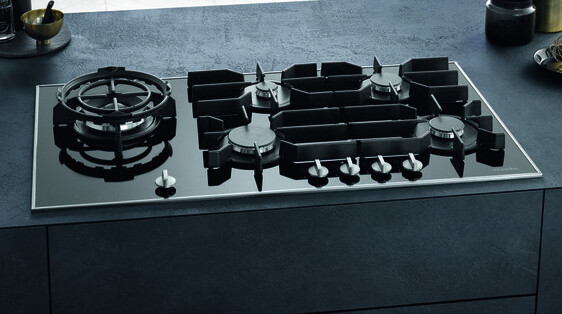
Miele gas hob. Cast iron pan supports over burner crowns. The central high-output wok burner is larger in diameter and produces significantly more heat than the surrounding standard burners.
Surface finishes.
Glass, steel, or enamel.
The surface finish of a gas hob determines how it looks in the kitchen, how it cleans, and how it integrates with the worktop and surrounding appliances. Three finishes cover the market. Gas on Glass dominates modern German kitchen specifications. Stainless steel is the professional kitchen reference. Enamel sits at the mid-range entry level.
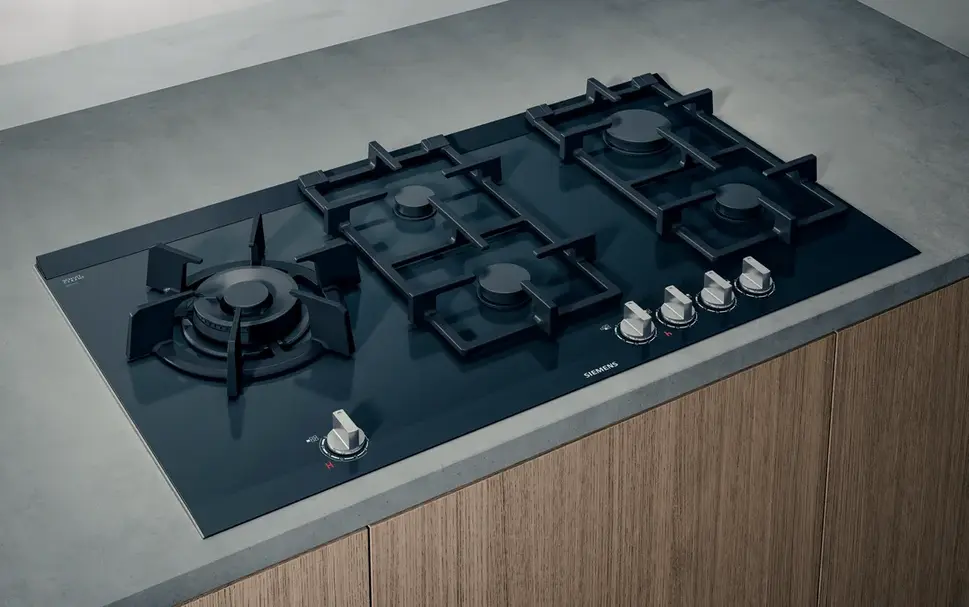
- Wipes clean easily between supports
- Integrates well with modern kitchen finishes
- Shows dust and water marks under strong light
- Pan supports must be lifted, not dragged across the glass
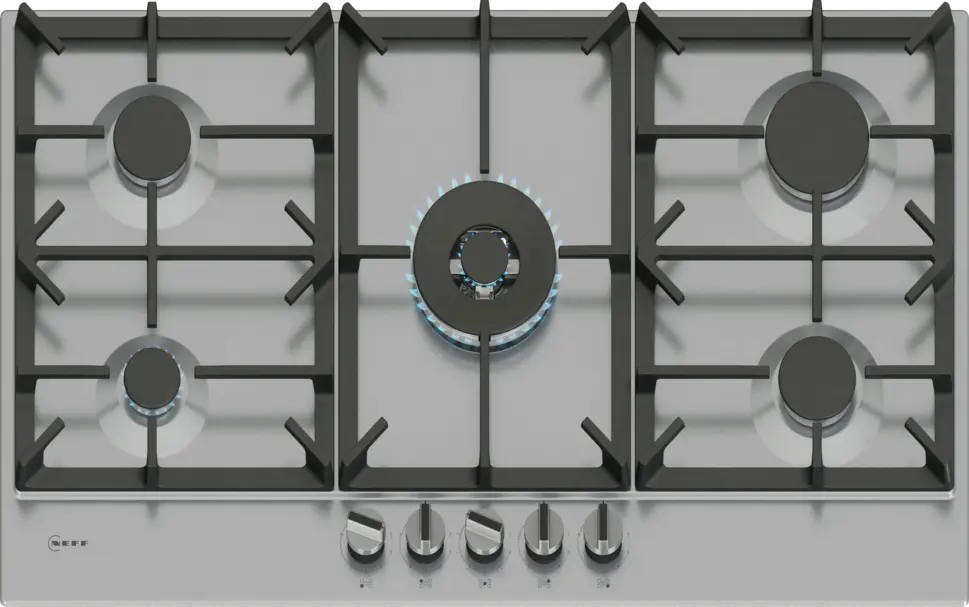
- Durable and heat-tolerant under daily cooking
- Classic professional finish, easy to match across appliances
- Shows fingerprints and water marks clearly
- Fine scratches accumulate over time, particularly on brushed finishes
- Lower cost than glass or stainless
- Traditional appearance, available in cream and black as well as standard finishes
- Chips are visible and permanent — the damage does not self-heal or polish out
- Cleaning requires more effort around the enamel edges and spill channels
LPG vs natural gas.
Confirm your fuel type before ordering.
Gas hobs are manufactured to run on either natural gas (methane, delivered via the UK mains network) or LPG (liquefied petroleum gas, typically propane or butane, supplied in cylinders or a tank). These are different gases with different pressures and burning characteristics. A hob configured for natural gas will not work correctly on LPG, and vice versa.
Most gas hobs sold in the UK are supplied configured for natural gas as standard. LPG conversion kits, which replace the gas jets and adjust the pressure regulator, are available for most models but must be fitted by a Gas Safe engineer. Some manufacturers supply LPG jets in the box as standard. Check the specification sheet before purchasing if you are on LPG.
The choice between LPG and mains gas is typically determined by your property type rather than personal preference. Most urban UK properties have access to the mains natural gas network. Rural properties, off-grid homes, and some coastal or island locations use LPG because the mains network does not reach them.
- Continuous supply, no cylinders to manage or replace
- Standard configuration on most UK gas hobs
- Not available in all areas, particularly rural locations
- Not available in new UK builds from 2026
- Requires specific LPG jets fitted by a Gas Safe engineer
- Propane performs better in cold temperatures than butane
- Tank or cylinder supply needs monitoring and scheduled delivery
- Running cost typically higher than mains gas per unit of energy
Always confirm the fuel configuration with your Gas Safe engineer before ordering. A hob fitted with the wrong jets for your fuel type will produce incorrect flame heights, incomplete combustion, and in extreme cases a carbon monoxide risk. This is not a DIY adjustment. LPG conversion must be performed by a Gas Safe registered engineer.
Standard sizes.
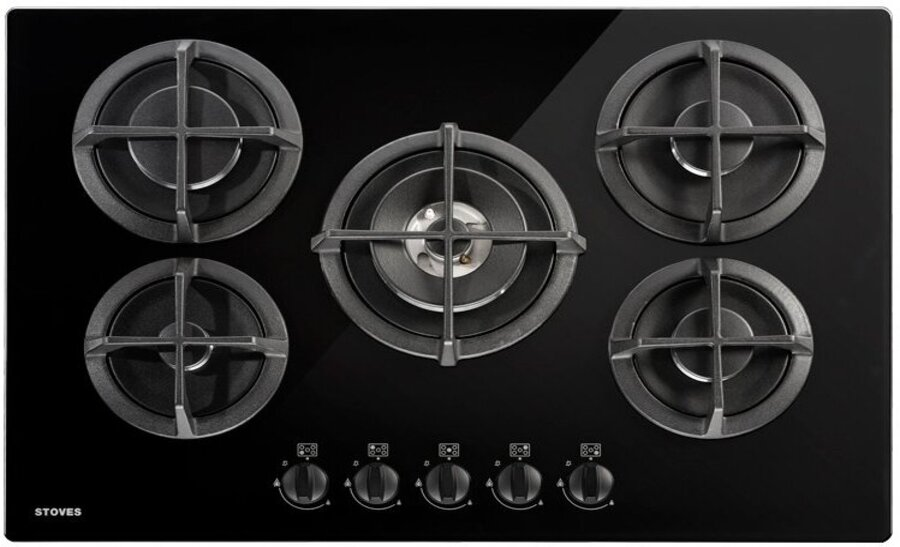
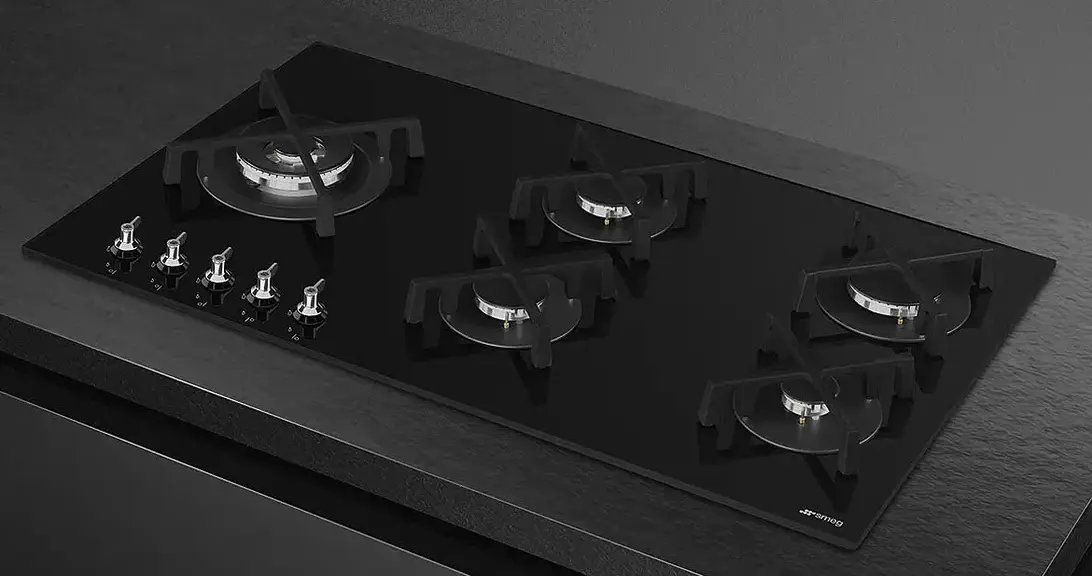
Domino gas modules (30–40cm) pair well with induction zones on the same worktop. A compact two-burner gas module alongside a 60cm induction hob gives flame cooking for wok work and precise digital control for everything else. See the Domino Hob guide for the modular format options.
Clearances.
Confirm these before your kitchen is designed.
Gas hob clearance requirements are safety specifications, not design preferences. They must be met for the installation to comply with UK building regulations and for your home insurance to remain valid. Confirm all clearance dimensions with your Gas Safe engineer and kitchen designer before the layout is finalised. Changing cabinet or hood positions after a kitchen is installed to meet clearances is expensive and sometimes not possible without structural work.
The most commonly overlooked clearance is the distance between the hob and the overhead extractor. 750mm is the minimum for most gas hobs. Some manufacturers specify more. Measure this from the hob cooking surface to the lowest point of the extractor hood or canopy. If a ceiling-mounted extractor sits too low, it will not comply with the hob manufacturer's installation requirements and may void the warranty of both appliances.
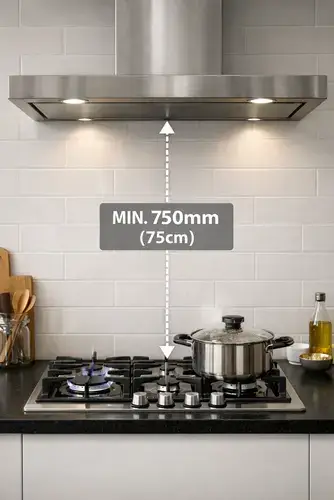
750mm is the standard minimum clearance from the gas hob cooking surface to the lowest point of the overhead extractor. Always check the specific hob installation guide — some manufacturers require 800mm or more. This must be confirmed before the hood position is fixed.
No electrical sockets or switches above the hob. Switches, sockets, and electrical outlets must not be positioned in the hot zone above the burners. The exact exclusion zone is defined in BS 7671 and your hob installation guide. Discuss the socket plan with your electrician before first fix.
Installation.
Top-mounted or flush-mounted. Decide before templating.
- Compatible with all worktop materials
- Simpler rectangular cutout. Easier for the fabricator.
- Easier to replace at end of service life
- Small lip helps contain spills at the hob edge
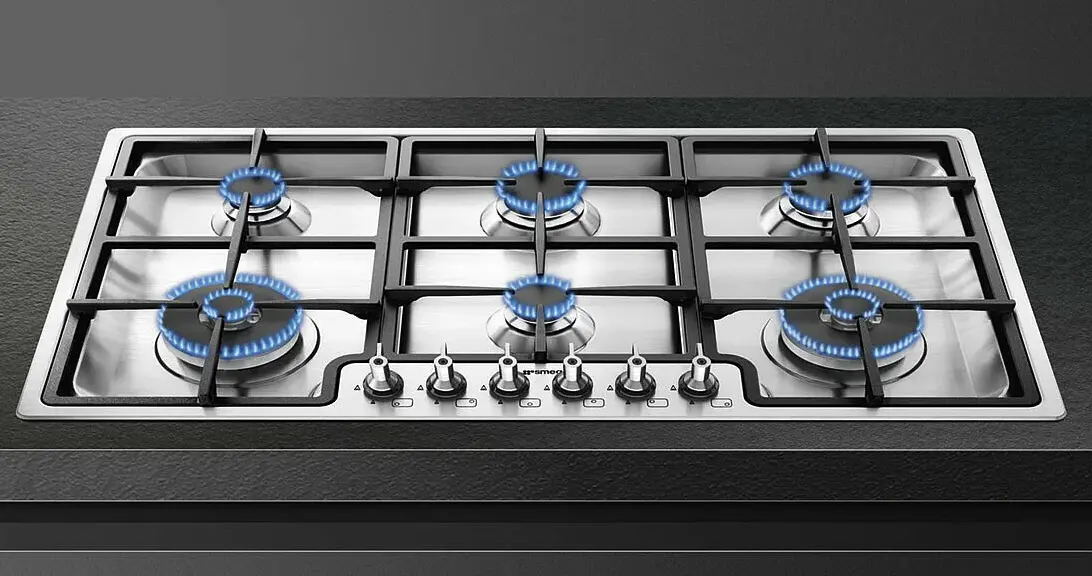
- Stone or quartz only — laminate and timber not suitable
- Requires a rebated cutout to precise manufacturer dimensions
- Thicker worktops (30–40mm) needed if an oven sits directly below
- Future replacement hob must match the same frame dimensions
Confirm the installation method with the worktop fabricator before the template visit. The fabricator needs the cutout dimensions from the hob installation guide, not the overall hob dimensions. For flush mounting, they also need the rebate depth specification. Bring the installation instruction sheet to the template appointment.
Gas vs induction.
Gas and induction are the two dominant hob technologies in the UK market. Both are capable of producing excellent cooking results. The differences are in heat delivery method, efficiency, safety, cleaning, and long-term running cost. The comparison below covers the practical distinctions that matter for a UK kitchen buyer in 2025.
| Aspect | Gas hob | Induction hob |
|---|---|---|
| Heat delivery | Open flame heats pan from below and around the base. Heat is visible and immediately responsive to knob adjustment. | Electromagnetic field heats the pan base directly. The glass surface stays cool. Response to adjustment is instant and precise. |
| Efficiency | 40–55% efficiency. Significant heat escapes into the kitchen around the pan and from the flame itself. | 85–90% efficiency. Almost all energy goes directly into the pan. Less ambient heat in the kitchen during cooking. |
| Speed | Traditional heating speed. Full output from first ignition with no warm-up period. | Faster than gas for boiling water. The efficiency advantage means more energy enters the pan per second. |
| Control feel | Analogue and visual. The flame is a direct indicator of heat level. Many experienced cooks find this more intuitive than digital levels. | Digital and precise. Consistent low-heat settings without the flame drift that occurs at low gas settings. |
| Cookware | Works with all cookware: steel, stainless, cast iron, copper, aluminium, ceramic, glass. No compatibility requirement. | Requires induction-compatible cookware with a ferromagnetic base. Copper, aluminium, and glass pans will not work without a bonded steel base. |
| Safety | Open flame and very hot cast iron supports throughout cooking. Flame-failure device closes the gas valve if the flame is extinguished. | Glass surface stays cool away from the active zone. Residual heat indicator shows when the surface is safe to touch. Auto shut-off and child lock standard. |
| Cleaning | Pan supports and burner caps must be removed for cleaning. Grease and spills collect in the burner recesses and under the supports. | Flat glass surface wipes clean with a cloth and hob cleaner. Spills do not bake onto a very hot surface. |
| Power cuts | Continues to work during a power cut. Ignition needs electricity but a match lights the burner. | Stops completely during a power cut. No backup cooking capability. |
| Services | Requires a gas connection. Gas Safe engineer for installation. Not available in new UK builds from 2026. | Dedicated electrical circuit (32 amp minimum). No gas connection needed. |
| Running cost trend | UK gas prices have increased significantly since 2021. Running costs per cooking session sit higher than induction on current UK energy tariffs for many households. | Higher efficiency means less energy used per cooking session. Electricity unit cost is higher than gas, but efficiency advantage partially offsets this. |
UK market context: the shift towards induction
The UK is moving steadily towards electric cooking. Induction takes the majority share in new kitchen specifications. Gas hobs remain fully available and are the right choice for many households — particularly those with an existing gas connection who prioritise flame cooking and cookware compatibility. However, several German and European brands are releasing fewer gas models and lead times have extended on some units.
If you are installing a gas hob in a kitchen renovation, ask your electrician to run a 32-amp induction-rated cable to the hob position at the same time. The cost of running the cable during a renovation is a fraction of the cost of running it later. This gives you a simple path to induction when you next replace the hob without requiring additional electrical work.
Benefits and limits.
- Immediate visible control. The flame is a direct, intuitive indicator of heat level. Many experienced cooks find this more natural than digital power settings.
- Works with all cookware types. No pan compatibility requirement. Your existing collection of stainless, copper, aluminium, and non-magnetic cookware all work without replacement.
- High output for specialist cooking. High-output wok burners on 70–90cm models deliver the heat intensity required for genuine wok-frying and charring that standard induction zones do not fully replicate.
- Continues working during a power cut. Ignition requires electricity, but the burner lights with a match and cooking continues uninterrupted.
- Existing gas connection already in place. If the pipework is present and in good condition, a gas hob is a straightforward installation without additional service runs.
- Lower energy efficiency than induction. 40–55% of the energy from gas reaches the pan. The remainder heats the kitchen environment, which is particularly noticeable in smaller rooms and open-plan spaces.
- More cleaning effort. Pan supports, burner caps, and the recesses beneath them require periodic removal and scrubbing. Dried spills and grease build-up is harder to remove than on a flat induction surface.
- Open flame safety considerations. Young children and elderly users face a higher risk from the open flame and very hot cast iron supports than from a cool induction surface.
- Not available in new UK builds from 2026. If you are planning a new build, gas is not an option. In existing properties, confirm the gas pipework condition with a Gas Safe engineer before specifying a new hob on an old supply.
- Running cost uncertainty. UK gas tariffs have become less predictable. Induction's efficiency advantage means the running cost comparison versus gas can change significantly with tariff movements.
Safety and regulations.
Gas Safe installation is a legal requirement. UK law requires that any work on a gas appliance, including installation, adjustment, servicing, and conversion to LPG, is carried out by a Gas Safe registered engineer. This is not optional. An unregistered installation is illegal, likely to invalidate your home insurance, and may prevent a future sale of the property. Keep the Gas Safe certificate with your kitchen documentation.
Ventilation. Gas combustion consumes oxygen and produces combustion gases including carbon dioxide and, in incomplete combustion, carbon monoxide. The room must have adequate ventilation to supply combustion air and remove combustion products. Building regulations define the ventilation requirements for rooms with gas appliances. Your Gas Safe engineer confirms ventilation adequacy as part of the installation.
Carbon monoxide detector. A carbon monoxide detector is strongly recommended in any room with a gas appliance. Position it on the ceiling or wall according to the manufacturer's instructions, and test it regularly. Replace it within the manufacturer's stated service life.
Carbon monoxide is odourless and colourless. You cannot detect it without a sensor. A malfunctioning or poorly ventilated gas appliance can produce dangerous levels without any visible or olfactory warning. A working carbon monoxide detector is not optional in a kitchen with a gas hob.
Buying checklist — confirm before ordering.
- LPG or natural gas? Confirm your fuel type and whether the hob requires conversion jets for LPG. Check if jets are included or need to be ordered separately.
- Cutout and worktop dimensions. Confirm the hob cutout dimensions against your worktop depth, particularly if an oven sits below (30–40mm worktops required for rebated flush-mount with oven below).
- Extractor clearance confirmed. Measure from the hob cooking surface to the lowest point of the planned hood. 750mm minimum. Check your hob installation guide for the specific model requirement.
- Gas Safe engineer booked. The engineer must carry out the installation. Get the Gas Safe certificate at completion.
- Induction cable provision. Ask your electrician to run a 32-amp cable to the hob position during the renovation, even if you are installing gas now. This avoids costly additional electrical work in future.
- Carbon monoxide detector. Specify and fit a detector at installation. Keep a record of its service life and replacement date.
UK cost guide.
These figures are indicative for 2025. They cover the hob unit only. Gas Safe installation, worktop cutout fabrication, and any pipework modifications are additional costs. Use them to understand relative positioning between product tiers before requesting quotes.
Budget separately for installation. Gas Safe installation typically adds £150–£300 depending on access and region. LPG conversion, if required, adds a further cost for jet replacement and pressure testing. New pipework runs or connection to an existing supply not immediately adjacent to the hob position add further to the total installed cost.
Is a gas hob
right for your household?
- You have a working gas connection in place and want to use it. Pipework condition should be confirmed by a Gas Safe engineer before specifying a new hob on an old supply.
- You cook with non-magnetic cookware (copper, aluminium, ceramic) and do not want to replace it.
- Visual flame control matters to you. You find analogue knob-and-flame cooking more intuitive than digital power levels and are not ready to change your cooking approach.
- You regularly cook at high heat for wok dishes, charring, and searing, and want the specific output profile that a high-BTU gas wok burner delivers.
- Your property experiences regular power cuts and you want a cooking capability that is not dependent on electricity.
- You are planning a new build from 2026. Gas connections are not available. Induction is the default electric specification.
- Safety is a priority. Young children or elderly household members benefit from the cool-surface and auto-shutoff characteristics of induction that gas cannot provide.
- You want a simple cleaning routine. A flat induction surface requires significantly less effort to maintain than gas burners, caps, and pan supports.
- You cook in an open-plan space where heat produced by a gas hob affects the comfort of the living area. Induction directs energy into the pan rather than into the room.
- Long-term running cost efficiency matters. Induction's 85–90% efficiency delivers more cooking energy per pound spent on fuel than gas at current UK energy tariffs.
Return to the Hobs guide to compare gas against all other hob types. The Induction Hob guide covers the full induction specification in detail. The Dual Fuel Hob guide covers the option of combining gas burners and induction zones in a single unit.