
Grill hobs.
Indoor barbecue on your worktop.
A grill hob is a built-in cooking module that brings barbecue-style grilling to the worktop. Food sits on open grates or a ridged plate above a heat source. Fat and cooking liquid drain through the grates or channel into a removable drip tray below. The result is charred grill lines, direct radiant heat, and the flavour profile of outdoor grilling — without needing the garden or the weather.
In UK kitchen specifications, grill hobs are almost always fitted as a domino module alongside a main induction hob. The grill handles steaks, burgers, fish fillets, and firm vegetables in a dedicated cooking zone while the induction hob stays free for pans, sauces, and everything else. A grill hob is a specialist appliance, not a replacement for an induction hob. Its value depends entirely on how often grilled food features in your cooking.
This guide covers how grill hobs work, the two heating technologies, flush versus top-mounted installation, the three compatibility checks for fitting beside another hob, extraction requirements, sizes, buying considerations, and the honest comparison with a teppanyaki plate. Read the extraction section before finalising your kitchen plan — a grill hob produces significantly more smoke than any standard hob and an undersized extractor is the most common installation mistake.
How a grill hob works.
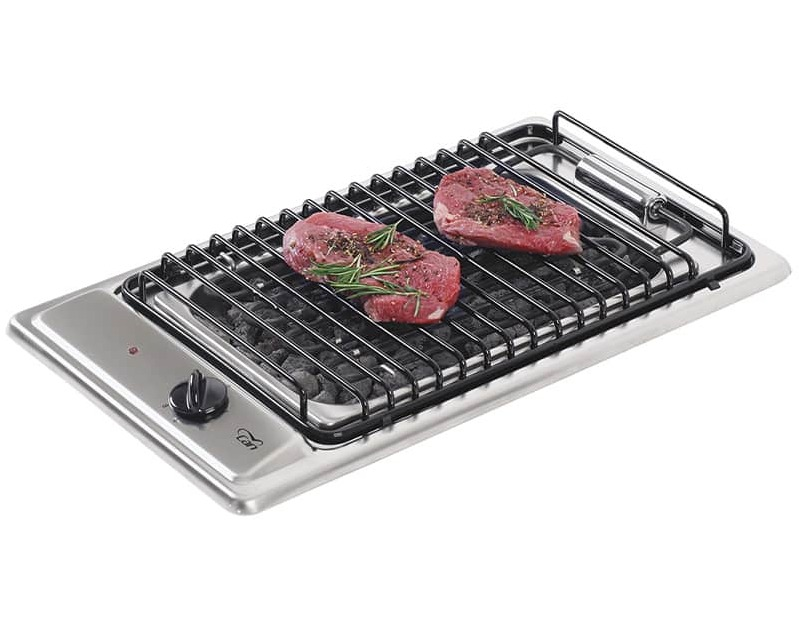
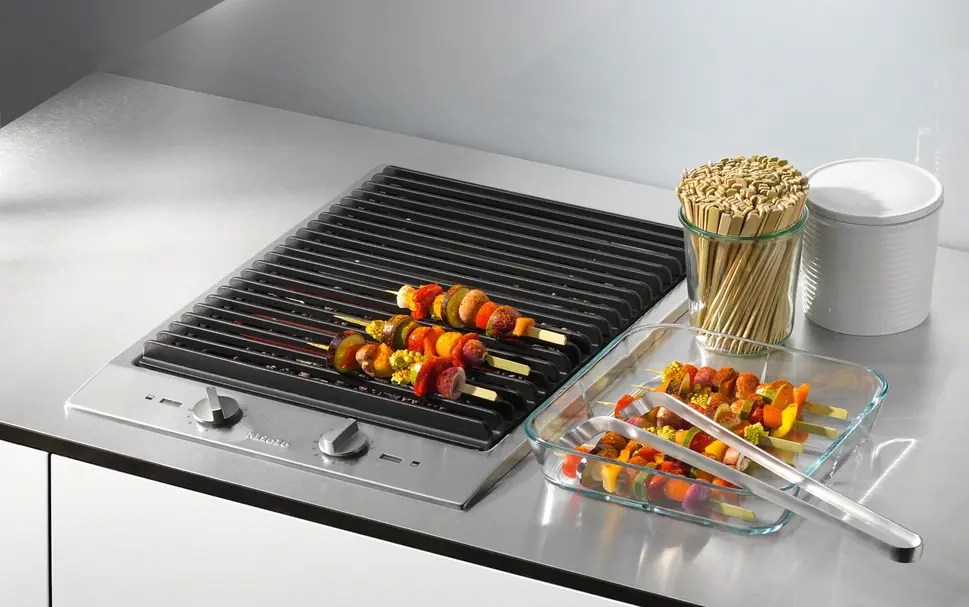
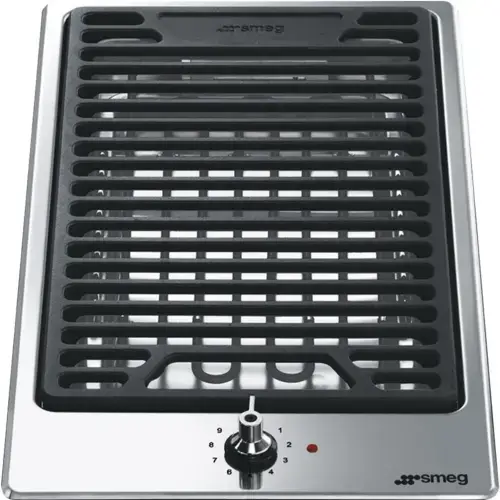
A grill hob works by radiating intense heat upward from a heat source — either electric elements or heated lava stones — through an open grate or ridged plate surface. Food placed on the grates receives direct radiant heat from below while the bars create the characteristic grill marks and char effect of a barbecue.
The gap between the grate bars allows fat to render and fall away from the food as it cooks. A drip tray below the grate catches this fat and cooking liquid. This fat separation is the primary health argument for grilling over shallow frying — food cooks without sitting in its own fat.
Most domino-format grill hobs offer two heating zones that run at independent temperatures. You cook meat at maximum heat on one side while holding vegetables or already-cooked items at a lower temperature on the other. Controls typically run along the front edge of the module and are accessible even during cooking. The grate, the tray, and sometimes the burner element are all removable for cleaning after each session.
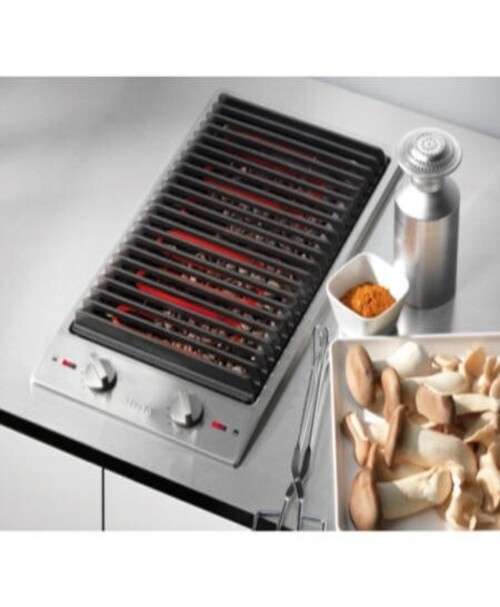
Miele grill hob. Cast iron ridged grate above the heating elements. Fat drains through the grate gaps into the removable drip tray. The module sits flush with the adjacent hob and worktop surface.
Electric elements
vs lava stone.
Grill hobs in the UK market use one of two heating technologies beneath the grate. Both produce excellent grill results. The practical differences relate to heat character, maintenance, and cost. Most households will be well served by a quality electric element grill. Lava stone is a premium specification for those who specifically want the deep radiant heat quality that the stones provide.
- Predictable, controllable heat across the grate surface
- Choice of open grate (grill marks) or solid ridged plate (more contact area)
- Simpler maintenance — elements are durable and do not need replacement under normal use
- Heat character is direct radiant heat, not the diffuse deep heat of lava stones
- Deep, intense radiant heat with excellent sear and flavour development
- More consistent temperature across the cooking surface once up to heat
- Higher purchase price — available mainly on premium brand models
- Stones require turning periodically for even wear and replacement when cracked
- More maintenance: vacuum or wipe stones regularly, replace degraded stones
Flush or top-mounted.
Decide before the worktop is templated.
A grill hob installs into the worktop either flush with the surrounding surface or sitting on top of it with a visible frame at the edge. Confirm this decision before the worktop company visits to template. The cutout specification — including any rebate depth for flush mounting — is different between the two methods. Changing the mounting choice after the worktop is cut requires a new worktop.
- Stone, quartz, porcelain, or Corian only — not laminate or timber
- Rebate depth and cutout dimensions from the manufacturer's installation guide
- Silicone sealing around the perimeter to prevent water ingress into the cabinet
- Future replacement must match the same frame dimensions
- Compatible with all worktop materials including laminate and wood
- Standard rectangular cutout — simpler for the fabricator to execute
- Easier to replace at end of service life without worktop modification
- Small lip creates a cleaning detail at the join where the module meets the worktop
What to tell the worktop company before the template visit. Confirm: (1) flush-mounted or top-mounted, (2) the exact cutout dimensions from the installation guide for this specific grill model, (3) rebate depth specification if flush mounting, (4) the position of the grill cutout relative to any adjacent hob cutout, and (5) the connector strip clearance between modules. Bring the installation instruction sheets for every hob module in the run. Do not rely on verbal descriptions — the fabricator needs the manufacturer's cutout drawing.
Fitting beside another hob.
Three checks before ordering.
A grill hob is almost always specified alongside an induction hob or other domino modules in the same worktop run. Three compatibility checks are essential before placing any orders. Discovering a problem after the worktop is cut is expensive to correct.
- Verify the cutout depth of every module you intend to combine. A grill module and an induction hob from the same manufacturer's domino range are designed to the same rebate depth and sit flush at the worktop surface. Modules from different brands or different product generations within the same brand may differ — even by a few millimetres.
- A depth mismatch produces a visible step between modules. On a stone island this is an unacceptable finish. Confirm the rebate depth from the installation guide for each unit before ordering. Do not rely on visual inspection of product images.
- Grill hob modules are typically heavier than standard domino hobs due to the cast iron grate and drip tray components. Confirm that the worktop support structure is adequate for the combined weight of all modules in the run.
- Confirm that the specific modules are designed to be installed directly adjacent. This is a specification check, not a visual one — modules may physically fit side by side while still requiring a clearance gap or filler strip between them per the installation requirements.
- Grill hobs generate significant radiant heat at and above the worktop level during use. Some manufacturers specify a minimum clearance between a grill module and an adjacent induction glass surface to prevent thermal stress at the glass edge. Check both installation guides before confirming the layout.
- Ask the manufacturer directly whether the two specific model numbers you are ordering are confirmed compatible for adjacent installation. Do not assume that same-brand modules are always compatible — confirm with the specific models.
- Order the manufacturer's connector strips at the same time as the modules. Connector strips are purpose-made bridging pieces that fill the gap between two adjacent modules, seal the join against spills running into the cabinet below, and mechanically link the modules together on the worktop surface.
- During grill cooking, fat renders off the food and some collects near the edges of the module. A gap without a connector strip allows this fat and any cooking liquid to drain into the cabinet below, which creates a hygiene and fire risk over repeated use.
- Connector strips are brand and model-specific. They are not interchangeable between manufacturers. Order them with the hobs and do not treat them as an afterthought — they are sometimes on longer lead times than the hobs themselves.
Stick to one manufacturer's range for the entire hob run. Depth dimensions, cutout sizes, connector strip profiles, and thermal clearance specifications are engineered within a brand's domino range to produce a flush, safe, and compatible result. Combining a grill module from one brand with an induction hob from another introduces risks across all three checks above that are difficult to resolve after installation.
Extraction.
Size it for the grill. Not for the induction hob.
Grilling produces more smoke, airborne fat, and cooking odour than any other domestic cooking method. Fat renders off the food surface and some becomes aerosolised by the radiant heat. Protein compounds char and produce smoke even at moderate grill temperatures. Without strong extraction, a grill session triggers smoke alarms, coats surfaces in grease, and leaves cooking smells throughout an open-plan home for hours.
Extraction capacity for a grill hob must be sized for the grill at full output, not for the adjacent induction hob. A hood or extractor that adequately handles the steam from induction cooking will be significantly underpowered for a grill session. For most island kitchens, this means an extraction rate of at least 600 m³/h and in practice often higher for a grill used at full heat with fatty cuts.
Treat extraction as a component cost of the grill hob specification, not a separate optional upgrade. The grill hob itself without adequate extraction is an appliance that creates more problems than it solves.
Overhead extraction — a ceiling or wall-mounted hood directly above the grill position — is the standard approach and the most effective for capturing grill smoke. The hood must be positioned at the correct clearance height and sized for the grill output, not just the nominal zone width.
Downdraft extraction — a slot in the worktop or a unit behind the grill that pulls vapour downward — is an option for island layouts where an overhead hood is not wanted or practical. Downdraft extraction for a grill hob requires a powerful fan and careful duct routing due to the volume of smoke and grease the grill generates. Confirm the rated extraction performance of the specific downdraft unit covers the grill output before specifying it as the sole extraction solution.
Ducted extraction is strongly preferred for a grill hob position. Recirculating extraction relies on grease and carbon filters. Under regular grill use, these filters saturate much faster than with induction cooking, reduce to ineffective performance quickly, and require frequent replacement to maintain any meaningful extraction at all.
Grill hob vs
teppanyaki hob.
Both grill and teppanyaki hobs are specialist domino modules that sit beside a main induction hob. Both are positioned for social, show-cooking situations. The difference is in the cooking surface, the food they suit, and the result they produce. Understanding the distinction helps confirm which is the right specialist function for your cooking style.
| Aspect | Grill hob | Teppanyaki hob |
|---|---|---|
| Surface type | Open grate bars or ridged plate. Food sits above the heat source. Significant air gap between food and element. | Flat smooth stainless steel plate. Food makes direct contact with the entire heated surface area. |
| Heat delivery | Radiant heat upward from elements or lava stones. Strong direct heat with air gaps around the food. | Conduction through the steel plate. Uniform heat across the cooking surface wherever the plate is in contact. |
| Best suited to | Steaks, burgers, lamb chops, firm fish fillets, kebabs, corn on the cob. Anything that benefits from grill marks, char flavour, and fat separation. | Thin cuts of meat and seafood, noodles, rice, eggs, pancakes, flatbreads. Anything suited to direct flat-surface contact. |
| Cooking result | Visible grill marks, charred exterior, barbecue-like flavour. Fat separation from draining through grates. | Even surface browning across the food face. Searing rather than charring. Closer to a restaurant-style griddle result. |
| Fat handling | Fat drains away through the grate gaps into the drip tray. Food does not cook in accumulated fat. | Small amount of cooking fat applied to the plate surface. A grease channel collects run-off into a tray. |
| Smoke level | High. Charring and fat-drip smoke are significant. Strong extraction is essential. Smoke alarms are likely without adequate extraction. | Moderate. More steam than smoke. Good extraction is needed but the demand is lower than for a grill hob at full use. |
| Cleaning effort | More demanding. Grates require removal, soaking, and scrubbing after each session. Carbon builds up on bars with repeated use. Drip tray must be emptied and washed. | Scrape the warm plate, wipe clean, empty the grease tray. More straightforward than grate cleaning if done immediately after cooking. |
| Social cooking | Familiar barbecue feel brought indoors. Cooking in front of guests produces a relaxed, recognisable experience that most guests engage with immediately. | Professional chef-style open cooking. Guests see an unfamiliar technique that adds theatre to the meal — particularly effective for Japanese-influenced entertaining. |
| Cookware | No cookware — food goes directly on the grate. Tongs and a spatula are the tools. | No pans required — spatulas and scrapers. All pan materials work on a teppanyaki plate if pan cooking is needed alongside the plate. |
If you regularly cook steaks, burgers, and barbecue-style food and want grill marks and char flavour, the grill hob is the right specialist choice. If you cook stir-fry dishes, flat foods, and social multi-ingredient sessions, a teppanyaki plate suits better. Some high-specification island kitchens include both in the same worktop run alongside an induction hob. This requires strong extraction sized for the grill output and careful domino compatibility planning for all three modules. See the Teppanyaki Hob guide for the full comparison from the teppanyaki perspective.
Standard sizes.
What to look for
when buying.
Benefits and limits.
- Authentic grill marks and charred flavour that no pan-based alternative fully replicates. For households who eat grilled meat, fish, and vegetables regularly, the result genuinely differs from pan cooking.
- Year-round indoor grilling regardless of weather. For homes without outdoor space, a grill-unfriendly garden, or a lease that prevents outdoor cooking, the grill hob brings that cooking style inside permanently.
- Fat separation as food cooks. Fat rendered from the food drains away rather than accumulating around the food. The cooking result is lower fat content per portion compared with shallow frying at equivalent heat.
- Social cooking on an island. Grilling in front of guests produces a familiar, engaging experience that feels less formal than serving from the kitchen and contributes to the open-plan entertaining brief that drives most island kitchen specifications.
- Main hob stays free. Grilling in a dedicated module means the adjacent induction zones remain available for pans, sauces, and accompaniments throughout the grill session.
- Extraction upgrade is mandatory and adds significant cost. This is not an optional extra. Budget for it as part of the grill hob specification from the start.
- Cleaning is more demanding than any other hob type. Grates must be removed and scrubbed after every session. Carbon builds up on bars with repeated use. Drip trays fill with fat and need emptying. Maintaining a grill hob to a hygiene and fire-safety standard requires consistent post-session attention.
- Specialist use only. A grill hob does one thing well. If your cooking is predominantly sauces, soups, pasta, and pan-based dishes, a grill module occupies worktop space and electrical capacity for a function you use infrequently.
- Higher electrical load than a standard domino module. Must be factored into the total circuit capacity alongside the main induction hob and oven.
- Premium brand dependency. UK parts availability and service for specialist grill modules is limited to a small number of premium brands. Budget for service and parts costs over the kitchen's lifetime.
Maintenance and care.
Fire risk from accumulated fat. A drip tray that is not emptied regularly will accumulate fat that ignites at high grill temperatures. This is the most common cause of grill hob fires in domestic kitchens. Empty the tray after every cooking session without exception. Check the tray is fully seated correctly before switching the grill on.
UK cost guide.
These figures cover the grill hob module only. Budget separately for extraction upgrade, electrical circuit, connector strips, and installation. The total installed project cost is significantly higher than the unit price alone.
Is a grill hob
right for your household?
- You eat barbecue-style grilled food several times a month and the grill marks and char flavour are genuinely important to you — not an occasional treat.
- You have or will install strong extraction specifically sized for grill output. The extraction upgrade is already in the brief rather than being added as a consequence of specifying the grill.
- Your kitchen has an island or peninsula layout where cooking in front of guests is part of the design brief and the grill hob contributes to that social cooking experience.
- You lack outdoor space or cannot use an outdoor barbecue and grilling indoors at the worktop is a genuine practical need rather than an aspirational feature.
- You are prepared to clean the grate, empty the drip tray, and maintain the module properly after every cooking session. The grill hob functions well only with consistent post-session cleaning.
- Grilling is an occasional treat rather than a regular cooking habit. A contact grill or a portable grill stored in a cupboard serves occasional grilling at a fraction of the installation cost and worktop footprint.
- Extraction capacity cannot be upgraded to cover the grill output. Installing a grill hob without adequate extraction creates smoke, fire, and odour problems that make the appliance unusable in practice.
- Budget is under pressure on core kitchen items. A grill hob with its required extraction upgrade, electrical circuit, and specialist installation adds significant cost. That budget may produce more daily value applied to a wider induction hob, better worktop material, or improved furniture quality.
- Your cooking style is more suited to flat-surface cooking (stir-fry, pancakes, direct-contact searing) than open-grate grilling. In that case a teppanyaki plate addresses your actual cooking needs better than a grill hob.
Return to the Hobs guide to compare grill hobs against all other types. The Domino Hob guide covers all five module types and the full buying checklist for multi-module installations. The Teppanyaki Hob guide covers the flat-plate alternative for social cooking and show-cooking positions.