
Handless Shaker.
Classic frame. No visible hardware.
A Handless Shaker kitchen combines the framed panel construction of a Shaker door with a handle-free opening system. The door retains the four-frame-member profile around a recessed centre panel that defines the Shaker style. The surface-mounted handle is replaced by a J-pull groove, a recessed edge profile, a push-to-open mechanism, or a continuous rail system running behind shortened door fronts.
The result sits between two distinct kitchen styles. It carries the warmth, shadow depth, and classical structure of a Shaker kitchen, while delivering the clean, uninterrupted front face of a handleless design. Both the framed panel detail and the absence of visible hardware are present in the same door. Neither quality is compromised by the other.
This is why Handless Shaker has grown as a specified style in UK open-plan kitchens. A buyer who wants framed character but finds bar handles visually disruptive in a contemporary living space has historically had to choose one or the other. Handless Shaker removes that trade-off. It suits open-plan extensions, modern family homes, and any space where the kitchen shares a visual field with a living or dining area and the owner wants classical structure without visible hardware across the run.
The opening mechanism chosen determines how the door behaves in daily use, what it costs, and what the maintenance commitment is. This guide covers all four mechanisms in detail, along with materials, German system compatibility, design considerations, and a decision framework. See the full kitchen door styles guide and the Shaker kitchen guide on this site for the wider context.
What is a Handless Shaker kitchen?
The Shaker door is defined by its construction: four framing members (two vertical stiles and two horizontal rails) around a flat recessed centre panel. This construction creates the shadow line at the panel rebate that gives the Shaker style its characteristic depth and warmth. Nothing about this construction requires a surface-mounted handle. The handle has always been an addition to the door, not an intrinsic part of it.
Handless Shaker simply removes the surface-mounted handle and replaces it with an integrated opening system. The Shaker construction remains unchanged. The shadow line remains present. The panel and frame proportions remain identical to a handled Shaker door from the same range. The only difference is how the door opens.
The distinction between Handless Shaker and a standard handleless slab kitchen is significant. A handleless slab door removes both the handle and all surface detailing, producing a flat, uninterrupted face. A Handless Shaker door removes the handle but retains the frame shadow and panel depth. The front face is handle-free but it is not featureless. This is the specific quality that makes the style useful: it delivers visual complexity and warmth without visible hardware.
Frame width affects how the style reads. A Handless Shaker door with a wide classic frame (70–90mm) reads as traditional and furniture-led. The same opening mechanism on a Skinny Shaker profile (30–60mm) reads as contemporary and transitional. The opening system and the frame proportion are independent choices that produce significantly different results in the same room.
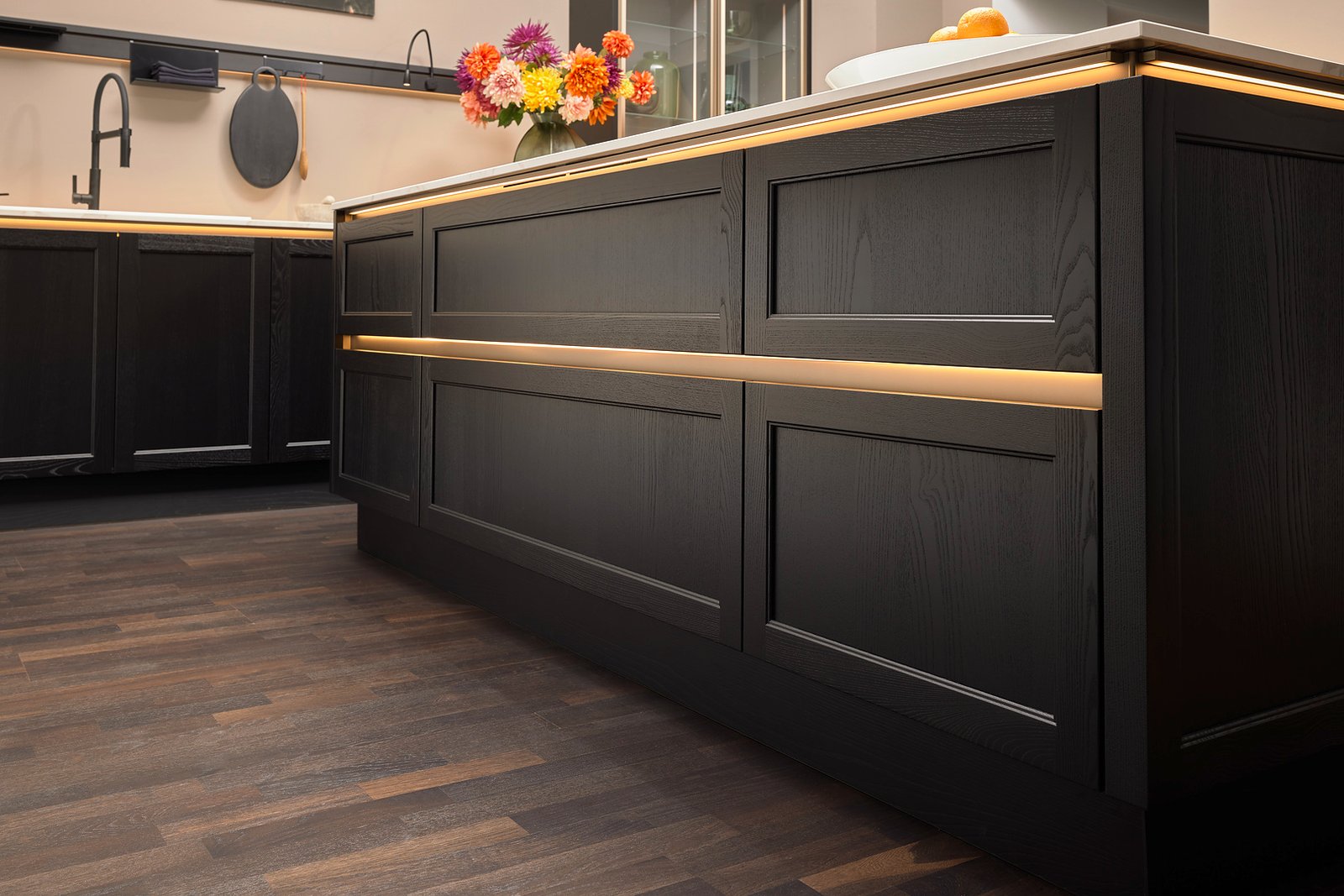
Nobilia Lugano in soft matt black. The Shaker frame shadow is fully present. No surface hardware breaks the front face. The door reads as classical in structure and contemporary in execution.
The four opening mechanisms
and what each delivers.
The choice of opening mechanism is the most consequential specification decision in a Handless Shaker kitchen. Each mechanism has a different visual profile, different ergonomics, different hardware requirements, and different implications for daily use. Understanding the trade-offs before the order is placed prevents the most common sources of dissatisfaction with this style.
- Best for: Long base unit runs where a consistent opening height is the priority
- Limitation: The Shaker frame on shortened door fronts needs careful proportioning. If the door height reduction is significant, the frame-to-panel ratio changes. Confirm with full-size samples.
- Soft-close: Standard on hinges and drawer runners. Not affected by the rail system.
- Best for: Base units where a top-edge grip sits at a natural hand height. Also well-suited to Shaker doors where full door height needs to be preserved.
- Limitation: Less effective on wall units where opening from the top edge requires reaching up. Edge grips are often more practical for wall unit doors.
- Soft-close: Fully compatible. The J-pull is part of the door, not the hinge mechanism.
- Best for: Specific doors in a kitchen where a pure flat face is the priority. Less suited to main cooking zone doors that are opened and closed dozens of times daily.
- Limitation: Standard mechanical push-to-open hinges do not integrate soft-close action on hinged doors. Servo-drive versions add significantly to cost. Requires precise reveal gaps that stay consistent as the kitchen settles.
- Soft-close on drawers: Push-to-open plus soft-close on the same runner is standard on quality German drawer systems.
A fourth approach: integrated edge profile. Some German manufacturers offer Shaker door designs where the frame profile itself provides the grip. A recessed section in the stile or rail edge acts as a finger pull without routing a separate groove or adding hardware. This is the most visually integrated option and works particularly well on tall housings, pantry doors, and wall units where J-pull ergonomics are less convenient. Ask whether your chosen Shaker range offers this as a door variant before defaulting to J-pull or push-to-open on non-base-unit doors.
| Mechanism | Best use | Soft-close on doors | Main consideration |
|---|---|---|---|
| True handleless rail | Long base unit runs | Standard on hinges | Door height reduction changes Shaker frame proportions. Confirm with full-size sample. |
| J-pull groove | Base units at natural hand height | Full compatibility | Less ergonomic on high wall units. Consider edge profile for wall doors. |
| Push-to-open | Selected doors where pure flat face is the brief | Not standard on hinged doors | Requires precise reveals throughout. Mechanical versions need regular adjustment. |
| Integrated edge profile | Tall housings, wall units, pantry doors | Full compatibility | Availability depends on the specific door range. Confirm at specification stage. |
Materials for
Handless Shaker doors.
Material choice for a Handless Shaker door involves the same considerations as any Shaker door, with two additional factors. First, the opening mechanism places different stress demands on the door depending on which system is used. A push-to-open door takes a direct pressing force on the centre panel every time it opens. A J-pull door is gripped at the top edge, which places rotational stress on the top rail joint. The material and construction quality needs to support these specific forces across decades of daily use.
Second, the absence of a handle means fingerprints and cleaning marks land directly on the door surface rather than on the hardware. Lacquer quality and resistance to cleaning chemicals matters more on a Handless Shaker than on a handled door where the surface is only touched at the handle location.
- Consistent colour and edge quality across the full run
- Lacquer quality varies significantly between manufacturers. Ask specifically about chemical resistance.
- Grain character that painted MDF does not replicate
- Edge lacquer quality at the frame profile determines long-term durability
- Best suited to J-pull and edge profile mechanisms rather than push-to-open
- Allows future repainting or colour change
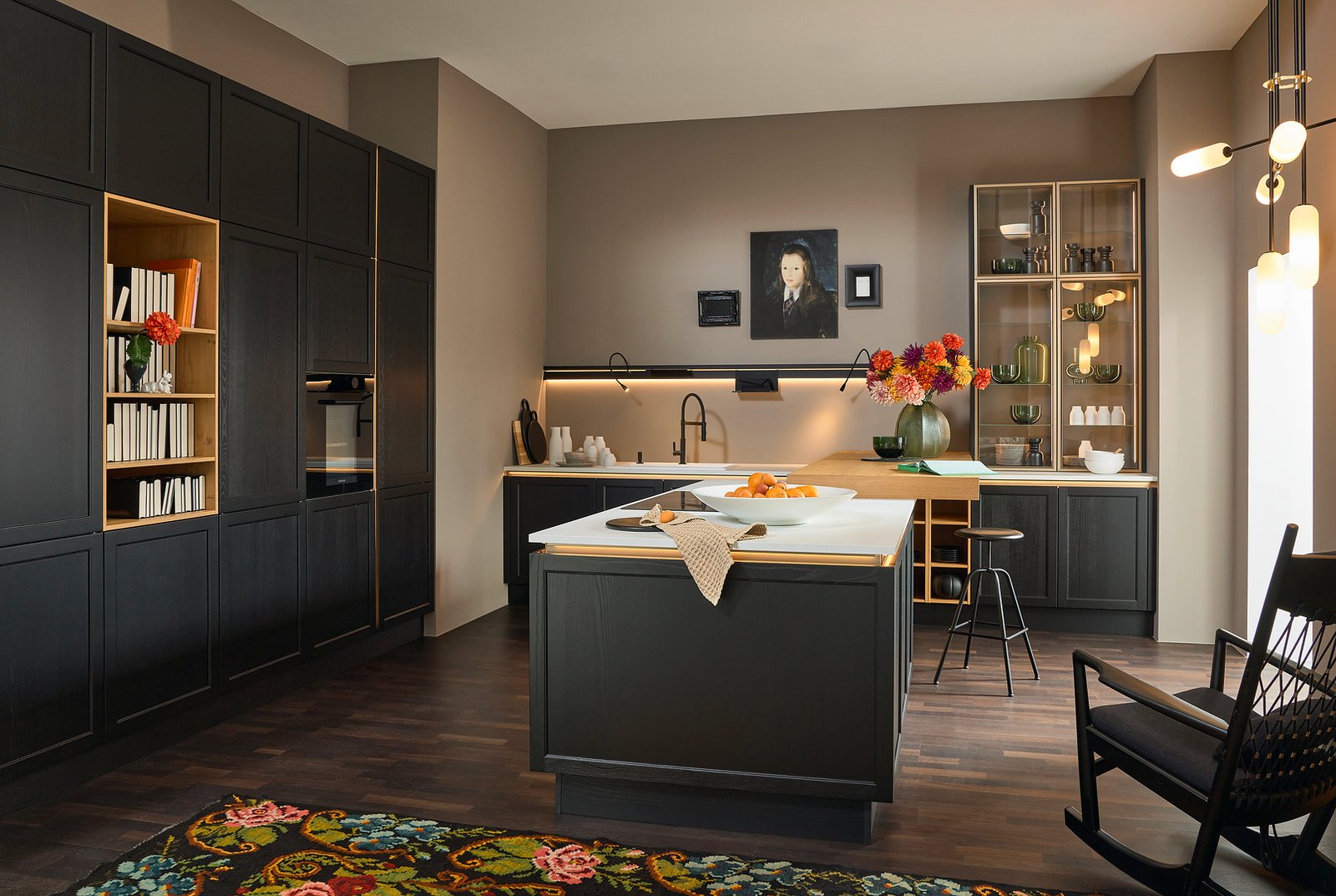
Nobilia Lugano lacquered MDF detail. The frame edge quality on a well-specified lacquered door stays sharp through years of daily use. The surface resists fingerprints and wipes cleanly without visible hardware collecting grease.
Ask your supplier specifically about lacquer chemical resistance for Handless Shaker doors. Without a handle, cleaning products land directly on the door face daily. A lacquer rated for cleaning chemical exposure will outlast a decorative-grade finish significantly at this surface contact level.
Handless Shaker on German
frameless cabinet systems.
German kitchen manufacturers design their systems around frameless carcasses. Doors overlay the front of the carcass directly and hang off the side panels. A Handless Shaker door on a German frameless system delivers exactly the same storage performance as any other door style on the same carcass. Full-width drawer boxes, deep pull-out larders, and integrated waste systems are all available without modification.
The precision engineering of German handleless systems is particularly relevant for J-pull and push-to-open Handless Shaker doors. J-pull grooving needs to be consistent in depth and position across every door in the kitchen for the opening experience to feel deliberate rather than variable. Push-to-open systems need calibrated latch forces that remain consistent through the specified cycle count without adjustment. German manufacturers including Nobilia, Bauformat, Häcker, and Nolte carry Shaker door profiles within handleless families specifically engineered for this combination.
For rail-based Handless Shaker, the rail runs at a fixed height behind the shortened door fronts. Alignment precision matters: a rail that sits even 2–3mm out of level reads as a mistake across a long run. German planning and installation methods using system grids and pre-drilled alignment points typically produce more consistent results than site-measured installation on bespoke systems.
Ask your supplier which hardware brand powers the opening mechanism and whether it has been cycle-tested. Published cycle ratings from Blum, Hettich, or Grass give an objective reference for the expected service life of the mechanism before adjustment or replacement.
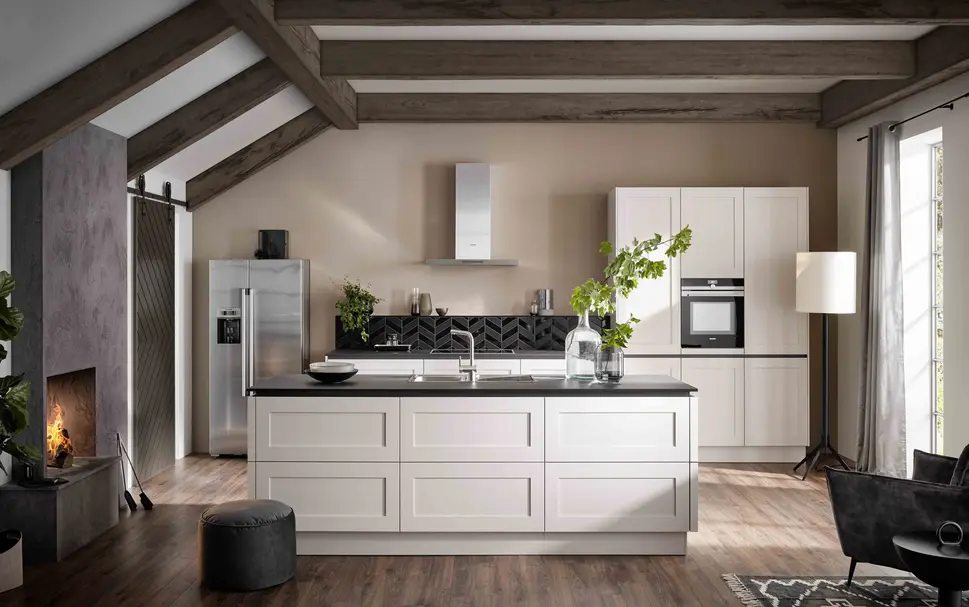
Handless Shaker on a German frameless system. The opening mechanism is integrated into the door profile. Storage performance behind the doors is identical to any other specification on the same carcass.
Request a physical mock-up before production is confirmed. Ask your supplier to produce a sample showing the Shaker frame profile against the rail line or J-pull groove at full size. This is the only reliable way to confirm that the frame proportions and the opening mechanism work together visually before the order is placed. A drawing does not communicate this relationship accurately.
Handless Shaker vs
Handled Shaker and handleless slab.
Handless Shaker sits between two established kitchen styles. The comparison below covers the three options a buyer choosing between them typically considers.
| Aspect | Handless Shaker | Handled Shaker | Handleless slab |
|---|---|---|---|
| Visual character | Shaker frame shadow and panel depth. No visible hardware. Classical structure, contemporary face. | Shaker frame with bar handle, knob, or cup pull. Hardware reinforces the traditional character. | Flat, featureless front face. The cleanest visual of the three. No frame detail, no hardware. |
| Opening ergonomics | Varies by mechanism. J-pull is intuitive. Push-to-open requires technique. Rail is most ergonomic for base units. | Most intuitive. A handle at any position gives a confident, immediate grip point for any user. | Depends on mechanism (rail, J-pull, push-to-open). Same ergonomic considerations as Handless Shaker without the frame. |
| Style direction | Transitional. Suits open-plan spaces where Shaker character is wanted alongside a contemporary interior. | Classic to contemporary depending on handle choice. Bar handles read modern. Cup handles and knobs read traditional. | Contemporary to minimal. No frame, no hardware. Suits very clean, modern, or Japandi-influenced interiors. |
| Maintenance | Fingerprints on the door face directly. Lacquer quality is critical. No hardware to accumulate grease. | Fingerprints accumulate at the handle and on the door near the handle. Hardware needs periodic cleaning. | Same fingerprint consideration as Handless Shaker. Flat surface may show marks more visibly depending on sheen level. |
| Best property type | Open-plan extensions, contemporary family homes, new builds where Shaker character is wanted without visible hardware. | Period homes, traditional schemes, and any property where the kitchen is a dedicated room rather than an open-plan living space. | Minimal interiors, urban apartments, and spaces where the kitchen is deliberately backgrounded against other design elements. |
Design tips for
Handless Shaker kitchens.
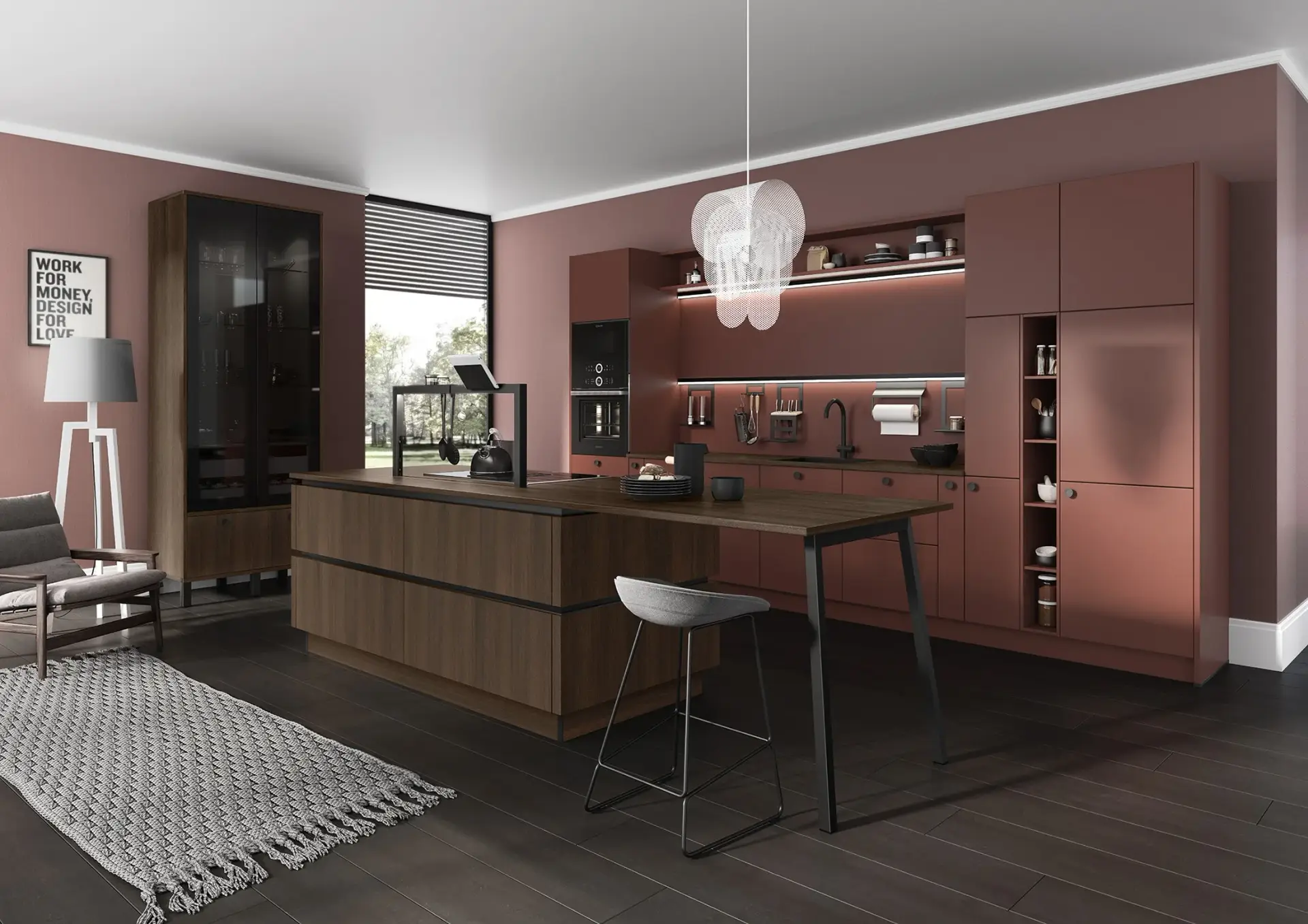
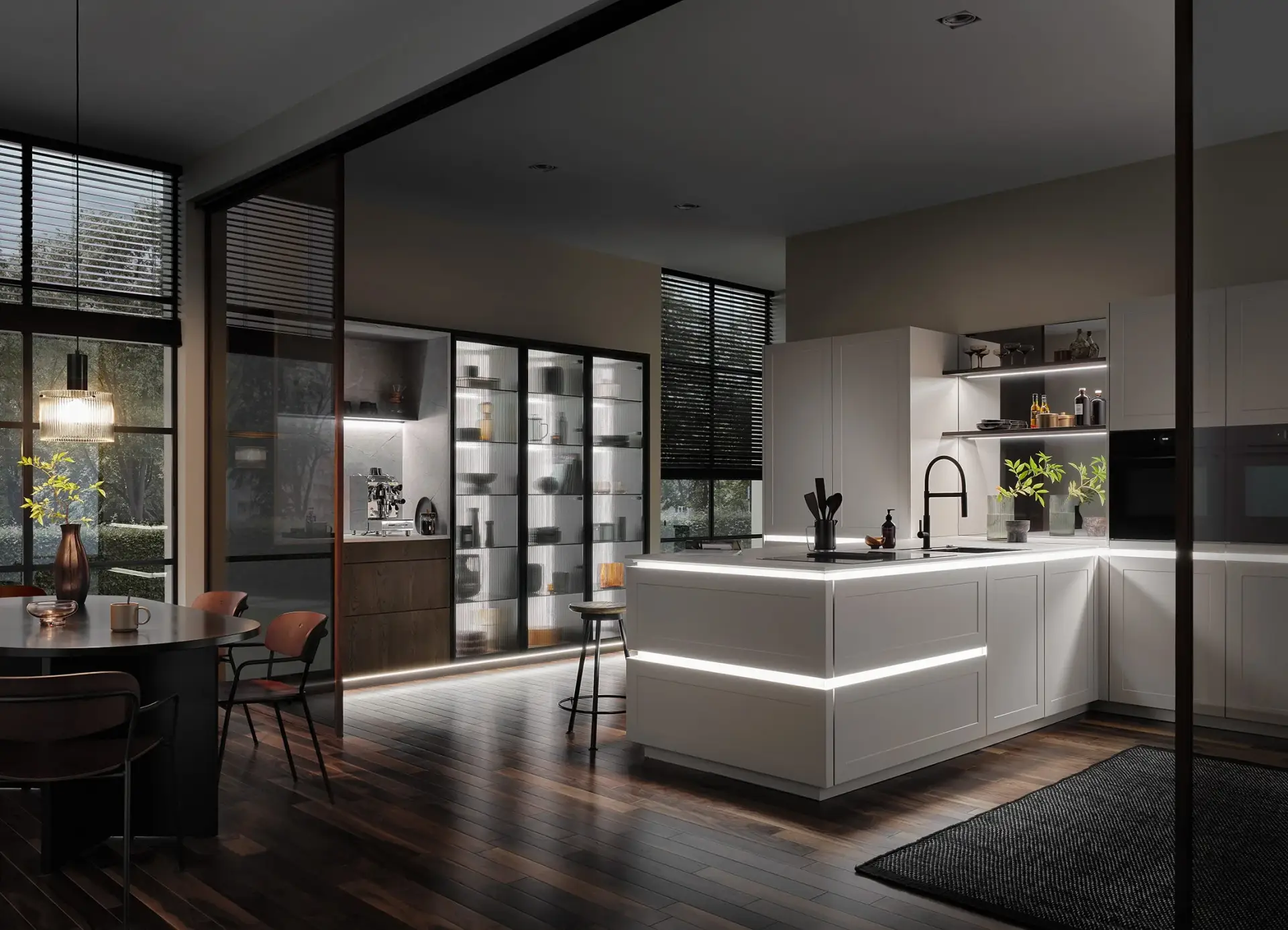
Bauformat Handless Shaker. The frame shadow gives the kitchen warmth and structure without visible hardware. The island continues the Shaker profile on the seating side, completing the composition from every angle.
Integrated opening profile in the Shaker frame stile. The grip is part of the door. Consistent reveals across the run are the detail that makes the handleless specification read as intentional rather than incomplete.
Specification checklist.
Use this checklist before signing the order. Each point addresses a specific source of dissatisfaction that is avoidable at the specification stage and difficult to rectify after installation.
- Confirm the opening mechanism for each door type individually. Base units, wall units, tall housings, and island doors may each benefit from a different mechanism. Do not assume one system applies throughout.
- Request a full-size sample showing frame profile against the mechanism. A 40mm J-pull groove on a 70mm frame and the same groove on a 40mm frame produce different visual results. Confirm at full size before production.
- Ask which hardware brand supplies push-to-open or rail systems and request published cycle ratings. Blum, Hettich, and Grass all publish these figures. A mechanism rated for 50,000 cycles is not equivalent to one rated for 200,000 cycles.
- Confirm lacquer specification for the door surface. Ask specifically about chemical resistance rating. On a Handless Shaker door, the lacquer is the only surface between daily cleaning chemicals and the substrate.
- Agree reveal dimensions and confirm how they will be maintained. 2–3mm consistent reveals across the full run are the baseline for a well-executed Handless Shaker kitchen. Wider or inconsistent reveals read as poor fitting regardless of door quality.
- Confirm soft-close specification for both drawers and hinged doors. Push-to-open hinges on doors do not combine with soft-close as standard. If soft-close is important on hinged doors, choose J-pull, edge profile, or rail instead of push-to-open for those doors.
- Check for touch-up lacquer supply at handover. Handless Shaker doors accumulate direct surface contact without a handle to take the wear. A touch-up kit matching the door lacquer colour should be included in the handover pack.
Is Handless Shaker
right for you?
- You want the warmth, shadow depth, and classical structure of a Shaker kitchen without visible bar handles or cup pulls breaking the front face.
- Your kitchen is in an open-plan space visible from a living or dining area, where the Shaker detail adds character but hardware would feel visually intrusive at that distance.
- You want a German kitchen with full storage performance and a framed door style. The Handless Shaker front lays over the frameless carcass exactly as any other door on the same system.
- You are prepared to engage with the mechanism choice properly and to specify the right opening system for each door type rather than applying one mechanism throughout.
- You are comfortable maintaining a lacquered door surface that receives direct daily contact without a handle to protect the most-touched area of the door.
- You want the maximum traditional, furniture-led character of Shaker construction. A handled Shaker with knobs or cup pulls delivers this more authentically, particularly in period homes.
- You want the cleanest possible contemporary face with no frame detail at all. A true handleless slab or a handleless kitchen with flat doors delivers this better than Handless Shaker.
- Push-to-open is the only mechanism you are considering and you need soft-close on all hinged doors. These two requirements do not combine on standard mechanical push-to-open hinges.
- Young children or elderly users are the primary kitchen users. A clear, confident handle that provides an obvious grip point at a consistent height is more accessible than any integrated mechanism.
Visit a showroom with both Handless Shaker and Handled Shaker displays. Open base unit doors and tall larders on both. The ergonomic difference between a confident bar handle grip and a J-pull groove is immediately clear in person in a way that descriptions cannot communicate. Also see the full door styles guide and the Shaker kitchen guide on this site.