
HPL worktops.
The complete UK guide.
High-pressure laminate (HPL) worktops sit at the quality boundary between standard chipboard laminate and engineered stone. The surface layer is a separate, pre-manufactured sheet produced by stacking multiple layers of kraft paper impregnated with phenolic resin, topped with a decorative paper and a protective melamine overlay, then pressing the entire stack at high pressure (typically 1,000–1,400 psi) and high temperature. The result is a dense, hard, dimensionally stable sheet — typically 0.6–1.0mm thick — that is then bonded to a chipboard or MDF core to produce the finished worktop.
This manufacturing distinction matters. Standard chipboard laminate (sometimes called LPL — low-pressure laminate, or post-formed laminate) fuses a thin decorative melamine layer directly onto the chipboard surface in a single press step. The decorative layer is approximately 0.2–0.3mm thick. HPL's separately manufactured, multi-layer surface sheet is three to five times thicker, denser, and harder. It meets EN 438 — the European standard for high-pressure decorative laminates — while most standard laminate worktops do not. The practical result is better abrasion resistance, better impact resistance, a wider heat tolerance range, and superior edge performance.
HPL is not the same as solid HPL throughout. Most HPL worktops have an HPL surface layer bonded to a chipboard or MDF core — the same chipboard vulnerability to moisture applies at cut-outs and edges. A small number of worktop products are produced from solid HPL through their full thickness, eliminating the core vulnerability but at significantly higher cost. For most UK kitchen applications, the HPL-surface-on-chipboard-core construction is the standard and performs well when installed correctly.
Where HPL sits in the market: significantly more capable than standard laminate in surface performance, significantly less expensive than quartz, ceramic, or stone, and without the heat, UV, or sealing limitations of quartz. For kitchens where budget is a genuine constraint but surface quality and longevity matter, HPL is consistently one of the strongest performing materials at its price point.
What is HPL.
Production and the EN 438 standard.
High-pressure laminate is produced by stacking multiple layers of kraft paper — each sheet individually impregnated with phenolic resin — on top of which a single decorative paper layer is placed, followed by a melamine-impregnated protective overlay. This layered stack is loaded into a press and subjected to temperatures of approximately 120–150°C and pressures of 1,000–1,400 psi. The heat and pressure cure the resins simultaneously through all layers, fusing the stack into a single dense, homogeneous sheet. The process takes place in a separate manufacturing operation before the sheet is bonded to its worktop core substrate.
The EN 438 standard for high-pressure decorative laminates specifies minimum performance thresholds for abrasion resistance, impact resistance, heat resistance, light fastness, steam resistance, and chemical resistance. Products meeting EN 438 have been independently tested and confirmed to perform above these thresholds. The standard is the formal technical definition of what separates HPL from LPL (low-pressure laminate) — it is not a marketing designation but a measurable engineering difference.
HPL vs LPL (standard laminate). Low-pressure laminate (LPL) is produced by fusing a decorative paper and thin melamine layer directly onto the chipboard surface in a single, lower-pressure step. The decorative layer is 0.2–0.3mm thick and is integral to the board surface. HPL's separately manufactured sheet is 0.6–1.0mm thick — three to five times thicker — and is bonded to the board after production. This difference in layer thickness, density, and the separate manufacturing step produce the performance gap: better abrasion, better impact, better heat tolerance, and better edge behaviour.
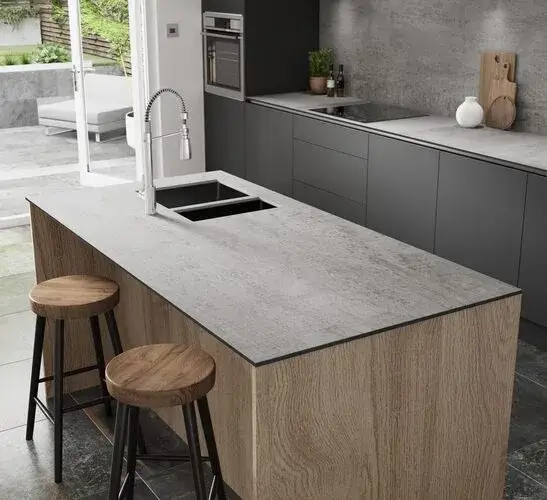
HPL worktop in a contemporary kitchen. The surface pattern quality of modern HPL — including highly realistic stone, marble, and concrete effects — sits well above standard laminate and is not immediately distinguishable from more expensive alternatives in a finished installation.
Construction layers.
What is inside an HPL worktop.
An HPL worktop is a layered product. Each layer performs a specific structural or protective function. The key distinction from standard laminate is the separately manufactured HPL surface layer — the sheet produced in its own press run under high pressure before bonding to the core. This manufacturing separation is what makes HPL a different product from standard post-formed laminate, not just a thicker version of it.
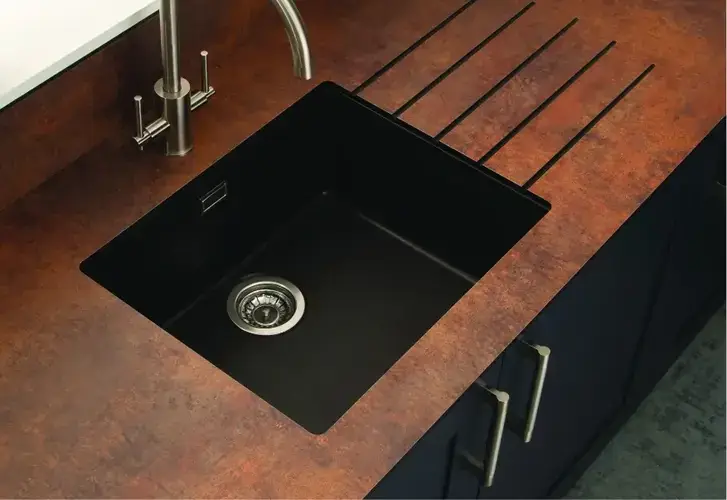
HPL worktop edge detail. The separately manufactured HPL surface layer (visible as the top face of the edge) is substantially thicker and denser than the surface layer of a standard laminate worktop. The core material beneath it is chipboard — the construction that requires careful sealing at all cut-outs during installation.
Solid HPL vs HPL-on-core. A small number of premium worktop products are produced from HPL throughout the full slab thickness — solid HPL with no chipboard core. These products eliminate the moisture vulnerability at cut-out edges but are significantly more expensive and less widely available than standard HPL-on-core construction. Confirm with your supplier whether the specific product you are specifying is solid HPL throughout or HPL surface on a chipboard or MDF core before ordering.
Design range.
Modern HPL surface printing technology produces highly realistic stone, marble, concrete, wood grain, and textile effects at a level of visual quality that was not achievable in standard laminate a decade ago. The coordination between the printed pattern and the surface texture of the overlay — embossed register printing — allows the grain lines of a wood effect to align with actual surface grooves, and the mineral texture of a concrete or stone effect to follow the visual character of the pattern. The result reads as more convincing than a flat-printed surface at close range and under hand contact.
Finish options include gloss, satin, honed/matt, and ultra-matt. Ultra-matt is particularly effective for stone and concrete effects — the very low sheen reduces fingerprinting and enhances the perception of material depth. Textured surfaces in a range of depths from light grain through to pronounced structure are available from most European HPL manufacturers.
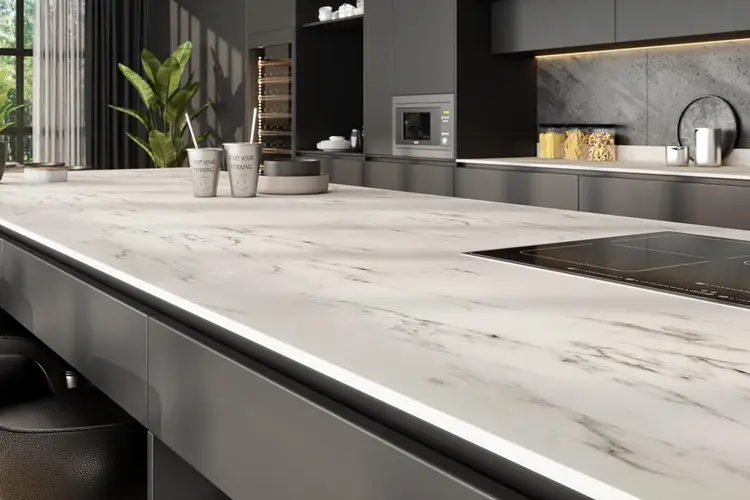
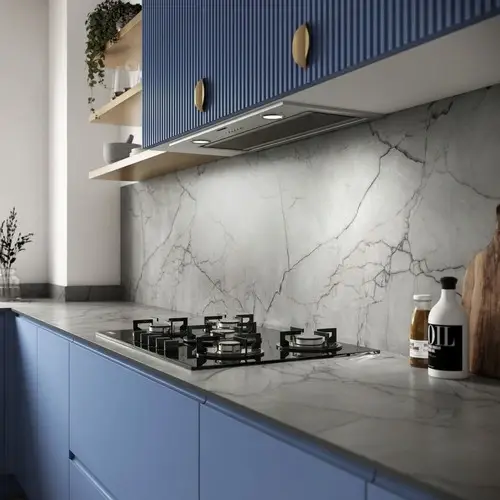
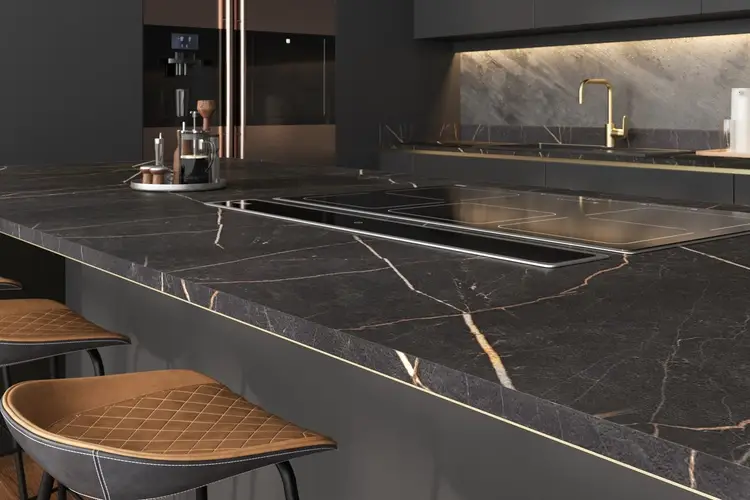
HPL worktop design range in contemporary UK kitchen installations. Marble effects, stone textures, and concrete finishes produced with modern digital printing and embossed-register surface coordination. The surface quality is not immediately distinguishable from more expensive engineered slab alternatives in a finished kitchen photograph.
HPL and kitchen system coordination. Major German kitchen manufacturers include HPL worktop ranges designed to coordinate with their door and cabinet colour collections — the worktop finish is matched to specific door colours as part of one designed system. This level of visual coordination is not achievable when mixing components from different sources. If you are specifying an HPL worktop with a German kitchen, confirm whether the manufacturer offers coordinated HPL worktops in your chosen kitchen finish.
Thickness options.
HPL worktops are available across a range of thicknesses. The thickness reflects the depth of the core substrate — the HPL surface layer itself is typically 0.6–1.0mm regardless of the total worktop thickness. Core thickness determines the visual edge depth, rigidity across spans, and overhang capability without additional support.
| Thickness | Characteristics | Best for |
|---|---|---|
| 16–20mm | Slimline profile. Contemporary edge appearance. Requires good cabinet support across the full run, particularly around cut-outs and overhangs. Less visual presence than thicker options. | Minimalist contemporary kitchens. Coordinated with slim door profiles in handleless designs. |
| 28–30mm | Good rigidity and visual presence. Comfortable appearance for most UK kitchen styles. Overhang capability improves over thinner options. Standard in many mid-range UK HPL kitchen specifications. | Standard domestic kitchens. Most style categories from contemporary through to transitional. |
| 38–40mm | The most common UK kitchen worktop thickness. Solid feel and visual weight. Good overhang capability for breakfast bar positions. Suits both contemporary and traditional kitchen designs. | Standard UK kitchen specification across most styles. Breakfast bar overhangs. Most common in German kitchen manufacturer ranges. |
Edge profiles in HPL. HPL machines cleanly and accepts a range of edge profiles. Post-formed rounded edges — where the HPL surface wraps continuously around the front edge radius — are a standard option that eliminates the top-front corner joint and produces a smooth, comfortable profile. Square edges with a separate matching ABS or PP edging strip are the contemporary alternative. Chamfered and softened profiles are available from most UK suppliers. Ornate decorative profiles such as ogee or full bullnose are generally not available in HPL — these require materials that machine to complex profiles, such as quartz, granite, or solid surface.
Slab sizes. Unlike quartz or porcelain where large slab formats allow long seamless runs, HPL worktops are typically supplied at standard widths (600mm deep is the most common UK cabinet depth) and lengths up to 3600mm depending on the supplier. Joins are visible on long runs and at internal corners. Well-executed joins in matching HPL are minimal in appearance but not invisible in the way that solid surface joins are.
Key features.
Advantages and limits.
- Significantly better surface performance than standard laminate — better abrasion, better impact resistance, better heat tolerance, better edge behaviour. EN 438 tested and confirmed.
- No sealing required. Non-porous surface cleans easily with standard household products throughout ownership. No periodic maintenance chemicals.
- Wide design range with realistic stone, marble, wood, and concrete effects produced by modern digital print and embossed-register surface coordination. Better visual quality than standard laminate.
- Long expected life of 15–20 years in domestic kitchen use — approximately double the typical life of standard laminate in equivalent conditions.
- Lower cost than quartz, ceramic, porcelain, or stone at any equivalent specification. Strong performance-per-pound value for budget-led kitchen projects.
- Lightweight relative to stone, quartz, and porcelain. Standard cabinet support is sufficient. No structural reinforcement required.
- Post-formed rounded edge eliminates the top-front corner joint — the most vulnerable moisture entry point in standard square-edged laminate — and produces a comfortable, durable front profile.
- Trivets required. HPL handles brief moderate heat better than standard laminate but still marks under sustained direct contact with very hot pans, oven trays, and hot appliances. Heat damage is not repairable.
- Chipboard core vulnerable to moisture at unsealed cut-outs. Sink, hob, and tap cut-outs must be properly sealed during installation. Unsealed cut-out edges are the primary cause of HPL worktop swelling and premature failure.
- Surface damage is not repairable. Burns, deep scratches, and swollen sections require section replacement. Unlike solid surface, HPL cannot be sanded and re-polished. Unlike stone, the surface cannot be reground by a specialist.
- Joins are visible. HPL joins on long runs and at corners show as seams. A well-executed join is neat and minimal — it is not invisible the way a solid surface join is.
- Limited edge profile options. Post-formed rounded or square edge with separate edging strip are the standard range. Ornate decorative profiles unavailable in HPL.
- Perceived as less premium than stone or porcelain in higher-value property contexts. This is a market perception issue rather than a technical performance issue — HPL genuinely outperforms quartz on several dimensions including UV stability and no heat sensitivity.
HPL vs laminate vs quartz.
Three-way comparison.
These three materials are the most commonly compared at the budget-to-mid-range level of the UK kitchen market. They sit at very different price points, have different surface performance profiles, and have different failure modes. Understanding the differences allows a specification that matches the actual kitchen brief rather than defaulting to the cheapest option.
| Aspect | HPL | Standard laminate | Quartz |
|---|---|---|---|
| UK price guide | £50–£100 per m² supply only | £20–£50 per m² supply only | £300–£600+ per m² supply and install |
| Surface layer | EN 438 HPL sheet, 0.6–1.0mm. Separately manufactured under high pressure. Phenolic and melamine resins throughout. | Thin melamine layer, 0.2–0.3mm. Fused directly to board surface at lower pressure in one step. No separate press run. | Engineered quartz aggregate and polymer resin, full slab thickness. Non-laminate construction. |
| Abrasion resistance | Good. EN 438 tested. Significantly better than standard laminate in lab and real-world use. | Moderate. Not EN 438 tested in most cases. Surface wears and marks faster than HPL under comparable use. | Good. Engineered surface resists everyday kitchen contact effectively. Better than HPL but at much higher cost. |
| Heat tolerance | Short contact to approx. 140–160°C. Always use trivets. Better than standard laminate. Burns permanently. | Short contact to approx. 120–135°C. Always use trivets. Burns permanently. Lowest heat tolerance of the three. | Moderate. Resin binder marks permanently under hot pans. Always use trivets. Heat damage often permanent. |
| Moisture at surface | Non-porous HPL surface. Very good moisture resistance. Core remains vulnerable at unsealed cut-outs. | Non-porous surface when intact. Thinner and more vulnerable to surface damage. Core very vulnerable at unsealed positions. | Non-porous throughout. No sealing. Core not exposed in standard installation. Better moisture tolerance than both laminate types. |
| Sealing requirement | None for the surface. Cut-out edges must be sealed at installation. | None for the surface. Cut-out edges must be sealed at installation. | None. No sealing required at any stage. |
| Surface repairability | Not repairable. Burns, deep scratches require section replacement. | Not repairable. Same limitations as HPL. | Limited. Small chips fillable but visible. Heat damage often not repairable. Better than laminate at small chip repair. |
| Joins | Visible. Well-executed joins are neat and minimal. | Visible. Edge and join quality varies more between products and installers. | Visible on long runs and around islands. Cannot be made invisible unlike solid surface. |
| UV stability | Good. No resin binder to degrade. Suitable near large glazing. | Moderate. Some patterns fade in prolonged direct sunlight exposure. | Moderate. Resin binder yellows and fades in sustained UV. Not outdoor-recommended. |
| Expected life | 15–20 years in normal domestic use. Approximately double standard laminate. | 5–10 years in normal domestic use. Earlier failure where moisture and wear are not managed. | 20+ years in normal domestic use. Longer expected life than both laminate options at significantly higher cost. |
| Visual quality | Modern digital printing with embossed-register coordination. Realistic stone, marble, and concrete effects. Better than standard laminate. Not equivalent to quartz visual depth. | Simpler patterns, fewer textures. Surface printing quality lower than HPL. More basic visual result. | Engineered aggregate provides visual depth in the material body. Wider design range including bold veining. Not replicable in laminate. |
| Best suited for | Busy domestic kitchens where durability matters but budget does not extend to stone or engineered slab. 15–20 year performance at laminate price. | Short-term use, rental properties, utility rooms, or very tight budgets where longevity is not the priority. | Domestic kitchens where low maintenance, stain resistance, and visual quality justify the significant cost premium. Not outdoor-suitable. |
The HPL value case. HPL costs 70–90% less than quartz at the supply level, lasts approximately the same duration as many laminate kitchens are kept before full renovation, and significantly outperforms standard laminate on every technical dimension. For kitchens where the total renovation budget does not support quartz or stone, HPL is a materially better choice than standard laminate in exchange for a modest price premium. The premium over standard laminate is typically £20–£60 per square metre at supply level — a very small proportion of a total kitchen budget.
Maintenance and care.
HPL maintenance is simple. The non-porous surface requires no sealing, no specialist products, and no periodic professional treatment. Daily cleaning with warm water and mild detergent is sufficient. The key daily habits are protecting the surface from hot pan contact, using chopping boards for food preparation, and wiping spills before they dry on the surface. The strategic maintenance focus is on installation quality and edge protection — preventing moisture from reaching the core through unsealed cut-outs and joints.
Installation is the most important maintenance decision. Most HPL worktop failures are installation failures, not material failures. The chipboard or MDF core of any HPL worktop is structurally sound when dry and protected. The same core fails when moisture reaches it through unsealed cut-outs, poorly jointed sections, or inadequately protected appliance positions.
- Seal all sink and hob cut-out edges with the manufacturer-supplied sealing tape or appropriate sealant before the sink or hob is fitted
- Protect the underside above dishwashers with the specified insulation detail
- Seal all section joints on the top face with appropriate joint sealant
- Apply matching décor edging to any cut end that will be visible in the finished kitchen
- Confirm the rear edge is sealed where it contacts the wall or upstand
A well-specified HPL worktop installed without proper cut-out sealing will fail earlier than a budget laminate installed correctly. The engineering advantage of HPL exists at the surface level — the core vulnerability is shared with all chipboard-core laminate products. Correct installation at cut-outs, joints, and appliance positions is what determines whether the worktop lasts 5 years or 20.
UK cost guide.
HPL worktops are priced as supply-only material. Installation cost is additional and varies by kitchen complexity, cut-out count, edge treatment, and installer rates. Supply prices reflect the HPL product grade, decor family, surface finish quality, and core thickness. European manufacturer HPL ranges (particularly German, Swiss, and Austrian) typically sit in the mid-to-upper supply price band. Budget HPL from less established sources is available at lower supply prices but with less consistent quality and fewer coordinated colour options.
Compare HPL total cost against quartz total cost. Entry HPL supply at £50–£65/m² plus installation at £100–£200 per kitchen produces a total cost that is a fraction of entry quartz at £300+/m² including installation. For a 5m² kitchen worktop area, the total cost differential between HPL and entry quartz is typically £1,200–£1,800. Whether that differential is justified by the performance upgrade from HPL to quartz depends on the kitchen's heat management habits and how much longer the buyer plans to keep the kitchen.
Who HPL suits.
- Budget is a genuine constraint and you want the best available laminate surface performance rather than the cheapest option. HPL costs modestly more than standard laminate and performs significantly better — particularly at the edge and around cut-outs.
- You are fitting a German kitchen system and want the worktop, doors, and cabinets to coordinate as a designed whole. German kitchen manufacturers offer HPL worktops matched to specific door colour collections.
- You want a simple, no-maintenance surface — no sealing, no oiling, no specialist products. Warm water and mild detergent throughout the life of the kitchen.
- The kitchen renovation has a defined lifespan. If you are planning to renovate again in 15 years, HPL offers good value for that specific time horizon at a much lower cost than quartz.
- You are committed to using trivets and chopping boards consistently. HPL rewards these habits reliably over its expected life.
- Heat performance without trivets is the priority. Ceramic and porcelain have no resin binder and handle direct hot pan contact without marking. If consistent trivet use is not realistic, a harder mineral surface is the correct specification.
- Surface repairability matters. HPL damage requires section replacement. Solid surface is the only material that sands and re-polishes to near-original after accumulated surface marks.
- The visual quality and depth of quartz or natural stone is important. HPL stone and marble effects are good but identifiable as laminate under the hand and at close range. Quartz aggregate gives genuine visual depth that HPL printing cannot replicate.
- You are specifying a high-value property where the perceived premium of stone or porcelain is a relevant factor. HPL is perceived as a budget material by many buyers regardless of its technical performance.
- Ornate edge profiles are important. HPL is restricted to rounded or square post-formed edges. Quartz, granite, and stone offer the full range of decorative profiles.
Frequently asked questions.
See the Worktops hub to compare HPL with quartz, ceramic, granite, and other materials. The Laminate guide covers the comparison between German kitchen manufacturer laminate and high street laminate — and explains why the two products in the same category are not equivalent in construction or performance.