
Built-in microwaves
and combination microwaves.
A built-in microwave and a combination microwave sit in the same housing space and look similar in a kitchen drawing. They do not do the same job. The decision between them — and the size decision within each category — has more impact on daily cooking practicality than almost any other appliance choice in a kitchen renovation or extension.
A built-in microwave is a speed and convenience appliance: reheating, defrosting, melting, softening, and warming. It is shallower, lighter, and easier to fit than a combi microwave. It suits wall units and any position where depth is limited. It does not replace an oven for any cooking task. A combination microwave adds fan oven cooking, grill, and in some cases steam, producing a second capable cooking cavity in the same compact format. The combi microwave is a more capable appliance at a higher cost and larger physical size.
Size matters more here than in most appliance categories. The two main classes — standard built-in microwaves at approximately 380mm high and compact combi microwaves at approximately 450mm high — use different niche heights and deliver fundamentally different internal capacities. A 380mm microwave typically holds 17–21 litres. A 450mm combi microwave holds 36–50 litres. These are not variations of the same product. They are different appliances for different purposes that happen to look similar in elevation drawings.
This guide covers both clearly. It also covers wall unit microwaves, turntable versus flatbed designs, microwave function in full-size single ovens, steam-capable combi models, tower planning, and the installation checks that prevent the most common fitting mistakes in kitchen renovations.
Size guide.
The height and capacity difference.
The single most important thing to understand about built-in microwaves before specifying a kitchen is that the two main product classes are different sizes and cannot be substituted for each other in existing or planned furniture. A standard built-in microwave and a compact combi microwave look similar in elevation drawings and photographs. In practice they use different niche heights, deliver fundamentally different internal capacities, and suit different cooking needs.
The height classification also applies to full-size built-in microwave ovens, which use a standard 600mm oven niche. These are not compact appliances at all — they are full-size single ovens with integrated microwave capability (see Section Seven). Including this format, there are three size classes across microwave and microwave-capable appliances in UK kitchens.
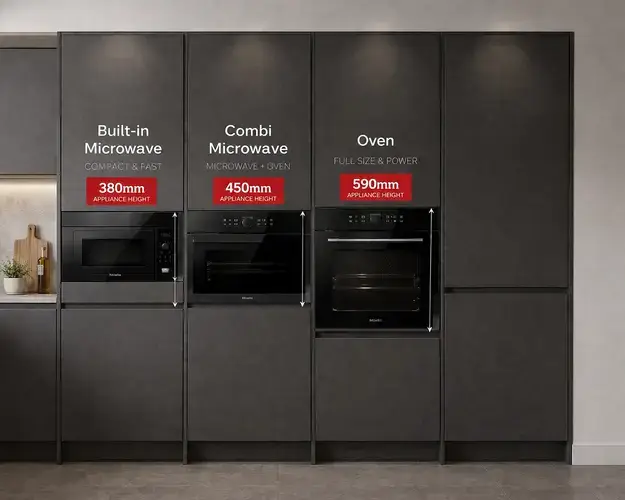
Height comparison across the three size classes. Left: 380mm standard built-in microwave. Centre: 450mm compact combi microwave. Right: 595mm full-size oven with integrated microwave. These three formats use different housing niches and are not interchangeable in planned furniture without structural changes to the cabinet column.
Always confirm three separate measurements before ordering:
- Appliance body dimensions — the physical oven including frame
- Required niche dimensions — the furniture cut-out from the installation guide
- Visible trim dimensions — what shows on the front face of the finished kitchen
These three figures are not always the same. The installation guide contains the niche dimensions the fitter needs — the product sales page usually does not.
Built-in microwaves.
What they do and when they are enough.
A built-in microwave is primarily a speed and convenience appliance. It reheats food quickly, defrosts efficiently, melts butter and chocolate without direct heat, softens ingredients before use, and handles everyday warming tasks that would otherwise require using the main oven for a disproportionate amount of time. It is not an oven. It does not brown food, bake pastry, roast meat, or produce any cooking result that requires dry radiant heat. A microwave that includes a grill extends this slightly — the grill adds surface browning — but a grill microwave is still primarily a microwave rather than a true second cooking cavity.
For most households with a well-specified main oven, a built-in microwave provides everything needed for daily convenience cooking without the larger footprint, higher cost, or additional depth requirement of a combi microwave. The decision to upgrade to a combi microwave is justified when the household genuinely wants a second oven-capable cavity, not simply when the combi microwave looks more impressive in the elevation drawing.
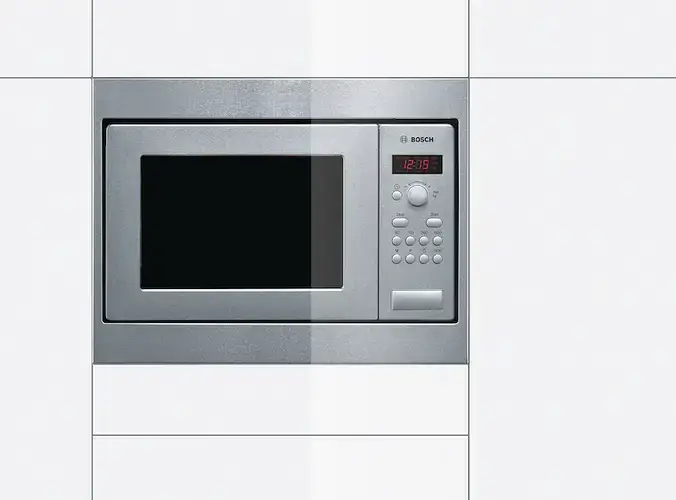
Standard 380mm built-in microwave. The compact niche height and shallower body depth make this the most versatile microwave format for UK kitchens — suitable for wall units, tall housings, and any position where depth is limited.
A built-in microwave is enough when: you have a good main oven that handles all baking, roasting, and grilling; you use the microwave primarily for reheating, defrosting, and convenience cooking; you are fitting the microwave into a wall unit or a position with limited depth; or you want to keep appliance costs controlled without paying for combi microwave functions you would rarely use.
Wall unit microwaves.
Depth, ventilation, and height planning.
A microwave in a wall unit is one of the most practical positions in a working kitchen — it keeps the appliance at a comfortable reaching height without consuming space in the tall appliance tower. The wall unit position requires careful planning because standard wall unit depths are significantly shallower than base unit depths, and the microwave must fit within this constrained depth including all required rear ventilation clearance.
Standard wall unit depth in UK kitchens is 300mm or 350mm. A built-in microwave specified for wall unit installation must have an appliance body depth — including the rear ventilation space the manufacturer specifies — that falls within this figure. Not all built-in microwaves achieve this. A 450mm combi microwave is almost certainly too deep for a standard wall unit installation. Always confirm the appliance body depth and required rear clearance from the installation guide before specifying a wall unit microwave position in a kitchen design.
Height within the wall unit run matters for daily use. When the microwave door drops open and the user reaches inside to remove a hot bowl or a mug, the arm and shoulder movement should be natural and comfortable for the main user. Position the microwave cavity at a height where the base of the open door does not obstruct reaching into the back of the cavity, and where lifting a full bowl out does not require a raised shoulder or awkward elbow position.
The housing above the microwave — typically a standard wall unit — should allow for heat dispersal from the top vent. Do not seal the top of the microwave niche without confirming the appliance vents from the front rather than the top. Most models specify the ventilation position in the installation guide.
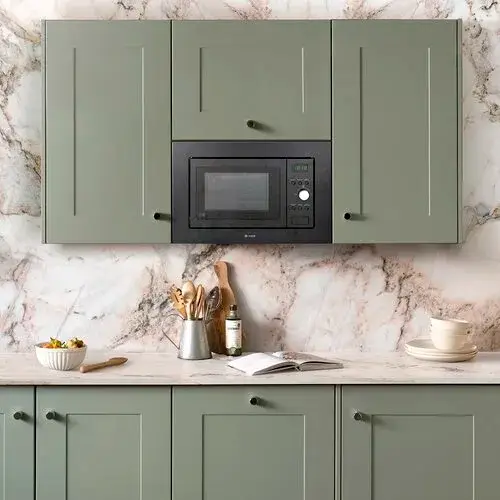
Wall unit microwave installation. The appliance body and all required rear ventilation clearance must fit within the standard wall unit depth of 300–350mm. Confirm appliance body depth from the installation guide before specifying — not the sales page.
Combination microwaves.
A second capable cooking cavity.
A combination microwave is a fundamentally different appliance from a built-in microwave, not a more advanced version of the same thing. It combines microwave heating with fan oven cooking, grill, or both — producing an appliance that heats with microwave speed when needed and cooks with oven-style results when the combination modes are used. The 36–50 litre internal capacity means it handles real cooking tasks, not just reheating and defrosting.
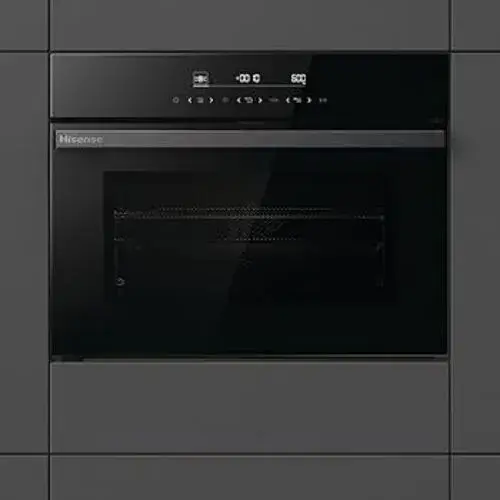
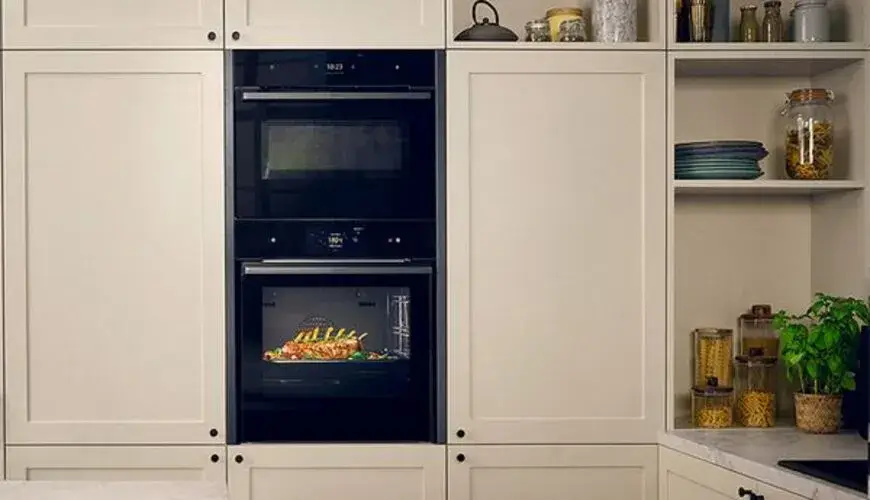
Left: 450mm compact combi microwave in a tall housing. Right: combi microwave and single oven stacked in a full appliance tower — the most common configuration for combination microwave installation in UK kitchens. The combi microwave at eye level above the main oven gives immediate access to both cooking cavities.
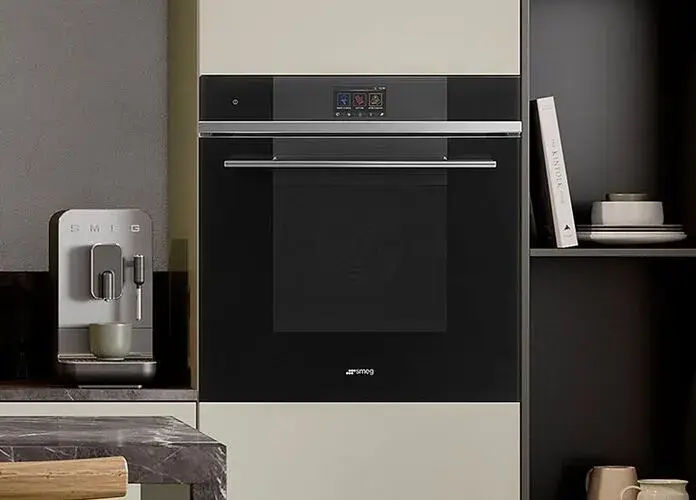
600mm wide combination microwave in a fitted kitchen — the standard width for most built-in combi microwave models. The 600mm width aligns with standard base and housing cabinet dimensions.
A combi microwave is worth choosing when: you want a second capable cooking cavity in the same housing as the main oven; you regularly cook pasta bakes, lasagne, jacket potatoes, and weeknight dishes that benefit from faster combination cooking; you want to replace both a countertop microwave and a second compact oven with one built-in unit; or you want the flexibility of oven-style cooking at eye level without using the main oven for small portions.
Turntable vs flatbed.
Interior design and daily use.
The interior design of a built-in microwave or combi microwave determines how the microwave energy is distributed through the cavity. There are two fundamentally different approaches: turntable and flatbed. The choice affects how usable the cavity floor is, how easy the interior is to clean, and what container sizes fit without restriction.
Turntable design places a rotating glass plate on the cavity floor. The plate rotates during cooking, moving the food through the microwave field to ensure even heating. Turntable models are the most common design at entry and mid-range price points. The rotating plate reduces the usable floor area by the plate radius on each side — a large rectangular dish or a tall container placed off-centre may not fit within the turntable circle. The plate itself and the drive coupling beneath it require regular cleaning.
Flatbed design distributes microwave energy through a rotating antenna beneath the flat cavity floor rather than moving the food. The cavity floor is completely flat and clear — no plate, no coupling, no restriction on container shape or size. Any container that fits within the cavity dimensions fits on the flat floor. Cleaning is also simpler: a smooth, flat surface with no moving parts to navigate around. Flatbed designs are now standard across most mid to premium combi microwave models. They are generally considered the more practical design for a built-in appliance that will be used daily.
For combi microwave ovens, flatbed design has an additional advantage: in oven and grill modes, the flat cavity floor behaves like a standard oven floor, making the full cavity floor usable for tray placement. Turntable designs can create challenges when using the oven modes with large flat trays that do not sit well on a turntable plate.
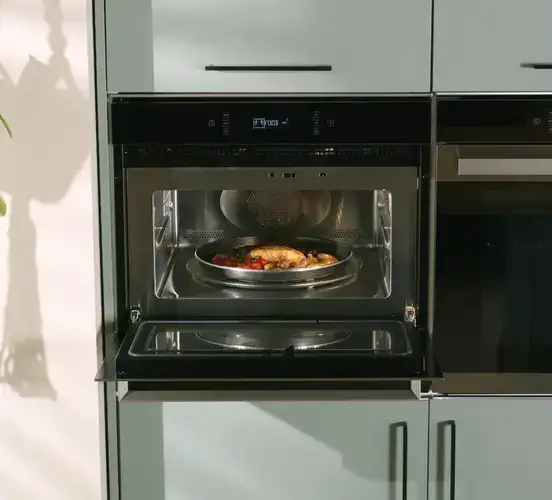
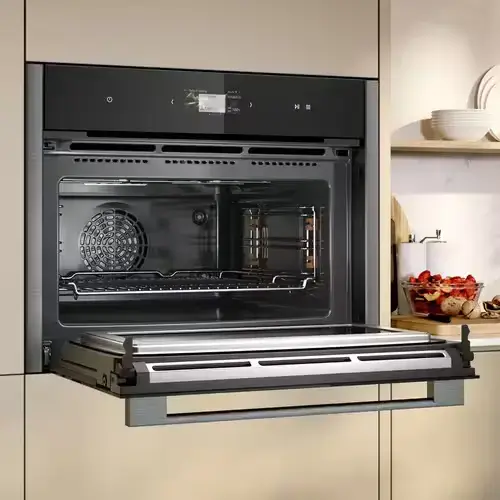
Left: turntable design — the rotating glass plate restricts container placement to the turntable circle. Right: flatbed design — the completely clear flat floor allows any container shape or size and is simpler to clean.
Steam-capable combi microwaves.
When steam is worth adding.
A steam-capable combination microwave adds a steam generator to the standard combi microwave capability. This produces a more versatile appliance — you have microwave heating, fan oven cooking, grill browning, and steam moisture control all available in one compact unit. The steam function improves reheating quality significantly: food reheated with gentle steam stays moist and does not dry on the surface the way microwave-only reheating often does. Fish, vegetables, rice, and plated meals all reheat better with steam.
Steam in a combi microwave is not the same as a dedicated steam oven. A full steam oven is designed around steam as the primary cooking method, with a larger water tank, more precise temperature and humidity control, and steam programmes specifically designed for delicate cooking. A steam-capable combi microwave treats steam as an enhancement to the existing microwave and oven functions — it extends the appliance's capability rather than replacing a dedicated steam oven.
Steam is worth specifying in a combi microwave when: you frequently reheat plated meals and want noticeably better results; you cook fish, vegetables, and rice in the combi microwave regularly; or you want steam capability in the kitchen without committing to a separate dedicated steam oven. Steam is not worth specifying if you primarily use the appliance for quick reheating and defrosting — a standard combi microwave without steam handles those tasks equally well at lower cost.
Steam combi microwaves require the same maintenance as steam ovens: regular descaling of the steam generator, filtered water for the tank in hard water areas, and emptying the water tank after use to prevent odour and scale build-up. In London and the South East, descaling may be required every few weeks under regular use. This is an ownership commitment to factor into the purchase decision.
What steam adds to a combi microwave:
- You frequently reheat plated meals and want better results than microwave-only reheating
- You cook fish, vegetables, and rice often in the combi cavity
- You want steam capability without a separate dedicated steam oven
- You primarily use the appliance for quick reheating and defrosting
- You want to avoid the ongoing descaling maintenance that steam requires
- Budget is a consideration — steam combi models cost significantly more
Single ovens with
integrated microwave function.
A growing number of full-size single ovens include an integrated microwave heating element as a built-in feature. This means the same appliance handles both conventional oven cooking and microwave reheating in one unit — using the standard 595mm single oven niche without requiring a separate built-in microwave in the kitchen layout.
The practical advantage is clear: one appliance, one niche, full oven capacity of 65–80 litres, and microwave convenience available without a separate unit. The main trade is that you use one appliance for both tasks — the oven and microwave functions cannot operate simultaneously. If you want to reheat food in the microwave while the oven bakes, a separate built-in microwave or combi microwave is the correct specification.
An oven with integrated microwave suits kitchens where the main priority is consolidating appliances, simplifying the layout, or reducing the number of separate built-in units. It is a strong choice for kitchens without space for an appliance tower, or for households who want microwave convenience without allocating a separate niche to it. It does not suit households who regularly need to run the oven and microwave simultaneously.
Key distinction. A single oven with integrated microwave is a full-size oven with microwave capability added — not a scaled-up microwave. The oven performance, cavity size, and cleaning systems are equivalent to a standard single oven. The microwave function is an addition that operates when the oven is not in use. This is a different product from either a built-in microwave or a combi microwave, and from a different part of the market entirely.
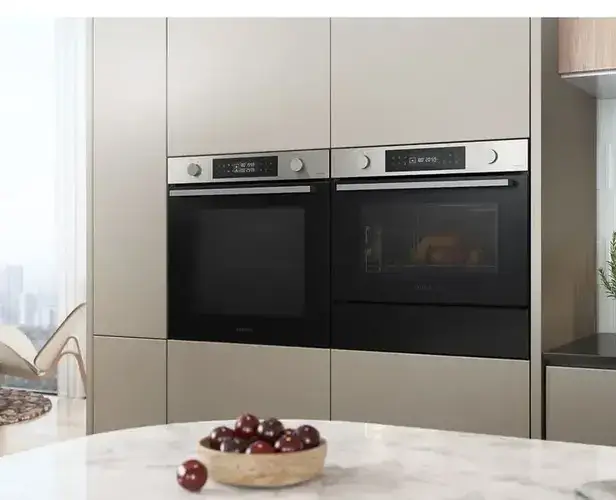
Single oven and combi microwave side by side in a tall housing — the alternative to a single oven with integrated microwave. The side-by-side configuration gives two independent cavities that can run simultaneously at different settings. The integrated microwave option puts both functions in one unit but cannot run simultaneously.
If you are specifying a new single oven, confirm whether the model you are considering includes integrated microwave function before adding a separate built-in microwave to the layout. Some premium single oven ranges include microwave function as standard in the specification, which may remove the need for a separate microwave unit entirely and free the niche for another use.
Tower planning and installation.
Where everything goes and why.
In a tall appliance tower, the position of the microwave or combi microwave relative to the main oven and other appliances determines how comfortable and safe it is to use every day. A good-looking elevation on the design drawing does not guarantee good daily ergonomics. Plan the tower sequence around how hot food is lifted and removed, not around visual symmetry.
The most common tower planning mistake. Ordering a combi microwave that is 5–10mm deeper than the available niche depth, leaving the door unable to close flush with the housing. This happens when the appliance depth is taken from the sales page rather than the installation guide, and when the depth of any trim kit is not accounted for. Always use the niche depth from the installation instructions, not the product headline dimension.
Comparison.
All formats side by side.
| Aspect | Built-in microwave | Combi microwave | Oven with microwave |
|---|---|---|---|
| Niche height | Approximately 380mm | Approximately 450mm | Approximately 595mm (standard oven niche) |
| Internal capacity | 17–21 litres | 36–50 litres | 65–80 litres (full oven capacity) |
| Width | 600mm standard. 500mm available. | 600mm standard | 600mm standard |
| Depth for wall units | Often suitable — confirm appliance body depth | Usually too deep for standard wall units | Not suitable — full oven depth |
| Primary function | Reheating, defrosting, convenience cooking | Microwave plus fan oven plus grill. A second capable cooking cavity. | Full-size oven cooking plus microwave function when oven is not in use |
| Simultaneous use | Microwave operates independently from main oven | Combi cavity operates independently from main oven | Oven and microwave share the same cavity — cannot run simultaneously |
| Browning capability | Grill models only. No browning in standard microwave mode. | Yes — grill element and fan oven produce browning and surface colour | Full oven browning and grill capability. No browning from microwave mode alone. |
| Steam function | Not available | Available on selected models at premium price | Not common. Some specialist models. |
| Electrical connection | Usually 13A socket | Usually 13A socket. Some high-power models require hardwired circuit. | Usually hardwired cooker circuit — same as a standard single oven |
| Best suited to | Kitchens with a good main oven where speed and convenience are the priority. Wall unit positions. Limited-depth housings. | Appliance towers where a second capable cooking cavity at eye level is wanted. Households who cook regularly and want flexibility. | Kitchens where consolidating appliances is the priority. One niche, one appliance, full oven plus microwave without separate units. |
| UK cost guide | £200–£500 | £400–£1,200+ | £800–£2,000+ (premium single oven pricing) |
The decision in plain terms. Choose a built-in microwave for convenience and simplicity. Choose a combi microwave when you want a second capable cooking cavity and use the oven functions regularly. Choose an oven with integrated microwave if you want to consolidate both functions in one unit and do not need to run them simultaneously. Do not choose by appearance or by what looks most impressive in a showroom — the right choice depends on how you cook each week.
Buying checklist.
Before you order.
Use this list before finalising any built-in microwave or combi microwave purchase. Most fitting problems in kitchen renovations are preventable with these checks completed before the order is placed and before the furniture is assembled.
- Decided between built-in microwave, combi microwave, or oven with integrated microwave based on cooking habits — not appearance
- Confirmed the niche height required: 380mm, 450mm, or 595mm
- Confirmed appliance width and whether 600mm or 500mm furniture is being used
- Confirmed appliance body depth plus required rear ventilation clearance fits the housing depth (critical for wall unit installations)
- For steam combi: confirmed water tank access position and descaling requirement are acceptable for the intended installation position
- Turntable or flatbed preference confirmed
- Downloaded installation instructions for the specific model and confirmed all three dimensions: appliance body, required niche, visible trim
- Electrical connection type confirmed: 13A socket or hardwired circuit. Socket position planned so the appliance slides fully into the niche.
- Tower position confirmed: combi microwave above main oven at a height where the user lifts food comfortably without raising the shoulder
- Door swing clearance confirmed in the kitchen layout — user has clear standing access directly in front of the open door
- Ventilation route confirmed: front-venting or top-venting, and housing design accommodates whichever applies
- Full tower stack reviewed — not just the microwave in isolation — to confirm all appliances fit the column and the microwave position is at a practical working height
Frequently asked questions.
See the Ovens hub for guides to single ovens, double ovens, compact ovens, and steam ovens. The Oven features guide covers combination microwave features in detail including flatbed design, defrost programmes, and premium features available across current combi microwave ranges.