
Mock In-Frame Kitchens.
The framed look. Full storage performance.
Mock in-frame describes a door and panel set that delivers the visual character of an in-frame kitchen on a standard frameless cabinet. The doors overlay the front of the unit in the normal German kitchen way. Beads, routed lines, and applied profiles on the door edges create the impression of a frame around each cabinet opening when you view the run from a normal viewing distance.
The critical difference from true in-frame is structural. There is no face frame on the cabinet. The frameless box sits behind the door exactly as it does in any other German kitchen specification. Full-width drawer boxes, wide pull-outs, and corner storage all remain available without the opening restrictions that a structural face frame introduces. You gain the visual character of the in-frame style without the access or cost penalty of the true construction method.
Mock in-frame sits between standard Shaker on a frameless carcass and full true in-frame construction. It suits buyers who want the period character and detail of a framed kitchen but are specifying a German kitchen system and do not want to move to a specialist British or Irish in-frame workshop at a significantly higher price point.
This guide covers how the effect is created, materials, colours, German system compatibility, design tips, and where mock in-frame sits in the three-way comparison with true in-frame and frameless. Separate guides cover true in-frame kitchens and Shaker kitchens in full detail.
What is a mock in-frame kitchen?
A true in-frame kitchen has a structural face frame fixed to the front of each cabinet. Doors and drawers sit inside the openings of this frame with small, even reveals on all four sides. The frame is part of the cabinet. It is a fixed structural element that defines both the look and the opening dimensions of every unit.
Mock in-frame achieves a visually similar result without the structural frame. The cabinet is a standard frameless box. Doors lay over the front of the carcass in the normal German kitchen manner. The framed appearance comes from the door design itself. Routed lines near the door edge, applied beading on the door face, or profiled outer sections create the impression of a frame around each opening. When doors sit side by side across a run, these lines read as the stiles and rails of a face frame from a normal viewing distance.
The distinction matters practically because the structural face frame of a true in-frame kitchen reduces the clear opening of each cabinet. This affects access to wide drawers, larder pull-outs, and corner units. Mock in-frame preserves the full opening dimensions of the frameless carcass. Everything behind the door behaves exactly as it does in any other German kitchen specification.
In North America this style is sometimes called inset-look or overlay framed. In the UK market, mock in-frame is the standard term. The key question to ask any supplier is whether their offer uses a structural face frame or whether the framed appearance is created on the door itself. The answer determines storage access, fitting complexity, and price position.
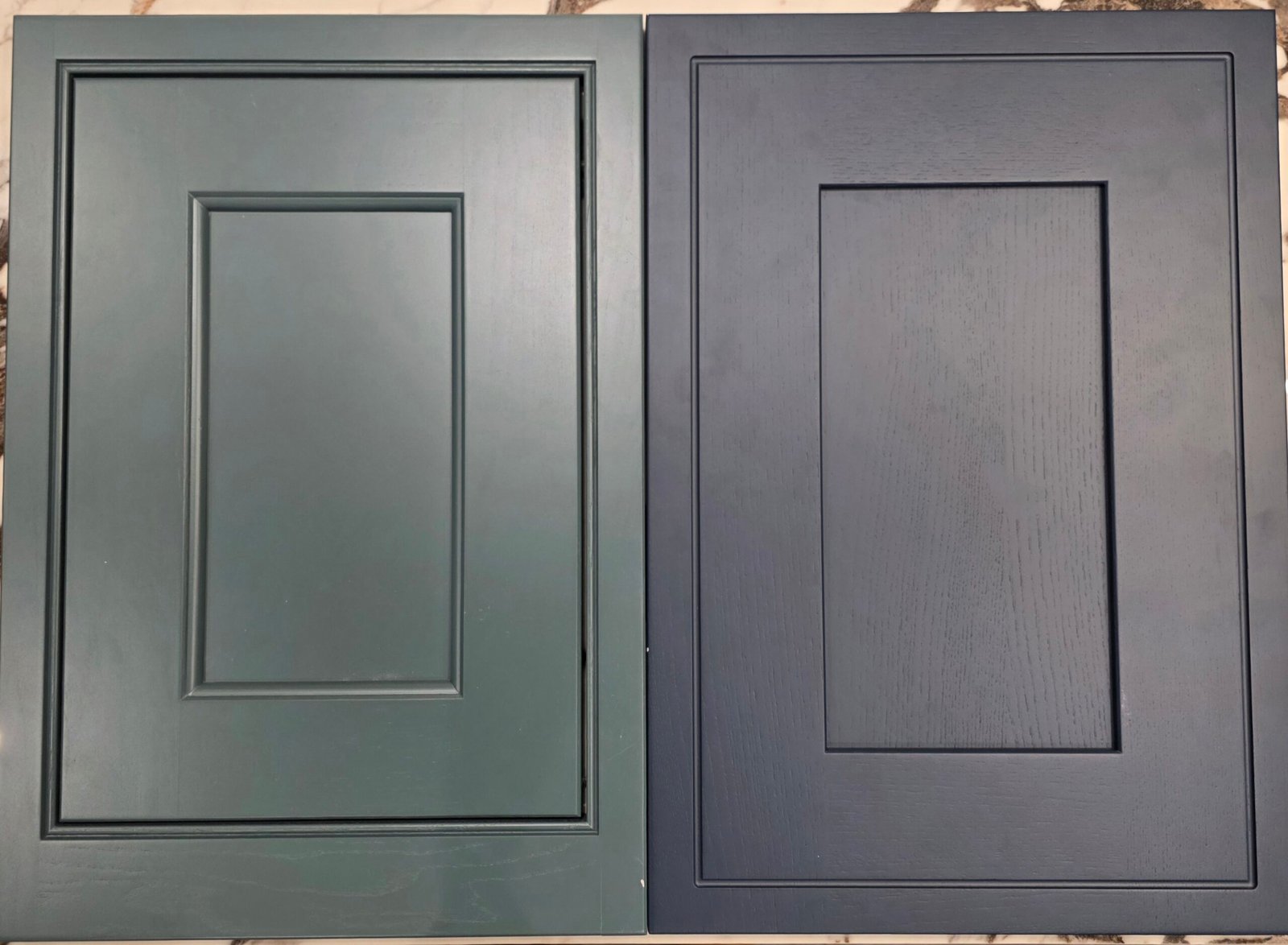
True in-frame (left) versus mock in-frame (right). The structural depth of the reveal differs at close range. From a normal viewing distance, the character reads as similar.
The question to ask in every showroom. Ask whether the framed kitchen on display uses a structural face frame with inset doors or whether the frame effect is applied to the door surface on a frameless carcass. These are two different products described with overlapping language. Confirm the construction in writing on the specification sheet before signing the order.
How the mock in-frame
effect is created.
Each manufacturer uses its own profile dimensions and proportions, but the principle is consistent across the market. The framed appearance is created at the door level, not the cabinet level. When doors sit side by side with consistent gaps across the run, the profiled edges read as the stiles and rails of a continuous face frame.
Routed outer frame lines are the most common approach. A fine router line sits a set distance in from the door edge. This creates a crisp shadow that mirrors the reveal shadow of a true in-frame reveal. When doors and drawer fronts are aligned across a run with even gaps between them, these routed lines connect visually to produce a grid of stiles and rails that reads as a frame from across the room.
Applied beading uses thin timber or MDF strips fixed to the door face or to the carcass surround. The beading sits proud of the door surface by a small amount, creating a physical edge that casts a shadow. This produces a stronger visual effect than a routed line alone and is more obvious as a deliberate frame detail. Applied beading on island backs and framed end panels extends the same visual language to the sides and rear of the kitchen.
The cabinets themselves remain standard 16mm to 19mm frameless units with familiar drilling patterns. Soft-close hinges, drawer runners, and internal storage follow the same specification as any other German kitchen in the same brand range. Fitters use standard overlay fitting methods with additional care on gap consistency and alignment, since the mock in-frame effect depends on even gaps reading as consistent reveals across the full run.
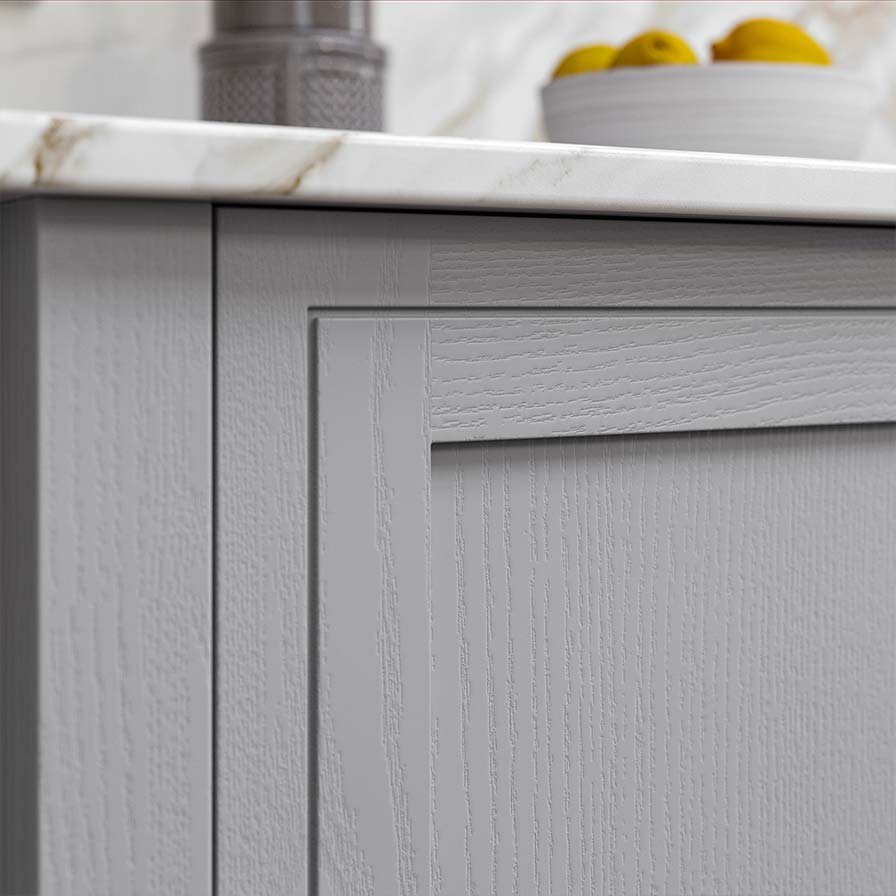
Routed profile on the door edge creates consistent shadow lines across the run. Even gaps between doors read as reveals when viewed from a normal distance.
Ask which parts of the door use solid timber, which use MDF, and whether any applied beading or wrapped elements sit close to ovens, dishwashers, or boiling water taps. Heat and steam exposure at profile edges and beading joints influences long-term stability more than the door panel specification alone.
- Consistent gap between doors is critical for the effect to read cleanly
- Profile depth and width vary by manufacturer and door style
- Works on both painted MDF and real wood doors
- Extends the frame detail to island backs and end panels
- Frame widths typically 25–70mm depending on unit size and style
- Narrower beads suit wall units. Broader profiles suit tall housings.
- Standard soft-close hinges, runners, and internal fittings throughout
- Fitting method is standard overlay with attention to gap consistency
- No specialist face frame joinery skills required at installation
Materials and door options.
Mock in-frame doors share construction methods with Shaker and other framed door styles. The framed detail sits on the front. The choice of core material affects durability, the quality of the profile edges, and how the door responds to cleaning and humidity over time.
Colour and finish.
How mock in-frame holds colour differently.
Mock in-frame holds colour in a way that plain Shaker on a frameless carcass does not. The routed profile or applied bead at the door edge creates a shadow line that gives each door a visual border. This border makes colour read as more contained and intentional than the same colour on a flat-edged Shaker door. A deep green or navy that might feel slightly formless on a standard Shaker run takes on more presence and structure when the profile edge frames it.
The practical result is that a wider range of colours works convincingly on mock in-frame than on standard Shaker. The profile gives the colour a physical boundary that reinforces rather than interrupts the design. This is why mock in-frame is a popular choice for buyers who want a bolder colour without going to full true in-frame construction.
Most German kitchen brands offering mock in-frame doors carry a standard colour range and extend to RAL Classic colours for more precise colour matching. Selected ranges offer Farrow and Ball and SIKKENS colour matching, bringing the full heritage paint palette into the kitchen. This allows the kitchen colour to match joinery, cabinetry, or paint colours elsewhere in the property, which is particularly relevant in period homes where the decorative scheme across rooms is carefully considered.
Matt and eggshell finishes suit mock in-frame well. They complement the profile detail and conceal small variations at joints and edges better than high-gloss surfaces. High-gloss is available but demands greater precision in alignment and gap consistency because reflections make any irregularity more visible.
Always request a painted door sample. Painted and lacquered mock in-frame doors look different in showroom lighting versus natural daylight in your room. Request a full-size door sample in your chosen colour, with the profile detail present, and view it in the space before confirming the order.
Mock in-frame on German
frameless cabinet systems.
German and European kitchen manufacturers design their systems around frameless carcasses. Mock in-frame styling drops onto this structure without modification. The carcass specification, hardware, and storage system remain identical to a standard slab or Shaker door build on the same range.
Storage and ergonomics. Frameless carcasses support full-width internal drawers, tall pull-out larder baskets, and integrated waste systems. A mock in-frame door does not reduce the opening dimensions in the way a structural face frame does. Access to everything behind the door stays consistent with any other door style on the same cabinet system.
Integration with appliances. Integrated appliances sit level with surrounding doors at standard heights. The framed detailing sits on the outer door face. Appliance clearances, hinge opening angles, and ventilation paths follow the same rules as any other modern German kitchen layout. No specialist modification is required at appliance cutouts or hinge positions.
Consistent sizing. German kitchen system widths of 300mm, 400mm, 500mm, and 600mm keep planning straightforward. Mock in-frame fronts are manufactured to fit this module grid so tall runs, peninsula layouts, and islands stay easy to design and price. The same planning software used for any other door style applies directly.
Labelling on drawings. Ask the designer to label each elevation on the kitchen plan as frameless, mock in-frame, or full in-frame. This one line prevents misunderstandings later in the process and ensures the supply chain delivers what was specified rather than what was assumed.
When reviewing a kitchen design, ask the designer to show you the elevation with the cabinet type labelled explicitly on each section. Frameless, mock in-frame, and full in-frame all appear under similar descriptions in showroom marketing. The label on the drawing confirms what is actually being supplied.
Design tips
for a convincing mock in-frame look.
The mock in-frame effect depends on proportion, consistency, and hardware choices more than any other single design decision. Small errors in gap consistency or frame proportion make the effect look unconvincing. The tips below keep the look resolved and calm rather than forced.
- Agree gap dimensions with the fitter before installation starts
- Random narrow fillers that break the rhythm across a run should be avoided at design stage
- Confirm gap consistency on the full frontal elevation drawing before signing the order
- 25–35mm suits wall units and smaller base doors
- 50–70mm suits tall housings and feature larder units
- Consistent profile family across the whole kitchen
- Matt finishes are more forgiving of gap and alignment variation
- High-gloss demands more precision as reflections amplify any irregularity
- Keep one handle family consistent across the full layout
- Brass and antique finishes suit period and warm-coloured schemes
- Black is a versatile choice that suits both light and dark palettes
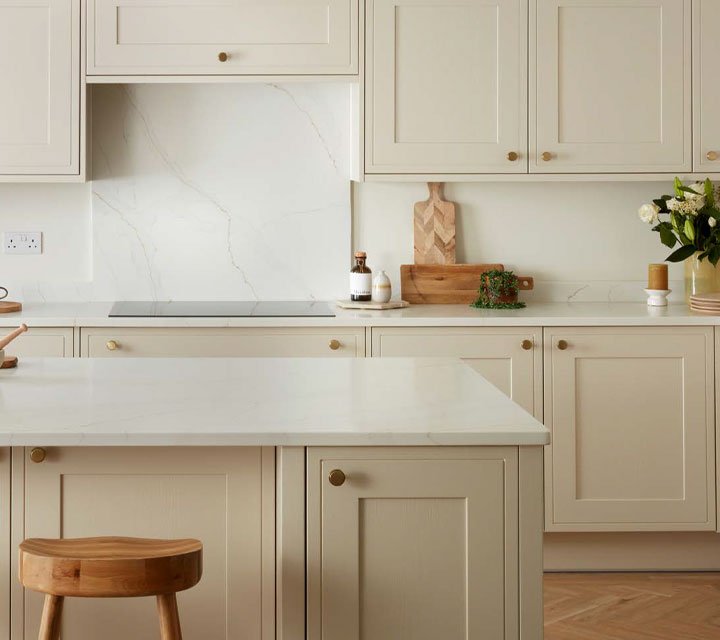
Consistent gaps across the run create the reveal effect. Feature glazed units and open shelves add visual variety without interrupting the framed grid.
Feature elements that reinforce the furniture character. Glazed dresser units, plate racks, and open oak shelves break up long runs of framed doors without disrupting the overall design language. Framed panels on island backs tie the island seating side to the wall run visually. These additions take the kitchen further from a system kitchen and closer to a piece of furniture, which is the intended effect of mock in-frame styling.
Benefits and limits.
- Strong framed character without the structural face frame on every cabinet. The visual effect is convincing at a normal viewing distance without the access and cost of true in-frame construction.
- Frameless carcasses retain full internal widths and generous drawer depths. The opening dimensions are not reduced by a frame on each side of the cabinet.
- Fitting complexity stays close to standard German kitchen installation. No specialist face-frame joinery or inset hinge adjustment is required. Standard overlay fitting methods apply.
- Works in both period homes and contemporary properties. The framed detail is sympathetic to traditional architecture without requiring it. It reads as considered and crafted in any context.
- Wider colour effectiveness than plain Shaker. The profile edge gives any colour a physical border that makes deeper and bolder shades read as more intentional.
- At close range, experienced eyes see that doors overlay the carcass rather than sitting within a structural frame. The shadow depth is shallower than true in-frame and the reveal is applied rather than structural.
- Applied beads and routed rebates introduce more edges and corners to clean than a flat slab or plain Shaker door. A regular wipe routine is needed to keep profile edges looking sharp.
- Mock in-frame sits above standard Shaker in price in most German kitchen ranges. The additional door detailing, profile precision, and fitting time increase both the door cost and the installation cost.
- Gap consistency is critical to the effect working correctly. Poor fitting that allows uneven gaps between doors breaks the framed illusion and is difficult to correct after installation without replacing doors or adjusting all hinge positions.
Mock in-frame vs true in-frame
and frameless.
All three routes are available across the UK market on German kitchen systems or from specialist British workshops. The differences are in cabinet structure, storage access, visual character, fitting complexity, and price position. The carcass quality, hardware specification, and warranty can all be equivalent across the three routes. See the in-frame kitchens guide and the Shaker kitchens guide on this site for the full picture on each alternative.
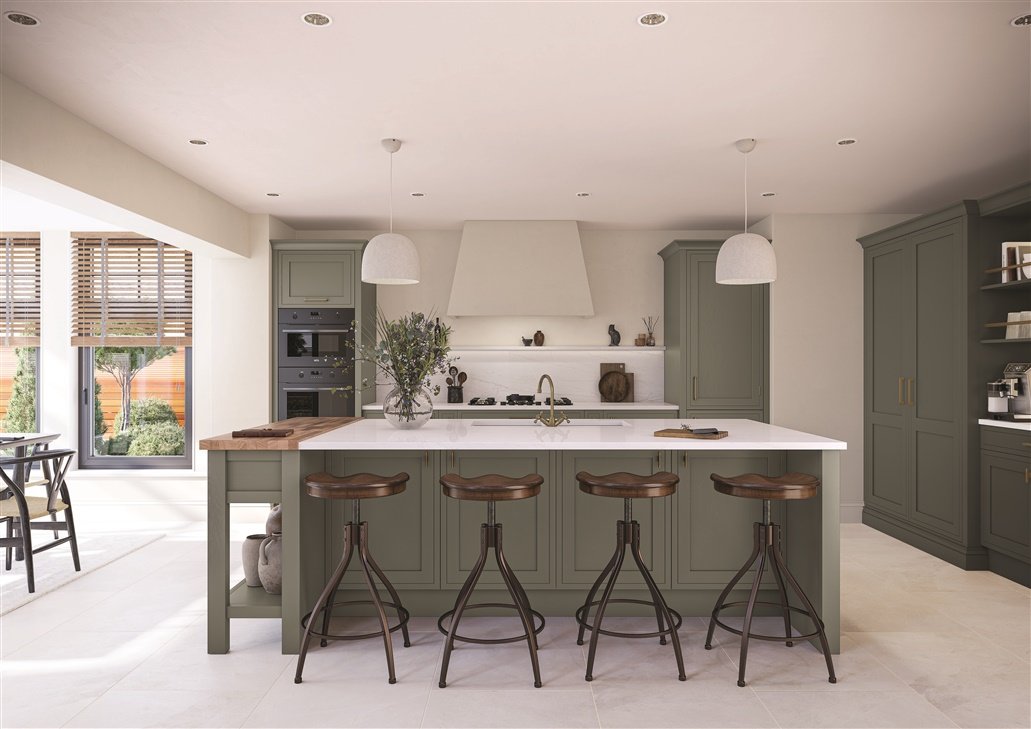
Mock in-frame in a contemporary open-plan layout. Consistent gaps, proportioned frame detail, and a considered colour choice are the elements that make the look work at this scale.
| Aspect | Mock in-frame | True in-frame | Frameless system |
|---|---|---|---|
| Cabinet structure | Frameless carcass. Framed effect created by door detailing, routed profiles, and applied beading. | Structural face frame on every cabinet. Doors and drawers sit inside the frame openings. | Frameless carcass. Lay-on doors with no frame detail on the door face or carcass. |
| Storage access | Near full opening width. Frameless carcass gives the same access as any other door style on the same cabinet. | Frame reduces clear opening on each side. Affects wide drawers and full-width larder pull-outs. | Maximum opening for each nominal cabinet size. No reduction from any frame element. |
| Visual character | Framed look with consistent profile shadows across the run. Convincing at normal viewing distance. Shallower shadow depth than true in-frame at close range. | Deep structural shadow lines around every opening. Furniture character. Most convincing framed visual of the three routes. | Clean, contemporary lines with no frame breaks. Minimal detailing. Suits slab, Shaker, and handleless doors equally. |
| Installation | Standard overlay fitting with careful attention to gap consistency. No specialist face-frame joinery skills required. | More skilled work to maintain even reveals inside frames. Inset hinges need accurate setting and occasional adjustment. | Straightforward for most layouts. Fastest fitting route across the three options. |
| Price position | Mid to upper-mid. Above standard Shaker on frameless. Below full true in-frame from a specialist. | Mid to premium. Higher material cost, longer fitting time, and more complex paint work than both other routes. | Widest spread, from entry-level to premium. The lowest-cost entry point of the three routes. |
| Best suited to | Buyers wanting in-frame character on a German frameless system with full storage performance and a controlled project budget. | Period properties and statement kitchens where structural joinery quality and long-term refinishing matter more than storage optimisation. | Projects led by storage, ergonomics, handleless styling, or a clean contemporary aesthetic where frame detail is not the brief. |
Ask for three prices on one plan. Request the same layout priced as mock in-frame, as a standard Shaker on frameless, and as full true in-frame if available. Review the three drawings and totals side by side. The visual difference and the cost difference become clear at the same time, and the right choice for your project and budget is much easier to make from that comparison.
Typical UK cost bands.
Mock in-frame typically sits in the middle of the three-way price comparison. Above a standard Shaker door on a frameless carcass due to the additional door detailing and fitting precision required. Below full true in-frame from a specialist British or bespoke workshop. The exact uplift varies significantly between manufacturers and ranges. Request itemised quotes that separate cabinet cost, door upgrade cost, decorative panel cost, worktops, appliances, and fitting. This breakdown shows precisely where the mock in-frame detail adds to the project spend versus the standard specification.
When comparing quotes across suppliers, confirm the carcass specification is equivalent. A mock in-frame door on a quality German frameless carcass with 16mm panels, soft-close hardware, and a 5-year warranty is a different product to the same door on a budget flat-pack carcass. Both may be described as mock in-frame kitchen quotes.
Is a mock in-frame kitchen
right for you?
- You want a framed, classic look on a German frameless cabinet system with the full range of modern storage solutions available behind the doors.
- You value strong internal storage, full-width drawers, and deep pull-out access as much as you value the visual character of the door style. The frameless carcass delivers both.
- Your budget is mid to upper-mid and you want the framed character to sit within a German kitchen system rather than commissioning a bespoke British or Irish in-frame workshop at a higher project cost.
- You prefer straightforward fitting and easy access for future service and adjustment. Standard overlay fitting methods apply. No specialist face-frame joinery skills are required.
- You want the option to use deeper, bolder colours that carry convincingly on a framed door profile. The profile edge gives colour a physical boundary that flat Shaker doors do not provide.
- You want the authentic structural depth and furniture-quality shadow of a true face-framed cabinet. The difference is visible at close range and the structural integrity of a real face frame is a different product to an applied profile.
- You prefer a very clean, minimal, or handleless scheme with as little surface detail as possible. A frameless Shaker or slab kitchen with or without a handleless system delivers this more completely.
- You want the sharpest storage performance per pound spent. Simple Shaker or slab doors on the same frameless carcass deliver the same internal storage at a lower door and fitting cost.
- You plan to refinish the kitchen in ten to fifteen years. Mock in-frame, like standard Shaker, is a replacement-rather-than-refinish product. True in-frame timber construction is the appropriate choice where long-term refinishing is the plan.
Visit a showroom with both mock in-frame and true in-frame displays if you are comparing the two. Open drawers and tall larders on both. Look at the reveals from one metre away and from across the room. Test the storage access. The practical difference and the visual difference are both clear in person. Also see the true in-frame guide and the Shaker kitchens guide on this site before booking a design appointment.