
Oven features explained.
What to look for when buying.
Modern built-in ovens, combination microwaves, and steam ovens offer a wider range of features than many buyers realise — and a narrower range of genuinely useful ones. Self-cleaning systems, air fry settings, meat probes, steam injection, app connectivity, retractable doors, and advanced fan programmes all appear across current UK ranges. The challenge is not finding features. It is working out which ones will improve the way you actually cook and which ones will sit unused.
This guide explains the main features available across three appliance types — standard built-in ovens, combination microwaves, and steam ovens — in plain terms. It covers what each feature does, what cooking style it suits, how the common marketing names differ between manufacturers, and how to compare options that are frequently confused with each other. The comparison section at the end covers the four decisions buyers find hardest: cleaning types, steam levels, microwave versus compact oven, and probe versus auto programmes.
Brand names are kept generic throughout. The same feature often appears under different names across manufacturers. Understanding what a feature does tells you more than which brand calls it what.
Standard oven features.
What matters and what to skip.
A standard built-in oven needs to cook well, clean easily, and be simple to use every day. Most buyers find the biggest day-to-day improvements come from self-cleaning, a strong fan cooking mode, an efficient grill, fast preheat, and good shelf flexibility. Premium features — air fry, steam assist, meat probe, connectivity — add real value when you will use them regularly. Understand what each does before deciding whether it justifies the price difference.
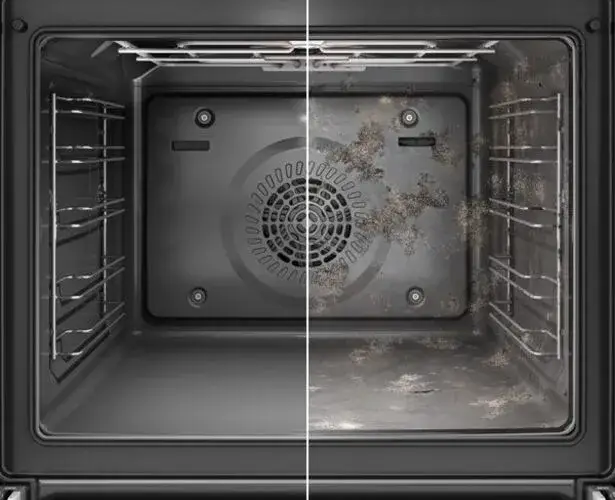
Pyrolytic cleaning heats the oven cavity to approximately 400–500°C, which burns all food residue — grease, splatter, burnt-on food — into a fine ash. When the cycle finishes and the oven cools, you wipe away the ash with a damp cloth. No chemical cleaners. No scrubbing. No soaking the shelves. The oven cleans itself.
Pyrolytic cycles take 1–3 hours depending on soil level and the programme selected. They use a meaningful amount of electricity per run. The oven locks automatically during the cycle for safety. Run it every 4–8 weeks depending on how often you cook and how heavily, rather than weekly.
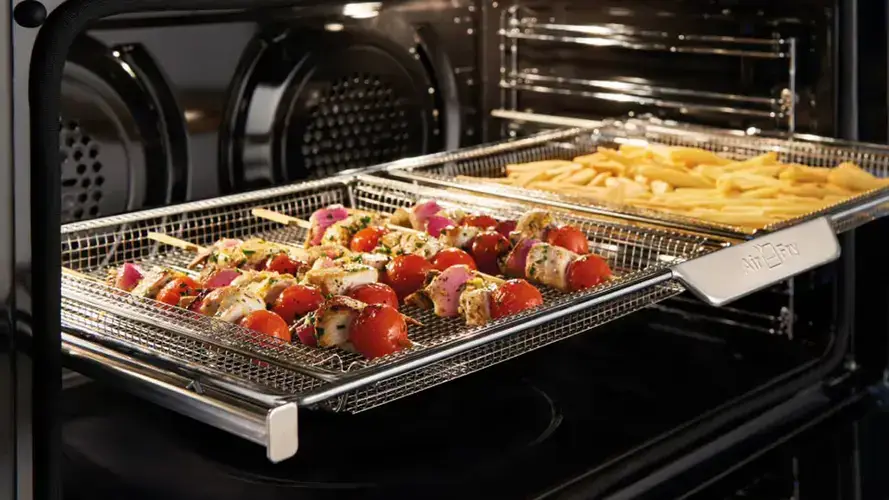
Air fry uses very strong circulating hot air — usually from a rear fan combined with high grill or element heat — to crisp foods such as chips, vegetable pieces, coated chicken, and frozen snacks with significantly less oil than deep frying. Most manufacturers pair this with a dedicated perforated tray that allows hot air to reach the food from all sides simultaneously.
The function works best when the tray is not overcrowded — air needs to circulate around individual pieces. Results depend on fan power, cavity size, and tray design. A well-designed built-in air fry function replaces the need for a separate countertop air fryer and frees up worktop space.
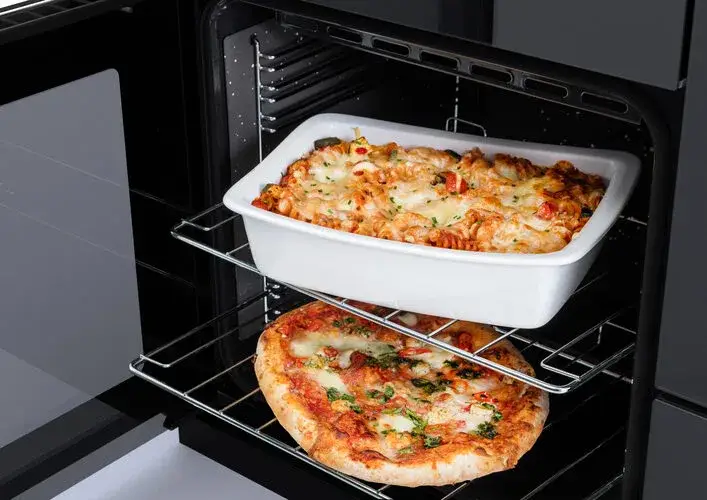
Fan cooking uses a rear-mounted fan and heating element to circulate hot air throughout the cavity. The circulating heat distributes more evenly than top-and-bottom heat alone, which allows food to cook on two or three shelves simultaneously without the lower shelf browning faster than the upper. It also preheats faster than conventional heat and often allows cooking at 10–20°C lower than the recipe temperature.
More advanced multi-directional fan systems refine airflow to further reduce hot spots across all shelf levels. These matter most for households baking across several shelves at once — batch cookies, multiple bread tins, multi-tray traybakes.
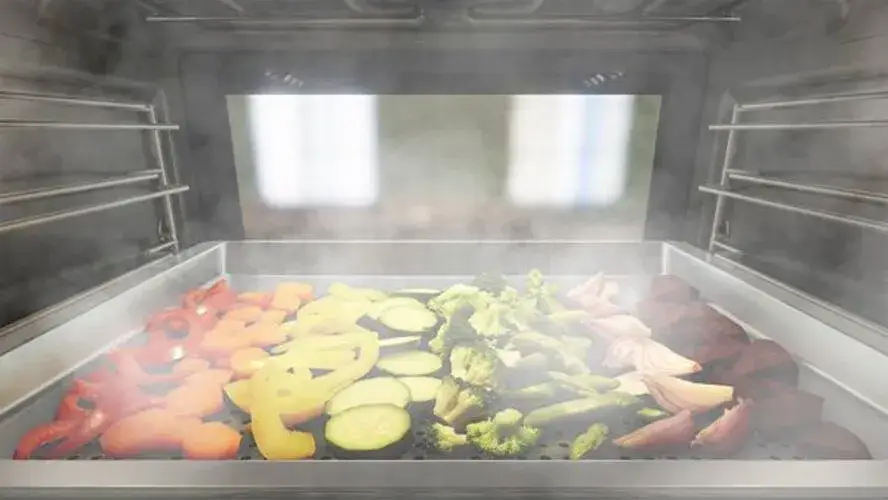
Added steam introduces controlled bursts of moisture into the oven cavity at selected points during cooking. The appliance remains primarily a conventional oven — steam is an enhancement rather than the main cooking method. Steam prevents the outer surface of bread from setting too quickly, which allows better oven spring and a more developed crust. On roasts, steam bursts help retain moisture in the centre while the exterior continues browning from the hot air.
This is a lighter steam function than a full combi steam oven. It is available on a growing number of premium standard ovens as a built-in feature — not a separate appliance purchase. See the steam ovens section for full steam and combi steam options.
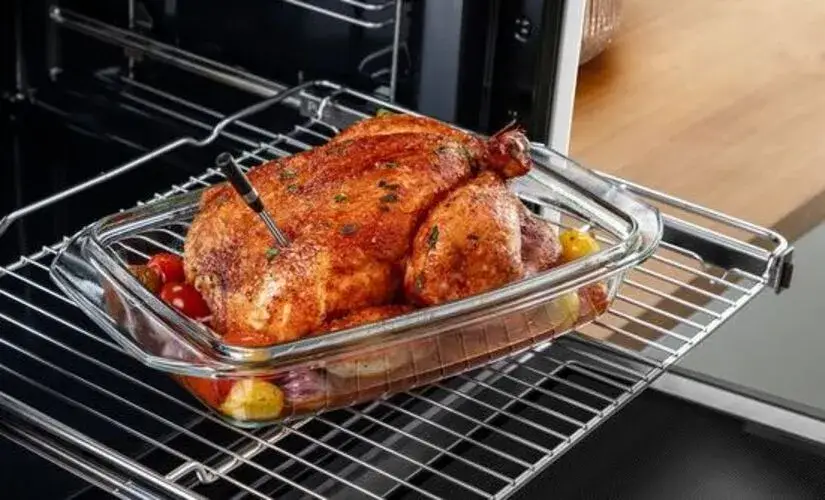
A meat probe is a temperature sensor inserted into the thickest part of the joint, bird, or roast. The probe reads the internal food temperature throughout cooking and reports it to the oven display. The oven either alerts you when the target temperature is reached or switches automatically to a hold mode to maintain serving temperature without overcooking.
Better probe systems use multiple temperature measuring points along the probe rather than one, which gives a more accurate average reading for large joints where temperature varies significantly between the centre and the edge. The probe eliminates guesswork on doneness for beef, lamb, pork, and whole poultry.
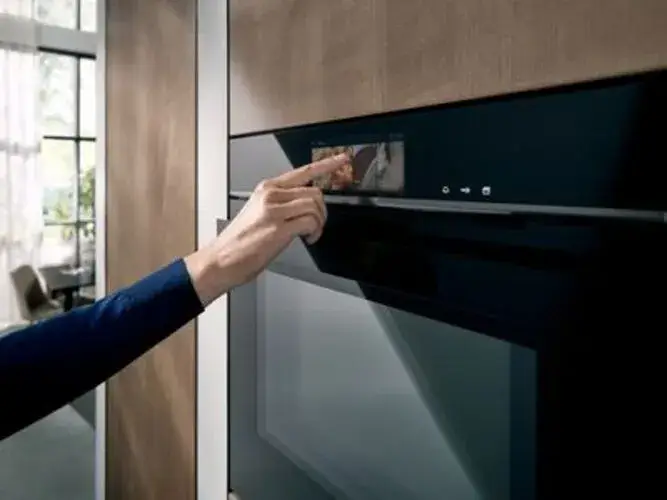
Automatic programmes guide cooking by food category, weight, or target finish. Select the food type — roast chicken, baked potato, lasagne, sponge cake — enter the weight if prompted, and the oven sets or suggests the temperature, function, and cooking time automatically. Some programmes manage the full cook cycle including temperature changes and finishing modes without further input.
Programme libraries vary significantly between manufacturers and price tiers. Entry ovens offer a small core set. Premium models include hundreds of programmes with detailed tray and shelf placement guidance on screen.
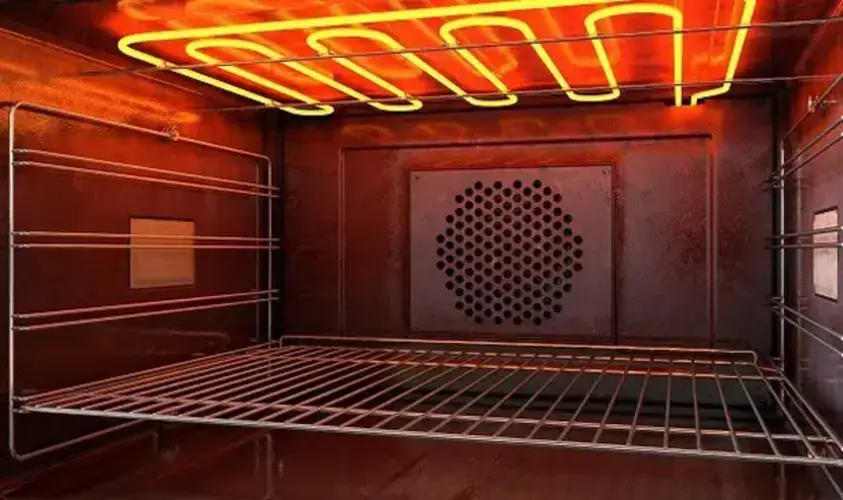
Fast preheat uses multiple heating elements simultaneously — top, bottom, fan, and grill elements working together — to bring the cavity up to temperature more quickly than standard preheating which uses only the specified cooking function elements. Once the target temperature is reached, the oven switches automatically to the selected cooking mode.
The benefit is straightforward: less waiting. A standard oven takes 10–15 minutes to reach 200°C. A fast preheat function achieves the same in 5–8 minutes on most current models. The improvement in cooking quality is minimal, but the convenience is genuine.
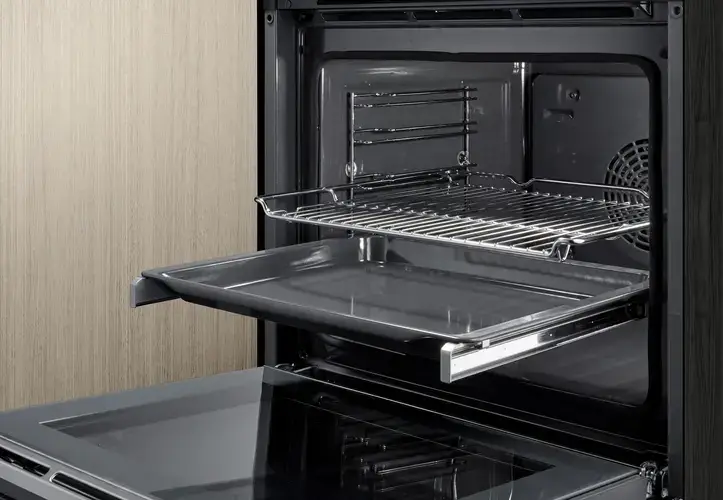
Telescopic rails are extending shelf runners that allow a shelf or tray to slide smoothly out to a fully extended, stable position without tipping or requiring full removal from the oven. Checking food, basting a joint, and lifting heavy roasting tins become significantly easier and safer. Rails should be fitted on at least the most-used shelf levels. Single-level rail sets are less useful than two or three positions.
Soft-close door hinges use a damping mechanism to slow and cushion the door as it closes, preventing it slamming. The feature reduces noise and wear on the hinge mechanism over years of use. Neither feature affects cooking performance directly, but both make daily oven use noticeably more refined.
Priority order for most buyers. Start with cooking performance (fan quality), then cleaning (pyrolytic is worth it), then usability (rails, fast preheat, clear controls). Air fry, probe, and steam add real value if those cooking styles match how you cook. App connectivity is useful if you genuinely cook from the sofa — for most households it is a low-priority feature.
Cleaning systems.
Pyrolytic, hydrolytic, and catalytic.
Cleaning is the feature most buyers underestimate during purchase and appreciate most during ownership. There are three different approaches to reducing manual oven cleaning. They work in different ways and suit different cooking intensities. The comparison section later in this guide covers them side by side. This section explains each system and where it genuinely helps.
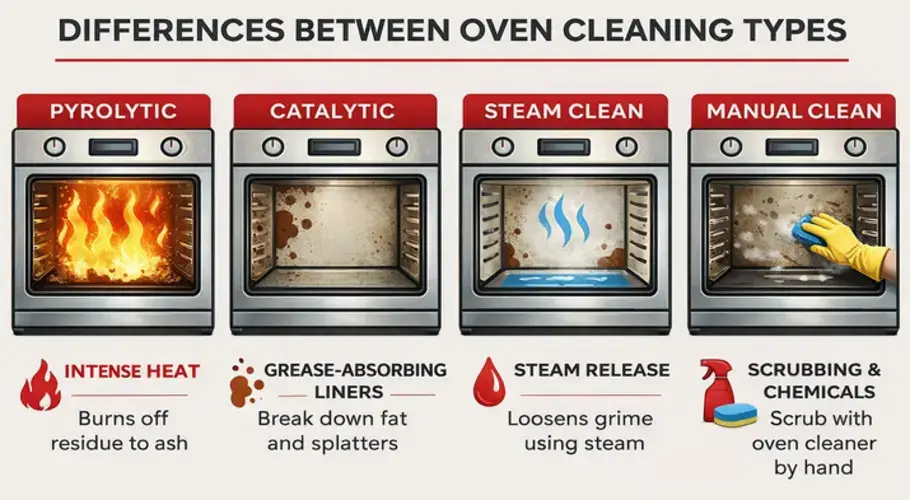
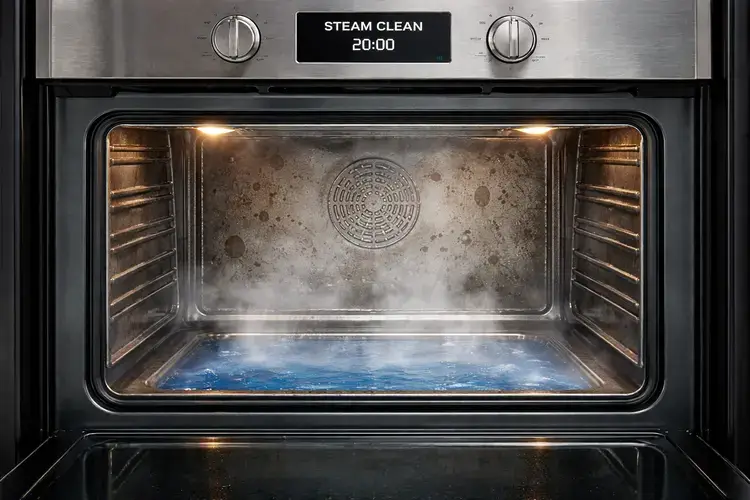
Left: the three cleaning systems compared side by side. Right: hydrolytic steam cleaning in action — water generates steam at low temperature to loosen residue for wiping. Noticeably quicker and lower-energy than pyrolytic but less effective on heavy soiling.
Combination cleaning systems. Many mid to premium ovens include both pyrolytic and an easy-clean or hydrolytic option. The pyrolytic programme handles heavy cleaning after a busy cooking period. The quick hydrolytic option handles lighter maintenance in between. Having both gives the most practical flexibility for everyday upkeep.
Door design and access features.
The oven door determines how you access food during and after cooking. Most built-in ovens use a standard hinged drop-down door — the door swings down and you reach over it. A retractable door changes this entirely. Door glazing affects safety, efficiency, and cleaning access. These features are often overlooked in specification comparisons but make a real difference in daily use.
Practical advantages: easier access to the full cavity depth, no hot door surface to lean over, better for eye-level installation where a dropping door at chest height is comfortable but harder to lean over, and a cleaner look when open. The mechanism requires specific housing clearance — confirm with the installer before specifying.
Cool-touch or four-glass doors take this further with an additional outer glass pane and enhanced edge sealing. The outer surface on these doors remains cooler under prolonged high-temperature cooking. This is a safety feature as much as an energy efficiency one — particularly relevant in kitchens with children who might touch the oven door during use.
Removable inner glass dramatically extends how long the door looks clean. It is a practical feature that has a direct impact on how the oven looks and how well you see food cooking, but it is frequently overlooked when comparing specifications.
Controls, connectivity,
and usability features.
Control interface and connectivity features span a wide range from simple and reliable to highly sophisticated. A clear, intuitive control system matters for daily use more than headline features. App connectivity adds genuine value in specific circumstances. Child lock and interior lighting are practical features that are easy to overlook in a showroom but matter consistently in everyday use.
Worth specifying if: you frequently forget to start the oven early, use guided recipe apps, want to monitor cooking from another room, or integrate with a wider smart home. Not worth specifying if you want the simplest possible reliable oven — connected features add complexity and occasional software dependency.
Confirm the lock mechanism works the way you expect: some systems lock all controls, others allow door opening but not setting changes. Check the detail for the specific model.
A detail that matters practically on every cooking session. The ability to see food clearly through the door glass without opening — losing heat and disrupting the cooking environment — is genuinely useful. The best LED systems show the full cavity at full brightness at any oven temperature.
Combination microwave features.
A combination microwave combines microwave energy with oven cooking, grilling, or both in a single built-in unit. It heats faster than a conventional compact oven and gives a better finish than a standalone microwave. The combination modes — microwave plus fan, microwave plus grill, or all three together — are what distinguish a built-in combination microwave from a basic countertop model.
This is the primary function of a combination microwave. Microwave energy heats the food from within while conventional fan heat or grill browns the exterior. Food cooks faster than oven-only cooking (the microwave accelerates heat penetration) and achieves better surface finish than microwave-only cooking. Lasagne, baked potatoes, pasta bakes, and reheated meals with crisp toppings are the clearest beneficiaries. The combination mode is the main reason to choose this appliance over a separate microwave and compact oven.
A flatbed design distributes microwave energy through the sides of the cavity using a rotating antenna underneath the floor rather than a spinning turntable platform. The cavity floor is flat and completely clear, which allows any container shape or size and makes the cavity easier to wipe clean. A turntable design uses a rotating glass plate to rotate the food through the microwave field. Turntables reduce the effective floor area by the plate radius and require that containers fit within the turntable circle without catching on the cavity walls.
Flatbed is generally considered preferable for convenience and usability. Most mid to premium combination microwaves now use flatbed design.
A grill element in a combination microwave adds browning and crisping capability that microwave energy alone cannot produce. A cheese topping on a pasta bake, breadcrumb coating on fish, or the surface of a roasted piece of chicken all require direct radiant heat to achieve colour and texture. The grill element either operates alone for grilling or in combination with microwave power for hybrid cooking where speed and surface finish are both needed simultaneously.
Built-in combination microwaves offer significantly more sophisticated defrost and reheat than countertop models. Sensor-based systems detect steam emissions from the food and adjust power and time automatically. Weight-based defrost programmes calculate defrost time from food weight input. Power-staged defrost alternates between high and resting phases to thaw evenly without cooking the outside while the centre remains frozen. These programmes produce noticeably better results than manual time-and-power settings for everyday defrosting.
The ability to save custom settings — time, power level, combination mode — as named user programmes means your most frequent cooking tasks become one-touch operations. Reheating a specific dish at a specific power for a specific time, or a combination programme you have refined for a particular meal, is accessible without re-entering settings. This is particularly useful in households where multiple people use the appliance and need consistent results without detailed knowledge of the settings.
Combination microwaves handle both microwave splatter from reheating and conventional oven cooking residue from combination programmes. The interior requires more frequent cleaning than a standard oven because microwave reheating generates splatter at much lower temperatures where residue is liquid rather than baked-on. Smooth enamel interiors wipe clean more easily than rough surfaces. Steam-clean programmes on some models loosen splatter before wiping. Removable cavity liners on selected premium models allow the interior to be taken out and cleaned flat.
Steam oven features.
Steam ovens are available in two sizes (compact 45cm and full-size 60cm) and three functional levels (steam assist in a standard oven, full steam only, and combi steam). The functional level determines what the appliance can do. The size determines where it fits in the kitchen. Both decisions come before choosing specific features.
See the Steam Ovens guide for the full page covering both formats. This section summarises the key features available within the steam oven category.
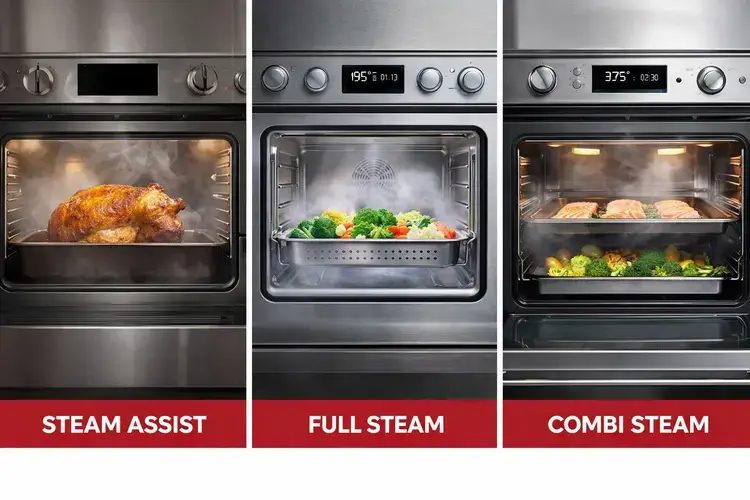
Three steam function levels. Left: steam assist — bursts of moisture added to a conventional oven. Centre: full steam only — steam is the primary heat source. Right: combi steam — hot air and steam working simultaneously. Each suits a different cooking brief.
Feature comparisons.
The four decisions buyers find hardest.
Pyrolytic vs hydrolytic vs catalytic cleaning
| Aspect | Pyrolytic | Hydrolytic or steam clean | Catalytic liners |
|---|---|---|---|
| Cleaning depth | Deepest. Burns all residue to ash. Full cavity including sides, back, roof, and floor. | Moderate. Loosens grease for wiping. Does not remove heavy baked-on residue. | Light passive maintenance. Absorbs and oxidises grease splatter during normal cooking. |
| How it works | Extreme heat (400–500°C) burns residue to ash. Door locks automatically for the full cycle. | Water added to the cavity or a tray. Low heat generates steam that softens residue for wiping. | Rough-textured panels on oven walls absorb grease. Heat from normal cooking gradually breaks it down. |
| Duration | 1–3 hours per cycle. | 20–40 minutes. | No dedicated cycle. Works during normal cooking sessions. |
| Energy use | Significant. Budget for electricity cost per cycle. | Low. Short cycle at moderate temperature. | None additional. Works on heat already used for cooking. |
| Manual effort after | Wipe ash from cooled cavity. One damp cloth. No scrubbing. | Wipe softened residue. More effort than pyrolytic but less than unassisted cleaning. | Occasional wipe of panels. Door glass and floor still require manual cleaning. |
| Coverage | Full cavity interior including door glass on models with removable inner glass. | Cavity walls and floor. Door glass still requires separate cleaning. | Side and rear wall panels only. Door glass and floor not covered. |
| Best for | Frequent cooks, family kitchens, buyers who want the easiest long-term maintenance. | Light to moderate use. Quick upkeep between pyrolytic cycles. Lower cooking frequency households. | Buyers who want some passive cleaning support at lower cost. Best as a supplementary feature alongside another cleaning method. |
Steam assist vs full steam vs combi steam
A standard oven with moisture enhancement. Steam bursts are added at controlled points during selected programmes. The oven functions as a conventional appliance throughout.
What it improves: bread crust development, oven spring on loaves and rolls, moisture retention in roasted joints. Results are noticeably better than a dry oven for these specific uses.
What it does not do: full steam cooking of vegetables or fish at 100°C. The steam level and control are not equivalent to a dedicated steam appliance.
Best for: buyers who bake bread or roast frequently and want better results from their main oven without a separate steam purchase.
Steam is the primary heat source. No dry oven elements active during steam-only modes. The cavity is held at steam temperature from 40–100°C.
What it does: gentle, moisture-retaining cooking for vegetables, fish, rice, eggs, custards, and dumplings. Preserves texture, colour, and nutrients better than boiling or roasting for these food types.
What it does not do: browning or crisping. Full steam cooking produces no Maillard reaction — no colour development on the exterior of food. Combine with dry modes for those results.
Best for: households where steam is used several times a week for everyday cooking, not just occasional bread or roasts.
Steam and hot air operate simultaneously from the same appliance. The oven produces both browning (from hot air) and moisture retention (from steam) in the same cooking cycle.
What it does: roast chicken with crisp skin and moist breast. Bread with better crust and crumb. Fish with moist texture and lightly coloured exterior. Baked pasta that does not dry on the surface. Regeneration reheating that produces freshly-cooked texture.
What it requires: a dedicated steam oven (compact 45cm or full-size 60cm) rather than a steam-assist feature on a standard oven. Higher purchase cost and ongoing maintenance commitment for limescale management.
Best for: buyers who want the broadest cooking capability from a single appliance and will use steam modes regularly.
Combination microwave vs compact oven
| Aspect | Combination microwave | Compact oven (standard) | Compact steam oven |
|---|---|---|---|
| Primary function | Microwave reheating and defrost with oven and grill combination options | Conventional oven cooking in a 45cm niche. Full fan, grill, and oven modes. | Steam and combi steam cooking in a 45cm niche. Full conventional modes also available. |
| Speed advantage | Fastest for reheating, defrosting, and midweek meals that benefit from microwave acceleration | Standard oven preheat and cooking times | Standard oven times for dry modes. Steam modes cook vegetables and fish quickly. |
| Cooking quality ceiling | Very good for everyday convenience. Combination modes produce better finish than microwave alone. Cannot match a dedicated oven for baking performance. | Full oven performance in a compact cavity. Suitable for baking, roasting, and all conventional cooking tasks. | Best food quality of the three for moist cooking, reheating, and bread. Combi steam produces results unavailable in either alternative. |
| Best use case | Second cavity focused on speed. Households that reheat frequently and want eye-level microwave access without a countertop appliance. | Second oven for additional cooking capacity. Households that cook from scratch often and want a genuine second oven at eye level. | Second oven with premium capability. Households where steam cooking, bread baking, and high-quality reheating are regular priorities. |
| Maintenance | Frequent wiping of splatter after use. Simpler overall maintenance than steam. | Standard oven maintenance. Cleaning system options as per main oven selection. | Descaling schedule essential. Tank emptying after use. More maintenance than either alternative. |
Meat probe vs automatic programmes
Measures actual internal food temperature in real time. Tells you exactly when the food has reached the target doneness — not when the time has run out. Food size, starting temperature, and how often the door was opened do not affect the probe reading.
Particularly valuable for: beef (rare, medium, well-done have specific temperature targets), lamb, pork (food safety has a defined internal temperature requirement), whole poultry, and any roast where precise doneness matters.
The probe does one job extremely well. It does not help with baking, vegetables, or any dish without a clear internal temperature target.
Guide temperature, function, and time for a wide range of food types. Input the food category and weight, and the oven manages the settings. Covers roasting, baking, grilling, and in some cases steam modes.
Particularly valuable for: less confident cooks, busy households where different family members use the oven, and anyone who wants consistent results across a range of dishes without remembering individual settings.
The programme library varies enormously between models. A large, well-designed programme library with shelf placement guidance is a meaningfully different product from a small basic set.
If you roast meat weekly and want precise, consistent doneness without cutting and checking, a probe is the more valuable feature. It solves a specific problem very effectively.
If you want support across a wider range of dishes, benefit from guided cooking, or have household members who cook less confidently, automatic programmes deliver more value across your total cooking use.
The best answer: an oven that includes both. Mid to premium models often include a probe as part of a broader feature set that also includes a substantial automatic programme library. At this tier, you are not choosing between the two.
Simple shortlist for most buyers. Decide on appliance type and position first (main oven, second compact oven, combination microwave, or steam oven). Then decide on cleaning method — pyrolytic is worth the premium for frequent cooks. Then add the cooking features you will use weekly: air fry if you use it, probe if you roast meat regularly, steam assist if you bake bread. App connectivity, keep warm, dehydrate, and extended programme libraries are useful when the priority features are already met. Do not pay a premium for features you will not use.
Frequently asked questions.
See the Ovens hub for guides to single ovens, double ovens, compact ovens, and steam ovens. The Which oven guide works through the specific questions that lead to the right oven choice for your layout and cooking habits.