
Porcelain worktops.
The complete UK guide.
Porcelain is a kiln-fired slab material with no resin binder, no organic content, and near-zero porosity. It is the only worktop material you place hot pans on directly without any concern for the surface. It requires no sealing, no oiling, and no specialist maintenance products. It performs equally well indoors and outdoors, does not fade in UV, and suits kitchen worktops, dining tables, wall cladding, flooring, and external applications without changing specification.
The trade is fabrication complexity. Porcelain requires specialist diamond tooling for every cut, drill, and profile. It is brittle at exposed edges and chips on heavy impact. It offers a limited range of edge profiles compared with stone or solid surface. And the decorative pattern on most porcelain exists only at the surface of the slab — drainer grooves, edge profiles, and island drop-down panels expose plain base material unless full-body porcelain is specified.
Slabs are typically supplied at 3200mm × 1400mm, though exact formats vary by manufacturer and product range. Confirm the available slab dimensions with your supplier before finalising the layout and join positions for your specific kitchen.
What is porcelain.
How it is made and how it differs.
Porcelain begins as a dry mixture of kaolin clay, feldspar, silica quartz, and mineral pigments. The mixture is pressed under high pressure into large format slabs and then fired in a kiln at temperatures exceeding 1200°C. At these temperatures, the kaolin vitrifies: the clay minerals fuse and recrystallise into a dense glass-ceramic matrix. The result is a slab with near-zero porosity, extremely high hardness (7–8 on the Mohs scale), and no organic or polymer content anywhere in its structure. This is a fundamentally different product from tiles or standard ceramic, and a fundamentally different composition from quartz or solid surface.
The absence of resin binders is the fundamental technical difference between porcelain and quartz. Quartz composite worktops use crushed quartz aggregate bound with polyester or acrylic resin — typically 7–10% of the slab. The resin component is what limits quartz's heat performance, UV stability, and outdoor suitability. Porcelain has none of these limitations because it has no organic content to degrade.
Porcelain vs ceramic. Both begin with clay-based raw materials. The difference is firing temperature and compression pressure. Standard ceramic retains measurable porosity — up to 3% absorption or more. Porcelain achieves absorption below 0.5%. Standard ceramic is not appropriate for kitchen worktops. Purpose-made large-format porcelain slabs are a different product category entirely.
Porcelain vs sintered stone. Sintered stone uses a similar mineral-based production process but typically employs a wider range of raw materials and higher pressing forces. Both are non-porous, resin-free, and heat-resistant. For practical kitchen use, both materials perform comparably. The distinction is most visible in slab format and pattern technology.
Slab format. Most porcelain worktop slabs are supplied at 3200mm × 1400mm. This is large enough to cover most kitchen runs without a join — an advantage that reduces visible joint lines and simplifies installation. Exact slab dimensions vary by manufacturer and product range. Confirm the available format with your supplier before agreeing the fabrication layout, as join positions depend directly on slab size.
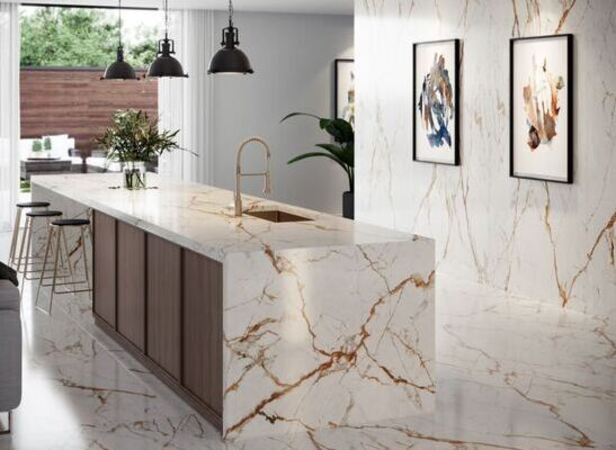
Large-format porcelain slab with marble-effect surface pattern in a contemporary kitchen. Modern digital printing technology produces highly realistic stone, marble, and concrete patterns. The surface pattern sits on top of the porcelain body — full-body porcelain is the alternative where pattern runs throughout the slab thickness.
A note on crystalline silica. Many stone and slab products including porcelain contain crystalline silica. Cutting and polishing releases respirable silica dust, which causes silicosis — a serious, incurable lung disease — with prolonged exposure. Low-silica formulations are available. The product safety data sheet is the only reliable way to confirm silica content. Ask your supplier for this document and confirm dust control practices with your fabricator before installation.
Key benefits.
Why buyers choose porcelain.
Design possibilities.
Modern digital printing technology applied to porcelain slabs produces highly realistic marble, concrete, stone, metal, and textile effects. The visual quality of premium porcelain in marble and stone effects is close enough that the difference from the natural material is not immediately apparent to the eye in a finished kitchen. The practical performance difference is significant: no etching, no sealing, no acid sensitivity.
Finish options include polished/gloss, satin, honed (light matt), and textured/structured surfaces. Matte and textured finishes are more forgiving in daily use — fine scratches and water marks are less visible, and fingerprints show less dramatically. Polished finishes amplify light reflection, which suits kitchens where the worktop is intended to be a visual focal point.
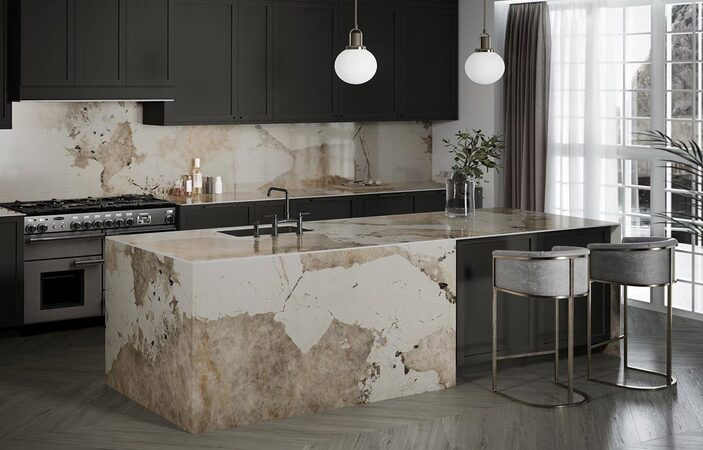
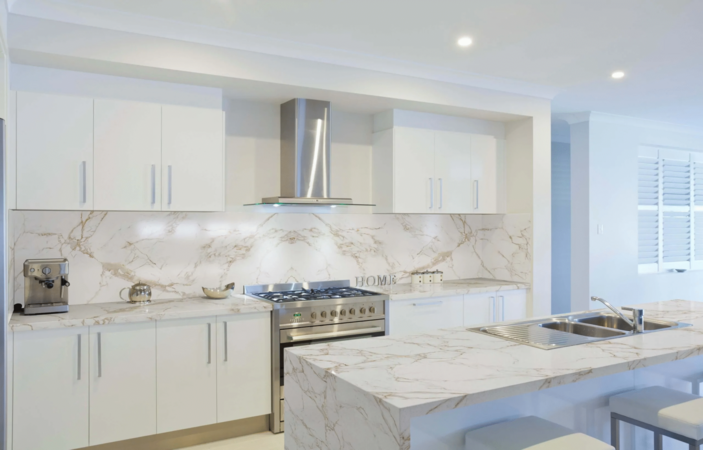
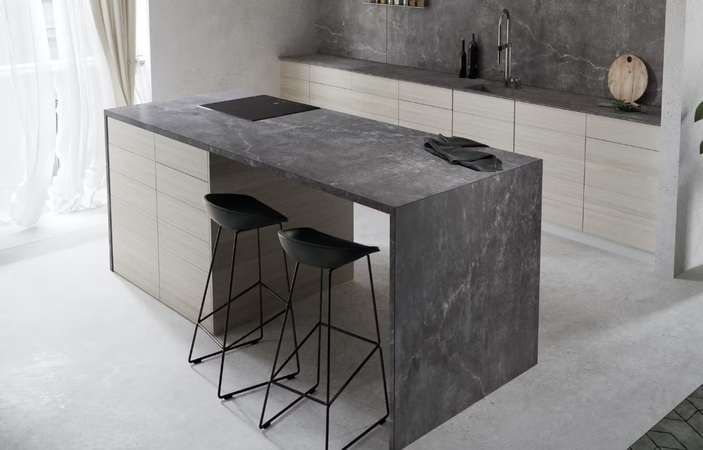
Porcelain design range: marble-effect with bold veining (left), warm stone texture (centre), dark concrete (right). The same material delivers all three aesthetics in the same thickness and with the same performance specification. No sealing, no acid sensitivity, no UV fading.
Full-body porcelain.
When the pattern runs all the way through.
Standard porcelain worktops are produced by applying a decorative print or surface treatment to the top face of the fired slab. The visual pattern exists at the surface. The body of the slab beneath is a uniform base colour, typically white or grey.
Full-body porcelain is manufactured differently. The mineral pigments and colour are distributed throughout the entire depth of the slab. The veining, texture, and colour variation visible on the top face continues through the full thickness of the material. When the slab is cut, the cut edge shows the same pattern as the surface. When drainer grooves are machined, the groove walls carry the pattern. When edge profiles are formed, the profile face shows continuous pattern rather than a uniform base colour.
This distinction matters most at edge profiles, drainer grooves, mitre cuts, and island drop-down panels. In a standard surface-print porcelain, all of these expose the plain body material. In full-body porcelain, the continuity extends through the edge, into the groove, and across the drop-down panel.
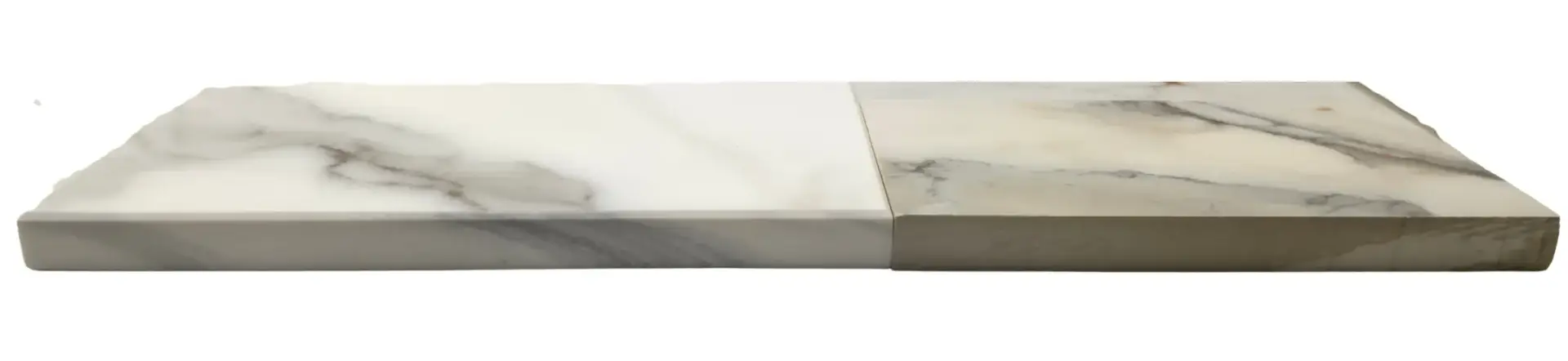
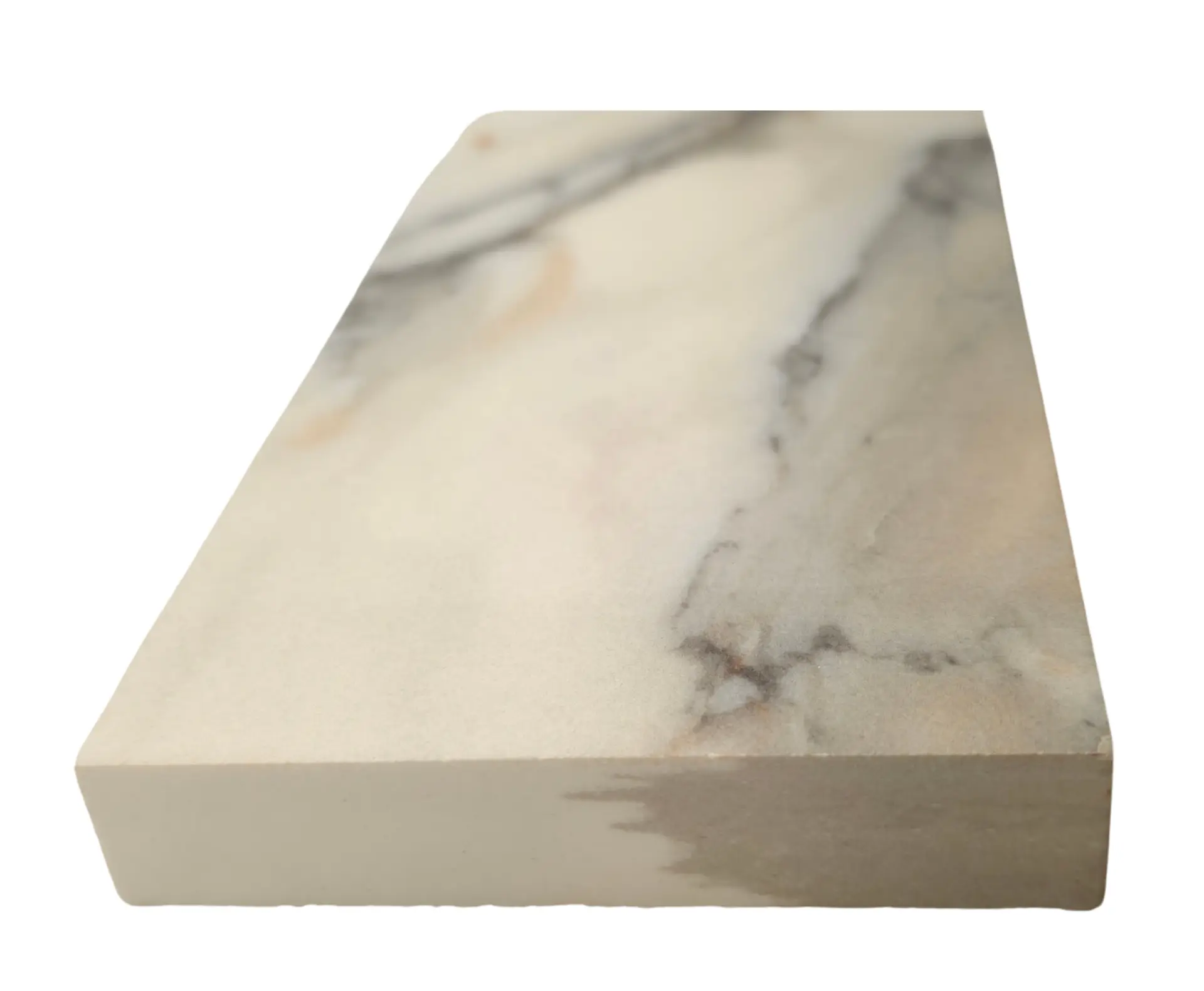
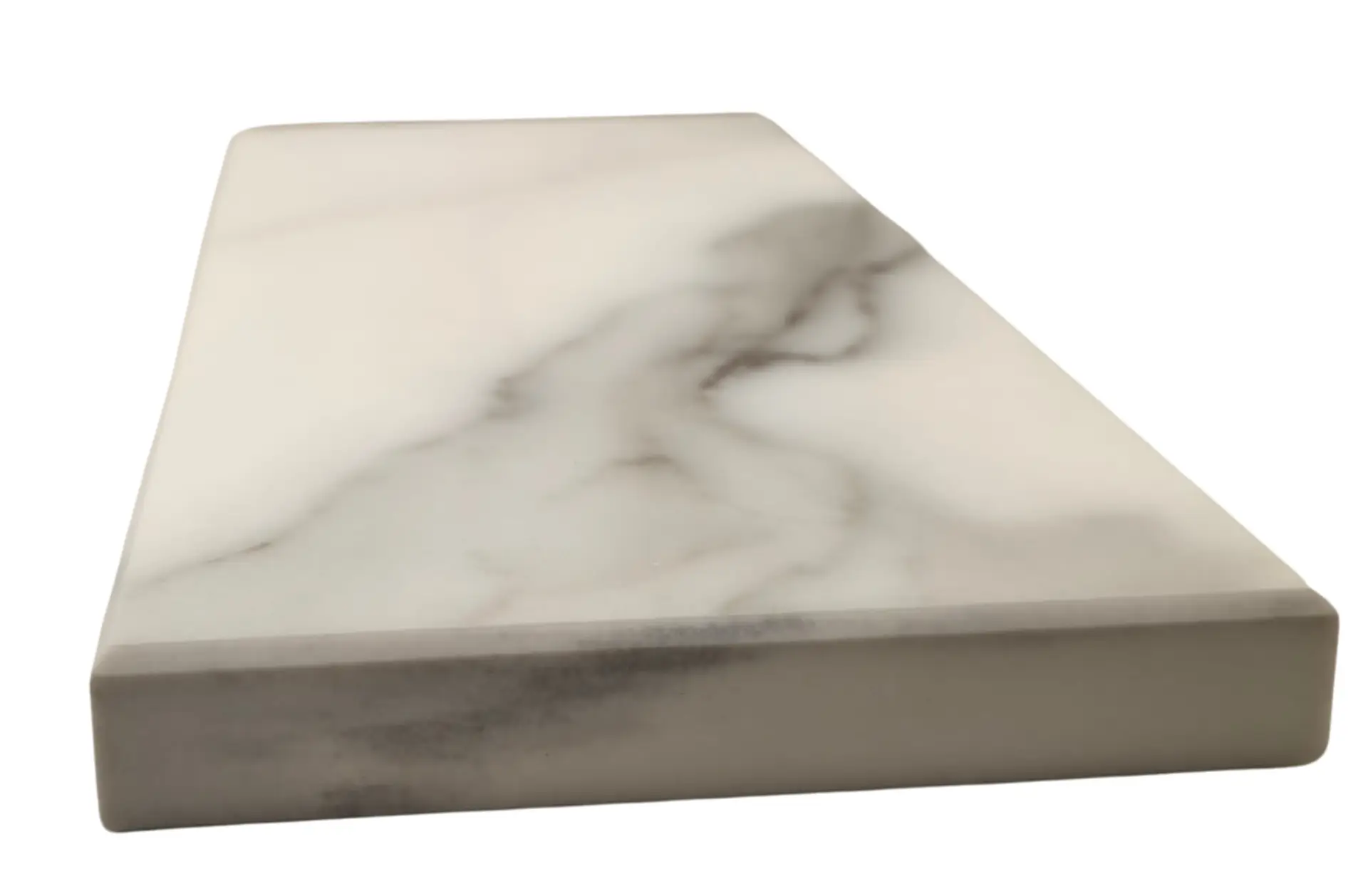
Full-body porcelain is available at a premium over standard surface-print products. For most kitchen specifications where the edges are profiled to a simple square or eased detail and the worktop sits flush to the cabinets, the distinction is minimal. Where the brief includes waterfall island ends, deep edge profiles, or drainer grooves, full-body porcelain produces a visually superior result.
Book matching and
vein coordination.
Book matching places two or more consecutive slabs side by side so the pattern mirrors across the join, creating a symmetrical layout. For porcelain with strong directional veining, book matching produces a dramatic visual result on large islands, L-shaped runs, and waterfall edges where the veining continues down the vertical face.
Unlike natural stone, porcelain manufacturers produce book-matched slabs as a designed product — consecutive slabs are produced with the pattern intentionally mirrored. This makes porcelain book matching more reliable and consistent than natural stone book matching, where vein continuity depends on the stone quarry.
Vein-matched slabs maintain the same veining direction across joins without mirroring. For kitchens where visual continuity across a long run is important but symmetry is not the intent, vein matching is the alternative.
Budget 15–30% extra material for book-matched designs. Fabricators must cut from specific positions on each slab to achieve the mirror, producing cutting waste at positions that do not align with the pattern. Confirm the material allowance with your fabricator before ordering.
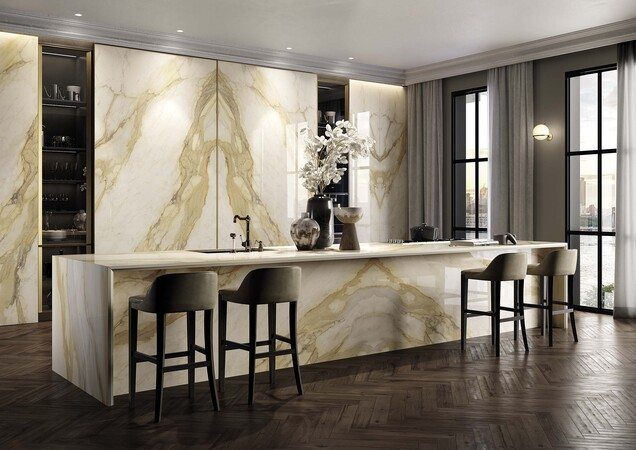
Book-matched porcelain on a large island. The veining mirrors symmetrically across the central join. This effect is most powerful on slabs with bold, directional veining at sufficient scale to read across the full island width.
Thickness options.
Porcelain is available in a wider range of thicknesses than any other slab worktop material. Thinner profiles deliver a sharp, contemporary aesthetic and are lighter to handle and install, but require planned substrate support. Thicker slabs are more self-supporting across longer spans and suit premium kitchen specifications where material presence is part of the brief.
The thickness shown at the front edge of the worktop does not have to match the slab thickness. Build-up lamination and mitring allow a 12mm slab to present as 20mm, 30mm, or 40mm at the visible edge. This is how most thick-edge looks are achieved in porcelain kitchens without the weight penalty of a solid slab throughout.
| Thickness | Notes | Typical use |
|---|---|---|
| 4mm | Ultra-thin. Full backing substrate required throughout. | Wall cladding, splashbacks, overlay on existing worktops. |
| 6mm | Very slim profile. Backing substrate required. | Contemporary worktops, wall panels, overlay systems. |
| 8mm | Slim. Often bonded to backing board for worktop applications. | Contemporary worktops, cladding. |
| 12mm | The most common UK kitchen worktop thickness. Good rigidity in most spans. | Standard kitchen worktops, islands, bathroom vanities. |
| 20mm | Solid and self-supporting across longer spans. Premium weight and feel. | Longer runs, premium kitchens, outdoor worktops. |
| 30mm | Usually achieved via build-up edge rather than solid slab. Solid 30mm is heavy. | Statement looks, chunky edge profiles. |
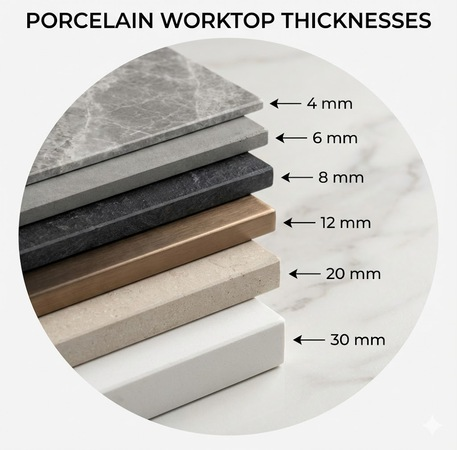
Porcelain thickness comparison. Thinner profiles (6mm, 12mm) deliver contemporary aesthetics and lighter weight. 20mm provides greater rigidity for longer spans without build-up. Most thick-edge looks are achieved through build-up lamination on a 12mm base slab.
Edges and
build-up lamination.
Porcelain offers fewer decorative edge profiles than stone or solid surface. The material's hardness makes machining complex curved profiles technically demanding and expensive. In most UK kitchen porcelain installations, edges are square with a small arris or softened chamfer. This suits contemporary handleless and true handleless German kitchen designs well.
Build-up lamination bonds a strip of porcelain to the underside of the front edge, creating a thicker visible profile. A 12mm slab presents as 20mm or 30mm at the visible edge face. In standard surface-print porcelain, the lamination line also marks the transition from patterned surface to plain base material. In full-body porcelain, the pattern continues across the join.
Mitring joins two pieces at 45-degree angles to create a deeper front face with no visible horizontal join line on the front edge. Mitring requires very precise cutting and is more expensive than lamination, but produces a cleaner result on patterned slabs.
Island drop-down panels. On waterfall island ends or any application where the back face of a panel is visible, standard surface-print porcelain will show plain base material on the visible back face. The print is on the front face only. Full-body porcelain is the solution.
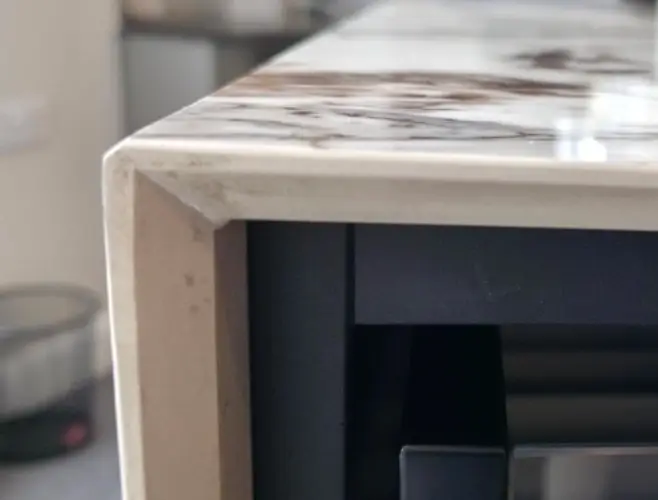
Mitre edge on a porcelain worktop. The 45-degree cut joins two pieces to create a deep front face without a horizontal join line. On full-body porcelain, the pattern continues across the mitre. On standard surface-print porcelain, the mitre line marks the transition to plain base material.
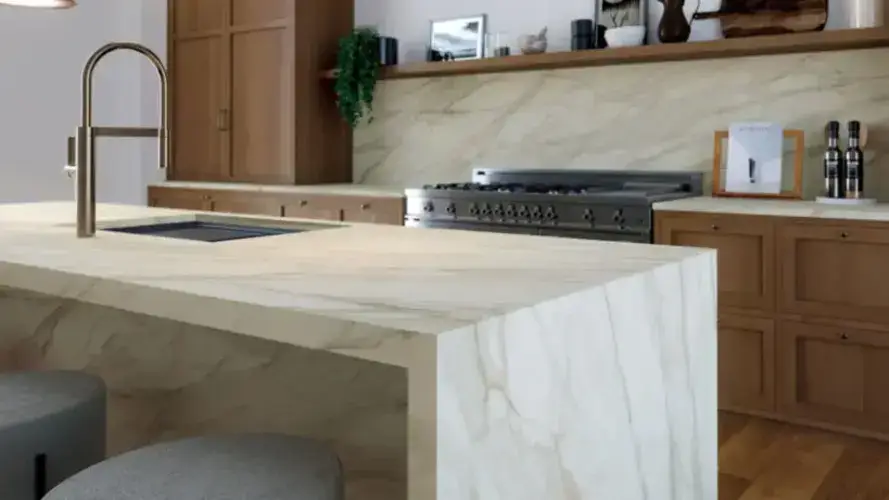
Build-up lamination on a porcelain worktop. A strip of matching porcelain bonds to the underside of the front face, creating the visual presence of a much thicker slab at the edge. The horizontal join line is visible.
Island drop-down panels and visible back faces. In any installation where the back or underside face of a porcelain panel is visible — waterfall island ends, seating overhangs, open shelf undersides — standard surface-print porcelain will show plain base material on that face. The decorative pattern is printed on the top face only. Discuss this with your fabricator and designer at specification stage. Full-body porcelain resolves the issue because the pattern runs through the full thickness.
Drainer grooves.
What happens to the pattern.
Drainer grooves are machined channels cut into the worktop surface beside the sink, sloping gently towards the sink bowl to direct draining water. The practical function is the same regardless of material. The visual result differs significantly depending on whether the porcelain is standard surface-print or full-body.
In standard surface-print porcelain, the drainer grooves will not carry the surface pattern. The print exists only on the top face of the slab. When the groove is machined into that face, the cutting tool removes the printed surface layer and exposes the plain base material — typically a uniform white or light grey. The grooves appear as plain channels against the patterned surrounding surface. This is normal, expected behaviour and is not a defect.
On plain, solid-colour porcelain, the groove base is the same colour as the surrounding surface and the transition is almost invisible. On bold marble-effect or strongly veined patterns, the plain groove base creates a noticeable contrast. Full-body porcelain is the correct specification when pattern continuity through the grooves matters.
Thickness and drainer grooves. Drainer grooves require sufficient material depth to machine safely. On slabs thinner than 20mm, it is often not practical to cut drainer grooves — the wall of material between the groove base and the underside of the slab becomes too thin and risks fracture. If drainer grooves are part of your specification, confirm with your fabricator whether the slab thickness you are considering supports them. 20mm is typically the minimum practical thickness for machined drainer grooves in porcelain.
Ask to see a sample of the drainer groove detail before committing. Request that your fabricator show you a test piece or completed example of the specific porcelain with drainer grooves machined in. What reads clearly in a showroom slab sample may look different once grooves are machined and the plain base material is exposed.
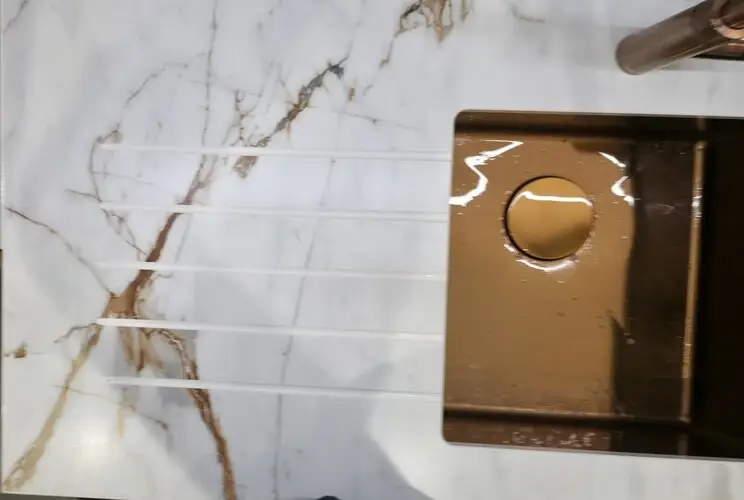
Drainer grooves in a standard surface-print porcelain worktop. The grooves expose the plain base material beneath the surface print. On plain or lightly patterned porcelain, the contrast is minimal. On bold marble-effect patterns, the transition is clearly visible. Full-body porcelain resolves this.
- Standard surface-print porcelain: grooves show plain base material, not the surface pattern
- Full-body porcelain: pattern continues through groove walls and base
- Plain and lightly patterned porcelain: groove contrast minimal and often acceptable
- Bold marble-effect and strongly veined porcelain: groove contrast clearly visible
- Ask the fabricator for a test piece before committing to a bold-pattern specification with drainer grooves
Advantages and limits.
- Excellent heat resistance with no resin binder to scorch or warp. Hot pans from the hob do not damage the surface. The best heat performance of any slab worktop material.
- No sealing required at any stage. Near-zero porosity means no maintenance chemicals and no periodic resealing. Very low lifetime maintenance cost.
- UV stable. Does not fade, yellow, or degrade in sunlight. Suitable for outdoor kitchens and bright south-facing rooms where quartz, solid surface, and wood all have limitations.
- Maximum hygiene. Non-porous surface with no absorption and no pore structure for bacteria. Food-safe with simple cleaning.
- Wide design range including highly realistic marble, stone, and concrete effects. Book-matched and vein-matched options available in large slab formats.
- Lightweight relative to thickness. A 12mm porcelain slab weighs significantly less per square metre than a 20mm or 30mm stone slab — relevant for cabinet loading and installation handling.
- Edges chip on heavy impact. Dropped cast iron onto a corner is the most common damage cause. Edge chips are repairable with colour-matched filler but rarely invisible on close inspection.
- Pattern is surface-printed on most porcelain. Drainer grooves, edge profiles, mitre cuts, and island drop-down panels will not carry the pattern. Full-body porcelain resolves this at a premium.
- Limited decorative edge profiles. Porcelain's hardness restricts complex edge machining. Ornate profiles like ogee or full bullnose are not available. Simple square, chamfered, and arris edges are standard.
- Professional installation required with specialist diamond tooling. Not adaptable with standard tools after installation.
- Repair quality is limited. Chips can be filled but the repair is typically visible on close inspection. Large damage requires section replacement.
- Edge pattern discontinuity on cheaper products. On some lower-cost surface-print ranges, the edge detail may not match the top surface pattern exactly in scale or colour.
Porcelain vs
other worktop materials.
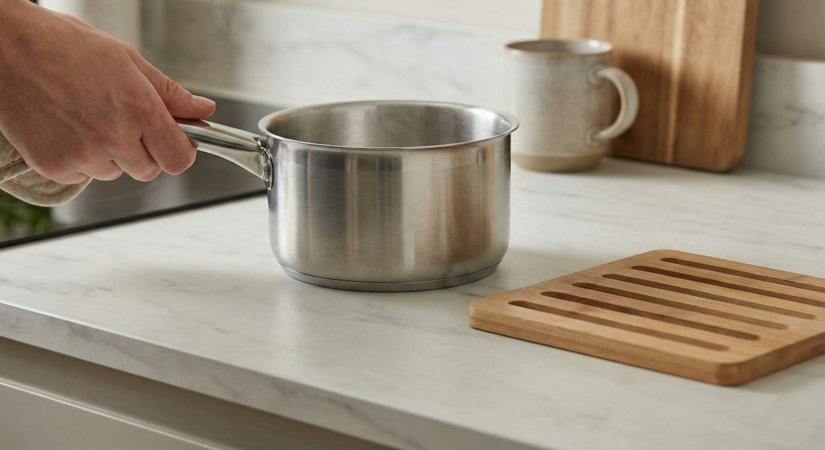
Porcelain handles direct contact with hot pans without marking. The absence of a resin binder is why porcelain's heat performance sits above quartz, solid surface, and laminate. Trivets remain good practice near edges, but hot pan contact on the main surface does not damage the porcelain.
Porcelain vs quartz. Porcelain wins on heat (no resin binder), UV stability, and outdoor suitability. Quartz wins on edge profile options, the depth and warmth of three-dimensional pattern appearance, and repairability. Both are non-porous with no sealing requirement and at comparable price points.
Porcelain vs granite. Granite requires periodic sealing, carries thermal shock risk from sealant degradation, and is heavier. Porcelain needs no sealing, handles heat freely, and is lighter. Granite offers natural variation through the full body of the stone. Most porcelain's pattern exists at the surface only.
Porcelain vs sintered stone. Both are resin-free, non-porous, and heat-resistant. Sintered stone typically offers larger slab formats. Performance at kitchen worktop level is comparable for most buyers. Price for premium sintered stone typically exceeds entry and mid-range porcelain.
| Aspect | Porcelain | Quartz | Granite | Solid surface | Laminate |
|---|---|---|---|---|---|
| UK price guide | £250–£700+ per m² | £250–£700+ per m² | £150–£600+ per m² | £300–£700+ per m² | £50–£150 per m² |
| Heat resistance | Excellent. No resin. Hot pans tolerated on the flat surface. | Moderate. Resin binders mark under sustained heat. Trivets required. | Good. Stone tolerates heat but sealant degrades. Thermal shock risk. Trivets required. | Low-moderate. Marks from very hot pans. Trivets essential. | Poor. Blisters and marks from direct heat contact. |
| Scratch resistance | Excellent (7–8 Mohs). Matte finishes more practical than gloss. | Good. Engineered surface resists everyday contact. | Very good (6–7 Mohs). | Low-moderate. Softer surface accumulates marks. Renewable. | Moderate. Surface layer wears over time. |
| Porosity and sealing | Non-porous. No sealing. Ever. | Non-porous. No sealing. | Porous. Sealing every 1–3 years required. | Non-porous. No sealing. | Good stain resistance on surface. No sealing. |
| UV stability | Excellent. Suitable outdoors. No organic content to degrade. | Moderate. Resin binders degrade under UV. Not outdoor-recommended. | Good. Natural stone stable under UV. | Good in most conditions. Some formulations fade in direct sun. | Moderate. Fades and can lift with prolonged moisture and sun exposure. |
| Repairability | Limited. Edge chips fillable but visible. Section replacement for large damage. | Limited. Small chips fillable but usually visible. | Good. Stone re-polishing by specialist possible. | Excellent. Sanding and re-polishing restores surface. Unique advantage. | Good for surface marks. Major damage requires strip replacement. |
| Edge profiles | Limited. Square, chamfer, and arris. No ornate profiles. | Wide. Most decorative profiles achievable. | Very wide. Stone machines well for decorative profiles. | Very wide. Thermoformed curves and complex shapes achievable. | Limited to straight profiles in most installations. |
Installation.
Porcelain is the most technically demanding worktop material to fabricate and install. It requires specialist diamond-tipped tooling for all cutting, drilling, and shaping. Every cut-out for a sink, hob, or tap requires a specialist fabricator. This is not a DIY-adaptable material at any stage.
Maintenance and care.
Porcelain maintenance is the simplest of any worktop material. No sealing, no oiling, no specialist maintenance chemicals, no professional maintenance visits. The non-porous surface resists absorption of all common kitchen liquids and cleans with standard household products.
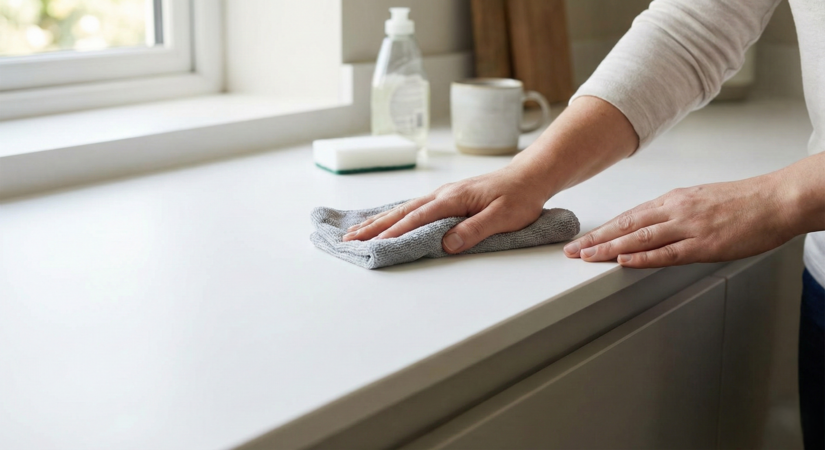
Porcelain cleaning is genuinely simple — warm water and mild detergent, no specialist products, no sealing. The non-porous surface does not absorb spills and requires no periodic maintenance treatment. This is one of the most compelling practical arguments for porcelain over sealed natural stone.
UK cost guide.
Porcelain pricing sits at a comparable level to mid-range quartz. Entry-level porcelain in plain colours starts below £250 per square metre; premium large-format marble-effect slabs with book matching exceed £700. The most significant cost variables are pattern complexity, slab format, thickness, edge detail, and number of cut-outs. Installation cost is typically higher than most other materials due to the specialist tooling and skill required.
What affects the final price. Cut-outs for hobs and sinks are typically priced per cut-out (commonly £50–£150 each). Mitred edges, drainer grooves, and waterfall end panels add fabrication time above the per-metre-squared rate. Book matching requires 15–30% additional material. Prices typically exclude VAT. Always compare like-for-like: same pattern, same thickness, same edge detail, same cut-out scope.
Who porcelain suits.
- Heat performance is important. You cook regularly, move hot pans between the hob and worktop, and want a surface that handles this without trivets, sealant degradation, or any marking concern.
- You want the simplest possible maintenance — no sealing, no oiling, no specialist products, no periodic professional care. Warm water and mild detergent for the life of the kitchen.
- Your kitchen gets significant natural light or opens to the garden. UV stability and outdoor suitability give porcelain an advantage over quartz and resin-bound materials in bright rooms.
- You want a marble-effect or stone-effect aesthetic without marble's etching problem or granite's sealing requirement. Porcelain delivers the look with none of the natural stone maintenance commitments.
- You understand the pattern limitations and have either accepted them or specified full-body porcelain to resolve drainer groove and edge panel continuity.
- You want ornate decorative edge profiles — ogee, full bullnose, classical moulding. Granite, quartz, and solid surface offer a much wider edge range.
- Repairability matters. Porcelain chips are not invisibly repairable. If a surface that sands and restores is important, solid surface is the material in that category.
- You want the visual depth and natural variation of real stone through the body of the material. Most porcelain is surface-printed. Full-body porcelain narrows but does not fully close this gap.
- Your budget is under £250 per square metre for supply and installation combined. Porcelain's fabrication cost means it is not competitive with laminate, entry-level solid surface, or budget timber worktops.
- You want seamless joins on a long run, thermoformed curves, or an integrated sink without a silicone joint at the rim. Solid surface is the material that achieves these — porcelain cannot.
Frequently asked questions.
See the Worktops hub to compare porcelain with quartz, granite, marble, and other materials. The Quartzite guide covers the natural stone alternative with comparable hardness and realistic marble aesthetics in a material that runs through the full body of the slab.