
Quartzite worktops.
The complete UK guide.
Quartzite is a natural metamorphic rock that starts life as sandstone. Deep underground, intense heat and pressure transform it over millions of years into a dense, crystalline stone with very high quartz content. The result is one of the hardest natural stone options for kitchen worktops, typically sitting at 7 or above on the Mohs scale — harder than most granites and significantly harder than marble.
In UK kitchens, quartzite attracts buyers who want bold natural veining and the look of marble without marble's susceptibility to scratching and etching. Many popular quartzite colours sit in whites, creams, and greys with dramatic sweeping veins that suit premium German kitchen designs, waterfall islands, and full-height splashbacks.
Quartzite needs sealing. The stone is porous and requires an impregnating seal before installation and periodically thereafter. The sealant is what provides stain resistance — without it, the stone absorbs liquid. The same applies to heat: the stone itself tolerates high temperatures, but the sealant does not. Repeated exposure to very hot cookware damages the sealant over time, and rapid temperature differentials between a hot pan and a cold stone surface cause thermal shock, which can crack the worktop. Trivets are the correct permanent habit.
One additional caution specific to quartzite: some stones sold under the quartzite label are actually marble, dolomite, or other calcite-bearing rocks that etch and stain easily. Always ask the fabricator how the stone reacts to acid before committing to any slab.
What is quartzite.
Quartzite forms when quartz-rich sandstone is subjected to intense heat and pressure deep in the earth's crust. The process recrystallises the quartz grains, fusing them together into a dense, interlocking crystal matrix. The resulting stone is harder and more resistant than the sandstone it began as. True quartzite contains a very high proportion of quartz — typically 90% or above — which gives it a distinctive glassy surface and strong scratch resistance.
Quartzite's hardness places it above most granites on the Mohs scale. This translates in practical kitchen use to a surface that holds up well to everyday contact — pans, utensils, and general preparation — when used alongside chopping boards. The crystal structure also gives quartzite good UV stability, which suits kitchens with large south-facing windows or significant natural light.
The patterns and colours available from quartzite depend on the mineral content of the original sandstone and the intensity of the metamorphic process. Many popular quartzites show white, cream, and grey backgrounds with bold sweeping grey, silver, or gold veins — patterns that are often compared to dramatic marble but in a harder, more kitchen-practical material. Some quartzites show partial translucency in thinner sections, which suits backlit feature applications in premium kitchen designs.
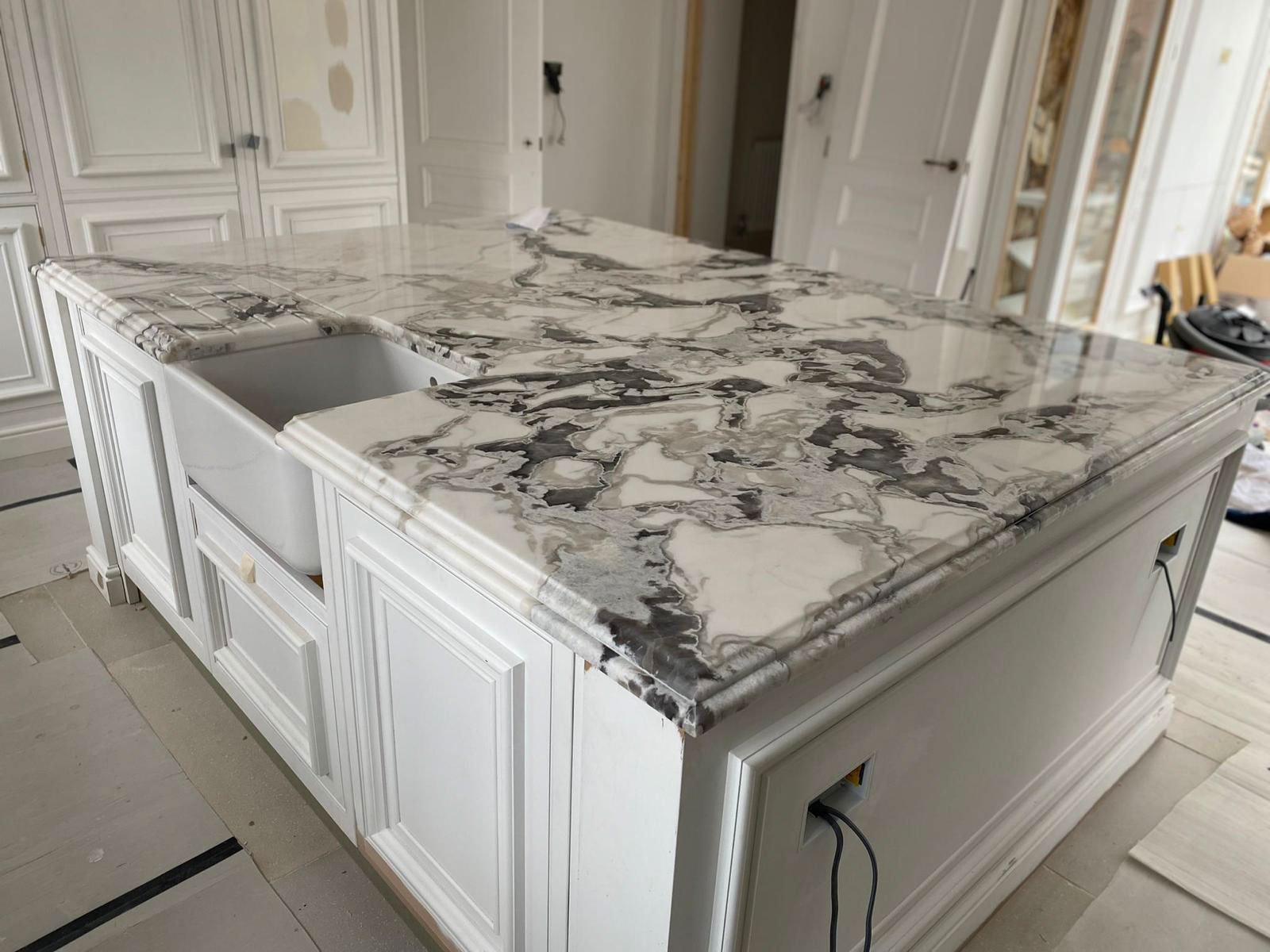
Quartzite's dense crystalline structure produces a surface with distinctive depth and light reflection that polished granite and engineered quartz both differ from. The bold veining in popular quartzites is entirely natural.
Heat, sealing,
and thermal shock.
Quartzite's heat performance is often cited as an advantage over quartz. This is accurate in a specific and important sense: the stone itself tolerates high temperatures and will not scorch or warp as quartz's resin binders do. The practical picture for a sealed quartzite worktop in a kitchen is more nuanced.
The sealant on the surface of the stone does not have the same heat tolerance as the stone itself. An impregnating sealer fills the pores of the quartzite and provides stain resistance. Very hot cookware placed directly on the sealed surface degrades this compound over time. The effect is cumulative — a single incident is unlikely to cause visible damage, but repeated hot pan contact across months and years depletes the sealant faster and leaves the stone increasingly unprotected against staining. A worktop regularly used without trivets may need resealing significantly earlier than the 1–2 year guideline.
Thermal shock is the more immediate risk. It occurs when a rapid temperature differential is applied to the stone — a very hot pan placed on a cold surface near a sink being the most common kitchen scenario. The stone expands and contracts unevenly, generating internal stress that can crack the surface. Thermal shock cracks are not repairable by polishing and typically require section replacement.
Use trivets as a permanent habit. The quartzite stone itself handles high temperatures. The sealant that protects the porous stone does not. Repeated hot pan contact degrades the sealant over time, and rapid temperature changes between a hot pan and a cold surface cause thermal shock, which can crack the worktop. This applies to all pans taken from the hob at full temperature and anything removed directly from the oven. The risk is highest near sinks and in areas of the worktop exposed to cold draughts or near external walls.
Sealing explained. Most UK fabricators apply an impregnating sealer before installation. This penetrates the stone's pores and fills them rather than sitting as a coating on the surface. When functioning correctly, water and liquid spills bead on the surface. When the sealant is depleted, liquids absorb into the stone and darken the contact point.
The water drop test. Place a few drops of water on the quartzite surface and leave for 10–15 minutes. If the water maintains a beaded shape, the sealant is intact. If the stone darkens at the contact point, the stone is absorbing moisture and resealing is due. Do not wait until staining has established itself in the stone — reseal at the first sign of reduced beading.
Sealing frequency. Most quartzites benefit from resealing every 1–2 years depending on use level and the specific stone's density. Denser, lower-porosity quartzites need resealing less often. Ask your fabricator what sealer they applied at installation, whether it is an impregnating sealer or a topical coating, and their recommended interval for the specific stone.
- The stone tolerates heat; the sealant that protects it does not
- Hot pan contact degrades the sealant gradually over months of repeated use
- Thermal shock from rapid temperature changes can crack the stone surface
- Thermal shock risk is highest near sinks where the stone is cooler
- Cracks from thermal shock are not polishable — section replacement is typically required
Colours and design possibilities.
Most popular quartzites sold for UK kitchen worktops sit in white, cream, and light grey backgrounds with bold sweeping veins in grey, silver, charcoal, or gold. This colour and pattern combination is what drives much of the appeal — the look of a statement marble but in a material that handles everyday kitchen use more reliably. Beyond the classic veined whites, quartzite is available in darker tones, warm beiges, and stones with strong mineral movement that suits large-format island specifications.
Layout planning matters significantly with quartzite. Each slab is unique in pattern distribution, and the veining direction varies across the length and width of the slab. For long islands or L-shaped layouts, view the actual slabs at the stone yard before committing. What looks aligned in a small sample may read very differently across a 3-metre run.
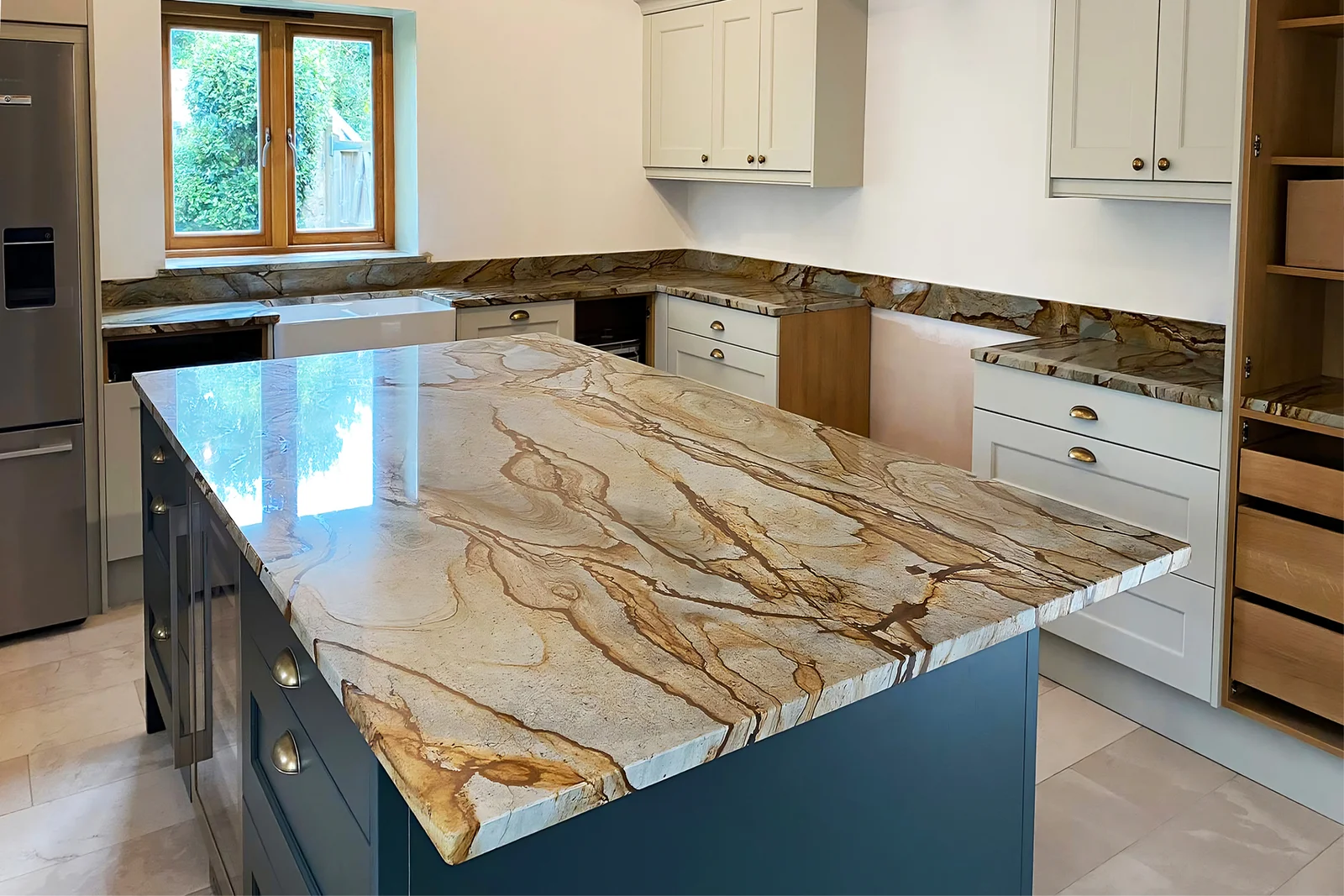
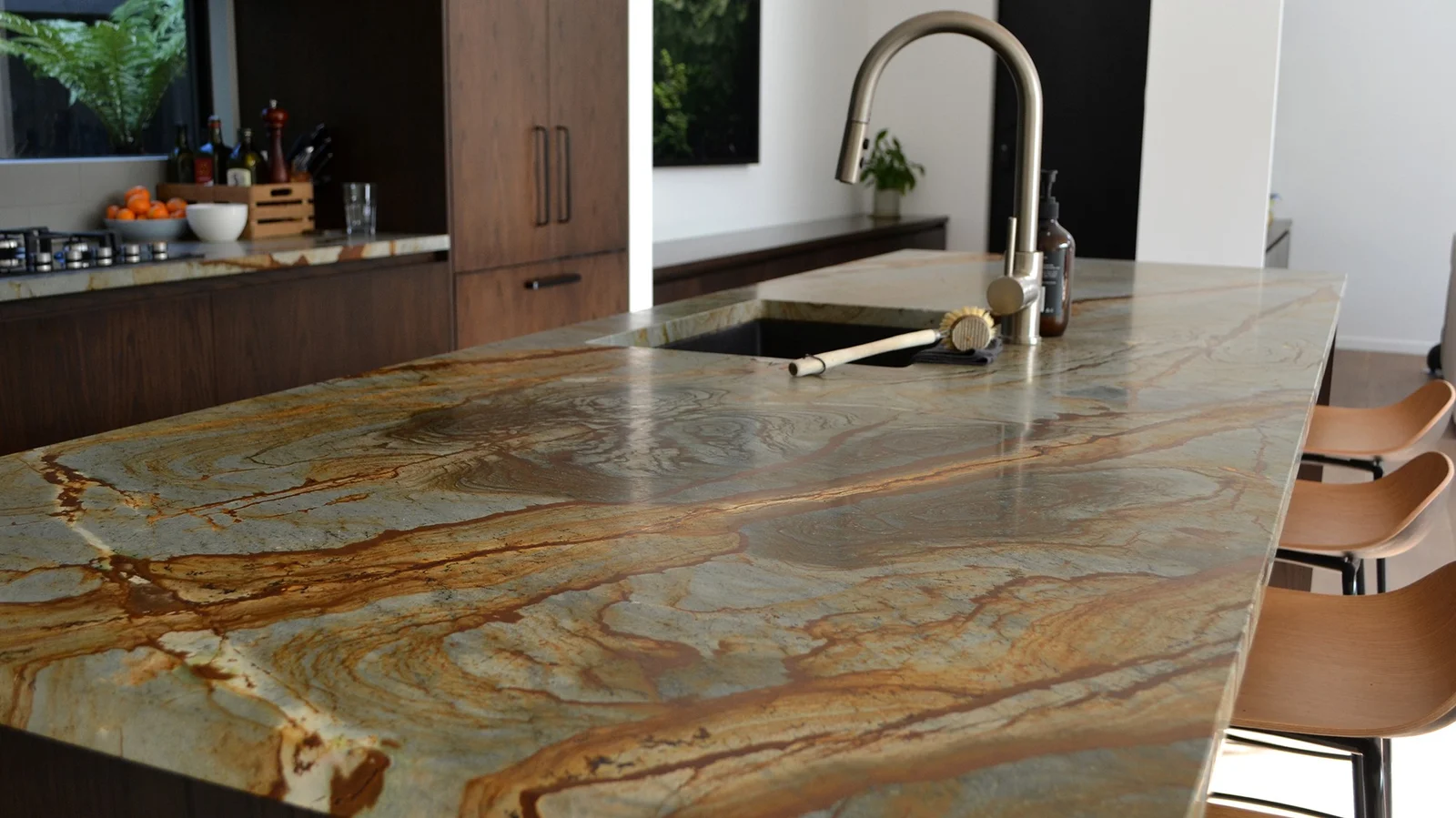
Quartzite in UK kitchen installations. The dramatic veining suits waterfall islands, full-height splashbacks, and feature wall applications where the stone drives the design. The same stone reads very differently across different slab sections — visit the stone yard to view actual slabs rather than relying on samples.
Quartzite vs quartz.
The name trap.
The names are confusingly similar. The materials are fundamentally different. Quartzite is natural stone cut from metamorphic rock. Quartz (as a worktop product) is an engineered composite manufactured from crushed quartz crystal, resins, and pigments. Treating them as variants of the same category is one of the most common mistakes in kitchen planning — the care requirements, heat performance, maintenance schedule, and installation cost differ significantly.
- Natural stone cut from metamorphic rock. Each slab unique in pattern and colour.
- High hardness (7+ Mohs). Strong scratch resistance in everyday kitchen use.
- Stone itself tolerates heat well. Sealant does not — use trivets consistently.
- Porous — requires impregnating seal and resealing every 1–2 years.
- Natural variation between and within slabs. Visit the stone yard to approve the actual slab before fabrication.
- Good UV stability. Suits bright rooms and some covered outdoor applications.
- Some stones sold as quartzite are actually marble or dolomite. Confirm acid reaction before buying.
- Manufactured from crushed quartz, resins, and pigments. Consistent pattern within a product line.
- Good scratch resistance. Quartz crystal content resists everyday contact.
- Low heat tolerance — resin binders mark under sustained hot pan contact. Trivets equally required.
- Non-porous. No sealing required. Very low maintenance in daily use.
- Predictable, consistent patterning. Samples match the final product reliably.
- Not recommended for outdoor kitchens — UV exposure degrades resin binders over time.
- Wide choice of colours and patterns. Available at a broader price range than quartzite.
Mislabelled quartzite is a real risk in the UK market. Some stones sold as quartzite are marble, dolomite, or other calcite-bearing rocks that etch easily with acidic liquids (lemon juice, vinegar, wine). These stones perform very differently from true quartzite in kitchen use. Ask your supplier or fabricator to confirm how the stone reacts to diluted acid before committing to a slab. A fabricator who works with quartzite regularly will know the answer immediately.
Strengths and trade-offs.
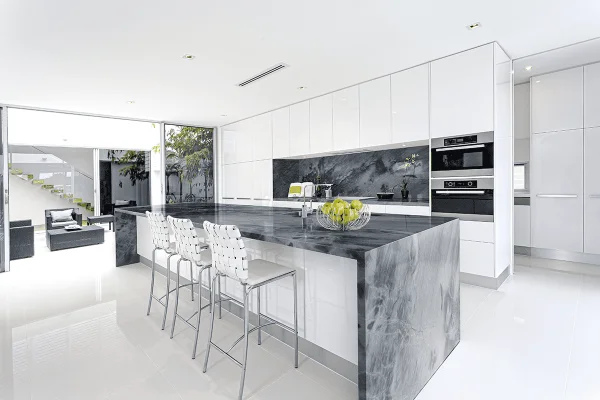
Quartzite on a kitchen island. The combination of bold natural veining, hard-wearing surface, and genuine natural stone character is what drives quartzite's appeal in premium German kitchen designs.
- High hardness. True quartzite at 7+ Mohs resists everyday scratching significantly better than marble and performs at least as well as most granites.
- Natural stone character. Bold veining and genuine depth that engineered materials cannot replicate. Every slab is unique.
- Good UV stability. Suits south-facing kitchens with large glazing and bright open-plan rooms. More stable under UV than resin-bound surfaces.
- Long service life. With correct sealing and careful use, quartzite outlasts most other kitchen surfaces.
- Suits premium German kitchen designs. Particularly effective for waterfall islands, full-height splashbacks, and feature areas where stone drives the design.
- Some stones show partial translucency in backlit applications, which creates a distinctive effect in premium feature installations.
- Premium price. Quartzite sits firmly in the premium bracket for supply, fabrication, and installation cost. Entry-level pricing starts significantly above mid-range quartz.
- Sealing commitment. Requires resealing every 1–2 years. The seal is what provides stain resistance — neglecting it leaves the porous stone unprotected.
- Trivets required permanently. The sealant on the surface is damaged by hot pan contact over time. Thermal shock risk on rapid temperature changes.
- Mislabelling risk. Some stones sold as quartzite are marble or dolomite. These etch with acids and behave very differently in a kitchen. Always verify before buying.
- Natural variation requires stone yard visit. Samples are not reliable for pattern matching on a full layout. View and approve actual slabs.
- Fabrication skill matters. Quartzite is harder than marble and more demanding to fabricate well. Confirm your chosen fabricator has relevant quartzite experience.
Quartzite vs
other worktop materials.
This table covers practical kitchen performance. Exact results depend on the specific stone grade, finish, installation, and maintenance routine. These are practical generalisations for typical UK kitchen use.
| Aspect | Quartzite | Quartz | Granite | Marble | Porcelain |
|---|---|---|---|---|---|
| UK price guide (supply and install) | £400–£700+ per m² | £250–£700+ per m² | £150–£600+ per m² | £300–£800+ per m² | £250–£700+ per m² |
| Hardness | 7+ Mohs. Very good scratch resistance. Harder than most granites. | Good. Quartz crystal content resists everyday contact. | 6–7 Mohs. Very good scratch resistance in normal use. | 3–4 Mohs. Scratches easily in kitchen use. | Very good. One of the hardest worktop surfaces available. |
| Heat performance | Stone tolerates heat. Sealant is damaged by hot pan contact. Thermal shock from rapid temperature changes can crack the surface. Use trivets. | Low. Resin binders mark under sustained heat. Trivets always required. | Stone tolerates heat. Sealant damaged by hot pan contact. Thermal shock risk. Use trivets. | Stone tolerates heat. Sealant required. Same risks as quartzite. | Excellent. No organic binders. Fully heat resistant. |
| Stain resistance | Good when sealed. Porous without seal. Reseal every 1–2 years. | Very good. Non-porous. No sealing required. | Good when sealed. Porous without seal. Reseal every 1–3 years. | Poor. Etches and stains with acids even when sealed. | Excellent. Non-porous. No sealing required. |
| Acid sensitivity | True quartzite resists acid well. Some mislabelled stones etch easily. Confirm with fabricator before buying. | Good acid resistance. Resin surface does not etch. | Good acid resistance. Natural stone does not etch. | High sensitivity. Etches permanently with lemon, vinegar, wine. | Excellent. Fully acid resistant. |
| Maintenance | Resealing every 1–2 years. Trivets required. Daily cleaning simple. | Very low. No sealing. Wipe clean. Trivets required. | Resealing every 1–3 years. Trivets required. Daily cleaning simple. | High. Regular sealing, acid avoidance, and careful management required. | Very low. Wipe clean. No sealing. No special products needed. |
| Natural variation | Yes — each slab unique. Visit stone yard to approve actual slabs before fabrication. | No. Engineered for consistent patterning. Samples match the product. | Yes — each slab unique. Samples are indicative only. | Yes — significant variation between and within slabs. | No. Manufactured product. Consistent within a batch. |
Quartzite vs quartz. The closest practical comparison for most UK buyers. Quartz requires no sealing and offers very predictable, consistent patterning. Quartzite requires maintenance, involves natural variation, and carries the mislabelling risk. The trade is natural stone character and better UV stability versus engineered reliability and zero maintenance. Both materials require trivets — quartz because of resin binder heat sensitivity, quartzite because of sealant degradation from hot pan contact.
Quartzite vs marble. The most common design comparison since both offer dramatic veining and a premium stone look. True quartzite significantly outperforms marble in hardness and acid resistance. Marble scratches and etches easily in kitchen use. Quartzite suits active kitchens; marble suits low-use applications where aesthetics take priority over daily resilience.
Quartzite vs granite. Both are natural stones with similar maintenance requirements. Quartzite typically offers more dramatic veining and pattern movement. Granite offers more colour range globally and often has a wider UK availability at entry and mid-range price points. Both materials require trivets and periodic resealing.
Maintenance and care.
Quartzite maintenance in daily use is straightforward. The habits that matter most are using trivets consistently and resealing before the stone's absorption rate increases. Most quartzite maintenance problems develop from one of two causes: hot pans placed directly on the surface depleting the sealant over time, or sealing that has fallen overdue allowing staining to establish in the porous stone. Ask your fabricator at installation what sealer they applied, whether it is an impregnating sealer or a topical product, and their recommended interval for the specific stone.
UK cost guide.
Quartzite sits firmly in the premium price bracket. Supply, transport, and fabrication are all more demanding than for many other worktop materials. These figures are indicative for the UK market. Always obtain quotes with the specific stone name, quarry source, thickness, and finish specified — price comparisons across suppliers mean very little without the same stone being quoted.
What affects the final price. Layout complexity — number of joins, waterfall ends, book matched sections, and curved pieces — significantly affects fabrication cost over and above the per-metre-squared material rate. Stone yield varies by the specific slab and pattern, which affects how much material is needed for a given layout. Build-up edging adds both material and labour cost. Always obtain itemised quotes that specify the stone name, quarry, thickness, finish, and all cut-outs separately. Prices exclude VAT in most supplier quotations.
Who quartzite suits.
- You want natural stone with bold veining and the look of marble in a harder, more kitchen-practical material.
- You are committed to using trivets consistently and resealing the stone every 1–2 years as part of kitchen maintenance.
- You plan a long-term kitchen where the surface drives the design — a waterfall island, full-height splashback, or feature area where stone character matters.
- You have access to a stone yard where you view and approve actual consecutive slabs before fabrication. Layout planning with quartzite demands this step.
- Your budget comfortably accommodates premium material and fabrication costs without compromising on furniture quality, worktop thickness, or other kitchen specification.
- You have confirmed that the stone you are specifying is true quartzite — acid resistant and consistent in performance — rather than a mislabelled calcite stone.
- You want zero maintenance with no sealing requirement. Quartz, porcelain, and sintered surfaces are non-porous and need no resealing at any point.
- You prefer consistent, predictable patterning where the sample accurately represents the final layout. Engineered materials offer this; quartzite does not.
- Budget is under pressure on core kitchen items. Quartzite's cost premium is only justified when it can be specified at the correct thickness and fabrication quality. A value quartzite at poor fabrication quality is a worse outcome than a well-fabricated granite.
- You are not certain your stone is true quartzite and cannot confirm it through your fabricator. The mislabelling risk in the UK market is real and the consequences — an etching, scratching stone in an active kitchen — are significant.
- You want the thinnest possible worktop profile or the maximum heat resistance without any maintenance requirements. Porcelain at 12mm delivers both without the natural stone maintenance commitment.
Frequently asked questions.
Quartzite is one of several premium natural stone options for UK kitchens. See the Worktops hub to compare quartzite with granite, quartz, porcelain, marble, and other materials across the same practical criteria.