
Solid surface worktops.
The complete UK guide.
Solid surface worktops — sometimes called resin composite or acrylic solid surface — are manufactured sheets made from a blend of acrylic or polyester resin with mineral fillers, typically aluminium trihydrate, pressed and cured into a dense, non-porous slab. The material is consistent all the way through — there is no decorative layer on a different core. This through-body construction is what makes the material repairable in a way that laminate, quartz, and stone surfaces are not.
The defining practical advantages of solid surface over every other worktop category are: seamless joints, thermoformed shapes, and integrated features. Separate sheets join with a colour-matched adhesive that, when sanded and polished, produces a joint invisible to the eye and imperceptible under the hand. The same material used for the worktop forms the sink, drainer, upstands, and window cills — one continuous, hygienic surface throughout the kitchen. And because the material softens with heat applied during fabrication, it bends to produce curves, soft radii, and ergonomic edges that no stone or engineered surface achieves without cutting and joining separate pieces.
The trade is heat and scratch tolerance. Solid surface is softer than quartz, porcelain, or granite. It marks from hot pans placed directly on the surface, and fine scratches appear in daily use. The important distinction is that these marks are not permanent — the material is renewable. Light scratches respond to non-abrasive cream cleaner applied across a wider area to even the sheen. Deeper marks from heat or sharp impact respond to fine sanding and re-polishing by a solid surface specialist. A kitchen that has accumulated years of surface wear can be returned to a near-original finish without replacement. No other engineered worktop material offers this.
Solid surface suits German kitchens — particularly long island runs, peninsulas, and layouts where design continuity matters — and any kitchen where seamless hygiene and long-term service are the priority over absolute surface hardness.
What is solid surface.
Solid surface is a manufactured worktop material made from a blend of acrylic or polyester resin with mineral filler — typically aluminium trihydrate — and colour pigments. The mixture is cast or pressed into sheets and cured to produce a dense, homogeneous slab. Unlike laminate (a printed layer on a board core), quartz (crushed minerals in a resin matrix), or stone (a natural material), solid surface is consistent throughout its full thickness. The colour and composition you see at the surface is the same composition all the way through the slab.
This through-body construction has two practical consequences that distinguish solid surface from every other worktop category. First, surface damage — scratches, light heat marks, minor impact damage — removes material rather than penetrating to a different substrate. The damage stays at the surface level and within a material that is workable. Second, because the material is workable, a solid surface specialist can sand and re-polish the affected area, blending the repair into the surrounding surface until the mark is effectively gone. No veneer breaks, no substrate is exposed, no colour change at the repair boundary. This repairability is genuinely unique in the engineered worktop category.
Solid surface material is available from multiple UK fabricators in hundreds of colours — clean whites, soft concretes, stone-effect textures, and plain solids. The material ships in large sheet format and the entire kitchen, including sinks, upstands, and drainers, is fabricated from the same sheets. A skilled fabricator is critical to the quality of the finished result: joints, curves, and integrated features all depend on the precision and technique of the fabrication team.
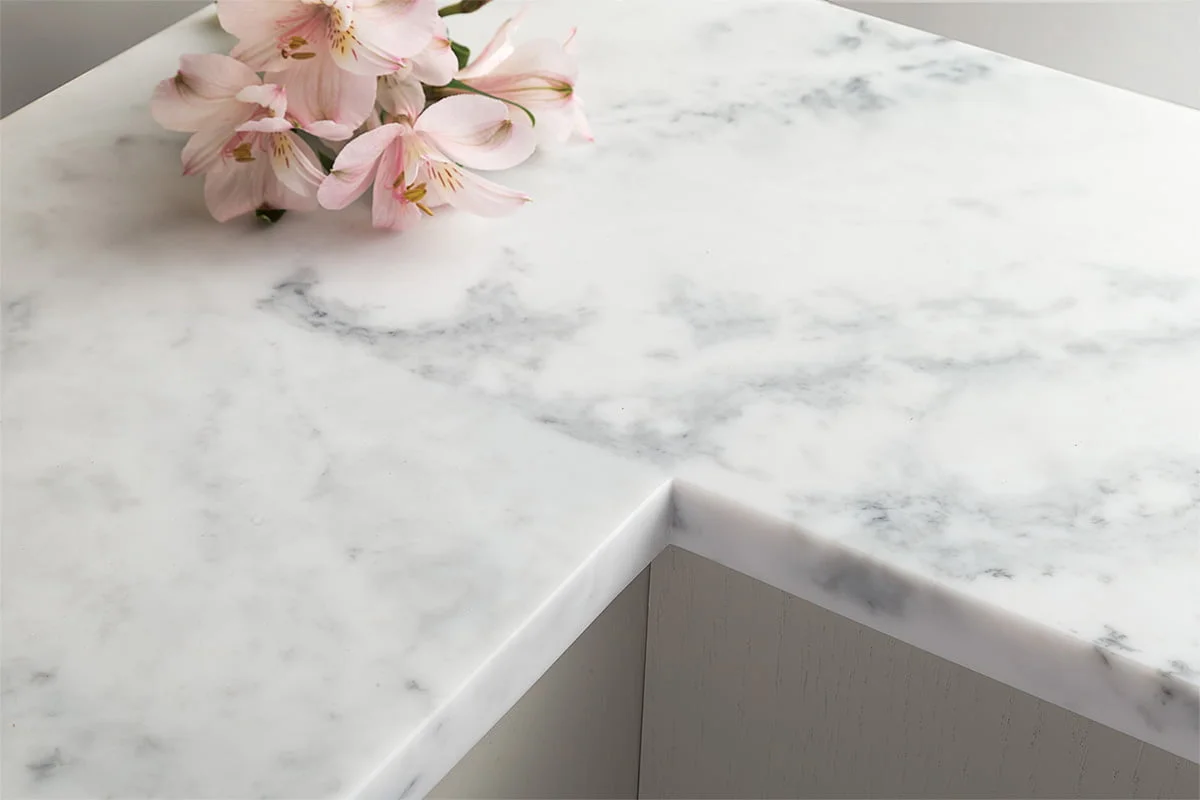
Solid surface in a contemporary kitchen. The seamless run from worktop to integrated sink bowl — with no silicone joint at the rim — is one of the defining practical and aesthetic advantages of solid surface over undermount sinks in stone or quartz. The continuous surface cleans in a single wipe from end to end.
Thermoforming.
Curves, shapes, and design freedom.
Thermoforming is the fabrication process that distinguishes solid surface most fundamentally from every other worktop material. When heated to approximately 150–165°C, solid surface sheet becomes pliable — it behaves like a stiff cloth rather than a rigid slab. A fabricator places the heated sheet over a mould and the material conforms to the shape. When cooled, it holds the formed geometry permanently with no stress fractures and no change to its surface integrity.
This capability enables worktop designs that no other material can deliver without cutting and joining separate pieces. A curved breakfast bar island wraps around a corner in one continuous piece. The external corner of a peninsula is a smooth radius rather than a mitre or a butt joint. The underside of a worktop curves down into a coved upstand with no silicone line at the junction. The front edge of an island forms an ergonomic bullnose that is part of the worktop itself rather than a separate bonded edge strip.
The mould determines the radius — fabricators work with custom-built formers for each project or from a standard library of curves used across multiple kitchens. Thermoformed sections are cooled slowly to avoid stress, then trimmed and finished. The result, when done by an experienced fabricator, is indistinguishable from a single piece of material.
Fabricator skill is critical for thermoforming. Curves formed at the wrong temperature, cooled too quickly, or bent over an unsuitable former can develop internal stress that causes cracking months after installation. Always confirm that the fabricator has demonstrated experience with thermoformed solid surface and ask to see completed examples before committing to a curved specification.
What thermoforming makes possible.
- Curved breakfast bar edges and island ends in one continuous piece — no joint at the curve
- Soft external corners on peninsulas and islands — smooth radius rather than a 90-degree mitre
- Coved upstands where the worktop surface curves up to meet the wall — no silicone line between worktop and splashback
- Ergonomic front edge profiles that are part of the worktop rather than bonded edge strips
- Shaped drainer areas with integral draining channels running into the sink bowl
- Custom shaped islands where the worktop profile follows an architectural feature or room geometry
- Wrap-around surfaces for fitted furniture where the worktop continues down vertical panels
Not all solid surface products support thermoforming equally well. The radius achievable depends on the sheet thickness and the specific formulation. Thicker sheets require larger minimum radii. Ask your fabricator for the minimum bend radius for the specific sheet thickness and product you are specifying — and confirm this against the radii in your kitchen design before fabrication begins.
Design possibilities.
Solid surface suits kitchens where design continuity is the brief — where the worktop, upstands, sink, and drainer read as a single material rather than a collection of joined components. The colour palette runs from clean whites and warm creams through soft concretes, stone-effect textures, and plain mid-tones in grey and beige. The range suits contemporary handleless German kitchens, Shaker and in-frame designs with a clinical quality, and open-plan kitchens where the island or peninsula is a design focal point.
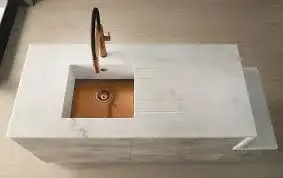
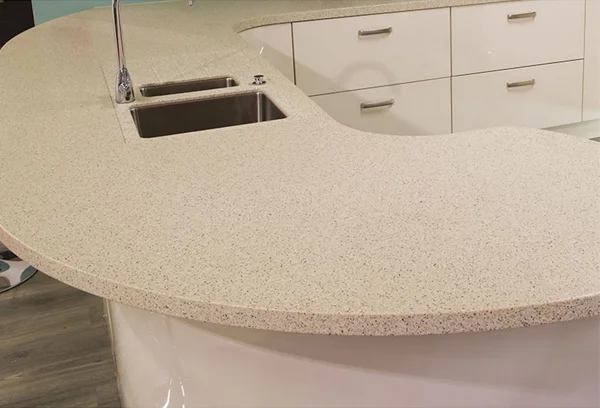
Solid surface in UK kitchen installations. The seamless continuous material — from worktop to upstand (left), from worktop through the drainer to the integrated sink bowl (right) — produces a level of design and hygienic continuity that no other worktop material achieves. Joints, where they exist, are chemically bonded and sanded to near-invisibility.
Integrated features.
Sinks, drainers, upstands, and beyond.
The integration capability of solid surface — where the sink, drainer, upstands, and worktop surface are all fabricated from the same material — is the feature that most differentiates it in a practical kitchen context. Every material transition in a kitchen is a cleaning challenge. Silicone joints around undermount sinks collect water, food residue, and bacteria over time. The junction between a worktop and a separate tiled splashback traps debris. A coved upstand in the same material as the worktop eliminates these junctions entirely.
Integrated sink bowls are formed from the same solid surface material as the worktop and joined with colour-matched adhesive. The join at the rim is chemically bonded and sanded — the transition from worktop surface to sink bowl interior is a smooth, continuous curve with no silicone line and no gap. In a finished kitchen, the eye and hand find no boundary between worktop and sink. This is a hygiene and aesthetic advantage that welded stainless steel shares, and that no stone or porcelain undermount arrangement equals.
Coved upstands form where the worktop surface curves up to meet the wall, eliminating the horizontal silicone bead between the back edge of the worktop and the beginning of the splashback material. In standard kitchen installations, this junction is one of the most frequently neglected cleaning zones — grease, condensation, and food particles accumulate in the silicone channel. A coved upstand removes the channel entirely.
Drainer areas and channels. Sloped drainer sections with machined channels running toward the sink bowl are common in solid surface kitchens. Unlike stone drainers (which involve machining the surface and produce a groove that intersects the polished face), solid surface drainers are formed as part of the initial fabrication, with a gentle slope and channels that are integral to the slab rather than cut after the fact. The result is cleaner in appearance and simpler to clean than stone drainer grooves.
Window cills and extended surfaces. The same material used for the worktop extends across window cills in many installations. This produces a continuous horizontal plane from the front of the cabinets to the window frame with no material change — particularly effective in kitchens where the window sits directly above or adjacent to the sink zone.
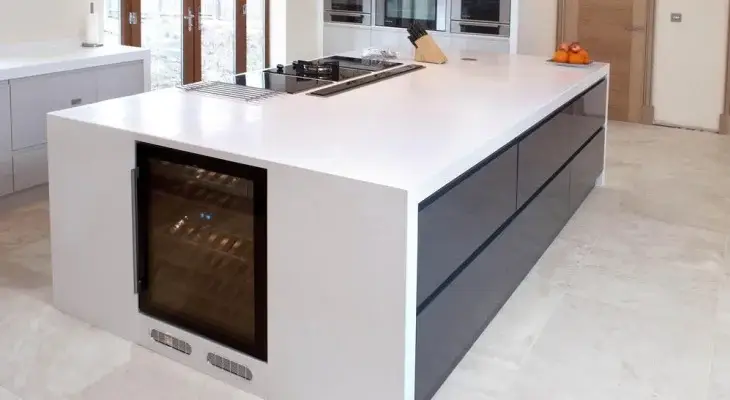
Solid surface integrated sink. The seamless transition from the worktop surface through the drainer area and into the sink bowl interior is unique to solid surface. No silicone bead at the rim. The surface cleans in a continuous single motion from end to end.
Key advantages.
Strengths and limits.
- Seamless joints that read as a single continuous surface on long runs, L-shaped, and U-shaped kitchen layouts. No visible line across the island.
- Surface renewable by sanding and re-polishing after years of accumulated marks. The worktop recovers to near-original condition without replacement. Unique in the engineered worktop category.
- Integrated sinks, drainers, upstands, and coved transitions all in the same material with no silicone joints. The most hygienic kitchen surface integration available.
- Thermoformed curves, soft corners, and ergonomic edge profiles in one continuous piece — shapes that every other material achieves only by cutting and joining.
- Non-porous surface with no sealing required. Many ranges hold independent hygiene certifications. Easy daily cleaning with mild detergent.
- Wide colour range including clean whites, soft concretes, and stone-effect textures. Suits contemporary German kitchen designs and any scheme where design continuity is the brief.
- Warm and quiet under plates and cookware. Comfortable for breakfast bars and seating positions where the surface is in sustained human contact.
- Lower heat tolerance than quartz, porcelain, or stone. Very hot pans and hot appliances placed directly on the surface cause marks. Trivets near the hob and oven are a permanent, non-negotiable kitchen habit.
- Softer surface than quartz or porcelain. Fine scratches appear in daily use from utensils, rough cookware bases, and general kitchen contact. Chopping boards protect the surface and remain important.
- Skilled fabrication is essential. Seamless joints, thermoformed curves, and integrated sinks all depend on fabricator technique. Poor fabrication produces visible joins, uneven surfaces, and weak bond lines that shorten the worktop's useful life.
- Some darker and saturated colours show marks and wear more visibly than lighter tones. Matte finishes are generally more forgiving in daily use than gloss in darker colours.
- Mid to premium price point. Supply, fabrication, and installation combined typically sit above laminate, entry-level granite, and mid-range quartz. The capability justifies the cost for the right kitchen brief, but it is not an entry-level material.
Solid surface vs
other worktop materials.
The original page compared solid surface only with quartz. This table expands the comparison to include granite, porcelain, and stainless steel — the materials most commonly shortlisted alongside solid surface in contemporary UK German kitchen projects.
| Aspect | Solid surface | Quartz | Porcelain | Granite | Stainless steel |
|---|---|---|---|---|---|
| UK price guide (supply + install) | £300–£700+ per m² | £250–£700+ per m² | £400–£950+ per m² | £150–£600+ per m² | £300–£600+ per m² |
| Seamless joins | Chemical bond + sanding produces invisible joins. Long runs read as one surface. | Joins visible on long runs and around islands even with colour-matched adhesive. | Joins visible. Cannot be chemically bonded like solid surface. | Joins visible. Natural stone pattern makes matching difficult. | Welded joins invisible. Continuous steel run with no visible seam. |
| Integrated sinks | Same material as worktop. No silicone joint at rim. Full hygienic continuity. | Undermount bowl with silicone joint at cut-out perimeter. | Undermount bowl with silicone joint at cut-out perimeter. | Undermount bowl with silicone joint at cut-out perimeter. | Welded bowl in same material. No joint at rim. Full hygienic continuity. |
| Thermoformed shapes | Yes. Curves, soft radii, coved upstands, ergonomic edges in one piece. | No. Straight runs with fixed edge profiles. Curves require cutting and joining. | No. Straight and angular only. | No. Limited to straight and angular cuts. | Yes. Sheet metal bends and forms. Coved upstands and shaped edges achievable. |
| Heat tolerance | Low-moderate. Marks from very hot pans and hot appliances. Trivets essential. | Moderate. Resin binders mark under sustained heat. Trivets always required. | Excellent. No organic binders. Fully heat resistant. | Stone tolerates heat. Sealant damaged by hot pan contact. Trivets required. | Excellent. Hot pans direct from hob tolerated. Best heat performance. |
| Scratch resistance | Low-moderate. Softer than quartz or porcelain. Scratches in daily use. Marks are renewable by sanding. | Good. Engineered surface resists everyday contact. Damage is not repairable. | Very good. One of the hardest surfaces. Damage is not repairable. | Very good. 6–7 Mohs. Specialist re-polishing possible. | Moderate. Fine scratches accumulate. Patina develops. Not re-polishable in situ. |
| Repairability | Excellent. Sanding and re-polishing restores surface to near-original. Unique advantage. | Limited. Local chips fillable but visible. Full resurfacing not possible. | None. Damage is permanent. | Good. Stone re-polishing possible by specialist. | Limited. Professional re-brushing possible but rarely matches aged surface. |
Solid surface vs quartz. The most common comparison buyers face. Quartz is harder, more scratch-resistant, and handles heat better. Solid surface offers seamless joins, thermoformed curves, integrated sinks without silicone joints, and the ability to restore the surface after damage. For kitchens where design continuity, long seamless runs, and an integrated sink are the brief, solid surface does things that quartz cannot. For kitchens where low maintenance and maximum surface hardness are the priority, quartz is the more practical choice.
Solid surface vs porcelain. Porcelain is harder, handles heat significantly better, and offers a very wide design range including large-format stone-effect panels. Solid surface's advantages over porcelain are seamless joins, thermoforming, and integrated sinks — all of which porcelain cannot match. Many contemporary kitchen specifications now use both: solid surface around the sink and on the island for seamless integration, porcelain or stone elsewhere for scratch and heat performance.
Maintenance and care.
Solid surface daily maintenance is simple. The non-porous surface requires no sealing, no periodic specialist treatment, and no specialist daily cleaning products. The key habits are: protecting the surface from hot pans at all times, using chopping boards for food preparation, and using appropriate non-abrasive cleaning products. The renewal advantage — the ability to sand and re-polish accumulated marks — means the long-term maintenance commitment is lower than the short-term care requirements suggest.
UK cost guide.
Solid surface pricing varies by colour, thickness, number and complexity of joins, extent of integrated features, and the degree of thermoforming involved. Complex curved layouts, multiple integrated sinks, and coved upstands throughout the kitchen add significantly to the base material cost. Always obtain itemised quotes that specify colour, thickness, number of joins, cut-out details, and any thermoformed sections separately.
Fabricator selection affects total cost significantly. Solid surface quality depends more on fabricator skill than on any other variable. An experienced certified fabricator commands higher day rates but produces better joins, cleaner curves, and more reliable integrated features. A poorly fabricated solid surface kitchen — with visible joins, cracked curves, or lifting sinks — is expensive to remediate. Budget for the right fabricator rather than the cheapest quote.
Who solid surface suits.
- You want long island runs, L-shaped, or U-shaped kitchen layouts to read as a single continuous surface with no visible joint line across the run. Seamless design continuity is the defining advantage of solid surface.
- You want an integrated sink with no silicone joint at the rim — a hygienic, visually seamless transition from worktop to sink bowl that no undermount arrangement in stone or porcelain matches.
- You want curved breakfast bar edges, soft external corners, or coved upstands in one continuous piece — shapes that every other material achieves only by cutting and joining separate pieces.
- You value the renewable surface advantage. You are comfortable with the knowledge that accumulated marks respond to professional re-polishing rather than requiring worktop replacement.
- You are willing to use trivets consistently, work on chopping boards, and commit to appropriate cleaning products throughout the life of the kitchen. The material rewards these habits reliably.
- Maximum scratch and heat resistance are the priority. Quartz and porcelain both outperform solid surface on hardness. If you want a surface that handles rough kitchen use without marks from day-to-day contact, harder surfaces suit better.
- You want the look of natural stone with dramatic veining, mineral patterns, or natural variation. Solid surface does not replicate this convincingly. Granite, quartzite, or marble-effect quartz are the correct categories.
- Your kitchen layout is simple and straight with no curved sections or integrated sinks — in which case the most distinctive advantages of solid surface are not being used, and alternatives may deliver better value for the specification.
- You want maximum heat performance without trivets. Porcelain and stainless steel are the only materials that handle hot pans directly without any surface marking concern.
- Fabricator access is limited in your area. Solid surface quality depends entirely on fabricator skill. If experienced, certified solid surface fabricators are not available locally, the result may not justify the cost over alternatives that are less skill-dependent to install well.
Frequently asked questions.
See the Worktops hub to compare solid surface with quartz, porcelain, granite, and other materials. The Stainless steel guide covers the only other material that offers welded sink integration without a silicone joint at the bowl rim.