Shaker Kitchens.
Timeless framing. Modern storage.
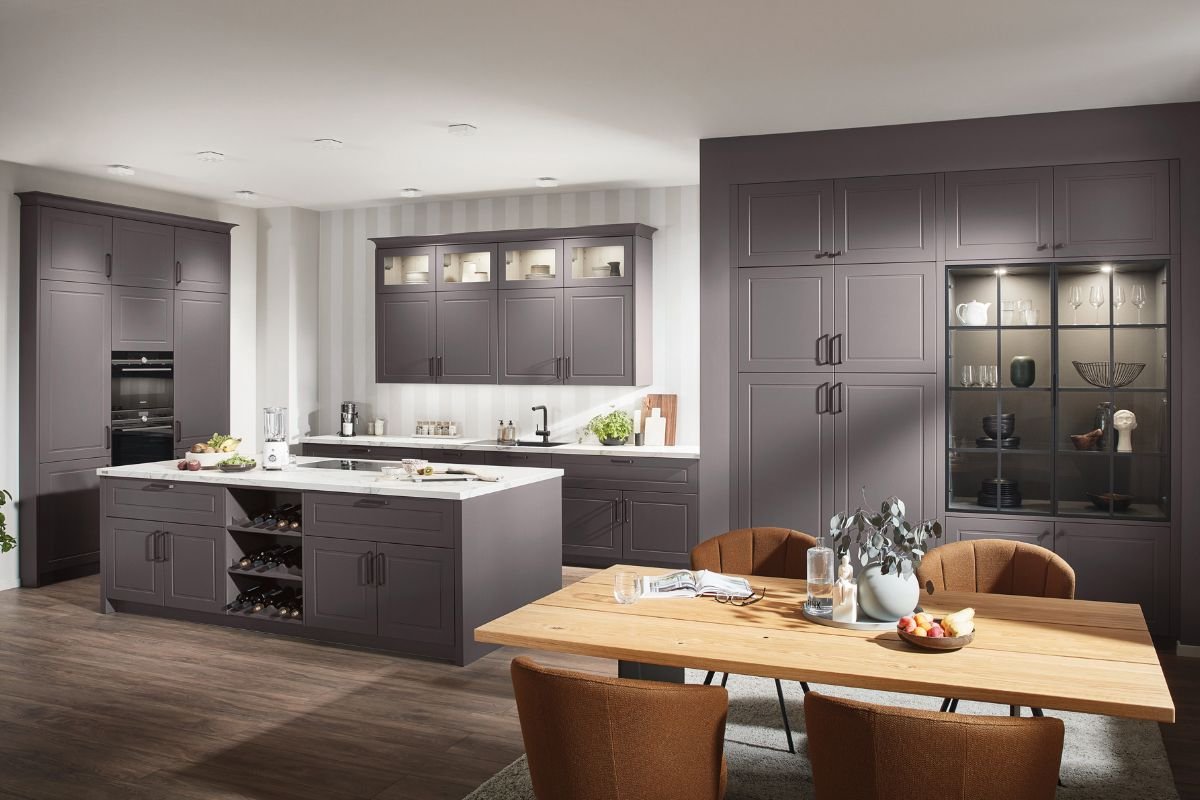
A Shaker kitchen door uses a simple frame around a flat recessed centre panel. Lines stay square and unornamented. The style originates from Shaker furniture craftsmanship, which valued function and restraint over decoration. In UK kitchens the same framed pattern has remained consistently popular for decades and suits a wider range of properties and styles than almost any other door design.
What makes Shaker particularly versatile is how much of the final character comes from the choices that sit around the door. Colour, handle style, worktop material, and the properties of the room all determine whether a Shaker kitchen reads as a contemporary city kitchen, a classic farmhouse, or a relaxed Georgian extension. The door provides the structure. Everything else steers the direction.
In German kitchen ranges, Shaker doors are typically applied to frameless carcasses. You get the full visual warmth and detail of the framed door combined with the modern storage performance of a frameless system. Full-width drawers, deep pull-outs, and grid-based height increments all sit behind a Shaker face.
This guide covers door construction, materials, finishes, colour, layouts, the Shaker variants available on this site, and how standard Shaker compares to slab and in-frame alternatives. Separate guides cover Skinny Shaker, Shaker handleless, and in-frame kitchens.
What is a Shaker kitchen?
The Shaker door is defined by its frame. Four rails, two stiles, one flat recessed centre panel. The frame sits proud of the panel, creating a visible shadow line around the interior of the door. This is the detail that gives Shaker kitchens their character. It is subtle at a distance and becomes more pronounced as you approach the cabinet.
The style originates from the Shaker religious communities of 18th-century America, whose furniture philosophy prioritised honest construction and the avoidance of unnecessary ornament. The same principles translate directly into kitchen design. Nothing on a Shaker door serves a purely decorative purpose. The frame is structural. The panel is flat. The lines are straight.
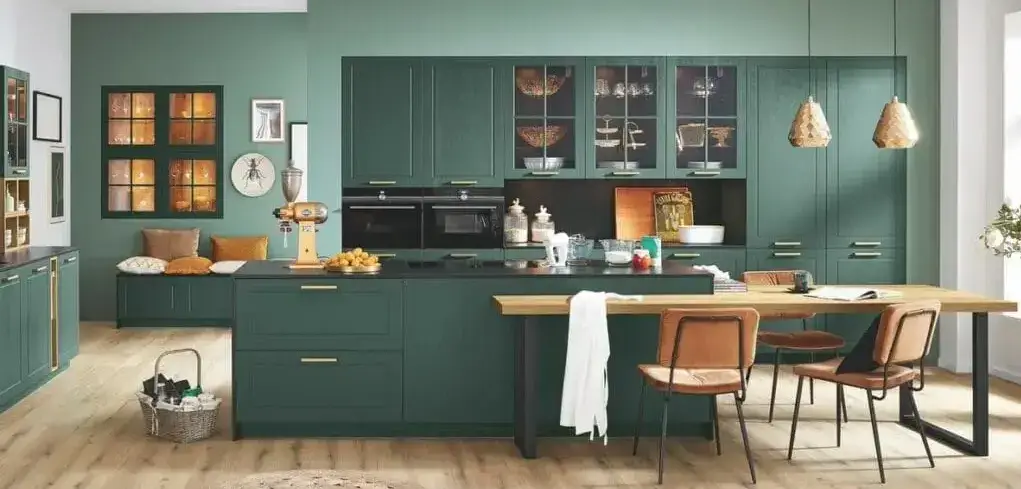
In UK homes this restraint is what makes Shaker so adaptable. The door provides structure without imposing a strong stylistic direction on the room. A painted Shaker door in a soft white with brass cup pulls reads as a classic country kitchen. The same door profile in deep forest green with slim black bar handles reads as contemporary and considered. The door itself is neutral enough to carry both directions convincingly.
When specified on German frameless carcasses, Shaker doors deliver all the visual warmth of the framed style while retaining full modern storage performance. Full-width base drawers, integrated pull-outs, and tall larder units all sit behind the Shaker face without compromise. The carcass and the door are independent of each other. The door is a design choice applied to an engineered box.
Standard Shaker door profile on German frameless carcasses. The frame detail is the defining element. Everything else in the room works around it.
Door construction
and engineering options.
Shaker describes the pattern on the front. Behind that pattern sit several engineering approaches. The construction method influences long-term stability, price position, how the door responds to humidity, and how easily the finish can be refreshed in the future.
Ask your designer to confirm which construction method applies to your chosen range. Five-piece frames, routered fronts, and wrapped profiles all look similar in photographs and showroom displays. They behave differently in damp conditions, respond differently to cleaning products, and have different refinishing options over time. The answer should be in writing before the order is confirmed.
Materials and finishes.
Shaker doors in the UK market sit in three main material groups. Real wood, wrapped MDF, and painted or lacquered MDF. Each group offers a different surface character, durability profile, and price position. The right choice depends on how the kitchen will be used, how much maintenance you are prepared to commit to, and what finish quality matters most.
- Natural grain varies between door panels. Not uniform.
- Seasonal movement is natural and expected. Not a fault.
- Future sanding and refinishing instead of replacement.
- Smooth wraps: keenest pricing, clean painted effect
- Wood grain wraps: more texture, slightly higher cost
- Protect edges near appliances and steam sources
- Sharpest profile edges of the three options
- Widest colour range including RAL and specialist palettes
- Best partner for premium worktops and appliances
For busy UK households a good lacquered MDF or higher-grade wrapped MDF front often gives the best balance of appearance, durability, and price. Real wood suits projects where natural grain and long-term refinishing sit at the top of the brief. Ask for a physical door sample of your preferred finish in direct natural light before confirming the order. Screen colours and brochure photographs do not accurately represent lacquered surfaces.
Colour choices
for Shaker kitchens.
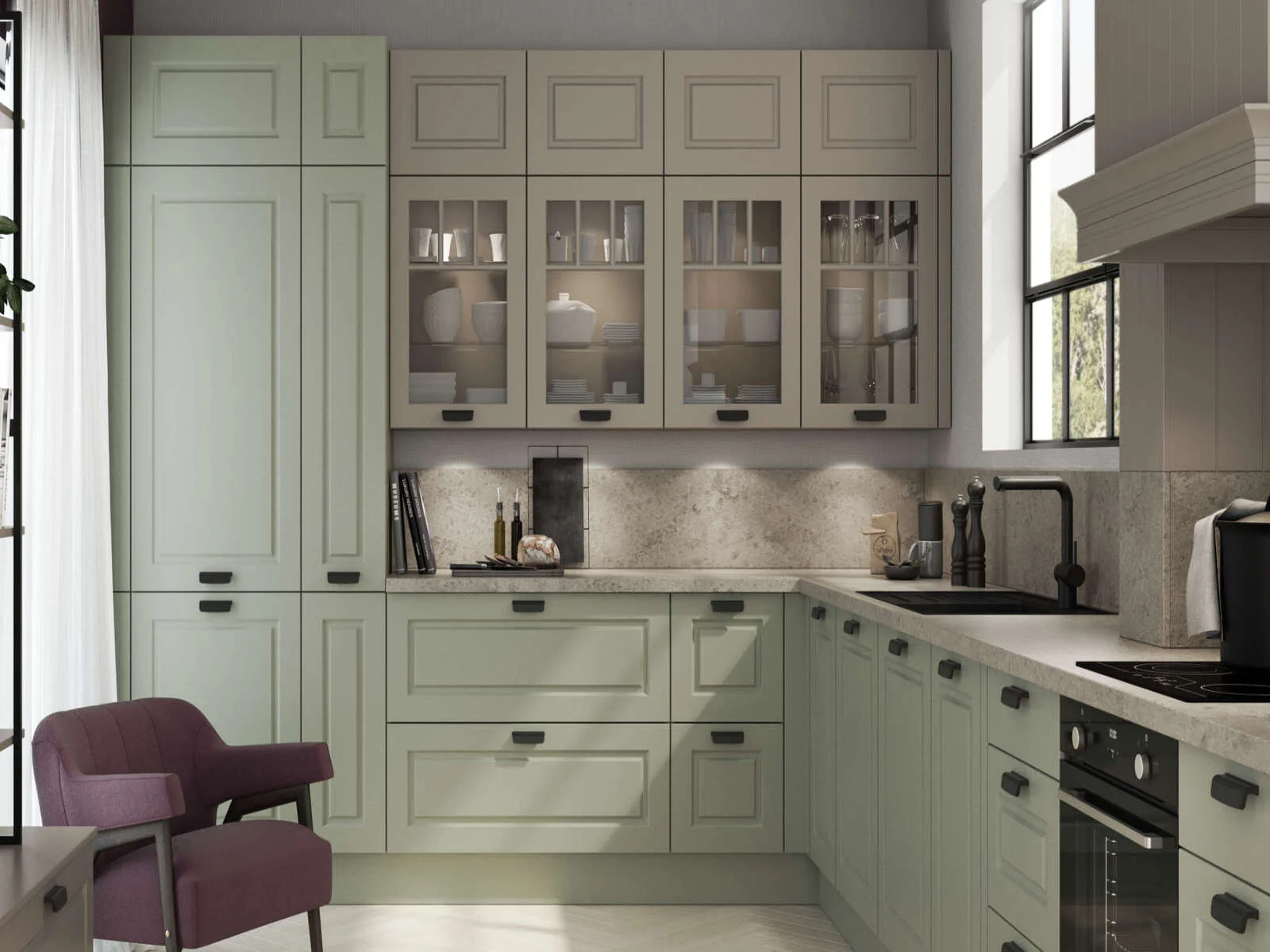
Shaker is one of the few door styles that holds a colour convincingly across almost the entire palette. The frame detail gives each door visual weight and structure that a flat slab door lacks. A colour that would look flat and uncommitted on a slab door reads as deliberate and resolved on a Shaker front. This is why deep greens, navies, warm greys, and charcoals have all become popular Shaker choices in UK homes over the last decade, where the same colours on a slab door often feel too heavy.
Standard manufacturer colour ranges cover the most popular UK shades. Most German kitchen brands offering Shaker doors also extend the palette to RAL Classic colours, giving access to over 200 standardised shades. Selected ranges additionally offer Farrow and Ball and SIKKENS colour matching. This means the Shaker door on your kitchen can match exactly the colour used on your joinery, cabinetry, or walls elsewhere in the property.
Two-tone Shaker layouts are particularly effective. The frame detail helps a colour transition between base and wall units feel intentional rather than disconnected. A deeper island in a contrasting tone against a lighter perimeter run is a natural composition for a Shaker kitchen in a way it is not for a slab kitchen.

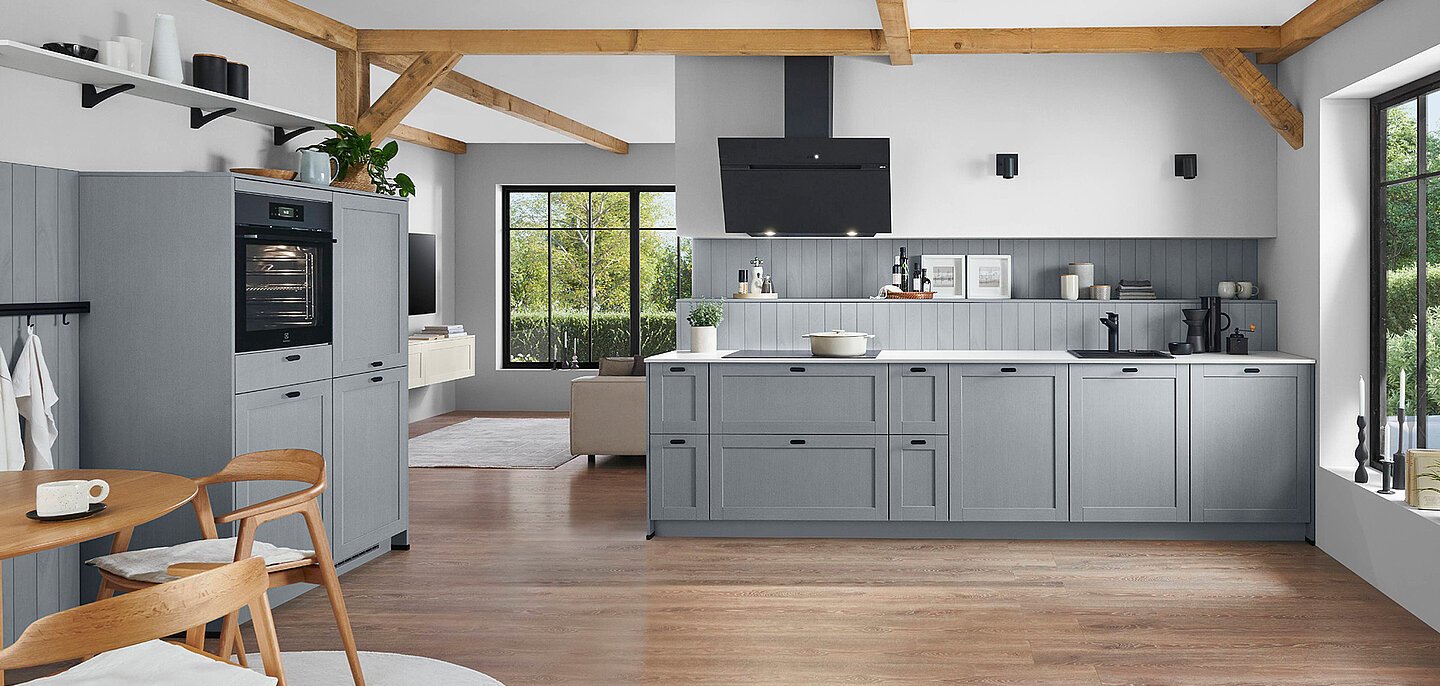
Painted Shaker in a classic colourway. The frame detail holds the colour at this depth. The same shade on a slab door would feel heavier.
Always request a physical door sample. Painted and lacquered Shaker doors vary significantly in depth and warmth depending on light conditions. A colour seen on a monitor or in a brochure looks different in natural daylight in your room. Request a full-size door sample and live with it in the space for a few days before confirming the order.
Shaker variants.
Four routes from the same starting point.
Standard Shaker is one of four related door styles available in German kitchen ranges. Each variant uses the same framed principle but modifies the frame width, handle approach, or construction method to produce a meaningfully different result. Understanding the differences helps you identify which variant fits your brief before you visit a showroom.
Layouts that suit
Shaker doors.
Shaker doors work across most standard UK kitchen layouts. The framed detail changes how each layout feels rather than changing what physically fits in the room. In tighter spaces a pale Shaker door with slim handles helps the room feel wider. In larger spaces a deeper colour with a bolder handle turns the same layout into a feature.
Galley and single-wall layouts. In narrower UK kitchens a pale Shaker door, particularly in off-white or soft grey, avoids adding visual weight to a tight space. Choose shallow frame profiles and lighter colours so the vertical lines of the frame do not crowd the view. Slim handles keep the horizontal emphasis of the run clean.
L-shaped and U-shaped layouts. Framed doors suit these classic shapes very well. Open shelves, glazed units, and mantle features all sit naturally alongside Shaker bases. Corner solutions, pull-out larders, and deep drawer stacks all fit behind the Shaker face on German frameless carcasses without modification.
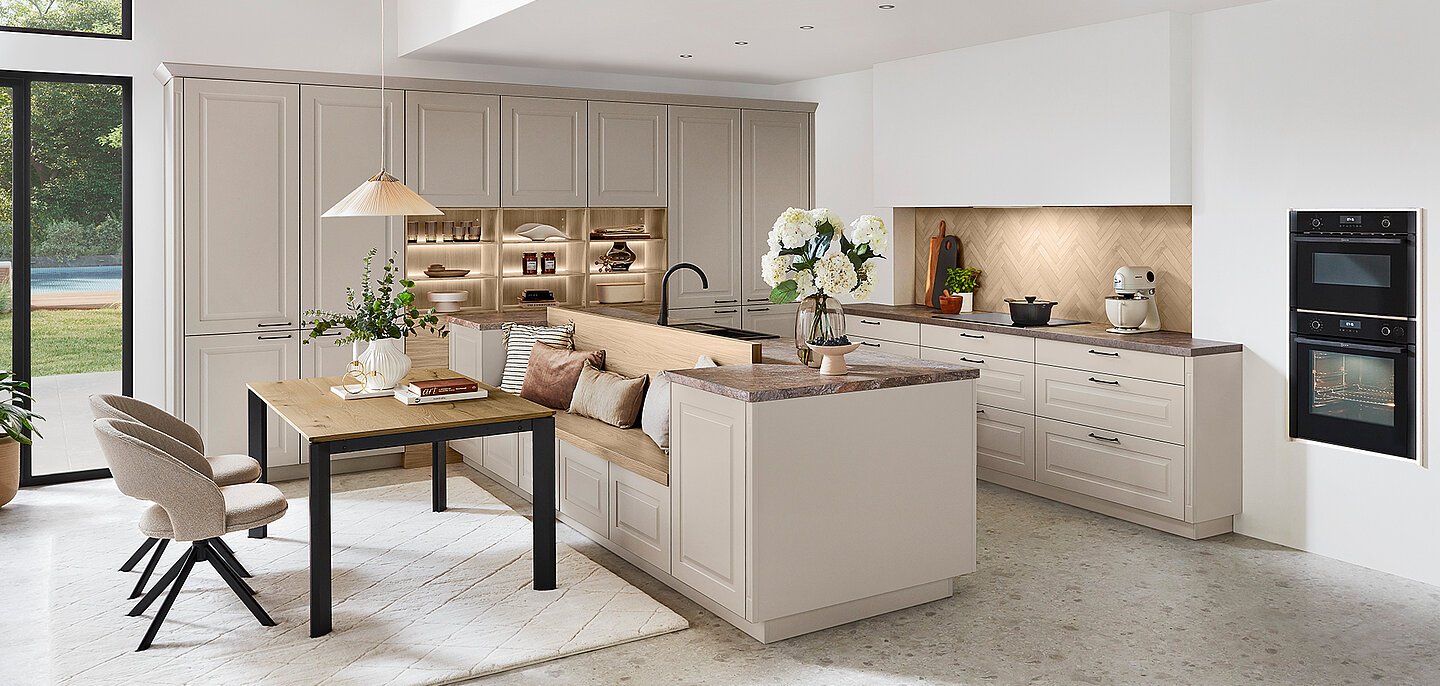
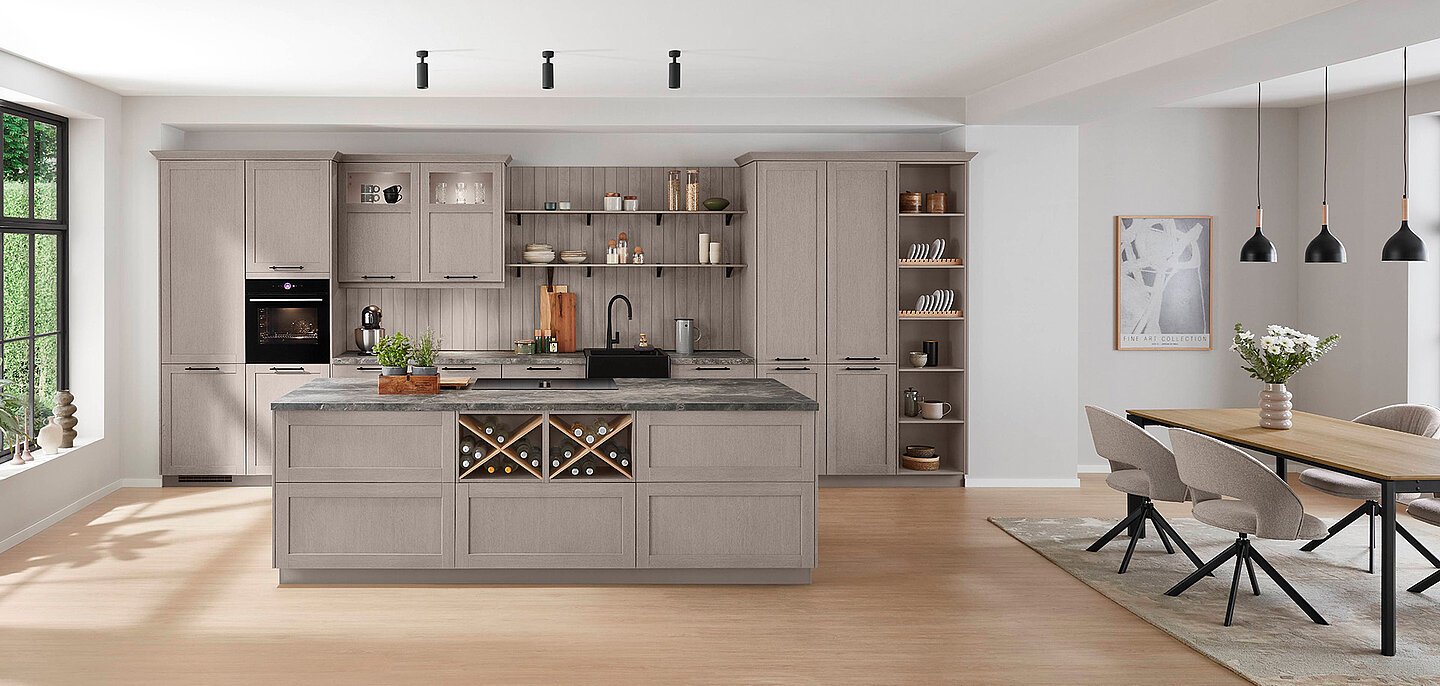
Islands and peninsulas. Shaker islands are a strong choice in open-plan spaces. A deeper colour on the island against a softer tone on the perimeter run is one of the most effective two-tone approaches available in kitchen design. Handle finish and plinth detail then tie the two elements together. The frame detail of the Shaker door makes this colour composition more resolved than the same approach on a slab door.
Open-plan kitchen-diners. The frame detail of a Shaker door gives the kitchen a visual mass and quality that reads well from a dining or living area. Pure slab doors can feel thin and flat viewed from a distance. The shadow line of the Shaker frame gives each cabinet front a presence that holds up across a larger room.
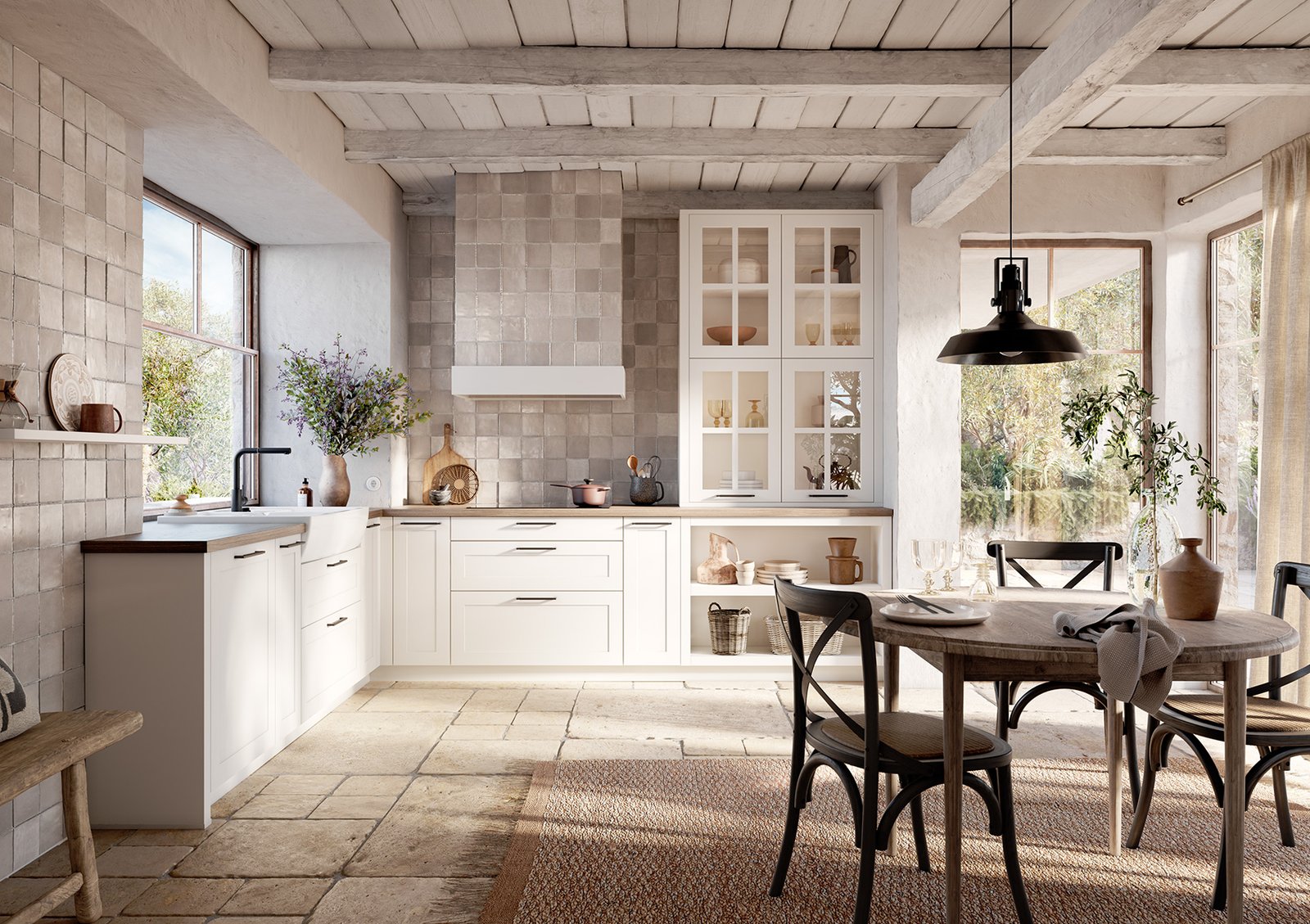
L-shaped Shaker layout with open shelving. The frame detail gives the run visual weight across the open-plan space.
Island in contrasting colour to the perimeter run. The Shaker frame detail holds the colour composition together on both elements.
Benefits and limits.
- A timeless framed look that suits period properties, new builds, and extensions across the UK. Less susceptible to looking dated than heavily styled alternatives.
- Works with both classic and modern handles. Cup pulls and knobs for a traditional feel. Slim bars or hidden profiles for a contemporary direction. The same door profile supports both without compromise.
- Easy route to two-tone colour schemes and feature islands. The frame detail holds a colour contrast better than a flat slab door, making colour transitions feel intentional.
- On German frameless carcasses, storage performance matches a pure modern slab-door system. No sacrifice in drawer width, drawer depth, or tall unit access.
- Real wood and lacquered MDF versions support future refinishing rather than full replacement, extending the useful life of the kitchen beyond the standard replacement cycle.
- Strong visual character that holds up when viewed from a dining or living area in an open-plan layout.
- More edges and grooves to clean compared to flat slab doors. The frame rebate collects dust and grease. A regular wipe routine takes more attention than cleaning a flat front.
- In very compact rooms, heavy frames in dark colours sometimes feel visually dominant. In tight spaces, lighter colours and a slimmer frame profile reduce this effect.
- Lower-price wrapped MDF Shaker doors are vulnerable to heat and steam at the profile edges near ovens, hobs, and kettles. The foil lifts from the MDF core with repeated exposure.
- In-frame Shaker variants involve higher fitting time and a higher overall project spend than standard Shaker on frameless carcasses.
Shaker vs slab
and in-frame kitchens.
When shortlisting door styles, the comparison is usually between Shaker, flat slab, and in-frame. All three are available on German frameless carcasses. The carcass specification, storage system, and hardware remain the same across all three. The differences are entirely in the visual character, cleaning effort, and price position of the door itself. Dedicated pages on this site cover in-frame kitchens and flat slab contemporary kitchens.
| Aspect | Standard Shaker on frameless | Flat slab doors | In-frame Shaker |
|---|---|---|---|
| Door appearance | Framed profile with flat recessed centre panel. Shadow line around the interior of each door. | Completely flat front with no frame detail or surface relief. | Shaker door sitting within a visible face frame fixed to the carcass. Deepest shadow and most furniture-like character. |
| Storage access | Full-width openings and drawers. Identical to a slab-door German kitchen in the same carcass. | Same as Shaker on frameless. No access penalty. | Face frame slightly reduces the clear opening on each side of the carcass. Full-width drawers are not possible. |
| Visual character | Balanced mix of traditional warmth and modern storage. Works across both classic and contemporary settings. | Clean, minimal, and strongly contemporary. Best suited to spaces where a hardware-free or very sleek look is the priority. | Furniture-led character with deep shadows and crafted quality. Most suited to period properties where the construction character is as important as the storage. |
| Cleaning effort | More edges than slab. Less depth and detail than heavily ornamented classical styles. A regular wipe routine manages it well. | Fastest routine. Flat fronts with no grooves or rebates. A single wipe covers the full door surface. | Most joints and edges. The face frame adds additional surfaces to the cleaning routine on every cabinet opening. |
| Colour range | Full range including RAL, Farrow and Ball, and SIKKENS on selected German ranges. | Same colour range. Colours look different on flat versus framed fronts. | Typically narrower. In-frame relies more on natural timber character. Painted options available at additional cost. |
| Budget position | Entry-level through to premium depending on material and finish. Wide spread. | Broadest spread. Often the lowest entry point in a German kitchen range. | Higher spend level due to additional timber, face frame construction, and longer fitting time. |
| Best suited to | UK homes seeking warmth, adaptability, and strong storage performance across a wide range of property types. | Design-led contemporary spaces where a clean, minimal aesthetic is the clear priority. | Feature kitchens in period homes where furniture-quality joinery character leads the design brief. |
Care and maintenance.
Build a short weekly routine. Wipe the handle area, the frame rebate, and the lower rail of base unit doors. Check hinges and handle fixings twice a year and tighten as needed. Small steps preserve finish and alignment over the full life of the kitchen.
Typical UK budget bands.
Exact figures depend on room size, specification, region, and building work required. These bands help position Shaker within a wider project budget. When comparing quotes, ask each retailer to separate cabinet, worktop, appliance, and fitting figures. This makes it possible to identify where an uplift in a quote comes from: the Shaker door, the cabinet system, or another part of the package.
When you compare quotes across retailers, confirm that the cabinet specification is equivalent, not just the door style. A Shaker door on a German frameless carcass with 16mm side panels, soft-close hardware, and a 5-year warranty is a different product to a Shaker door on a budget flat-pack carcass with standard runners. Both describe themselves as Shaker kitchens.
Is a Shaker kitchen
right for you?
- You want warmth and visual character without committing to a heavily ornamented or strongly period style. Shaker sits between classic and contemporary without fully belonging to either.
- The property is a period terrace, Victorian extension, farmhouse, or village home where a flat slab door feels too clinical and an in-frame kitchen feels too formal.
- You want the flexibility to push the look in different directions through colour and handle choice, now or in the future, without the door itself becoming dated.
- A two-tone layout or a contrasting island is part of the design intent. The Shaker frame holds colour combinations together better than a slab door in the same situation.
- You want modern storage performance behind a traditional face. German frameless Shaker delivers both without compromise.
- You are designing a very minimal or gallery-style kitchen where completely flat fronts with uninterrupted surfaces are essential. A flat slab door or handleless system gives this more completely than any framed door style.
- You are not prepared to clean inside the frame rebate regularly. The profile collects grease at the inner corners, and this requires a more attentive cleaning routine than a flat door.
- The room is very compact and a full standard Shaker frame would make the space feel visually heavy. A Skinny Shaker profile or a flat slab with thoughtful colour choices may be better suited.
A showroom visit settles the question. Open Shaker displays alongside slab and in-frame examples. Look at how each style reads from across the room. Open drawers and tall units. Check how light falls on the frame detail in the showroom lighting. You will reach a confident decision more quickly than any guide will take you. Also see the Skinny Shaker, Shaker handleless, in-frame, and mock in-frame guides on this site before you book a design appointment.