
Stainless steel worktops.
The complete UK guide.
Stainless steel kitchen worktops are made from sheet steel — typically grade 304 or 316 — bonded to a stable substrate such as moisture-resistant board. The steel sheet is cut, folded, welded, and finished to the kitchen's exact dimensions. Sinks, drainer grooves, hob cut-outs, and upstands are all fabricated as part of the same continuous piece, with welded joins rather than silicone-bonded seams at the bowl perimeter. The result is a worktop with no exposed joints where food and water collect.
Stainless steel's appeal in UK kitchens is built on two properties that no other worktop material matches simultaneously: genuine heat tolerance at normal cooking temperatures, and non-porous hygiene that requires no sealing, no oiling, and no special chemicals. A pan lifted from the hob goes directly on a stainless worktop without risk of scorching, burning, or cracking. The surface wipes clean with mild detergent. These properties explain why professional kitchens worldwide use steel almost exclusively.
Stainless steel does scratch. This is the most important practical fact for domestic buyers. The surface marks from everyday use — steel utensils, abrasive cleaning products, rough cookware bases, and general kitchen contact. On polished finishes, scratches are immediately visible against the reflective background. Brushed finishes are significantly more forgiving because fine marks along the grain direction blend into the textured surface. Most domestic stainless steel worktop buyers choose brushed for this reason. The scratching is cumulative and irreversible in the way a glass worktop scratches — unlike stone, stainless steel cannot be re-polished in situ, though it develops a working patina that many owners find characterful rather than problematic.
Stainless steel has a distinct industrial, professional aesthetic. It suits contemporary German kitchens, Shaker and in-frame designs with a professional kitchen reference, and open-plan kitchens where the cooking zone is a deliberate design statement. It does not suit buyers who want the look of natural stone, warm wood tones, or wide colour choice — for those briefs, other materials deliver better.
What is a stainless steel worktop.
Stainless steel is an iron alloy with a minimum chromium content of 10.5%. The chromium reacts with oxygen to form a passive chromium oxide layer on the steel surface — an invisible, self-healing film that provides corrosion resistance. When the surface is scratched or abraded, this passive layer reforms in the presence of oxygen, which is why stainless steel resists rust under normal kitchen conditions even as the surface accumulates visible scratch marks.
For kitchen worktops, the steel is supplied as a sheet typically bonded to a substrate of moisture-resistant MDF or particleboard. The fabrication process involves cutting, folding at edges, welding joints and sink bowls, and finishing the surface. The substrate provides rigidity and acoustic dampening — thicker substrates reduce the hollow drumming sound that characterises cheaper or unsupported steel panels.
Two grades are used in domestic kitchen worktops. Grade 304 (18% chromium, 8% nickel) is the standard for inland domestic kitchens — it provides excellent corrosion resistance against food acids, cleaning products, and normal moisture exposure. Grade 316 (with added molybdenum) provides superior resistance to chloride attack, making it the specification for coastal properties where salt air is a factor, or for demanding commercial environments.
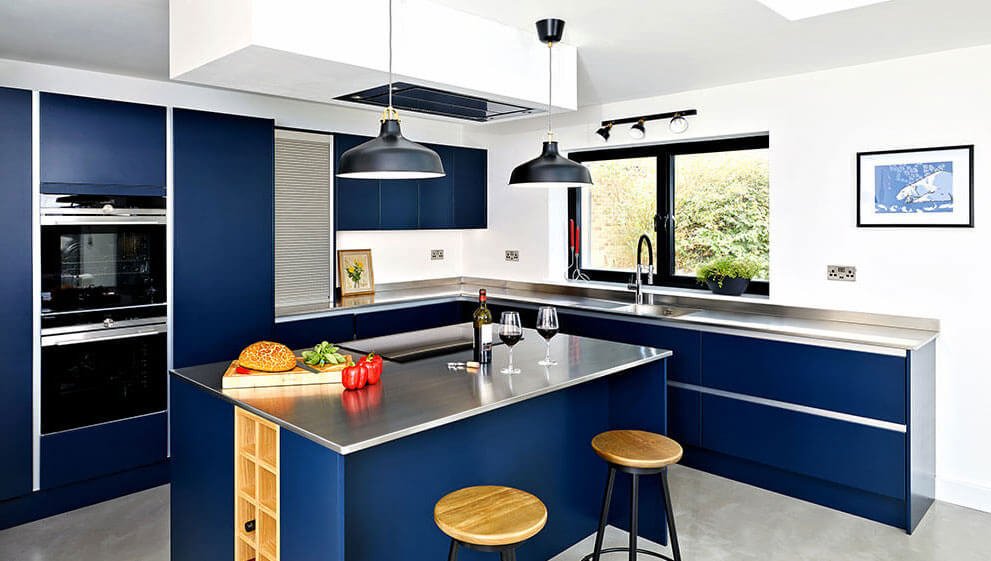
Stainless steel in a contemporary kitchen. The brushed finish runs continuously from the worktop surface through the integrated welded sink bowl, with no silicone joint at the rim. This seamless fabrication is one of the distinctive practical advantages of stainless steel over undermount stone or porcelain sinks.
Scratching and patina.
The most important thing to understand.
Stainless steel scratches. This is not a manufacturing quality issue or a maintenance failure — it is the fundamental nature of steel as a surface material in daily kitchen use. Every contact with a harder material leaves a fine mark. Steel utensils dragged across the surface, heavy pots placed down without care, abrasive cleaning pads, and the movement of steel-based kitchen equipment all leave traces in the surface.
The practical consequence of scratching depends entirely on the finish specified. Polished finishes are highly reflective. Every fine mark stands out clearly against the bright background. In heavy-use kitchens, polished stainless surfaces begin showing visible scratch patterns within weeks. The scratching does not affect the steel's corrosion resistance or hygiene properties, but the visual accumulation bothers many owners significantly.
Brushed finishes have a directional grain texture produced by mechanical abrading. Fine scratches running with the grain direction blend into the surface texture and become largely invisible. Cross-grain scratches are more visible, but the overall effect is far more forgiving than polished. The overwhelming majority of domestic stainless steel worktops in UK kitchens are specified in brushed finish for exactly this reason.
Unlike stone worktops where scratches can be polished out by a specialist, stainless steel surface marks are not practically remediable in the field. A professional steel fabricator can re-brush a section, but the result rarely matches the surrounding aged surface exactly. Most owners reach a point where the accumulated patina of the steel becomes part of its character — the hallmark of a working kitchen that has been genuinely used.
What causes scratching in a domestic kitchen. The most common sources are: steel utensils (ladles, spatulas, tongs) dragged rather than lifted across the surface; heavy stainless steel pots and pans placed down without care; cast iron cookware moved across the surface; abrasive cleaning pads including scourers and wire wool; and fine grit or debris from outdoor vegetables moved across the preparation area. All are everyday kitchen activities and most cannot be completely prevented over years of use.
Specify brushed finish, not polished. The choice between brushed and polished is the single most important specification decision for domestic stainless steel worktops. Brushed finish manages the inevitable scratch accumulation that is part of daily kitchen life. Polished finish makes every mark immediately visible. Unless the brief specifically requires a high-gloss professional aesthetic and the buyer understands and accepts the maintenance implications, brushed is always the more practical domestic choice.
- Fine scratches from daily kitchen contact accumulate over time — this is normal behaviour for steel surfaces
- Polished finishes show every mark clearly against the reflective background
- Brushed finishes absorb fine marks along the grain direction — far more practical for homes
- Unlike stone, steel cannot be re-polished in situ by a specialist
- Accumulated patina becomes part of the working kitchen character over time
- Scratching does not affect corrosion resistance or hygiene properties of the steel
Design possibilities.
Stainless steel's design language is specific: industrial, professional, honest about its material nature. It does not attempt to imitate stone, wood, or other surfaces — the appeal is the steel itself. This directness suits contemporary German handleless kitchens, traditional in-frame kitchens with a professional cooking reference, and mixed-material specifications where steel provides the working surfaces around the hob and sink while another material — often wood or stone — handles the island or more decorative areas.
Many UK households now specify stainless as part of a mixed-material kitchen rather than throughout. Steel near the hob for heat performance and ease of cleaning; stone or porcelain for the island where visual character matters more; solid wood for a baking or preparation area where warmth is the brief. This approach uses each material where it performs best.
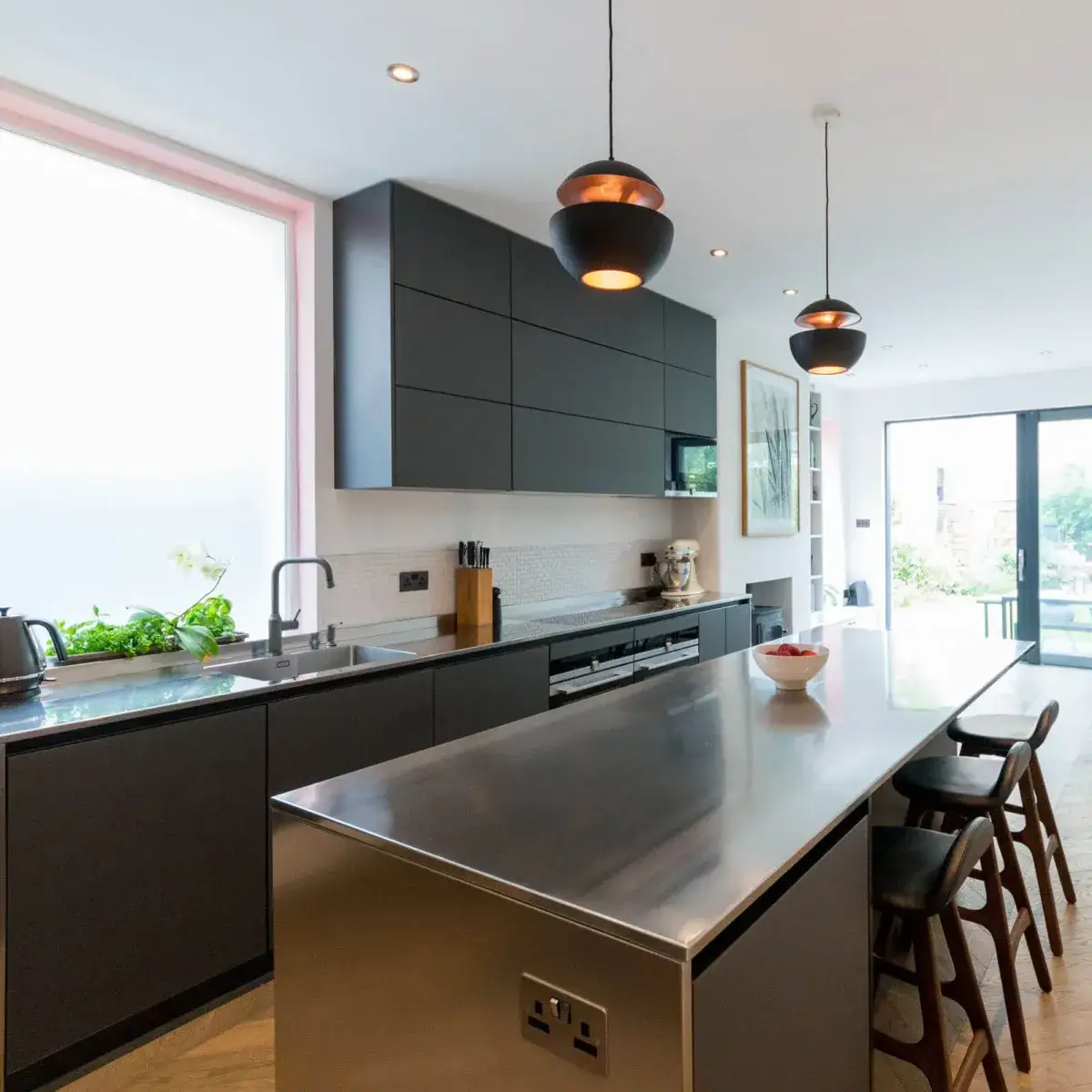
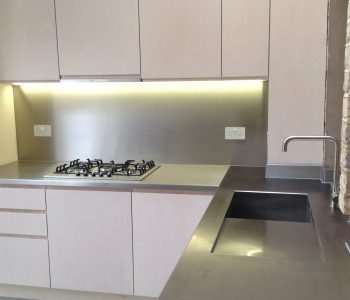
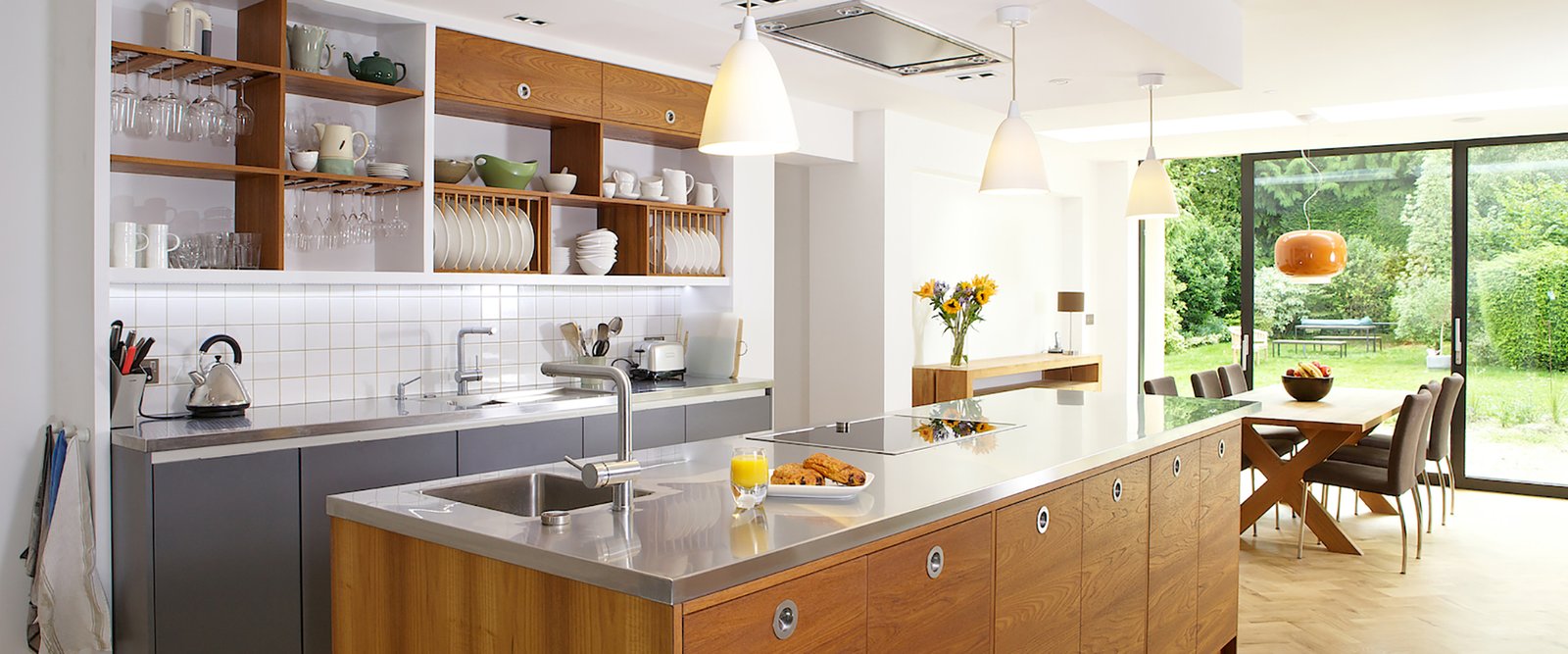
Stainless steel in UK kitchen installations. Brushed finish (all three images) is the standard domestic specification. The directional grain texture absorbs fine scratches from daily use far more effectively than polished finishes. Welded sinks and drainers form a continuous surface with no joint at the bowl perimeter.
Grade, gauge,
and specification choices.
Steel grade. Grade 304 (18/8 stainless — 18% chromium, 8% nickel) is the standard for domestic kitchen worktops in the UK. It provides excellent corrosion resistance against food acids, kitchen cleaning products, and normal humidity. Grade 316 adds molybdenum to the alloy, providing superior resistance to chloride attack. This matters in coastal properties where salt air is present, in kitchens with aggressive cleaning chemical use, or in commercial environments. For the majority of UK domestic kitchens inland, grade 304 is entirely adequate and appropriate.
Steel gauge. Gauge refers to the thickness of the steel sheet — not the total thickness of the worktop including the substrate. Heavier gauge steel feels more solid, produces less acoustic drumming under pan contact, and is more resistant to denting from heavy impacts. The substrate material and quality also significantly affects the overall rigidity and sound quality of the installed worktop.
Substrate quality matters as much as steel gauge. A 1.5mm steel sheet on a poor-quality substrate performs worse acoustically and structurally than 1.2mm steel on a good substrate. When specifying, ask the fabricator about the substrate material, thickness, and moisture resistance rating — particularly important around sink bowls where moisture exposure is highest.
Key strengths.
Advantages and limits.
- Best heat tolerance of any domestic worktop material. Hot pans from the hob go directly on the surface without scorching, cracking, or sealant degradation. No trivets required for normal cooking — though they help with heavy cast iron.
- Non-porous and hygienic. No sealing required. The same surface hygiene standard used in commercial food preparation environments. Wipes clean with mild detergent and water.
- Integrated welded fabrication. Sinks, drainers, upstands, and hob surrounds all in one continuous piece. No silicone seam at the sink bowl. The cleanest, most hygienic transition between worktop and sink of any material.
- Long service life. The functional properties — heat resistance, non-porosity, corrosion resistance — do not degrade over decades of use. Patina develops but performance stays consistent.
- Sustainable material with high recycled content and full recyclability at end of life.
- Suits mixed-material kitchen specifications. Steel near hob and sink; other materials for islands and lower-activity zones.
- Scratches accumulate over time and are part of the material's behaviour in daily use. Polished finishes show every mark. Brushed finishes manage this significantly better. Scratching on steel is not remediable in situ — unlike stone re-polishing.
- Water marks and fingerprints show in strong light on brushed surfaces and very visibly on polished. Regular wiping — particularly after washing up — is part of the daily routine.
- Dents are possible from sharp heavy impacts on unsupported spans. Once dented, steel cannot be easily reformed to its original state.
- Limited visual range. Metallic brushed or polished finishes only. No colour choice, no stone-effect options, no warmth of wood or stone. Buyers who want visual variety need to look elsewhere.
- Acoustic character. Steel over a hollow substrate produces a noticeable drumming sound under pan contact. Heavier gauge steel and good substrate quality reduce this significantly but do not eliminate it entirely.
- Cool surface temperature under the hand. Some buyers find steel's metallic coolness unfamiliar compared to stone or wood. This is subjective but worth considering before committing to a full kitchen in steel.
Stainless steel vs
other worktop materials.
The original page compared stainless steel only with porcelain. This table adds quartz, granite, and glass — the materials most frequently shortlisted alongside steel and porcelain in the same contemporary UK kitchen projects.
| Aspect | Stainless steel | Porcelain / sintered | Quartz | Granite | Glass |
|---|---|---|---|---|---|
| UK price guide (supply + install) | £300–£600+ per m² | £400–£950+ per m² | £250–£700+ per m² | £150–£600+ per m² | £350–£900+ per m² |
| Heat performance | Excellent. Normal cooking temperatures do not scorch or mark the surface. The best heat tolerance of any domestic worktop material. | Excellent. No organic binders. Fully heat resistant. | Low-moderate. Resin binders mark under sustained heat. Trivets always required. | Stone tolerates heat. Sealant damaged by hot pan contact. Thermal shock risk near sinks. Trivets required. | Good for normal temperatures. Thermal shock risk from very hot pans on cold glass near sinks. Trivets required. |
| Scratch resistance | Low-moderate. Fine scratches from everyday kitchen contact are normal and accumulate over time. Brushed finishes manage this much better than polished. | Very good. One of the hardest surfaces available. Resists everyday scratch contact. | Good. Engineered surface resists everyday contact. Chopping boards recommended. | Very good. 6–7 Mohs hardness. | Moderate. Scratches from abrasive contact. Marks are permanent — unlike stone, glass cannot be re-polished. |
| Hygiene / porosity | Fully non-porous. No sealing. Maximum hygiene. | Fully non-porous. No sealing. Maximum hygiene. | Non-porous. No sealing. Very high hygiene. | Porous — needs sealing every 1–3 years. | Fully non-porous. No sealing. Maximum hygiene. |
| Integration | Welded sinks, drainers, and upstands in one continuous run. No silicone joint at the bowl. Unique advantage. | Undermount sinks with silicone joint at the cut-out perimeter. | Undermount sinks with silicone joint at the cut-out perimeter. | Undermount sinks with silicone joint at the cut-out perimeter. | All cut-outs must be finalised before production. No field adjustment possible. |
| Colour and design range | Limited. Brushed or polished metallic finishes only. No colour choice, no stone-effect or natural material appearance. | Very wide. Stone-effect, concrete-effect, solid colours, large-format patterns. | Very wide including marble-effect, stone-effect, and solid colours. Engineered consistency. | Wide natural range. Each slab unique. No engineered options. | The widest of any material — any RAL colour, digital prints, backlit options. |
| Maintenance | Simple daily cleaning with mild detergent. Dry after use to prevent water marks. No sealing, no oiling, no special products. | Very low. Wipe clean. No sealing. No special products. | Very low. No sealing. Wipe clean. Trivets required. | Moderate. Sealing every 1–3 years. Trivets required. | Simple cleaning but frequent wiping on dark gloss surfaces. No sealing. |
Stainless steel vs porcelain. The most common practical comparison in contemporary UK kitchens. Porcelain is harder and more scratch-resistant. Stainless steel handles heat better and offers the unique advantage of welded sink integration with no joint at the bowl. Both are non-porous and require no sealing. Porcelain offers a far wider visual range. Steel offers better heat performance and the continuous fabrication that is unique to the material. Many kitchens now specify both: steel around the hob and sink, porcelain or stone for islands and other areas.
Stainless steel vs quartz. Steel and quartz occupy opposite positions on heat performance — steel is the best domestic material for heat tolerance, quartz is one of the most vulnerable due to resin binder sensitivity. Both are non-porous. Quartz has a wider visual range and does not scratch as readily. Steel offers welded sink integration and genuinely better heat performance. Quartz suits buyers who want low maintenance and visual consistency; steel suits buyers who prioritise cooking performance and hygiene.
Maintenance and care.
Stainless steel maintenance is simple compared to any natural stone or solid wood alternative. No sealing, no oiling, no specialist products. The daily routine is wiping down with the right products and avoiding the two things that cause the most visible problems: scratching from abrasive contact and water mark accumulation from leaving the surface wet.
UK cost guide.
Stainless steel worktop pricing depends on steel gauge, substrate quality, layout complexity, number of integrated sinks, level of detailing (coved upstands, drainer grooves, formed edges), and regional fabrication costs. All figures below are indicative — obtain itemised quotes from fabricators specifying gauge, grade, and all fabrication details.
Total fabrication cost versus stone. Stainless steel installation costs are typically lower than porcelain or quartzite, which require specialist diamond tooling and very careful handling. However, the base material cost for quality gauge steel is comparable to mid-range granite. The total cost of ownership is lower for steel than most natural stone options — no sealing products, no specialist cleaners, no periodic professional maintenance.
Who stainless steel suits.
- Heat performance is the primary brief. You cook frequently, move hot pans on and off the worktop, and want a surface that handles this without trivets, sealant concerns, or thermal shock risk.
- Hygiene is paramount — whether from allergy, medical need, or professional habit. The non-porous surface that requires no sealing and cleans completely with mild detergent is the standard in commercial food preparation and applies equally in domestic kitchens.
- You want the cleanest possible sink integration — a welded bowl with no silicone joint at the rim and a surface that runs continuously from worktop through the drain without any material change or hidden seam.
- You accept the brushed surface's working patina as part of the material's character. You specify brushed finish knowing fine scratches accumulate and become part of the kitchen's lived-in identity over time.
- You are planning a mixed-material kitchen — steel around the hob and sink, another material for the island or feature zones. This approach uses steel where its properties matter most without committing the full kitchen to a single metallic aesthetic.
- Scratching concerns you significantly. Stainless steel scratches in daily use and the marks accumulate permanently. If a pristine, unmarked surface matters long-term, porcelain or granite are more scratch-resistant alternatives with no comparable visual degradation.
- You want visual variety — colour, stone effects, natural patterns, or the warmth of organic materials. Steel offers brushed or polished metallic finishes only. Porcelain, quartz, granite, and glass all offer a far wider design range.
- Acoustic character concerns you. Steel over a hollow substrate produces a noticeable drumming sound under heavy pan contact. Buyers who are sensitive to kitchen noise find this characteristic difficult to overlook regardless of substrate quality.
- You want the warmth of natural materials — stone, wood, or ceramic — under the hand and to the eye. Steel's cool, metallic character is distinctive but not for everyone. Handle or view an installed example before committing.
- Denting concerns you. A heavy object dropped sharply on an unsupported steel span can leave a dent that is not practically reversible in the field. Stone and porcelain do not dent — they chip or crack, but denting is specific to metal surfaces.
Frequently asked questions.
See the Worktops hub to compare stainless steel with porcelain, quartz, granite, and other materials. Many buyers mix materials — the Porcelain guide and Granite guide cover the materials most often combined with stainless steel in UK kitchen specifications.