
Steam ovens.
Single and compact. The complete UK guide.
A steam oven is a built-in oven with an integrated steam generator. It adds moisture control to everyday cooking — steaming vegetables gently at low temperature, roasting chicken with a crisp exterior and moist centre, and reheating leftovers so they taste freshly cooked rather than dried out. Most models also run as a standard oven when steam adds no value to a particular dish.
Steam ovens are available in two formats, and the format decision comes before the brand decision. A full-size steam oven fits a standard 60cm oven niche — the same housing used by a conventional single oven — and is suited to households where steam is the primary cooking method, used daily for family-scale meals. A compact steam oven fits a 45cm niche and stacks in an appliance tower at eye level, typically above a full-size conventional oven. The compact format adds steam capability to a kitchen that already has a main oven — it does not replace it. Both formats deliver identical cooking results. The difference is cavity size, placement, and how the appliance fits into the wider kitchen layout.
In new German kitchen specifications, the compact steam oven is the most common second-oven choice: a 60cm single oven below with a 45cm steam compact at eye level above. Both run independently, both temperatures are available simultaneously, and the steam oven is accessible at working height for checking food and lifting hot trays. If you are planning a kitchen from scratch and steam cooking matters to you, this two-oven tower configuration is worth understanding before specifying the main oven.
This guide covers both formats clearly — what each suits, how to choose, and everything needed for correct specification: the four cooking modes, tank versus plumbed water supply, limescale and maintenance, steam safety, bread baking, accessories, installation requirements, UK costs, and the checklist that prevents fitting mistakes.
Single oven or compact.
Choose your format first.
Steam oven technology is identical across both formats. The format choice is a kitchen planning decision, not a cooking quality decision. Get this right before researching models, brands, or features.
- Fits a standard 60cm oven niche. Goes in the same housing position as a conventional single oven — either in a tall housing column or under a worktop if specified for that installation.
- Larger cavity: typically 50–70 litres. Handles full GN 1/1 trays and larger roasting pans. Better suited to family-scale steam cooking and batch preparation.
- Best for: primary steam oven. Households where steam cooking is the main method daily — not a supplement to a conventional oven but a replacement for it. Fish, vegetables, reheating, and roasting all done through steam modes.
- Can sit above or below a conventional oven. In a tall housing with two appliances, a full-size steam oven in the upper position gives eye-level access. The conventional oven goes below.
- Costs more at equivalent specification than a compact model. The larger cavity and steam system require a higher-powered generator in most full-size models.
- Fits a 45cm niche. Designed for appliance tower installation at eye level — typically above a full-size conventional single oven or alongside warming drawers and microwave units.
- Smaller cavity: typically 30–45 litres. Handles portions and medium-size meals. Check internal dimensions against your specific trays — a compact cavity takes smaller GN format trays than a full-size model.
- Best for: second oven with steam. Households that already have or plan a conventional main oven and want to add steam capability without a separate kitchen zone. The most common second-oven specification in new German kitchen towers.
- The tower configuration advantage. A 60cm conventional oven below and a 45cm steam compact above gives two independent cooking spaces at eye level simultaneously. Both run at different temperatures at the same time.
- Smaller cavity limits batch cooking capacity. Not suited as the sole oven in an active family kitchen where large roasting tins and multi-tray baking are regular tasks.
The practical decision. If you cook with steam daily and want it as your primary oven, specify a full-size 60cm steam oven. If you want to add steam capability to a kitchen with a conventional main oven — for reheating, vegetables, fish, and bread — specify a compact steam oven in the appliance tower above the main oven. Both deliver identical food quality results. The difference is purely capacity and placement.
What a steam oven does.
How steam changes cooking.
A steam oven has an integrated steam generator. When steam is active, the generator heats water and delivers it into the oven cavity as steam. The oven temperature, steam level, and the combination of the two are controlled independently. You cook at 100°C with steam only for gentle steaming, at 200°C with steam plus hot air for a roast with a moist centre, or at 80°C in regeneration mode for reheating food that tastes freshly cooked.
Manufacturers use different names for the same appliance: combi steam oven, steam combination oven, steam-assisted oven, or added steam oven. The core functionality is consistent across these descriptions. Steam adds moisture and control that a standard oven cannot provide.
A steam oven does not replace a conventional oven for all tasks. Dry cooking modes — fan, conventional heat, grill, defrost — operate without steam on all models. Cakes, meringues, and pizza benefit from dry heat with no steam. The steam oven replaces a conventional oven completely when steam and dry modes cover the full range of what a household cooks. In a two-oven configuration, the steam oven handles reheating, steaming, and precise baking while the conventional oven handles larger loads and higher-temperature roasting.
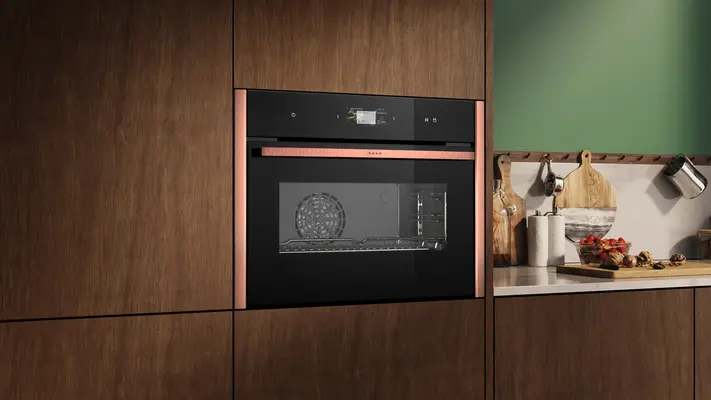
A compact steam oven in the standard 45cm built-in format, installed at eye level in an appliance tower. Steam functionality is controlled alongside standard oven modes from the same control panel. The full-size 60cm steam oven uses the same control logic and cooking modes in a larger cavity.
Where to start.
Steam ovens have a reputation for complexity. The practical reality is simpler. Most households use three things: steam vegetables and fish on the perforated tray, use regeneration for leftovers, and use steam plus hot air for roasts and bread. Everything else follows once you have confidence in those three uses.
Use regeneration for leftovers first. It is the single most useful mode for most households and requires no learning. Set to regeneration, place the food on a tray, and the steam oven delivers an even temperature and moist texture that a standard oven or microwave does not match. This mode alone justifies the appliance for many buyers.
Food quality benefits.
Steam changes the moisture balance inside the oven cavity. In a standard oven, dry heat draws moisture out of food. Steam-assisted cooking replaces or maintains moisture, which produces different and in many cases better results depending on the food type.
Best suited to: fish, vegetables, rice, eggs, dumplings, custards, reheating leftovers, bread and rolls, roast meats where moisture in the centre matters, and any dish where a standard oven produces a dry result.
Steam modes explained.
Steam ovens use a small set of core modes. Manufacturers use different names — combi steam, humidity plus, moisture plus, added steam — but the results are consistent across the category. Once you understand the four modes, the brand-specific naming becomes straightforward.
Automatic programmes. Most models include pre-set food programmes that manage steam timing, temperature, and duration automatically. Select the food type and weight, follow the tray and shelf prompt on screen, and the oven manages the cooking. Start with automatic programmes until you understand the manual mode settings for your most common dishes.
Single steam vs compact steam.
Capacity and kitchen planning.
Both formats offer the same cooking modes and produce the same quality results. The difference is capacity, kitchen planning context, and how the oven fits into the overall appliance layout.
A full-size 60cm steam oven is suited to households where steam is the primary cooking method — where the steam oven replaces a conventional oven as the main appliance. The larger cavity handles full trays of food for family cooking and batch preparation.
A steam compact oven is suited to an appliance tower where it sits alongside a full-size conventional single oven. The compact format adds steam capability without requiring a separate, dedicated kitchen zone. The tower approach gives two cooking spaces at eye level — the steam compact above for steam and gentle cooking, the single oven below for larger loads and conventional cooking.
| Aspect | Full size steam (60cm) | Steam compact (45cm) |
|---|---|---|
| Height | Approximately 59–60cm niche | Approximately 45cm niche |
| Typical capacity | Approximately 50–70 litres | Approximately 30–45 litres |
| Best fit | Primary steam oven for a household that cooks with steam daily | Second oven in an appliance tower at eye level above a full-size oven |
| Kitchen planning | Needs a 60cm tall housing position. May sit above or below a single oven | Stacks with other 45cm compact appliances in a tower column |
| Tray sizes | Standard GN 1/1 trays and larger roasting pans | Smaller GN format trays. Check the tray dimensions for your specific cooking needs |
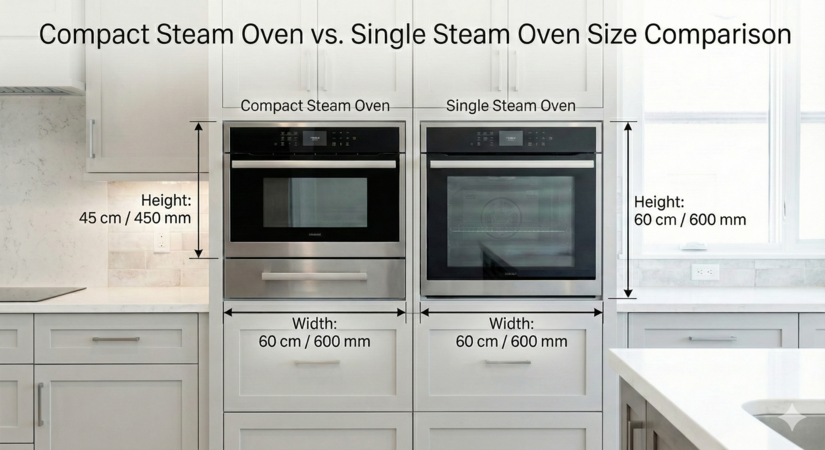
Full-size 60cm steam oven (left) versus 45cm steam compact (right). The compact format stacks in an appliance tower. The full-size format occupies a single-oven housing column.
Water supply.
Tank or plumbed.
A steam oven requires a water source. Most models in the UK market use a removable water tank that slides out from the front of the appliance. A smaller number of premium models offer a plumbed connection for a permanent water feed. The choice affects both daily routine and kitchen planning complexity.
A 1.0–1.5 litre tank covers approximately 45–60 minutes of continuous full steam, which is sufficient for most cooking sessions. Many everyday steam tasks — steaming vegetables, reheating a plate of food, proving bread dough — take 15–20 minutes and use a fraction of the tank capacity.
- Fill at the sink before cooking. No pipework required.
- Keeps kitchen planning simple. No plumbing consultation needed during the build.
- Use filtered water in hard water areas to reduce limescale build-up in the generator.
- Requires refilling before longer steam sessions. Low water alert on most models.
- Empty the tank after use to prevent stagnant water odour.
- No refilling routine. Suitable for households who use the steam oven multiple times per day.
- Some models manage waste condensate water through a drain connection in addition to the supply feed.
- Requires cold water pipework planned and installed during the kitchen build. Not suitable for retrofitting.
- Water filtration inline recommended in hard water areas to protect the steam generator.
- Available on selected premium models only. Confirm availability on the specific model you choose.
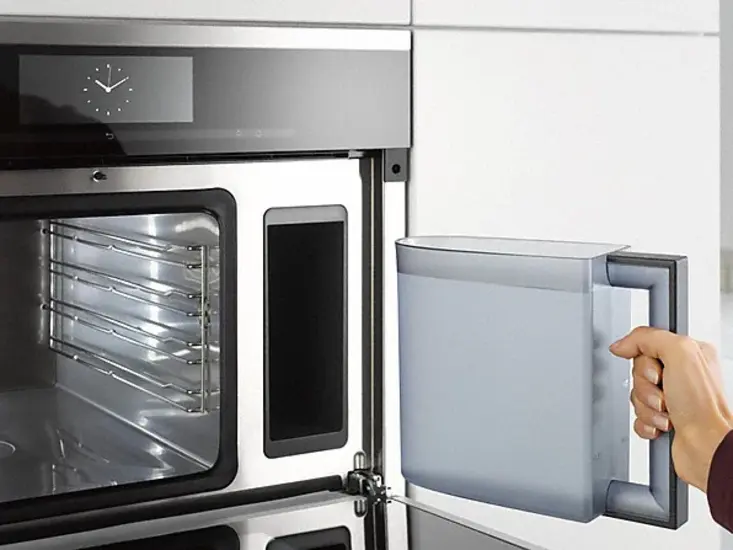
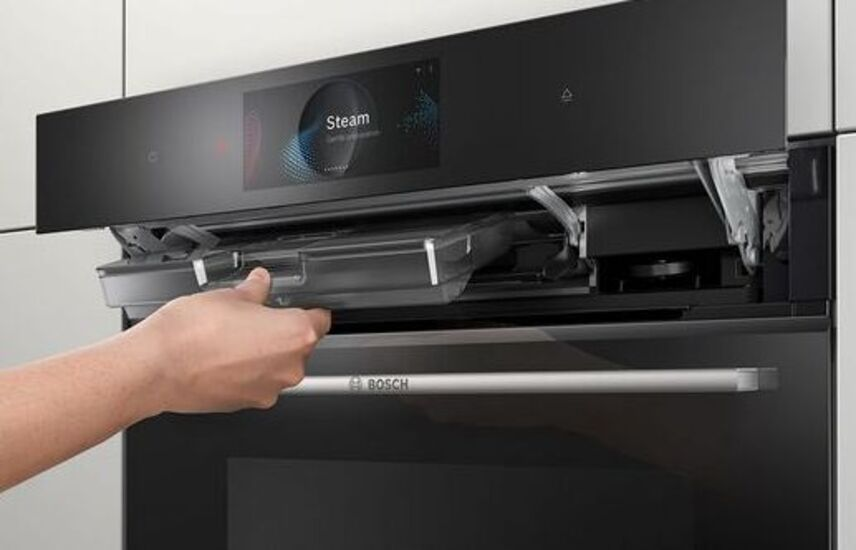
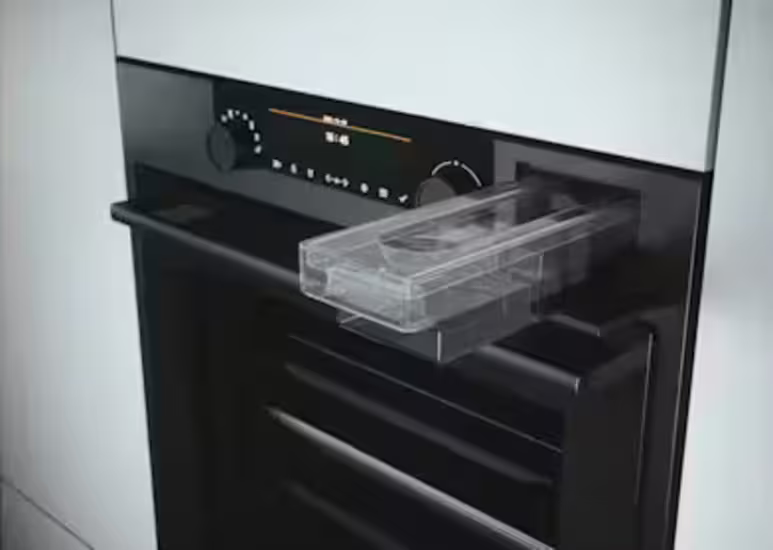
Steam compact ovens showing three different tank access configurations. The water tank drawer position varies by model — typically front-loading from beneath the door or from a dedicated slot in the appliance frame. Confirm the tank access position before finalising the housing design.
Tank refill reality. A 1.0 litre tank covers approximately 45–60 minutes of continuous full steam. Most everyday steam meals finish well within that window. The tank alert triggers before the generator runs dry on all current models from major brands.
Steam safety.
Steam burns skin faster than boiling water because it transfers heat more efficiently at contact. The risks are straightforward and easy to manage with consistent habits. Treat opening the steam oven door in the same way as lifting the lid from a saucepan of boiling water.
Do not open the oven door quickly after full steam or regeneration. Steam pressure inside the cavity releases in a concentrated burst when the door seal breaks. Crack the door, let the steam disperse, then open fully. This takes approximately 3 seconds and prevents contact burns.
Steam for better bread.
Steam at the beginning of bread baking prevents the outer crust from setting too quickly. The dough surface stays flexible for longer, which allows a greater oven spring — the final rise that happens as the loaf enters the hot oven. The result is better volume, a thinner initial crust formation, and ultimately a better crust texture once dry heat finishes the bake.
Professional bakery ovens inject steam into the baking chamber for exactly this reason. A domestic steam oven replicates the same principle at a compact scale. Bread baking is one of the uses that produces the most immediately noticeable difference from a standard oven.
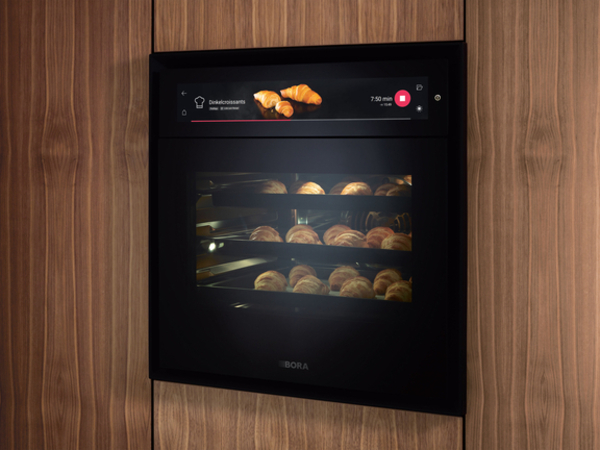
Bread baked with steam at the start of the bake. Steam prevents the crust setting too early, allowing more oven spring and better score opening. The crust is finished with dry heat for colour and crispness.
Trays and accessories.
Steam ovens work best with specific tray types. Most models are supplied with a starter set — typically a perforated tray and a solid tray. Confirm what is included in the box versus what is a paid accessory before purchasing, as tray sets vary significantly between entry and premium models.
Simple tray setup. For most steam cooking sessions, place the perforated tray at the chosen shelf level with a solid tray one position below. The solid tray catches any drips and keeps the oven base clean. This two-tray approach makes cleaning easier after every session.
Limescale and maintenance.
Limescale is the most important maintenance consideration for any steam oven. Every time the steam generator heats water, minerals dissolved in the water are left behind as calcium deposits. Over time, these deposits accumulate inside the generator, reduce steam output, and if left unaddressed, can damage the heating element.
The rate of scale build-up depends directly on water hardness. In London and the South East of England — areas with very hard water — the descaling prompt on a heavily used steam oven may appear within a few weeks of installation. In soft water areas of Scotland and the North West, the same oven may run for several months before descaling is required.
The maintenance routine is straightforward. Follow the descaling prompt when it appears, use the manufacturer's approved descaler product, and use filtered water for the tank where possible. Ignoring the descale prompt is the most common cause of steam oven service calls.
Use only manufacturer-approved descaler. Strong household acids (white vinegar, citric acid solutions not approved by the manufacturer) risk damaging internal seals, the steam generator lining, and sensor components. Check the manufacturer's maintenance guide for the approved descaler product reference before purchasing any descaler.
Installation requirements.
A full-size steam oven fits the same 60cm niche as a standard single oven. A compact steam oven fits a 45cm niche in an appliance tower. Both installations share the same principal considerations: electrical connection, water supply access, ventilation clearances, and the steam escape zone in front of the door opening. Height planning — where the oven sits in the housing — is particularly important for steam ovens because opening the door safely after a steam cycle requires a clear body position and good visibility into the cavity.
Height in the housing. When the door opens and you reach in to lift a hot, heavy tray from a steam oven, your arm must move naturally without the shoulder lifting awkwardly or the elbow knocking the door. Plan the cavity height around the main user's comfortable reach, not around visually neat furniture lines on the elevation drawing. A steam oven positioned slightly too high — where lifting a dish at arm's length requires raising the shoulder — becomes fatiguing and less safe over years of daily use. The compact steam oven at true eye level in a tower gives the best access; the full-size model benefits from being in the upper position of a two-oven column where possible.
What sits underneath. In an appliance tower, the appliance below the steam oven affects the effective cavity height. A warming drawer below creates a different access height than a second oven or a coffee machine below. Review the full tower elevation — not the steam oven in isolation — before finalising the housing column. The stack sequence determines whether the door opens at a comfortable working height for the household's main cook.
Electrical connection. Many models connect on a standard 13-amp plug. Some higher-powered models require a fixed wired connection to a fused connection unit. Confirm the power rating in watts and whether the oven is supplied with a fitted plug or a bare cable before ordering. If a fixed connection is required, plan the electrician visit before the kitchen installation date.
Water tank access. The water tank must be accessible for daily filling. Confirm where the tank is positioned on the specific model — some are front-loading beneath the door, others load from a slot in the appliance frame. The housing design must not obstruct this access point. Check tank access works comfortably from the natural standing position in front of the oven — not from an awkward angle beside or below it.
Ventilation and steam management. Steam escapes from the oven cavity every time the door is opened during or after steam cooking. The area directly in front of the oven door at eye level must be clear — no overhead cabinet, no shelf, no surface that would be damaged by repeated steam exposure. Leave sufficient ceiling height above an eye-level installation for condensation to clear.
Door swing and standing position. Stand squarely in front of the oven door when opening after a steam session — not to the side, not at an angle. The steam escape zone is directly in front of the door opening. Confirm the kitchen layout gives full clear standing access to the front of the oven: no island corner, no open dishwasher door, no adjacent appliance handle in the path of the person opening the steam oven at the end of a cooking session.
Niche dimensions: confirm from the installation guide, not the sales page. Full-size steam ovens use approximately 595mm height x 560mm width x 550mm depth. Compact steam ovens use approximately 450mm height x 560mm width x 550mm depth. Exact tolerances and ventilation gaps vary by model. Always download the installation instructions for the specific model and give those measurements to your kitchen fitter.
| Connection type | What it means | What to plan |
|---|---|---|
| 13-amp plug | Fits a standard UK socket when the oven is supplied with a plug fitted. Common on models below approximately 2.5kW. | Plan an accessible socket position that is not directly behind the oven body and does not restrict cable movement. |
| Fixed wired | Required on higher-powered models supplied without a plug. Needs a dedicated fused connection unit. | Plan a fused connection unit and an accessible isolation switch. Use a qualified electrician. Best done during a kitchen rewire. |
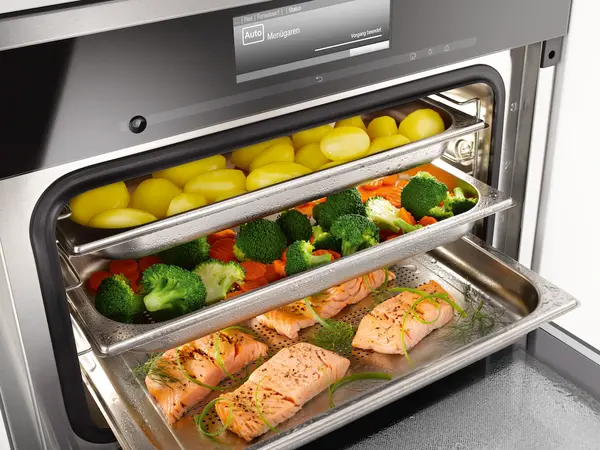
Steam compact oven at eye level in an appliance tower. This is the standard UK installation position. The steam escape zone in front of the door must be clear when the door is opened during or after steam cooking.
Confirm the cutout dimensions from the installation guide before the housing column is assembled. The cutout height, width, depth, and any ventilation gap requirements are found in the installation instructions, not on the product sales page. These are the measurements your kitchen fitter needs.
UK cost guide.
These figures cover the oven unit only and are indicative for 2025. Installation costs — electrical circuit work if required, and any plumbing if a plumbed model is specified — sit outside these figures.
Ongoing costs. Plan for manufacturer-approved descaler on a regular schedule — particularly in hard water areas. In very hard water, descaler may be needed every 4–6 weeks under heavy use. A filtered water jug reduces this significantly. Also include a wipe-down routine as part of daily kitchen maintenance after any steam cooking session.
Buying checklist.
These checks prevent the most common fitting problems and buying mistakes with steam compact ovens. All dimensional and electrical information comes from the installation instructions, not the product sales page.
- Measured the cabinet niche height, width, and depth and confirmed it suits a 45cm compact appliance
- Confirmed compact 45cm or full-size 60cm format for your layout
- Chosen tank or plumbed water supply. If plumbed, confirmed pipework is in the build plan.
- Confirmed the water tank access position on the specific model and checked the housing design does not obstruct it
- Checked internal cavity dimensions and shelf positions against the trays and dishes you plan to use most
- Checked the tray set included in the box — perforated tray and solid tray should both be present
- Confirmed the power rating and electrical connection type (13-amp plug or fixed wired) from the specification sheet
- Planned the socket or fused connection unit position. Isolation switch accessible without moving the oven.
- Checked the cutout dimensions and ventilation requirements from the installation guide
- Confirmed the steam escape zone in front of the oven door is clear — no overhead cabinet or surface that steam contact would damage
- Researched local water hardness and planned a filtered water jug and descaling product for maintenance
- Confirmed warranty length and UK service support for steam generator components
FAQ.
See the Single Oven guide for the full-size oven specification that typically sits below a steam compact in an appliance tower. The Compact Ovens guide covers the standard 45cm compact oven and compact microwave combination formats. The Double Ovens guide covers the two-cavity single-appliance alternative.